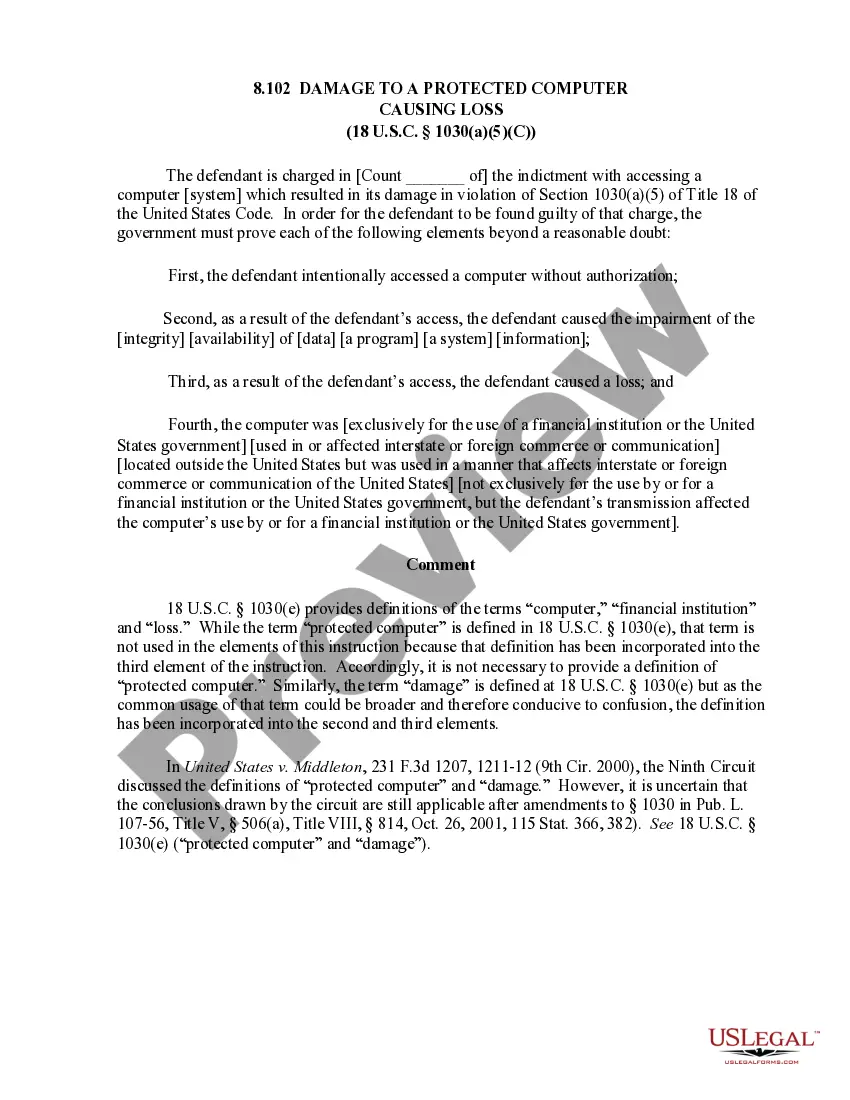
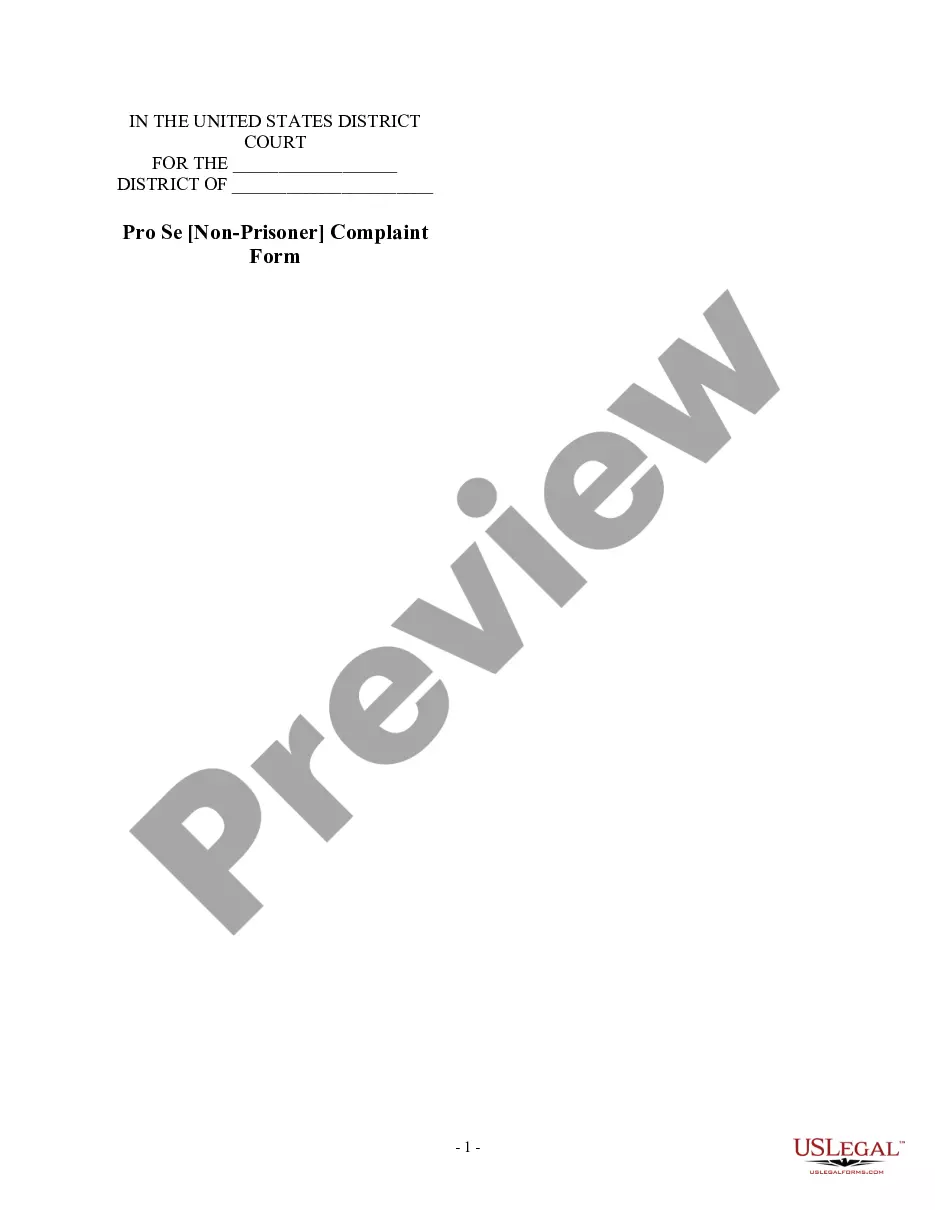
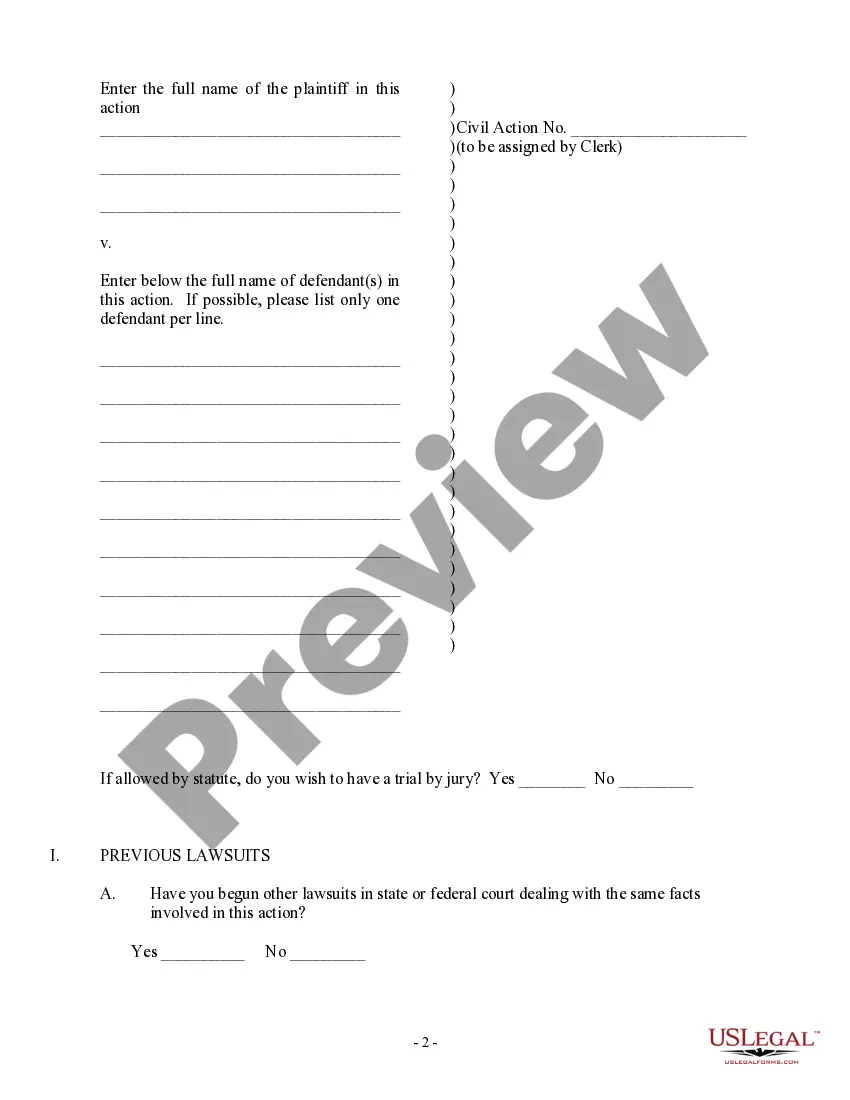
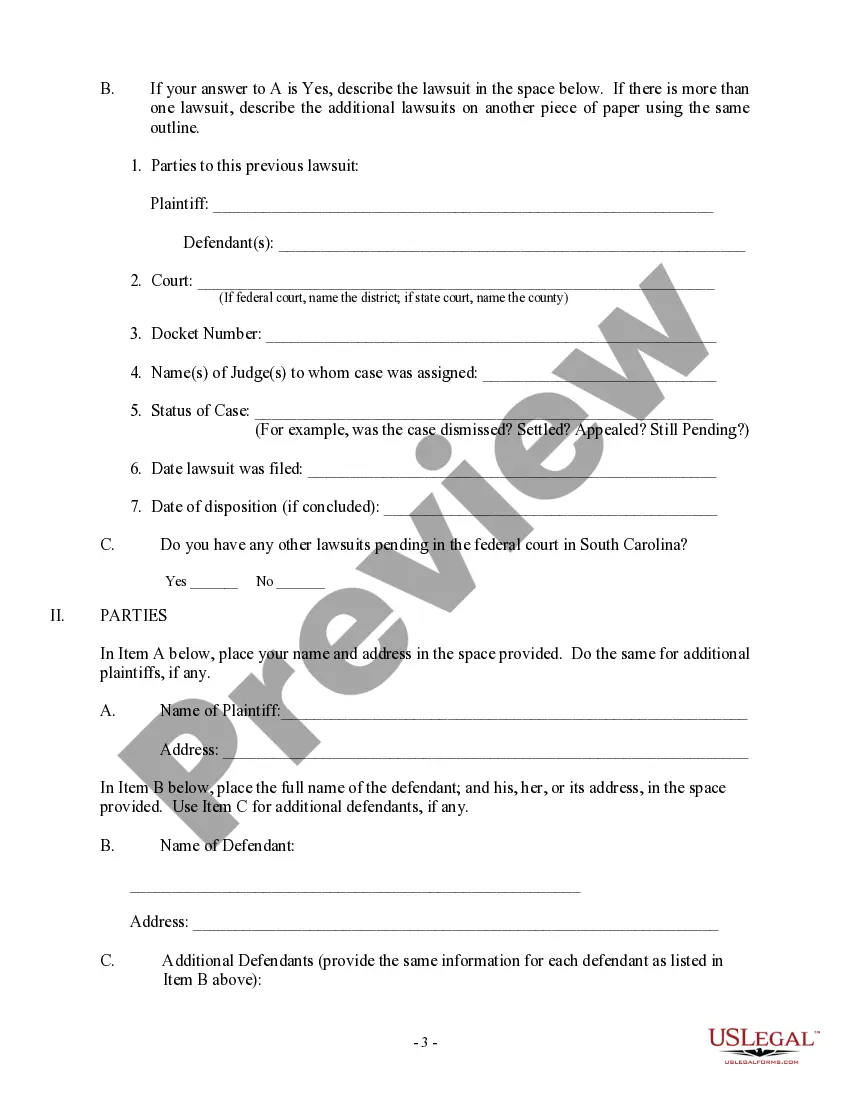
Federal Pro Se [Non-prisoner] Complaint Form:
** THIS IS NOT A FEDERAL PRO SE COMPLAINT FORM *****
Florida Federal Pro Se - Non-Prisoner - Complaint Form
Category:
State:
Multi-State
Control #:
US-01991
Format:
Word;
Rich Text
Instant download
Description
Free preview
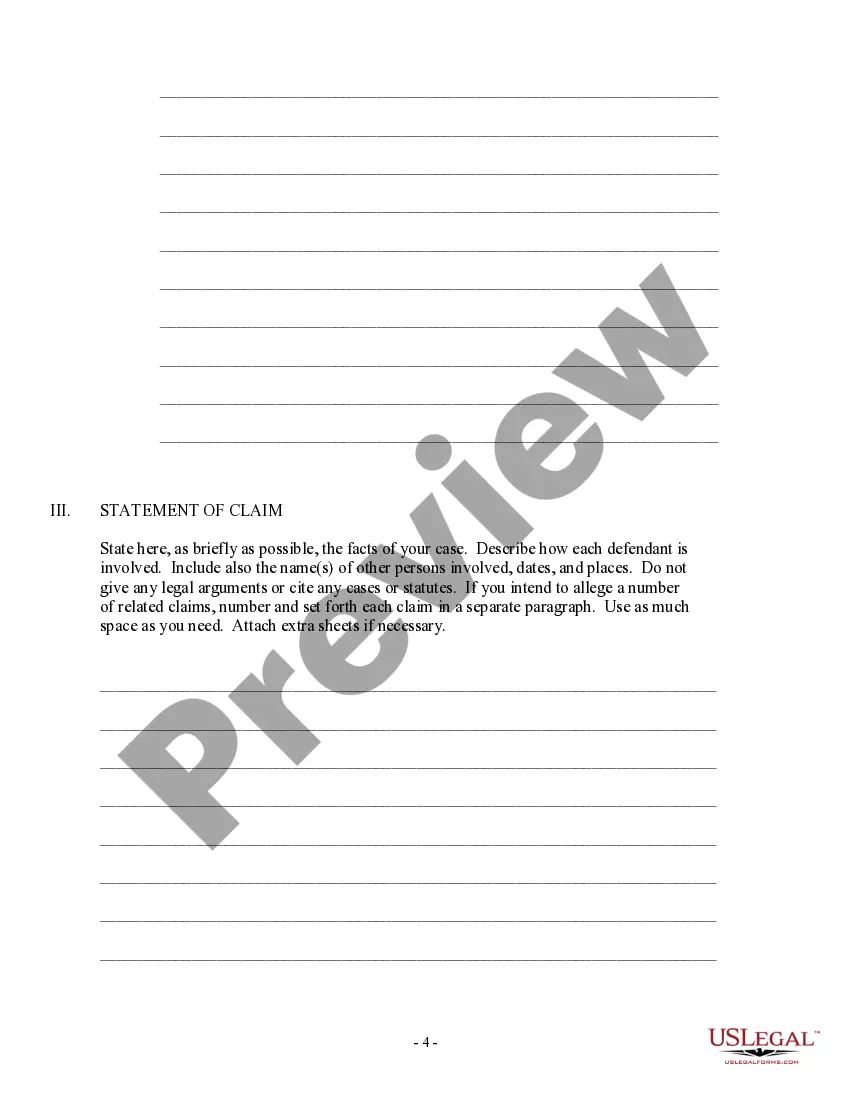
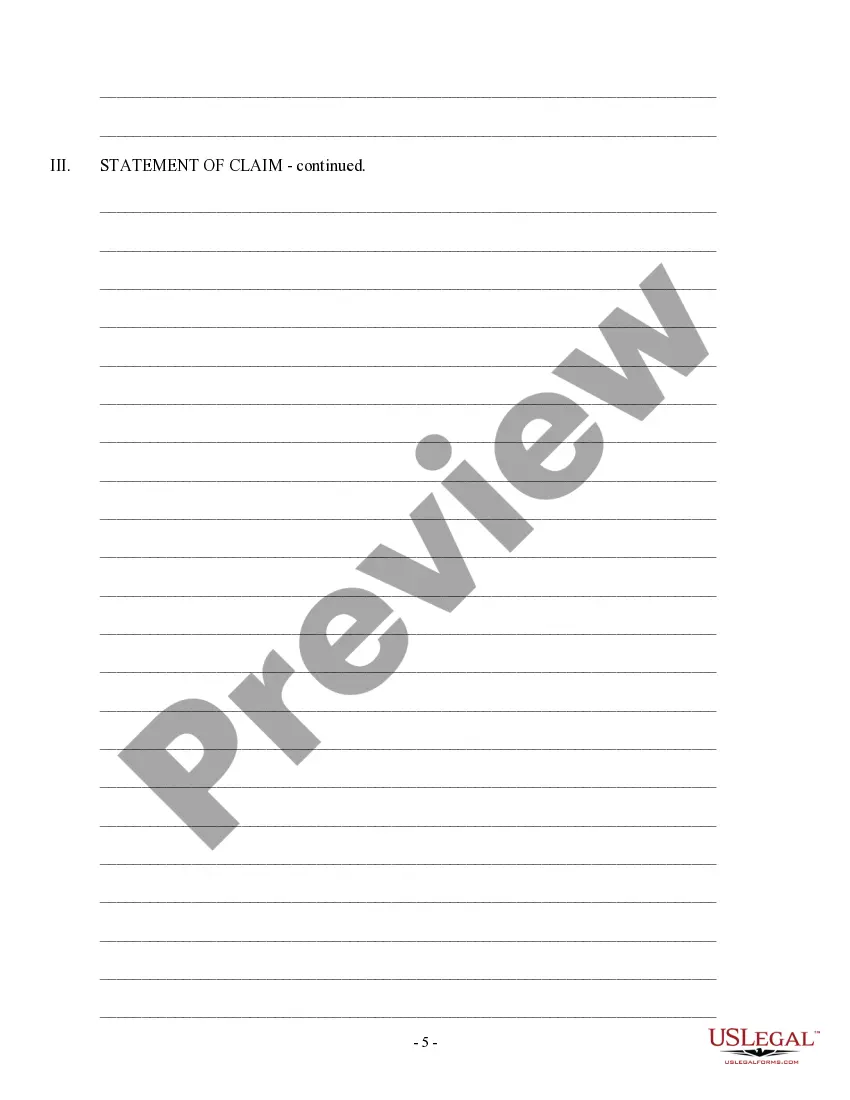
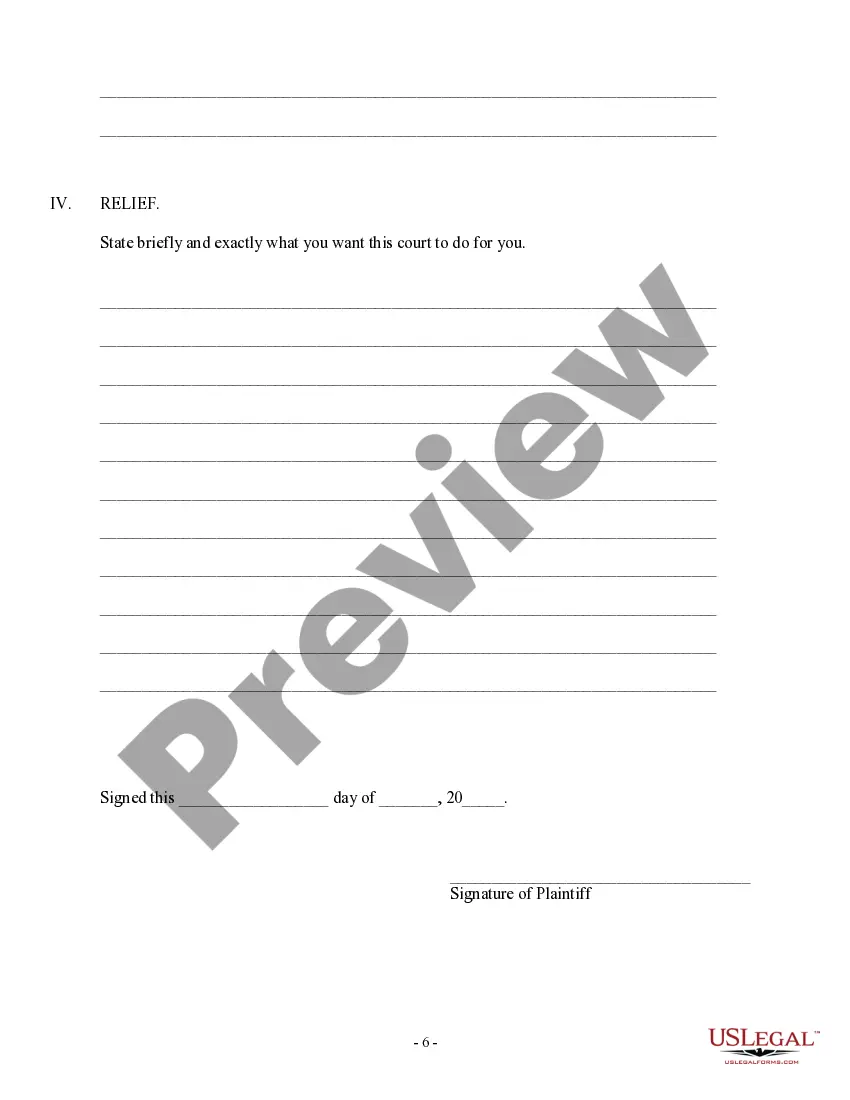
Get your form ready online
Our built-in tools help you complete, sign, share, and store your documents in one place.
Built-in online Word editor
Make edits, fill in missing information, and update formatting in US Legal Forms—just like you would in MS Word.
Export easily
Download a copy, print it, send it by email, or mail it via USPS—whatever works best for your next step.
E-sign your document
Sign and collect signatures with our SignNow integration. Send to multiple recipients, set reminders, and more. Go Premium to unlock E-Sign.
Notarize online 24/7
If this form requires notarization, complete it online through a secure video call—no need to meet a notary in person or wait for an appointment.
Store your document securely
We protect your documents and personal data by following strict security and privacy standards.

Make edits, fill in missing information, and update formatting in US Legal Forms—just like you would in MS Word.

Download a copy, print it, send it by email, or mail it via USPS—whatever works best for your next step.

Sign and collect signatures with our SignNow integration. Send to multiple recipients, set reminders, and more. Go Premium to unlock E-Sign.

If this form requires notarization, complete it online through a secure video call—no need to meet a notary in person or wait for an appointment.

We protect your documents and personal data by following strict security and privacy standards.
Looking for another form?




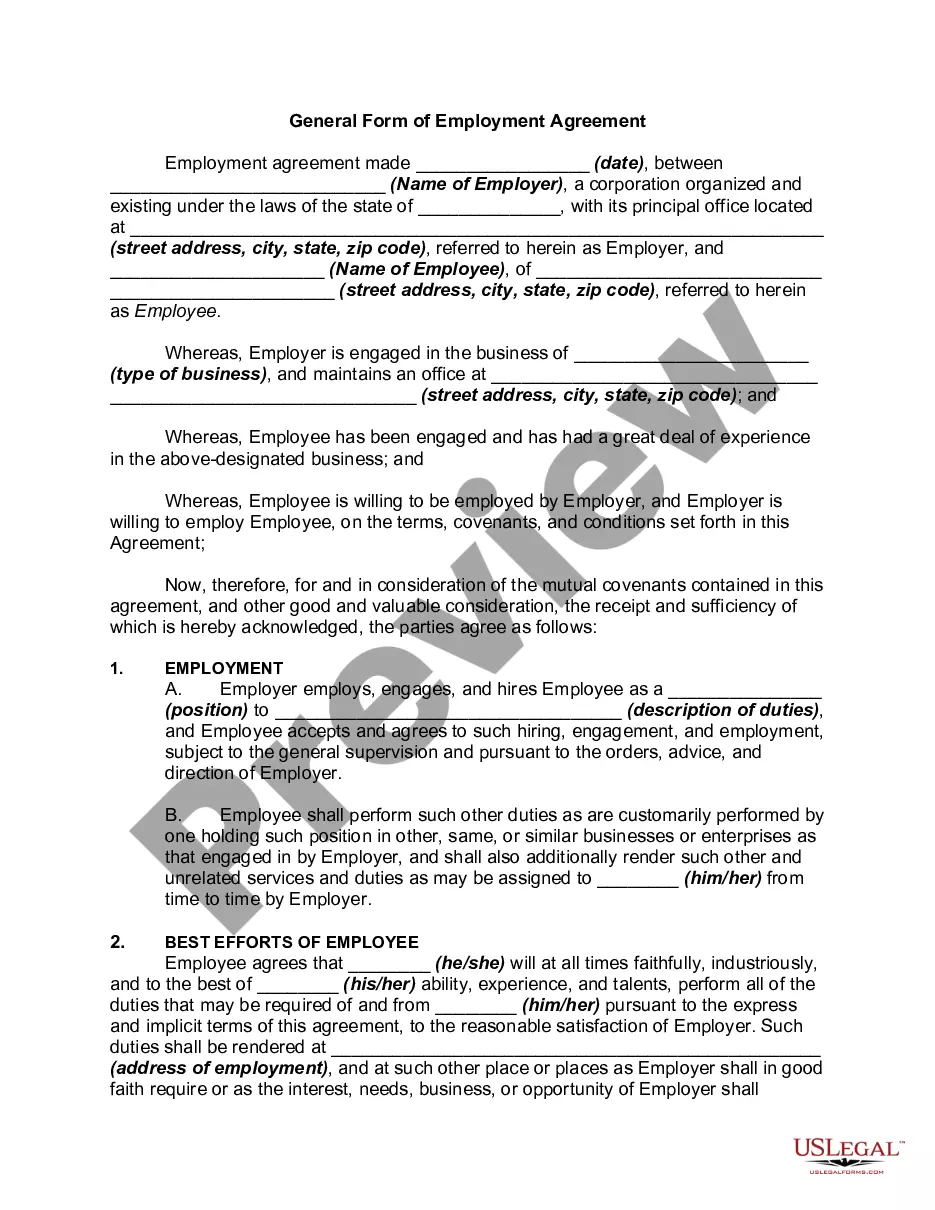

How to fill out Federal Pro Se - Non-Prisoner - Complaint Form?
You can spend hours online looking for the legal document template that meets the federal and state requirements you have. US Legal Forms provides a wide array of legal templates that are evaluated by professionals.
You can effortlessly obtain or create the Florida Federal Pro Se - Non-Prisoner - Complaint Form with our help. If you already possess a US Legal Forms account, you can sign in and select the Acquire option. After that, you can complete, edit, create, or sign the Florida Federal Pro Se - Non-Prisoner - Complaint Form. Every legal document template you purchase is yours to keep indefinitely.
To retrieve another copy of any purchased form, visit the My documents section and click on the relevant option. If you are accessing the US Legal Forms site for the first time, follow the simple steps below: First, ensure that you have chosen the correct document template for your region/area of interest. Check the form details to confirm you have selected the appropriate template. If available, use the Review feature to examine the document template as well. To locate another version of the form, use the Search field to find the template that fits your criteria and requirements.
- Once you have found the template you need, click Get now to proceed.
- Select the pricing plan you wish, enter your details, and register for an account on US Legal Forms.
- Complete the transaction. You can use your credit card or PayPal account to purchase the legal template.
- Download the format of the document and save it to your device.
- Make modifications to your document if necessary. You can complete, edit, sign, and print the Florida Federal Pro Se - Non-Prisoner - Complaint Form.
- Obtain and print numerous document templates using the US Legal Forms website, which offers the largest collection of legal forms.
- Utilize professional and state-specific templates to address your business or personal needs.
Form popularity
FAQ
Filing a pro se federal lawsuit requires you to draft a complaint that clearly lays out your legal claims and the relief you seek. Next, identify the correct federal court for your case and file your complaint with the court clerk. Don’t forget to follow the court's procedures for serving the complaint to the defendants. To streamline your filing process, use the Florida Federal Pro Se - Non-Prisoner - Complaint Form from USLegalForms, which guides you through the necessary steps.
To format a federal complaint, start by including a caption that lists the court name, the parties involved, and the case number. Clearly state your claims in numbered paragraphs, providing a brief description of the facts that support each claim. Use simple language and ensure that your complaint adheres to the rules of the court. For easier compliance, consider using the Florida Federal Pro Se - Non-Prisoner - Complaint Form available on USLegalForms, which provides a structured format for your document.
Rule 45(c)(1) addresses a subpoena to testify at a trial, hearing, or deposition. Rule 45(c)(1)(A) provides that compliance may be required within 100 miles of where the person subject to the subpoena resides, is employed, or regularly conducts business in person.
As a pro se litigant, you may pay the filing fee and deliver the complaint to the Clerk's Office in person or mail the complaint and filing fee to the Clerk's Office in the division in which you are filing your case.
Rule 45 , Federal Rules of Civil Procedure , governs subpoenas for discovery as well as for trial or hearings. Local Rule 3.04, Middle District of Florida, provides that a subpoena duces tecum requires fourteen days' written notice.
Whether you deliver or mail your complaint to the court, you must submit (i) an original of the complaint, (ii) a completed cover sheet, a copy of which can be obtained from the clerk's office, and (iii) the $402 filing fee. filing fee and any costs to have the complaint served in installments.
In Florida, ing to Rule of Civil Procedure 1.070 (j), a complaint must be served on the defendant within 120 days of its filing. If it is not served within the time frame specified, a motion to dismiss is appropriate, and the case is dismissed without prejudice.
Rule 1.410 - SUBPOENA (a) Subpoena Generally. Subpoenas for testimony before the court, subpoenas for production of tangible evidence, and subpoenas for taking depositions may be issued by the clerk of court or by any attorney of record in an action.
Federal Rule of Civil Procedure 45 does not provide a minimum time that a person has to respond to a subpoena. Largely, the timeframe is up to the issuing party. However, 30 days is generally seen as a reasonable amount of time.
Rule 45(c)(1) provides that the ?place of compliance? for subpoenas and the geographical scope of a court's authority to command a witness to testify at a trial, hearing, or deposition are: ?(A) within 100 miles of where the person resides, is employed, or regularly transacts business in person; or (B) within the state ...