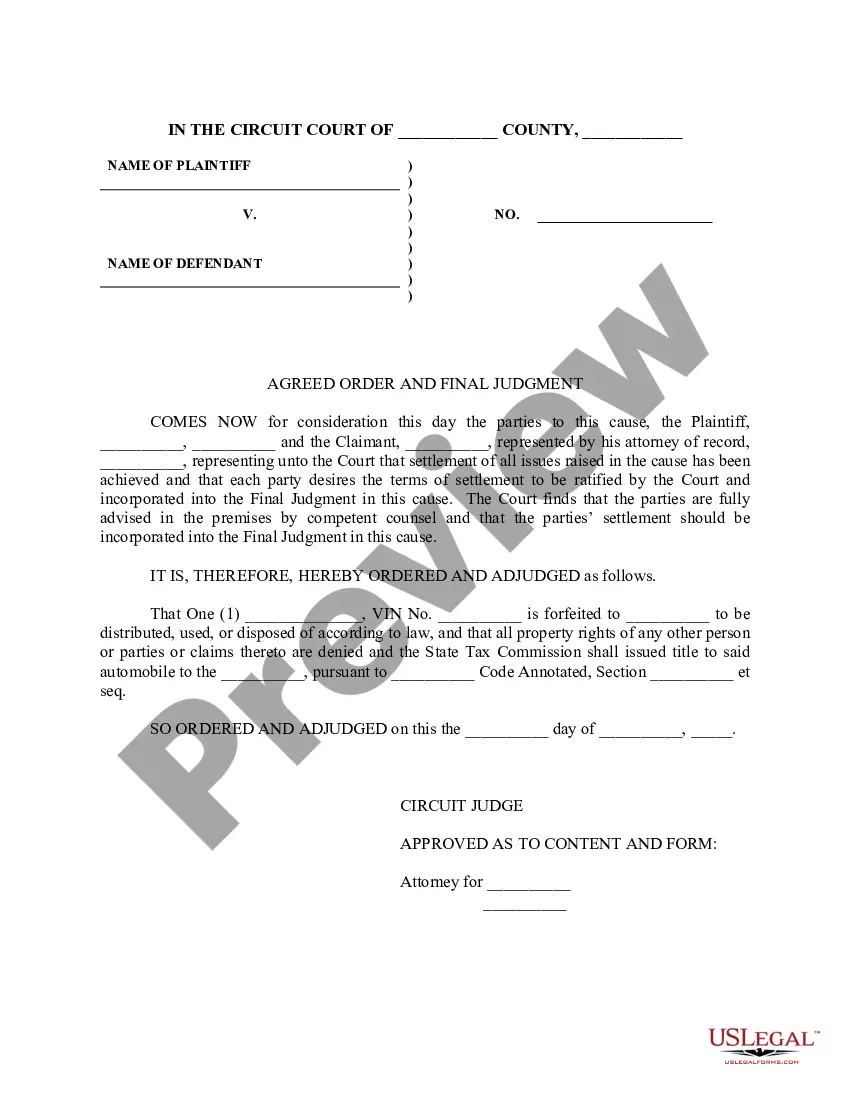
Florida Agreed Order and Final Judgment - Awarding Forfeiture
Description
Get your form ready online
Our built-in tools help you complete, sign, share, and store your documents in one place.
Make edits, fill in missing information, and update formatting in US Legal Forms—just like you would in MS Word.
Download a copy, print it, send it by email, or mail it via USPS—whatever works best for your next step.
Sign and collect signatures with our SignNow integration. Send to multiple recipients, set reminders, and more. Go Premium to unlock E-Sign.
If this form requires notarization, complete it online through a secure video call—no need to meet a notary in person or wait for an appointment.
We protect your documents and personal data by following strict security and privacy standards.

Make edits, fill in missing information, and update formatting in US Legal Forms—just like you would in MS Word.

Download a copy, print it, send it by email, or mail it via USPS—whatever works best for your next step.

Sign and collect signatures with our SignNow integration. Send to multiple recipients, set reminders, and more. Go Premium to unlock E-Sign.

If this form requires notarization, complete it online through a secure video call—no need to meet a notary in person or wait for an appointment.

We protect your documents and personal data by following strict security and privacy standards.
Looking for another form?



How to fill out Agreed Order And Final Judgment - Awarding Forfeiture?
US Legal Forms - one of the largest collections of legal documents in the United States - provides a variety of legal document templates that you can download or print.
By using the site, you will find thousands of forms for business and personal purposes, organized by categories, states, or keywords. You can quickly locate the latest versions of documents like the Florida Agreed Order and Final Judgment - Awarding Forfeiture.
If you have a subscription, Log In and download the Florida Agreed Order and Final Judgment - Awarding Forfeiture from the US Legal Forms library. The Download button will appear on every form you view. You can access all previously acquired forms in the My documents section of your account.
Make changes. Fill out, edit, print, and sign the downloaded Florida Agreed Order and Final Judgment - Awarding Forfeiture.
Every template you added to your account has no expiration date and belongs to you permanently. Therefore, if you want to download or print another copy, simply go to the My documents section and click on the form you need.
- If you are using US Legal Forms for the first time, here are simple instructions to get you started.
- Ensure you have selected the correct form for your city/state. Click the Review button to examine the content of the form. Read the form description to make sure you have chosen the right document.
- If the form does not meet your needs, use the Search field at the top of the page to find one that does.
- If you are satisfied with the form, confirm your choice by clicking the Buy now button. Then, select the pricing plan you want and provide your details to register for an account.
- Process the transaction. Use your credit card or PayPal account to complete the transaction.
- Choose the format and download the form to your device.
Form popularity
FAQ
895.01-895.05. (d) No testimony presented by the owner of the property at the hearing is admissible against him or her in any criminal proceeding except in a criminal prosecution for perjury or false statement, nor shall such testimony constitute a waiver of the owner's constitutional right against self-incrimination.
"Satisfaction of a judgment," which is governed by URCP 58B, means that the debtor has paid the entire amount of the judgment and all accumulated fees, costs and interest, or that the creditor has decided not to pursue further collection efforts.
Grounds for forfeiture A person may face civil or criminal asset forfeiture if he or she possesses property that is allegedly tied to illegal activity. This includes any property used during the commission of crimes, such as vehicles used to transport narcotics.
Unlawful to transport, conceal, or possess contraband articles or to acquire real or personal property with contraband proceeds; use of vessel, motor vehicle, aircraft, other personal property, or real property.
THE UNDERSIGNED owner and holder of the final judgment rendered in the action entitled (PLAINTIFF'S NAME) vs (DEFENDANT'S NAME) by the Circuit Court of County, Florida and recorded under Official Instrument# acknowledges that the judgment is fully paid. DATED on .
A: A Satisfaction of Garnishment is a document that confirms a debt has been fully paid, releasing the garnishee from further obligation to withhold money. Once filed, the garnishment order is resolved, and the debtor's wages or account are no longer subject to garnishment for that debt.
Presently there is a Florida statute that limits judgment liens to 20 years,3 and there is a Florida statute that limits ?actions? on certain judgments to 20 years and other judgments to five years. There is, however, no statute or court rule that places a time limit on the execution of judgments.
Whenever the entire amount due on a judgment, including interest, is paid in full, the holder of a judgment must execute a satisfaction of judgment and record the satisfaction in those counties where a certified copy of the judgment was previously recorded.