Florida Request for List of Subcontractors and Suppliers - Individual
What is this form?
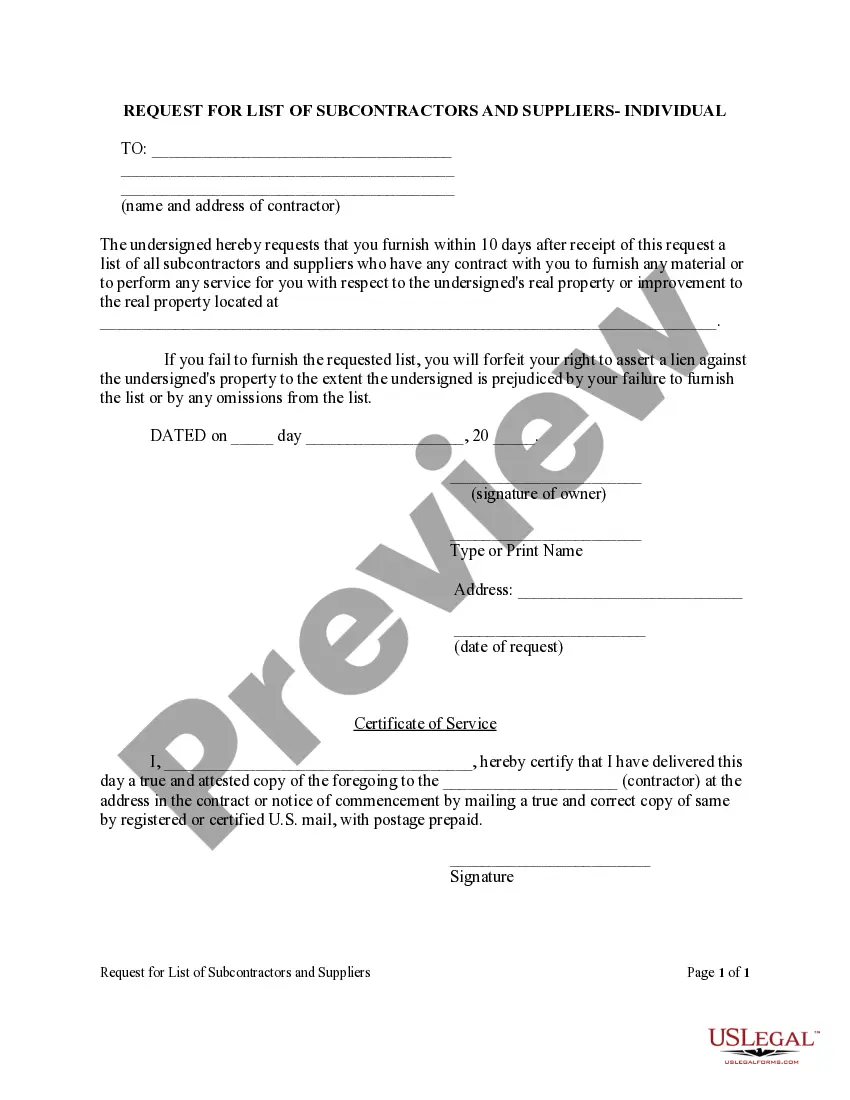
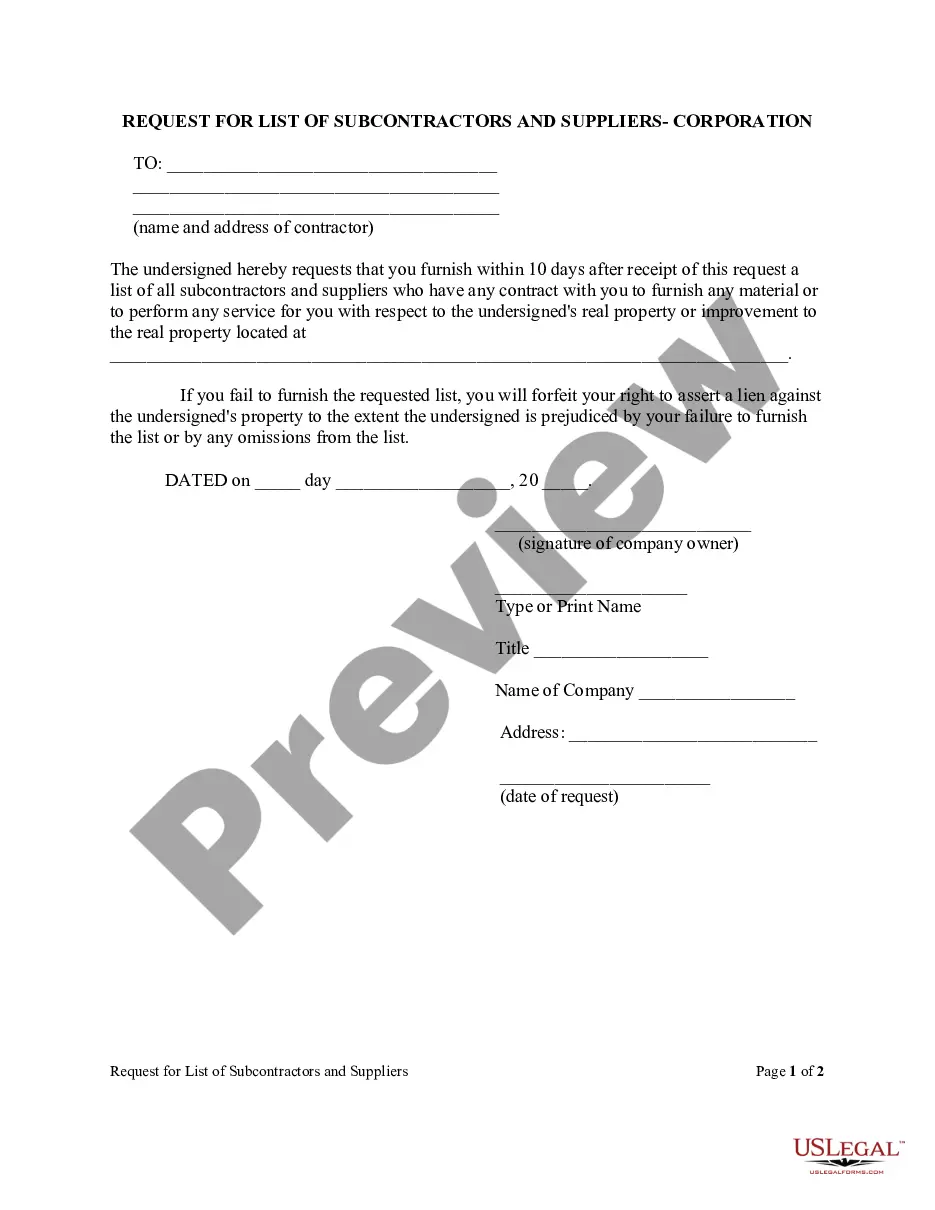
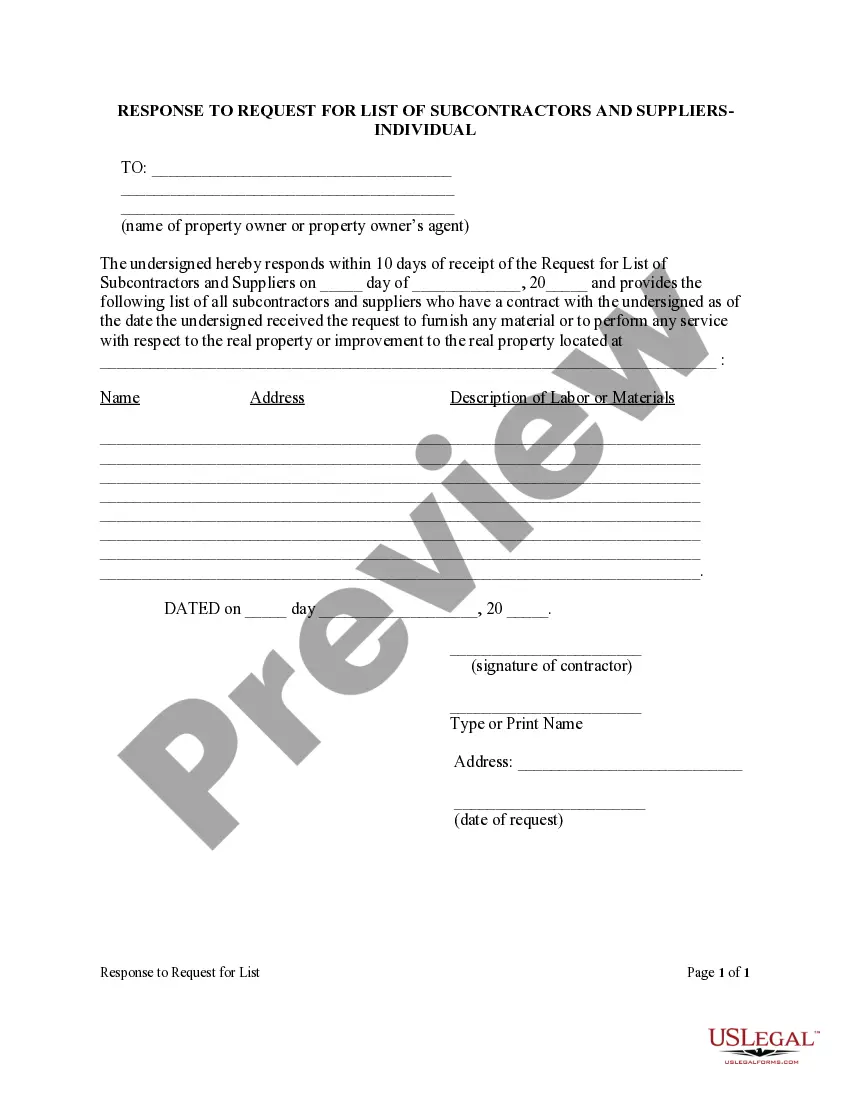
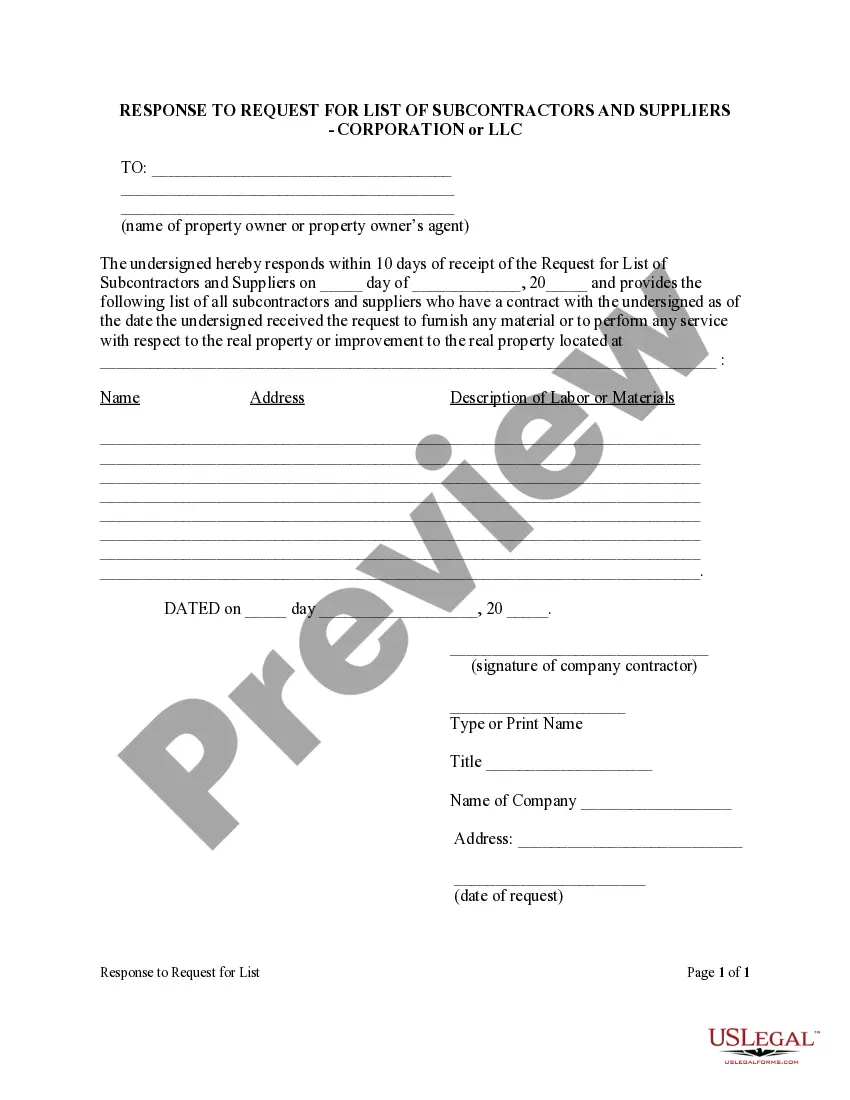
The Request for List of Subcontractors and Suppliers form is designed for property owners to formally request a contractor to provide information about subcontractors and suppliers involved in a project. This form helps protect the owner's rights by ensuring they know who is working on their property and what contracts are in place, distinguishing it from other construction-related forms such as lien waivers or notices of completion.
Key components of this form
- Requestor's name and address: Identifies the property owner making the request.
- Contractor's name and address: Specifies the contractor receiving the request.
- Property description: Clearly indicates the location and nature of the property in question.
- 10-day response requirement: Mandates the contractor to provide the requested list within 10 days of receiving the request.
- Consequences of non-compliance: States that failure to provide the list may result in losing the right to assert a lien.
- Signature section: Requires the ownerâs signature and printed name to validate the request.
Common use cases
This form should be used when a property owner wants to verify the subcontractors and suppliers working on their real property. It is particularly useful when there are concerns about the contractor fulfilling their obligations or when a lien may be asserted against the property. Using this form can protect the owner's interests by ensuring transparency regarding whom the contractor is engaging.
Who can use this document
- Individual property owners seeking clarity on contractual relationships involving their property.
- Homeowners involved in renovations or new construction projects.
- Individuals concerned about potential liens or disputes with contractors regarding subcontractors or suppliers.
How to prepare this document
- Identify the parties: Fill in your name and address as the requestor, and the contractor's name and address.
- Specify the property: Provide a detailed description of the real property or improvement related to the contractor's work.
- Set the date: Enter the date you are making the request.
- Sign the form: Provide your signature and print your name for verification.
- Consider certificate of service: Complete the certificate of service section to ensure the contractor receives a copy of the request.
Notarization guidance
This form does not typically require notarization unless specified by local law. However, it is recommended to verify any jurisdiction-specific requirements that may apply to your situation.
Get your form ready online
Our built-in tools help you complete, sign, share, and store your documents in one place.
Make edits, fill in missing information, and update formatting in US Legal Forms—just like you would in MS Word.
Download a copy, print it, send it by email, or mail it via USPS—whatever works best for your next step.
Sign and collect signatures with our SignNow integration. Send to multiple recipients, set reminders, and more. Go Premium to unlock E-Sign.
If this form requires notarization, complete it online through a secure video call—no need to meet a notary in person or wait for an appointment.
We protect your documents and personal data by following strict security and privacy standards.

Make edits, fill in missing information, and update formatting in US Legal Forms—just like you would in MS Word.

Download a copy, print it, send it by email, or mail it via USPS—whatever works best for your next step.

Sign and collect signatures with our SignNow integration. Send to multiple recipients, set reminders, and more. Go Premium to unlock E-Sign.

If this form requires notarization, complete it online through a secure video call—no need to meet a notary in person or wait for an appointment.

We protect your documents and personal data by following strict security and privacy standards.
Mistakes to watch out for
- Failing to include a complete and accurate property description.
- Not providing sufficient time for the contractor to respond.
- Neglecting to sign and date the form, rendering it invalid.
- Not sending the request via a traceable method, such as certified mail.
Why complete this form online
- Convenient access: Download and complete the form from anywhere at any time.
- Editability: Easily make changes to customize the form to your specific situation.
- Legal reliability: Forms are drafted by licensed attorneys, ensuring compliance with legal standards.
What to keep in mind
- The Request for List of Subcontractors and Suppliers is essential for property owners seeking transparency from contractors.
- Failure to respond to this request can impact a contractor's lien rights, protecting the owner's property interests.
- Using this form helps ensure that property owners are aware of all parties involved in their property work.
Looking for another form?
Form popularity
FAQ
Section 713.04 outlines the requirements for the notice of commencement, which is critical for establishing lien rights on a construction project. It details who must file the notice and the information required. Knowing how to navigate these requirements is essential for a successful construction project. Turn to the Florida Request for List of Subcontractors and Suppliers - Individual for a comprehensive approach to these regulations.
In Florida, property owners do not have a duty to warn undiscovered trespassers of hazards on their property. However, exposing dangers to known trespassers is a different matter, as there is a greater obligation to ensure their safety. This aspect of property law can significantly impact liability and risk management. Utilizing the Florida Request for List of Subcontractors and Suppliers - Individual can enhance your understanding of these legal frameworks.
In Florida, immediate family typically includes a spouse, parents, siblings, and children. This definition can play an important role in various legal considerations, including lien rights and property transactions. Understanding who qualifies as immediate family is essential for any legal documentation. When dealing with such matters, the Florida Request for List of Subcontractors and Suppliers - Individual can provide valuable insights.
Section 713.245 outlines the procedures for filing a lien in Florida, ensuring that lienholders follow specific guidelines. This section is critical for understanding how to establish or contest a lien effectively. Familiarity with this section can help you manage potential legal challenges. Make sure to reference the Florida Request for List of Subcontractors and Suppliers - Individual for further clarification.
A lien can be deemed invalid in Florida if it does not follow legal requirements, such as the proper notice being issued. Inaccuracies in documentation or failure to meet deadlines can also lead to a lien's invalidation. Always review related statutes to understand compliance standards. The Florida Request for List of Subcontractors and Suppliers - Individual can assist you in ensuring all details are accurate.
Section 713.20 addresses the rights of property owners and contractors regarding payment and liens. It explains how parties involved in a construction project can protect their interests through proper documentation. Understanding this statute is crucial for anyone managing construction work in Florida. For further assistance, refer to the Florida Request for List of Subcontractors and Suppliers - Individual.
In Florida, subcontractors typically need to hold a proper license to operate legally in the construction industry. This requirement helps ensure that they meet necessary standards for skills and knowledge. You can request a list of subcontractors and suppliers to verify their licenses, which can safeguard your project. To navigate this process smoothly, consider using the Florida Request for List of Subcontractors and Suppliers - Individual.
No, while both subcontractors and independent contractors operate independently, their roles differ significantly. A subcontractor typically works under a contract with a general contractor for specific tasks, while an independent contractor might provide services to various clients without direct oversight. Knowing the differences can streamline your projects. For support in managing these relationships, explore the Florida Request for List of Subcontractors and Suppliers - Individual from uslegalforms.
The three common types of subcontractors include specialty subcontractors, general subcontractors, and trade subcontractors. Specialty subcontractors focus on specific tasks, such as electrical or plumbing work, while general subcontractors manage overall project execution. Trade subcontractors possess expertise in specific trades, contributing their skills where necessary. For more information on subcontractors, check out the Florida Request for List of Subcontractors and Suppliers - Individual.
An independent contractor in Florida is someone who provides services based on a contract without being under the control of an employer. They have autonomy over how they complete their work, which differentiates them from employees. Understanding this classification is vital for taxation and liability purposes. For accurate outlining, refer to the Florida Request for List of Subcontractors and Suppliers - Individual on uslegalforms.