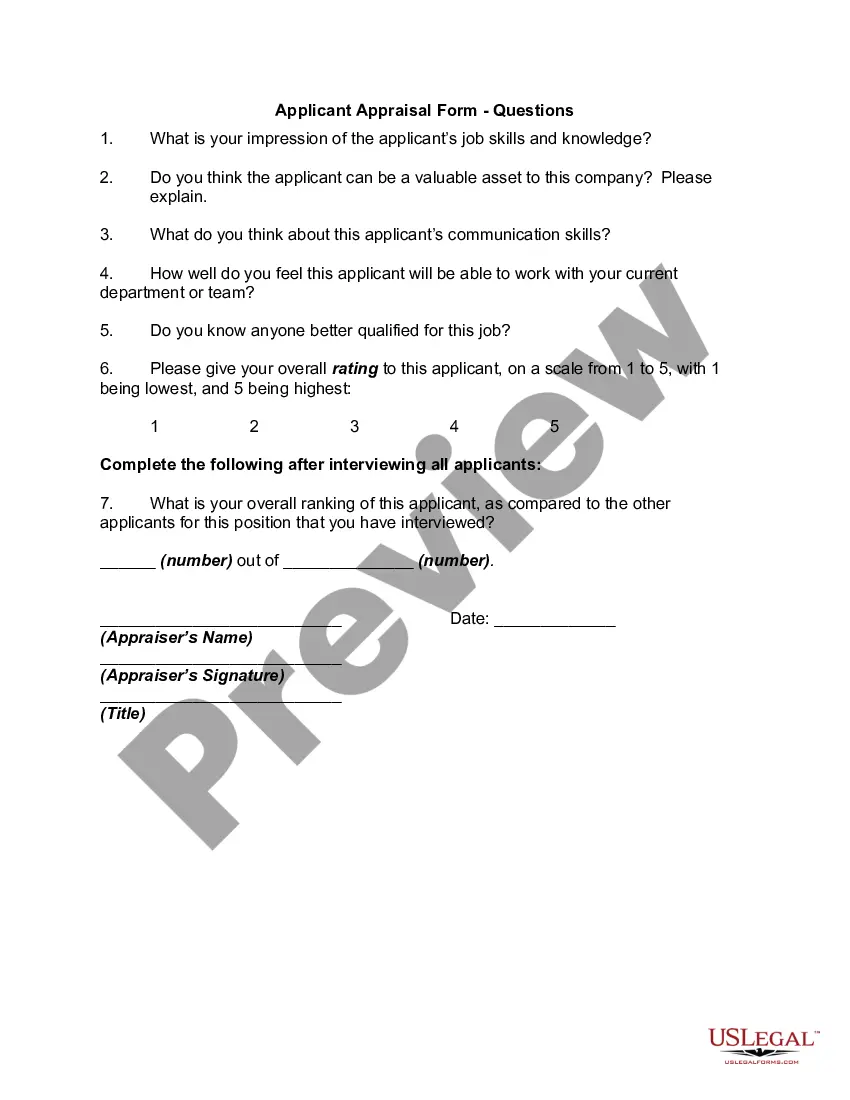
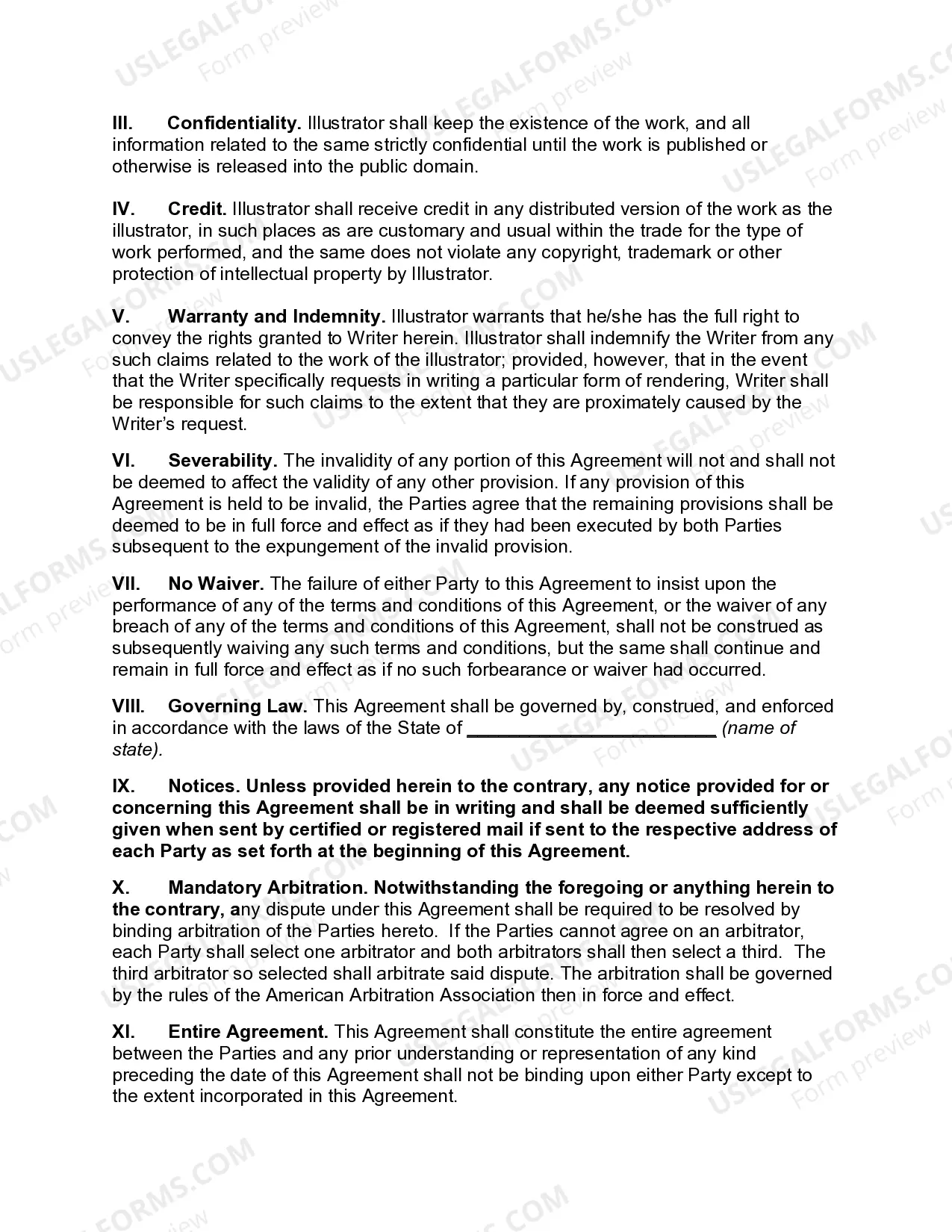
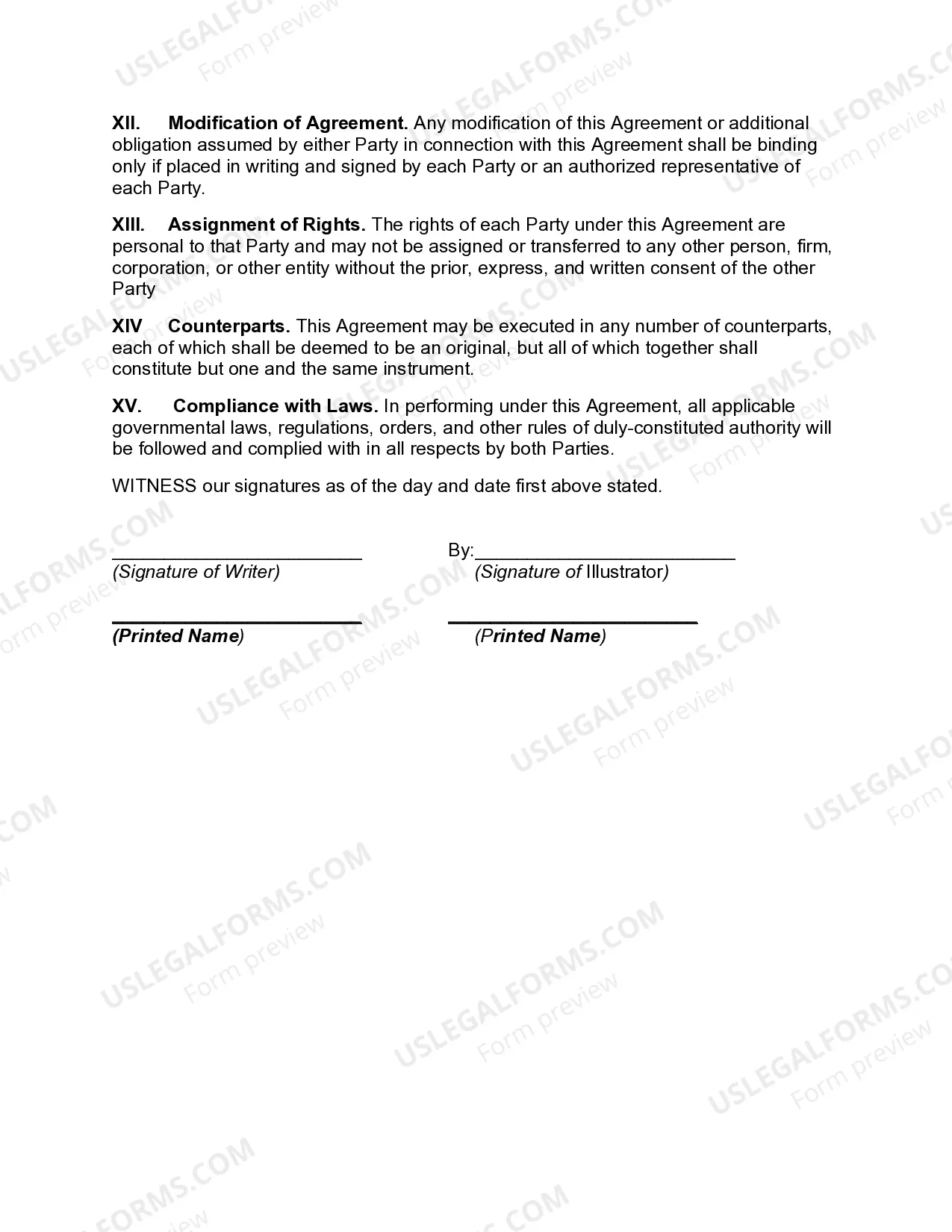
Delaware Illustrator and Author Agreement
Description
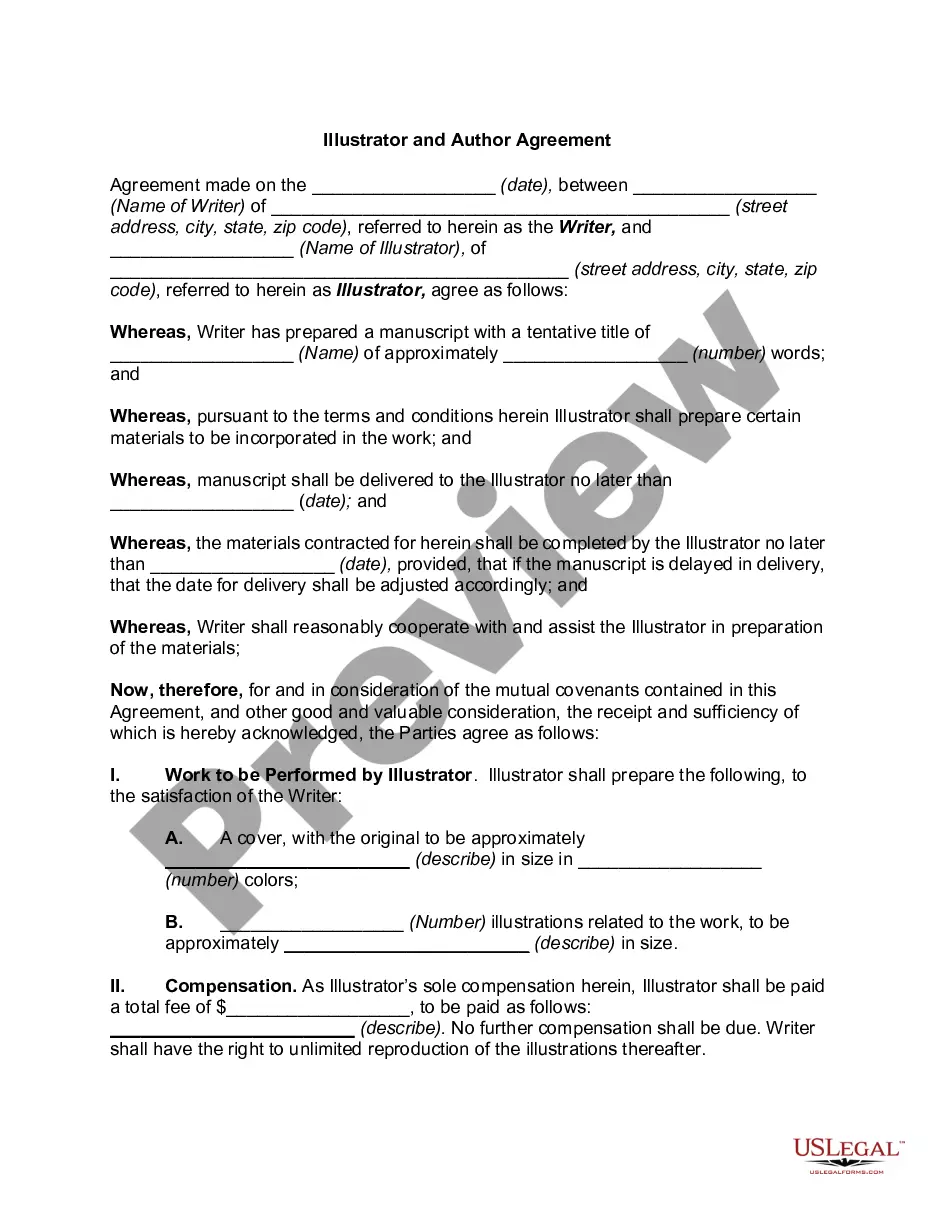
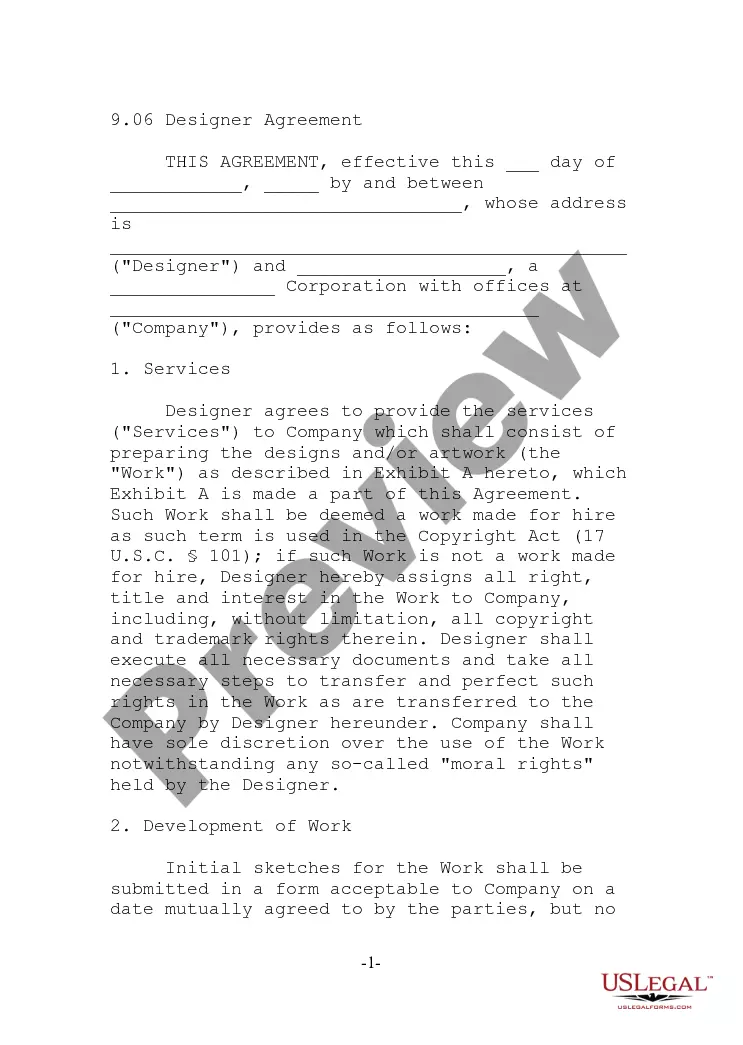
Get your form ready online
Our built-in tools help you complete, sign, share, and store your documents in one place.
Make edits, fill in missing information, and update formatting in US Legal Forms—just like you would in MS Word.
Download a copy, print it, send it by email, or mail it via USPS—whatever works best for your next step.
Sign and collect signatures with our SignNow integration. Send to multiple recipients, set reminders, and more. Go Premium to unlock E-Sign.
If this form requires notarization, complete it online through a secure video call—no need to meet a notary in person or wait for an appointment.
We protect your documents and personal data by following strict security and privacy standards.

Make edits, fill in missing information, and update formatting in US Legal Forms—just like you would in MS Word.

Download a copy, print it, send it by email, or mail it via USPS—whatever works best for your next step.

Sign and collect signatures with our SignNow integration. Send to multiple recipients, set reminders, and more. Go Premium to unlock E-Sign.

If this form requires notarization, complete it online through a secure video call—no need to meet a notary in person or wait for an appointment.

We protect your documents and personal data by following strict security and privacy standards.
Looking for another form?



How to fill out Illustrator And Author Agreement?
US Legal Forms - one of the most prominent collections of legal documents in the United States - offers a selection of legal template files that you can download or print.
By utilizing the website, you can access thousands of forms for business and personal use, categorized by groups, states, or keywords.
You can obtain the latest versions of forms such as the Delaware Illustrator and Author Agreement in moments.
If the form does not fulfill your requirements, utilize the Search box at the top of the screen to find the one that does.
When you are satisfied with the form, confirm your choice by clicking on the Get now button. Then, select the pricing plan you prefer and enter your credentials to sign up for an account.
- If you have an account, sign in and download the Delaware Illustrator and Author Agreement from your US Legal Forms library.
- The Acquire button will appear on each form you view.
- You can find all previously downloaded forms in the My documents section of your account.
- If you are new to using US Legal Forms, here are simple instructions to help you get started.
- Ensure you have selected the correct form for your area/region.
- Click on the Review button to examine the form's content.
Form popularity
FAQ
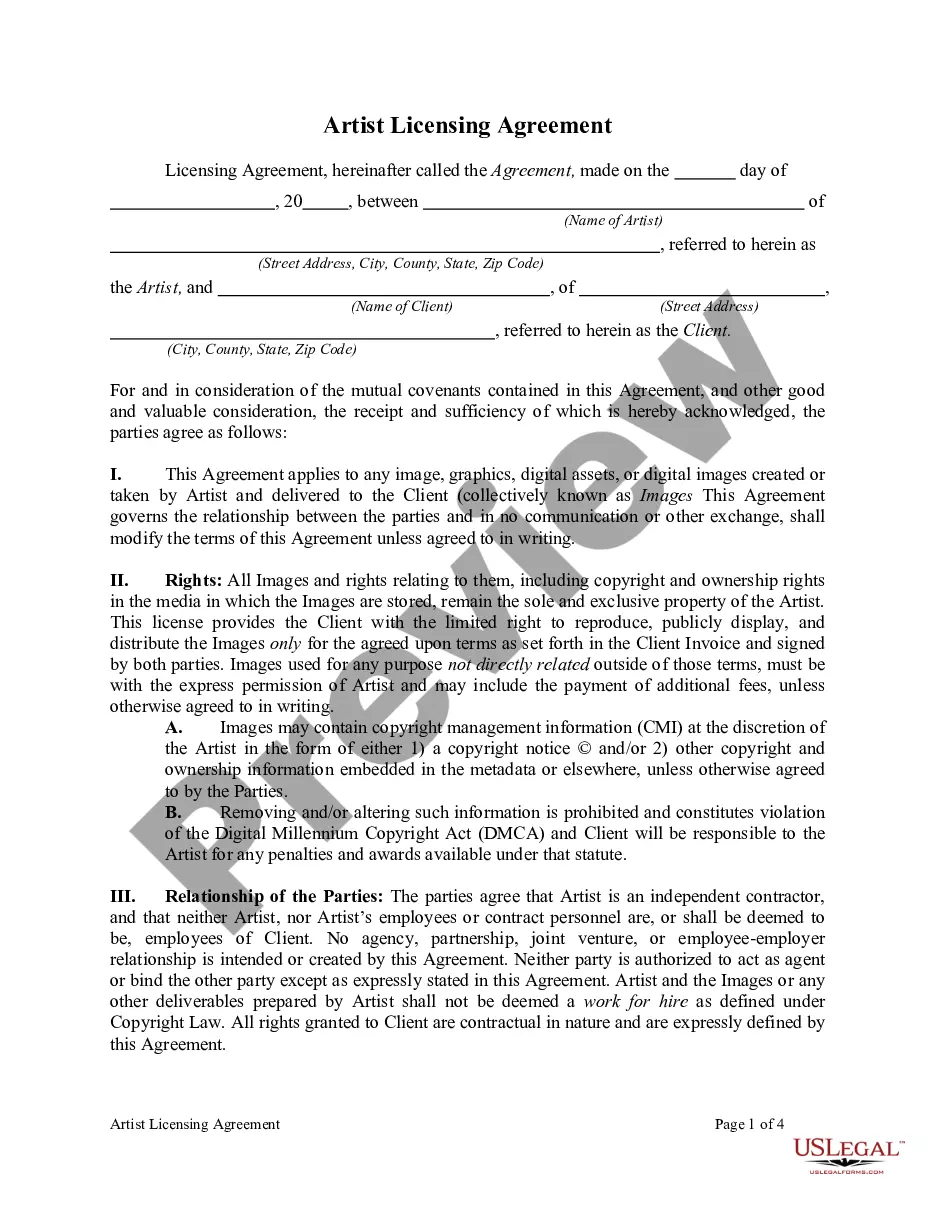
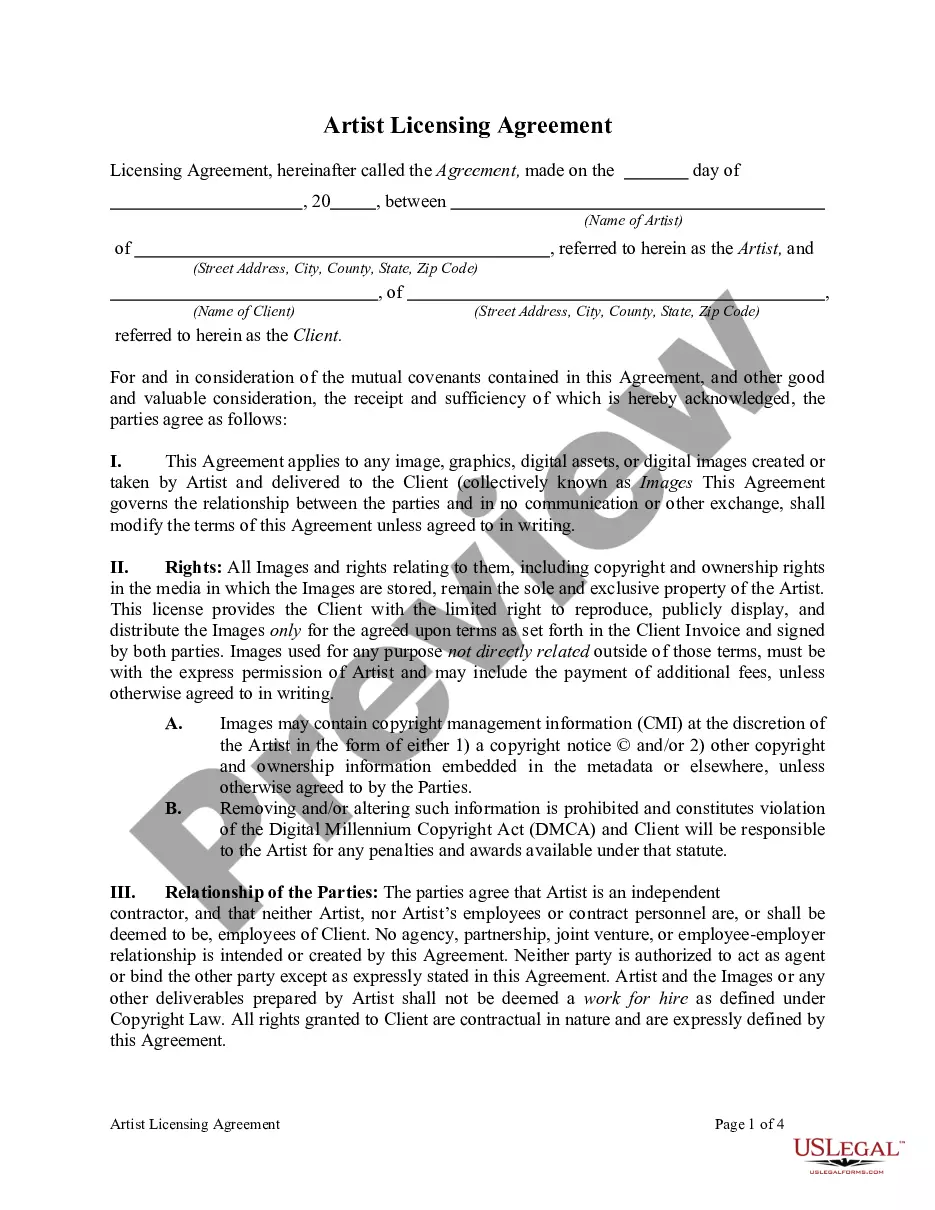
The artist is still the owner of the illustration and has the right to copy it (copyright). Clients pay to be able to use your work in predetermined ways for a certain amount of time in the form of a licence.
If you're the author or author/illustrator, you'll get the full royalty rate. This is typically 10% but could be lower or higher depending on the publisher and negotiations. There may even be a step clause in the contract where the royalty amount gets higher when you hit certain benchmarks.
Who owns the copyright for a public artwork? The artist retains all rights under the Copyright Act of 1976 (17 USC Section 101) as the sole author of the work for the duration of the copyright. The duration of copyright in the United States is currently the life of the author, plus 70 years.
If you're the author or author/illustrator, you'll get the full royalty rate. This is typically 10% but could be lower or higher depending on the publisher and negotiations. There may even be a step clause in the contract where the royalty amount gets higher when you hit certain benchmarks.
Illustrators are usually matched with authors by a publishing company. Sometimes, an author will choose an illustrator to work with, especially if they've worked the person before, but whether the author has published once or many times, it is usually the publisher who will pick an illustrator for a book.
Like anything else that can be copyrighted, artwork is protected by copyright when the art is affixed in a tangible form (such as a painting, sculpture, or drawing). You have to register your copyright with the US Copyright Office if you want to be able to take infringers to court and be awarded damages.
You own the copyright, unless2026 The good news is that in the United States you own the copyright in everything you create. Unless one of three things happens: your employer owns it because you create it as part of your job duties.
In self-publishing, the author usually pays a flat fee for the illustrator's services, rather than ongoing royalties. When the project is complete and payment has been made in full, the contract specifies that the copyright for the images is transferred to the author to publish, market, and sell their book.
Thankfully, self-published books have a much, much higher royalty rate than traditional publishers because you get to keep anywhere from 50-70% of your book's profits. With a traditional publisher, they take much more and you only end up with 10% maybe 12% after years of proving yourself as an author.
If you're the author and illustrator, you'll get to keep the full royalty rate, which would be similar to above: around 10% with possible benchmarks that will raise it to around 15%. If you're only the illustrator, the royalties will be split equally between you and the author.