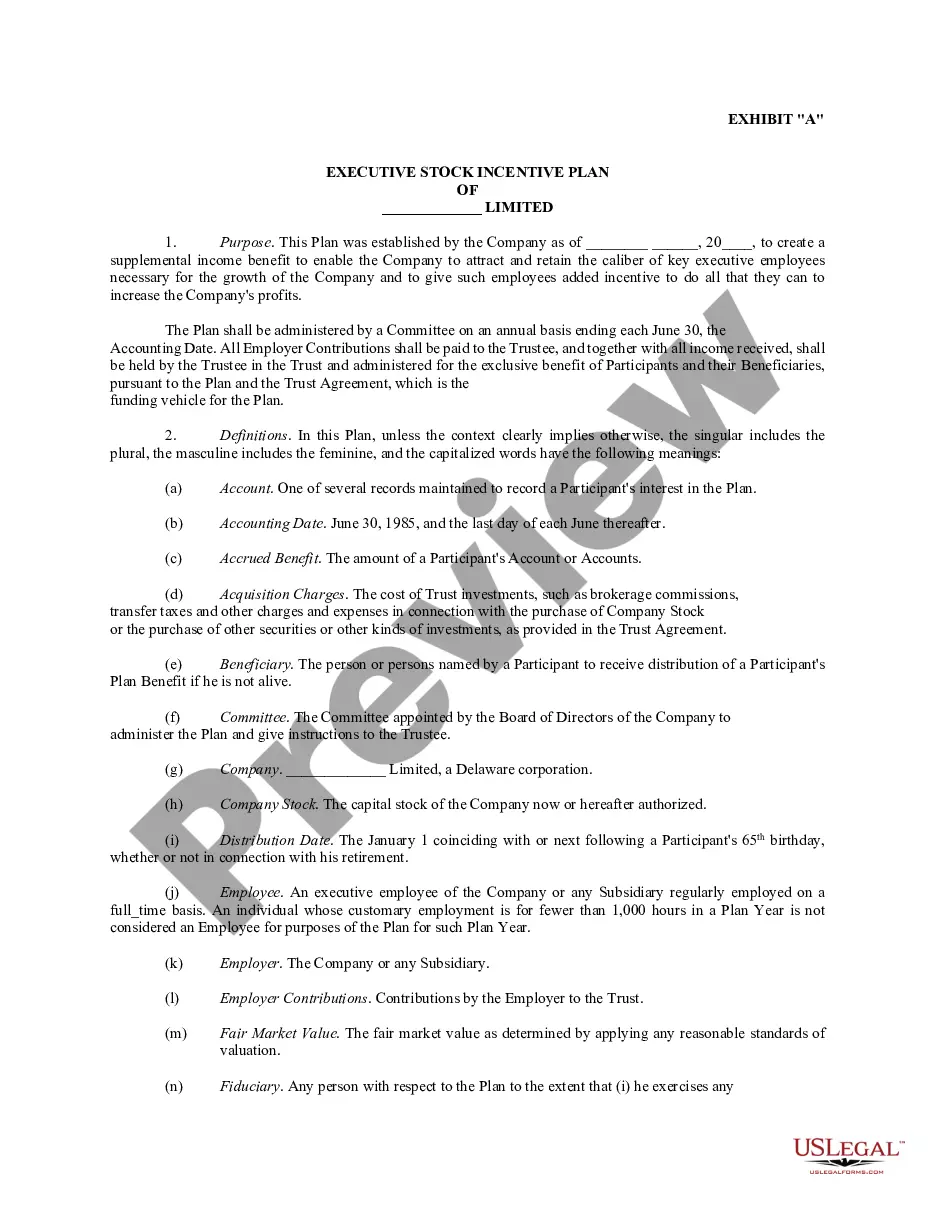
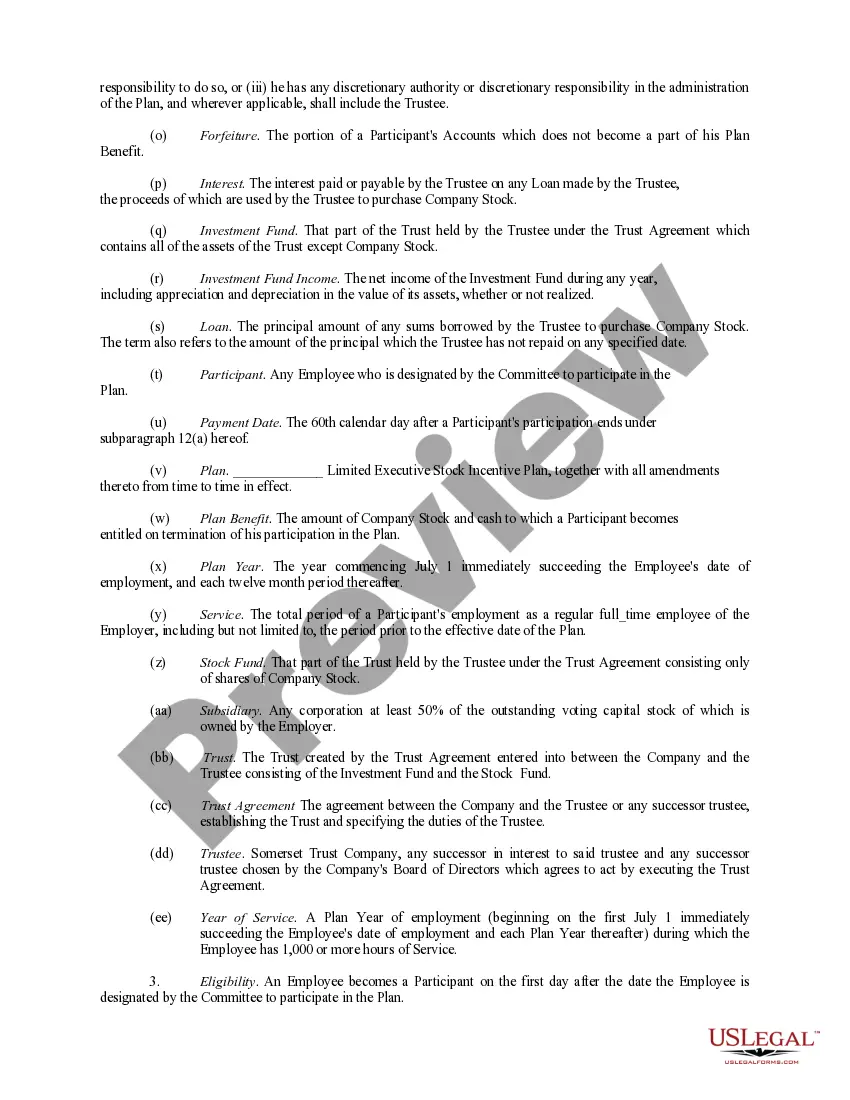
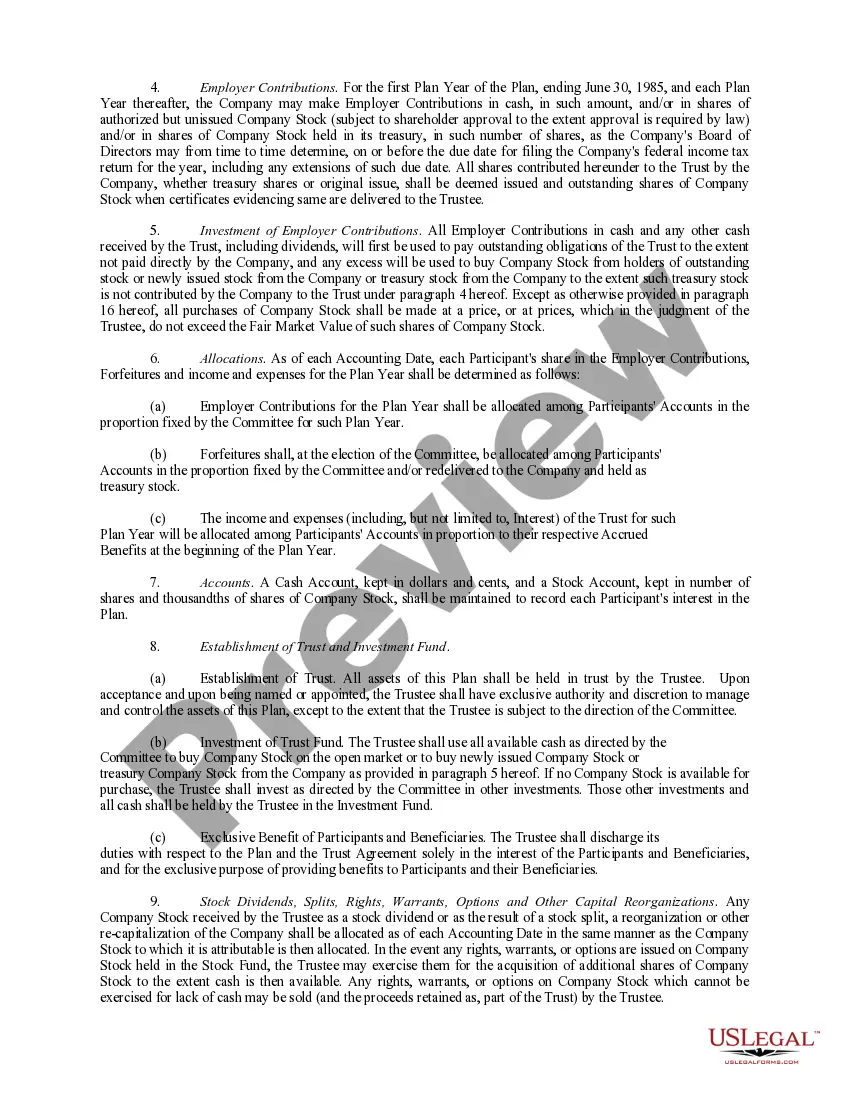
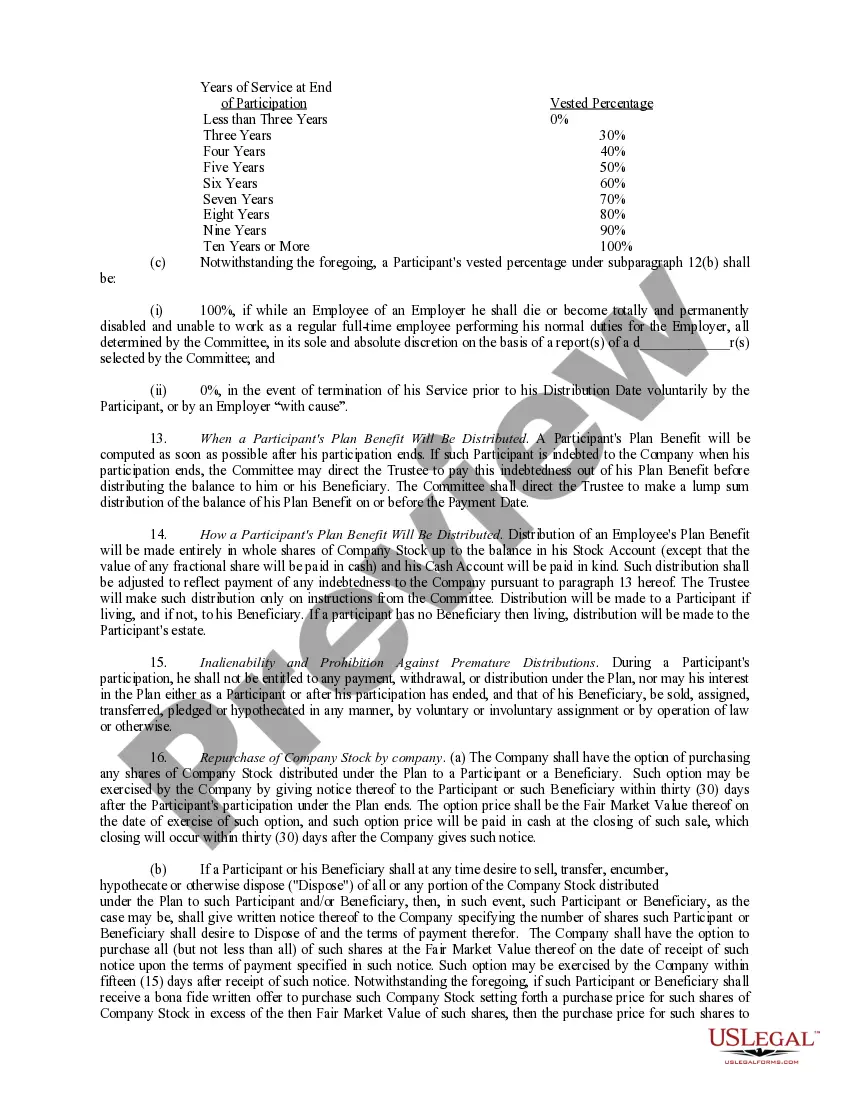
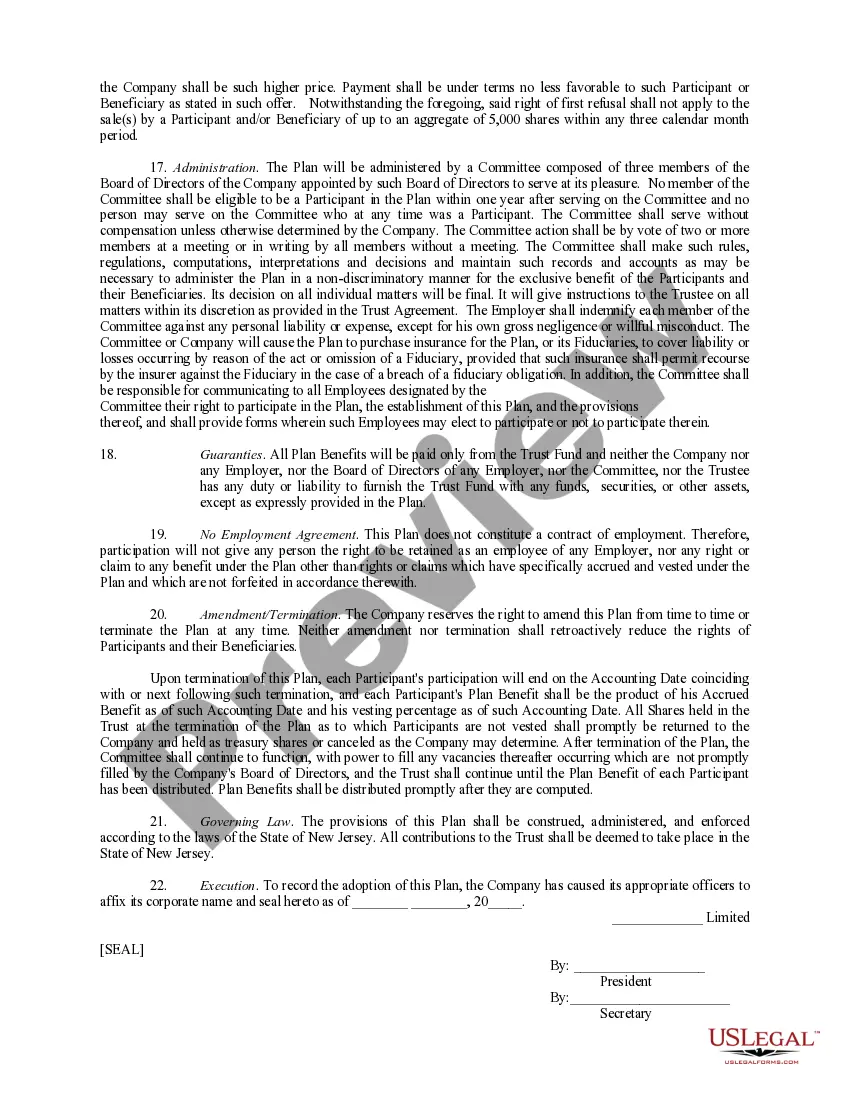
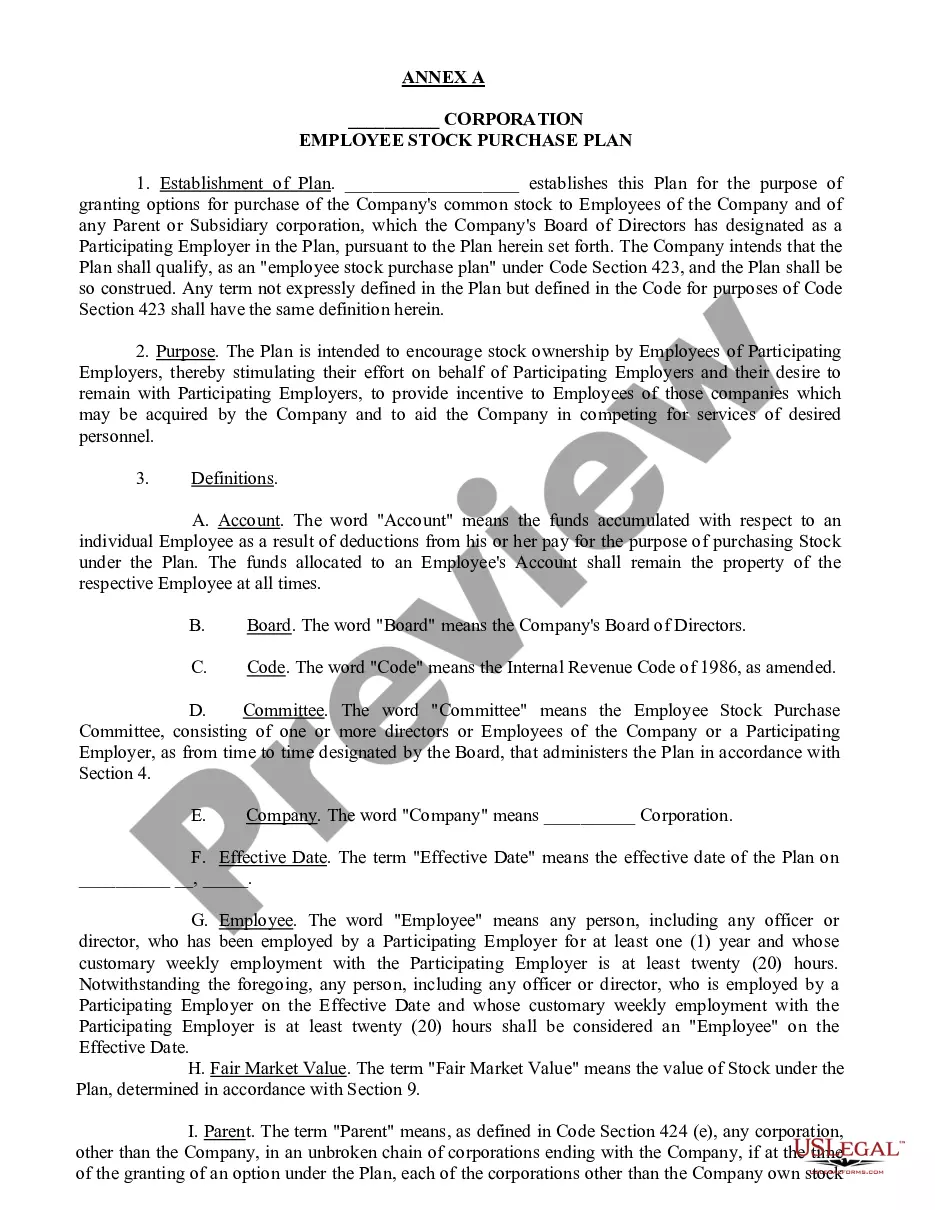
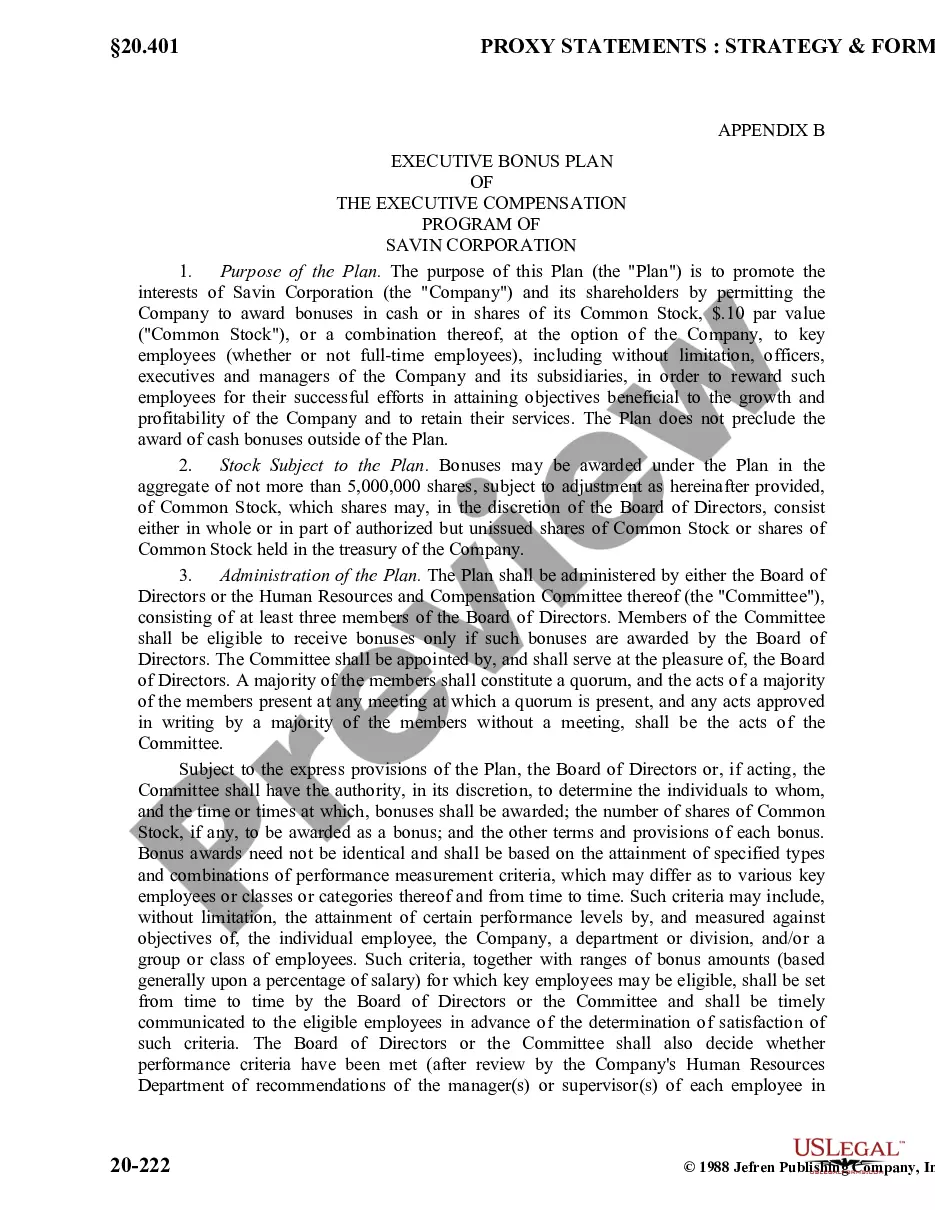
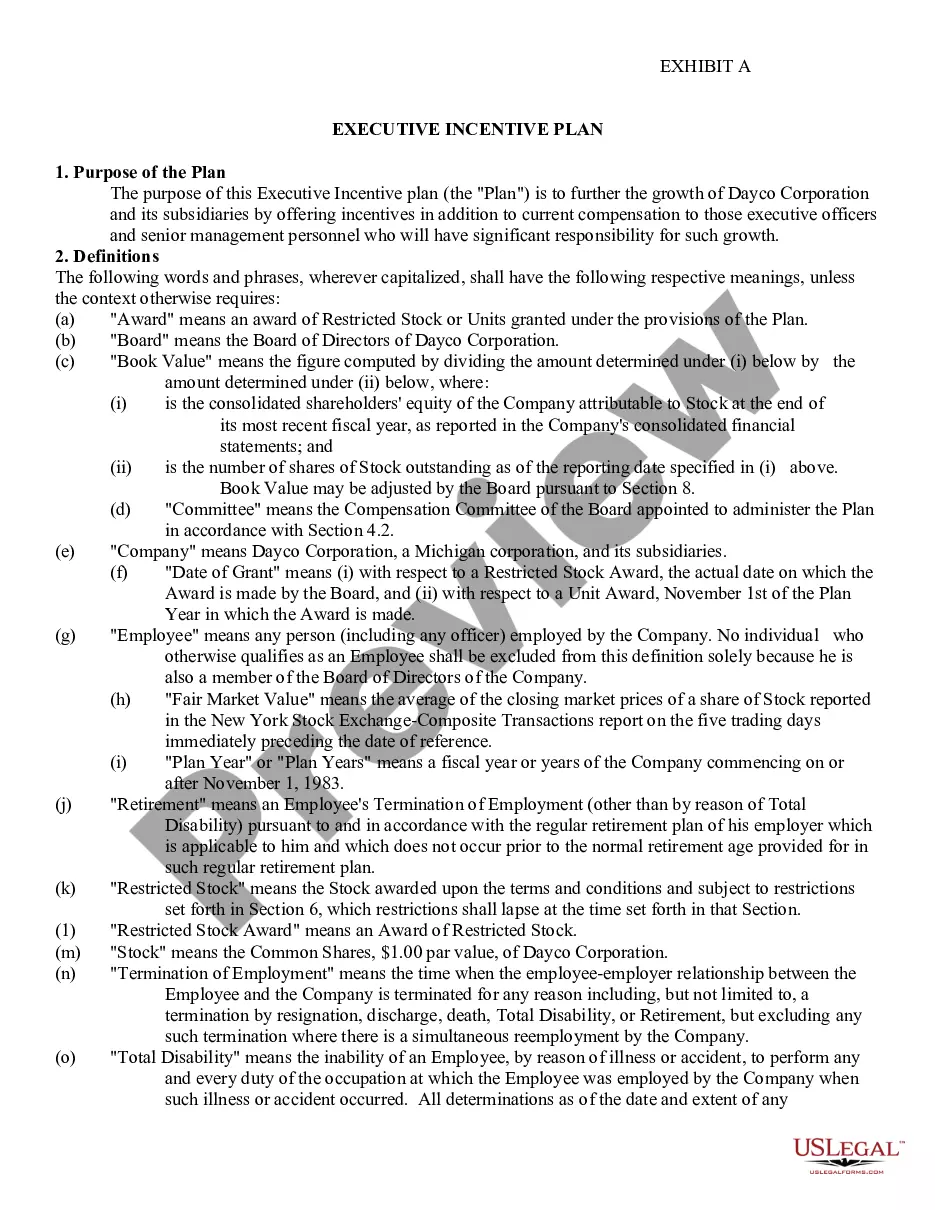
This form is an executive stock initiative plan. The form provides that the plan was created in order to create a supplemental income benefit to to enable the company to attract and retain key executive employees necessary for the growth of the company.
Delaware Executive Employee Stock Incentive Plan
Instant download
Description
Free preview


Get your form ready online
Our built-in tools help you complete, sign, share, and store your documents in one place.
Built-in online Word editor
Make edits, fill in missing information, and update formatting in US Legal Forms—just like you would in MS Word.
Export easily
Download a copy, print it, send it by email, or mail it via USPS—whatever works best for your next step.
E-sign your document
Sign and collect signatures with our SignNow integration. Send to multiple recipients, set reminders, and more. Go Premium to unlock E-Sign.
Notarize online 24/7
If this form requires notarization, complete it online through a secure video call—no need to meet a notary in person or wait for an appointment.
Store your document securely
We protect your documents and personal data by following strict security and privacy standards.

Make edits, fill in missing information, and update formatting in US Legal Forms—just like you would in MS Word.

Download a copy, print it, send it by email, or mail it via USPS—whatever works best for your next step.

Sign and collect signatures with our SignNow integration. Send to multiple recipients, set reminders, and more. Go Premium to unlock E-Sign.

If this form requires notarization, complete it online through a secure video call—no need to meet a notary in person or wait for an appointment.

We protect your documents and personal data by following strict security and privacy standards.
Looking for another form?





How to fill out Executive Employee Stock Incentive Plan?
You are capable of investing hours online searching for the proper legal document template that complies with the federal and state requirements you need.
US Legal Forms offers a wide array of legal forms that can be examined by professionals.
You can download or print the Delaware Executive Employee Stock Incentive Plan from their service.
Review the form description to make sure you have selected the correct one. If available, utilize the Preview button to look over the document template as well.
- If you possess a US Legal Forms account, you can Log In and hit the Download button.
- Then, you can fill out, modify, print, or sign the Delaware Executive Employee Stock Incentive Plan.
- Every legal document template you obtain is yours permanently.
- To retrieve an additional copy of any purchased form, visit the My documents tab and click the corresponding button.
- If you are using the US Legal Forms website for the first time, follow the simple instructions below.
- First, ensure that you have chosen the appropriate document template for the county/city that you select.
Form popularity
FAQ
Yes, a company can issue shares without shareholder approval in certain scenarios, such as issuing shares within the limits set by the board of directors. However, for substantial changes or new classes of shares, approval is often necessary. This process highlights the flexibility within the Delaware Corporate Law and complements initiatives like the Delaware Executive Employee Stock Incentive Plan, which aims to motivate employees through equity.
To issue shares in a Delaware corporation, you must first have the appropriate resolutions in place, typically outlining the share class and number. Following this, you will need to update your corporate records and potentially inform Delaware’s Secretary of State. If you are looking to incorporate an incentive program, the Delaware Executive Employee Stock Incentive Plan can be a beneficial framework under which to issue shares to your employees.
No, Delaware companies cannot issue bearer shares. Instead, shares must be registered in the name of a shareholder, ensuring accountability and traceability in ownership. This regulation supports the integrity of corporate structures and aligns with the benefits provided by the Delaware Executive Employee Stock Incentive Plan, where clear ownership is essential.
In Delaware, significant corporate actions generally require shareholder approval. This includes amendments to the company's certificate of incorporation, mergers, and changes to stock options, including those under the Delaware Executive Employee Stock Incentive Plan. Ensuring that shareholders are involved protects their interests and fosters transparency in corporate governance.
ESOPs and equity incentive plans both aim to motivate employees but differ in their structure. A Delaware Executive Employee Stock Incentive Plan primarily offers employees actual shares of stock, creating direct ownership. In contrast, an equity incentive plan may provide stock options or restricted stock units, which employees can convert into shares under certain conditions. Understanding these nuances helps companies tailor their approach to employee engagement.
The ESOP incentive plan is a program designed to align employees' interests with those of the company by giving them a stake in its ownership. In the context of a Delaware Executive Employee Stock Incentive Plan, it allows employees to acquire shares, fostering a culture of teamwork and investment in the company's success. These plans can enhance employee motivation, satisfaction, and retention.
Long-Term Incentive Plans (LTIPs) and Employee Stock Ownership Plans (ESOPs) serve different purposes. An LTIP focuses on rewarding employees based on company performance over a defined period, while a Delaware Executive Employee Stock Incentive Plan specifically grants employees ownership stakes through stock. This difference influences how employees engage with the company's growth and their vested benefits.
Reporting incentive stock options (ISOs) on your taxes requires you to understand the difference between qualified and non-qualified options. If you qualify under the Delaware Executive Employee Stock Incentive Plan, the tax implications can be advantageous. It's crucial to consult a tax professional to accurately report these options, as they can significantly affect your taxable income.
Filing an Employee Stock Ownership Plan (ESOP) involves multiple steps, beginning with plan design and documentation. You will need to create a detailed plan, which should include provisions regarding governance, funding, and eligibility to meet the qualifications of the Delaware Executive Employee Stock Incentive Plan. Consulting with legal and financial professionals speeds up the filing process and ensures all requirements are met.
Yes, Delaware corporations can issue stock without obtaining shareholder approval, depending on the corporation's bylaws and the type of stock issuance. The Delaware Executive Employee Stock Incentive Plan may allow for flexibility in stock issuance. However, it is essential to consult legal experts to ensure compliance with state laws and regulations.