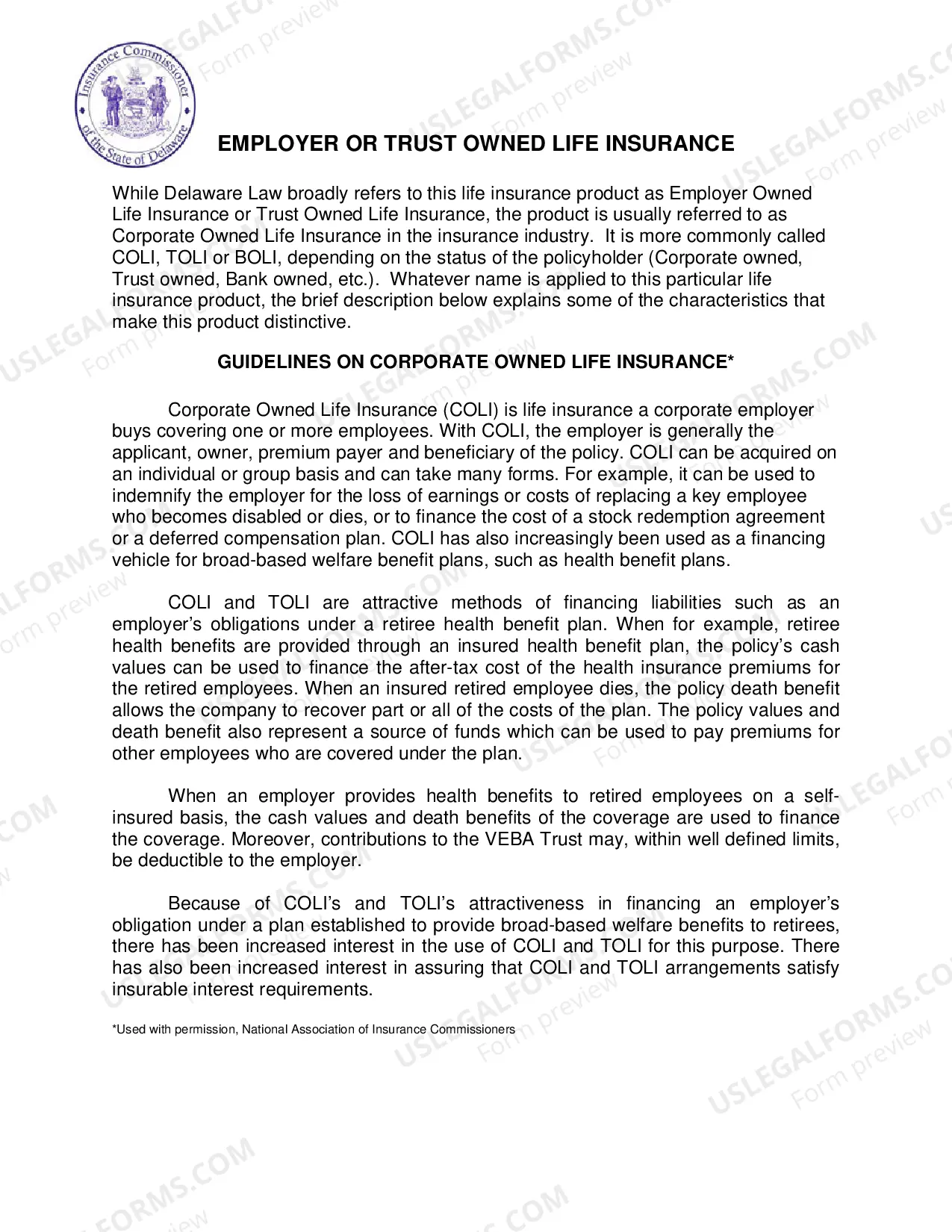
Delaware Employer / Trust Owned Life Insurance
Description
Get your form ready online
Our built-in tools help you complete, sign, share, and store your documents in one place.
Make edits, fill in missing information, and update formatting in US Legal Forms—just like you would in MS Word.
Download a copy, print it, send it by email, or mail it via USPS—whatever works best for your next step.
Sign and collect signatures with our SignNow integration. Send to multiple recipients, set reminders, and more. Go Premium to unlock E-Sign.
If this form requires notarization, complete it online through a secure video call—no need to meet a notary in person or wait for an appointment.
We protect your documents and personal data by following strict security and privacy standards.

Make edits, fill in missing information, and update formatting in US Legal Forms—just like you would in MS Word.

Download a copy, print it, send it by email, or mail it via USPS—whatever works best for your next step.

Sign and collect signatures with our SignNow integration. Send to multiple recipients, set reminders, and more. Go Premium to unlock E-Sign.

If this form requires notarization, complete it online through a secure video call—no need to meet a notary in person or wait for an appointment.

We protect your documents and personal data by following strict security and privacy standards.
Looking for another form?
How to fill out Delaware Employer / Trust Owned Life Insurance?
How much duration and assets do you typically allocate to drafting formal documentation.
There’s a superior alternative to obtaining such forms instead of engaging legal professionals or spending countless hours searching online for an appropriate template.
An additional advantage of our service is that you can access previously obtained documents that you securely store in your profile under the My documents tab. Retrieve them at any time and re-fill your documents as often as needed.
Conserve time and effort preparing legal documents with US Legal Forms, one of the most reliable online services. Register with us today!
- Browse the document content to ensure it satisfies your state criteria. To do this, review the document description or utilize the Preview option.
- If your legal document does not fulfill your needs, find another one using the search bar at the top of the page.
- If you already possess an account with us, Log In and download the Delaware Employer / Trust Owned Life Insurance. If not, proceed to the next steps.
- Click Buy now after locating the appropriate document. Select the subscription plan that best fits your needs to access the full capabilities of our library.
- Create an account and complete the payment for your subscription. You can pay using your credit card or through PayPal - our service is completely dependable for that.
- Download your Delaware Employer / Trust Owned Life Insurance onto your device and fill it out on a printed hard copy or electronically.
Form popularity
FAQ
Yes, many employers offer life insurance as part of their benefits package. This option often provides easy access to coverage without the need for medical exams. When selecting Delaware Employer / Trust Owned Life Insurance, reviewing the policy terms and coverage limits is crucial to ensuring it meets your needs and financial goals. If you need more personalized options, resources like uslegalforms can assist you in exploring suitable alternatives.
Transforming your life insurance policy into a trust involves several steps, but it's often a wise move for estate planning. First, you’ll want to draft a trust document that outlines your wishes regarding the policy. Afterward, you can name the trust as the beneficiary of your Delaware Employer / Trust Owned Life Insurance, ensuring that your assets are managed according to your wishes. You can also work with professionals who specialize in trusts to streamline this process.
A life insurance policy can indeed be owned by a trust. This arrangement often facilitates better management of the policy and ensures that the death benefit is directed appropriately to beneficiaries. For those exploring Delaware Employer / Trust Owned Life Insurance, this option can enhance your overall estate plan by aligning your life insurance with your financial goals.
Placing a life insurance policy in a trust offers several benefits, mainly regarding asset protection and tax advantages. It shields the policy assets from creditors and enables controlled distribution to beneficiaries, minimizing family disputes. This strategy is particularly effective in the context of Delaware Employer / Trust Owned Life Insurance, promoting efficient estate planning.
One significant problem with naming a trust as a beneficiary is that it can complicate the claims process. Insurance companies may require additional documentation or verification steps, which can delay the disbursement of funds. This issue is crucial to consider when dealing with Delaware Employer / Trust Owned Life Insurance, as you want the payout process to be as smooth as possible for your beneficiaries.
Yes, a trust can own a life insurance policy. When a trust holds a policy, it can create specific benefits for the beneficiaries, such as streamlined asset management and potential tax advantages. This structure is particularly advantageous in the context of Delaware Employer / Trust Owned Life Insurance, as it allows for more control over the distribution of funds.
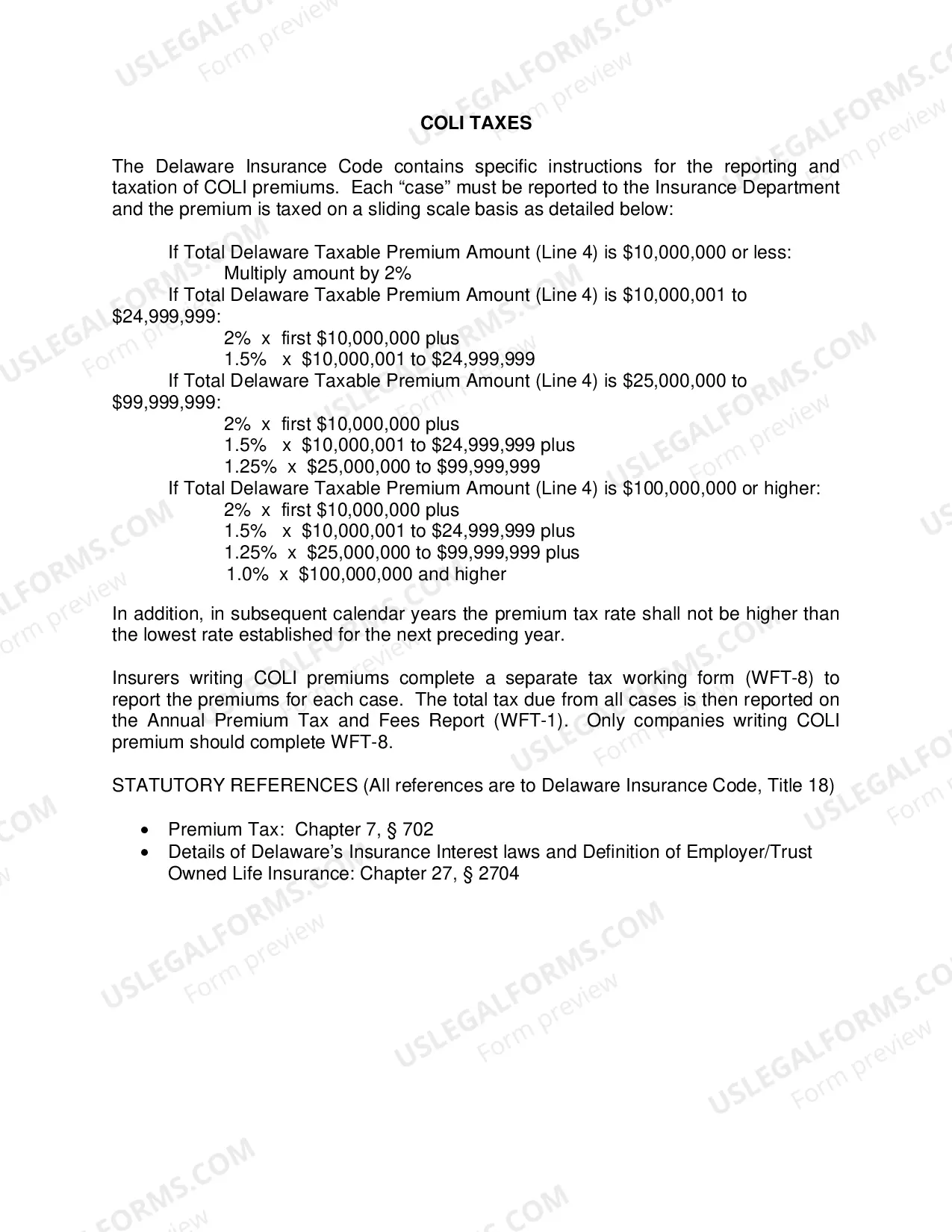
The Delaware Code 2704 addresses how certain life insurance policies are treated for tax purposes when an individual transfers ownership to a trust or business. It includes provisions that prevent unintended tax consequences, ensuring that policy ownership aligns with the goals of estate planning. Understanding this code is essential for those involved with Delaware Employer / Trust Owned Life Insurance, as it can significantly impact financial decisions.
Yes, premiums for employer-owned life insurance can often be tax deductible as a business expense. However, the specifics can vary based on ownership structure and benefit designations. To maximize your understanding and benefits of Delaware Employer / Trust Owned Life Insurance, consulting a tax advisor or financial planner might be a smart move.
Life insurance premiums for a business owner may be tax deductible if the business is the beneficiary. This could also apply to key person insurance policies, which protect the business against the loss of a key individual. Exploring how Delaware Employer / Trust Owned Life Insurance fits into your overall financial strategy can be advantageous.
In the case of employer-provided life insurance, the employer generally owns the policy. This means that the employer is responsible for premium payments and controls the policy benefits. If you are considering Delaware Employer / Trust Owned Life Insurance, it’s important to know how this ownership impacts both tax treatment and beneficiary designations.