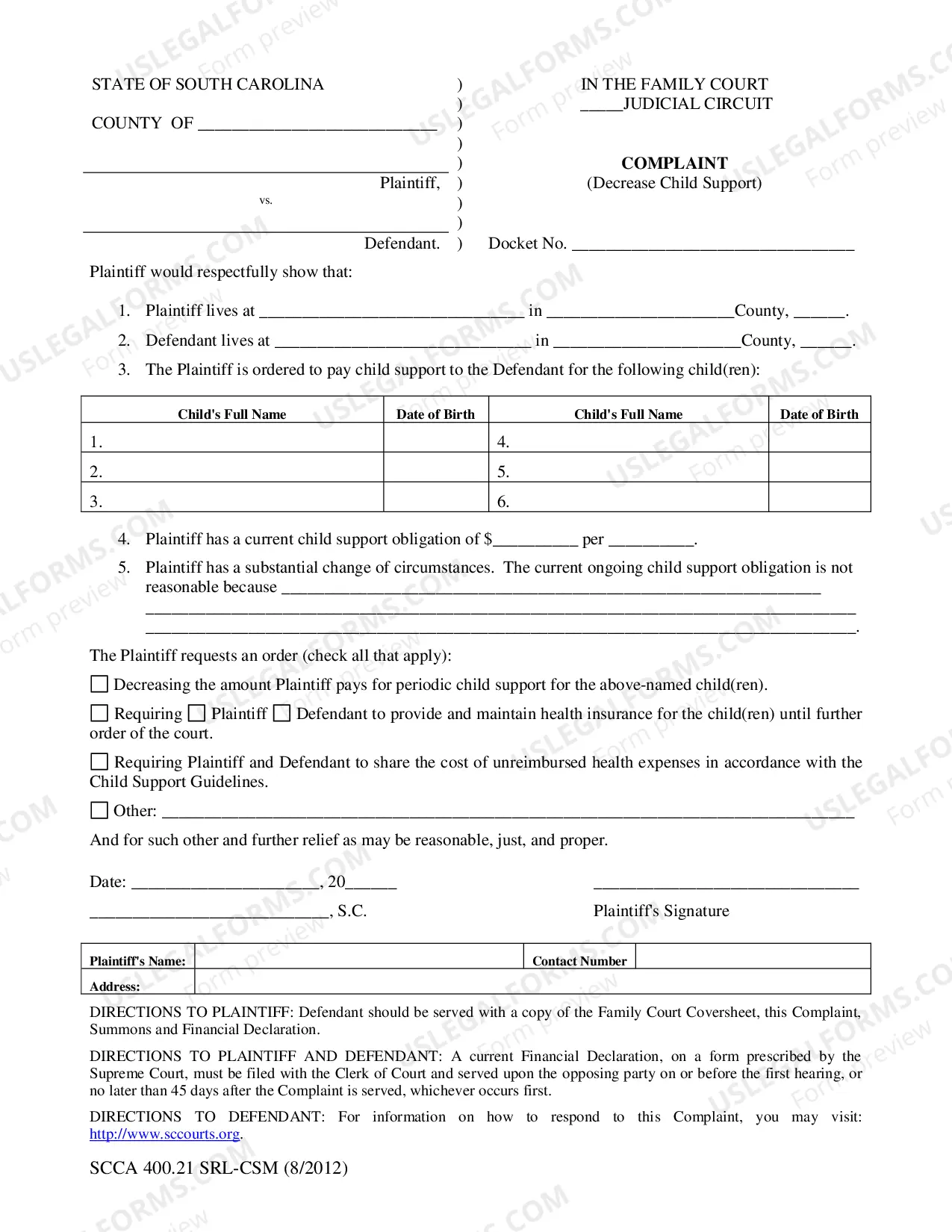
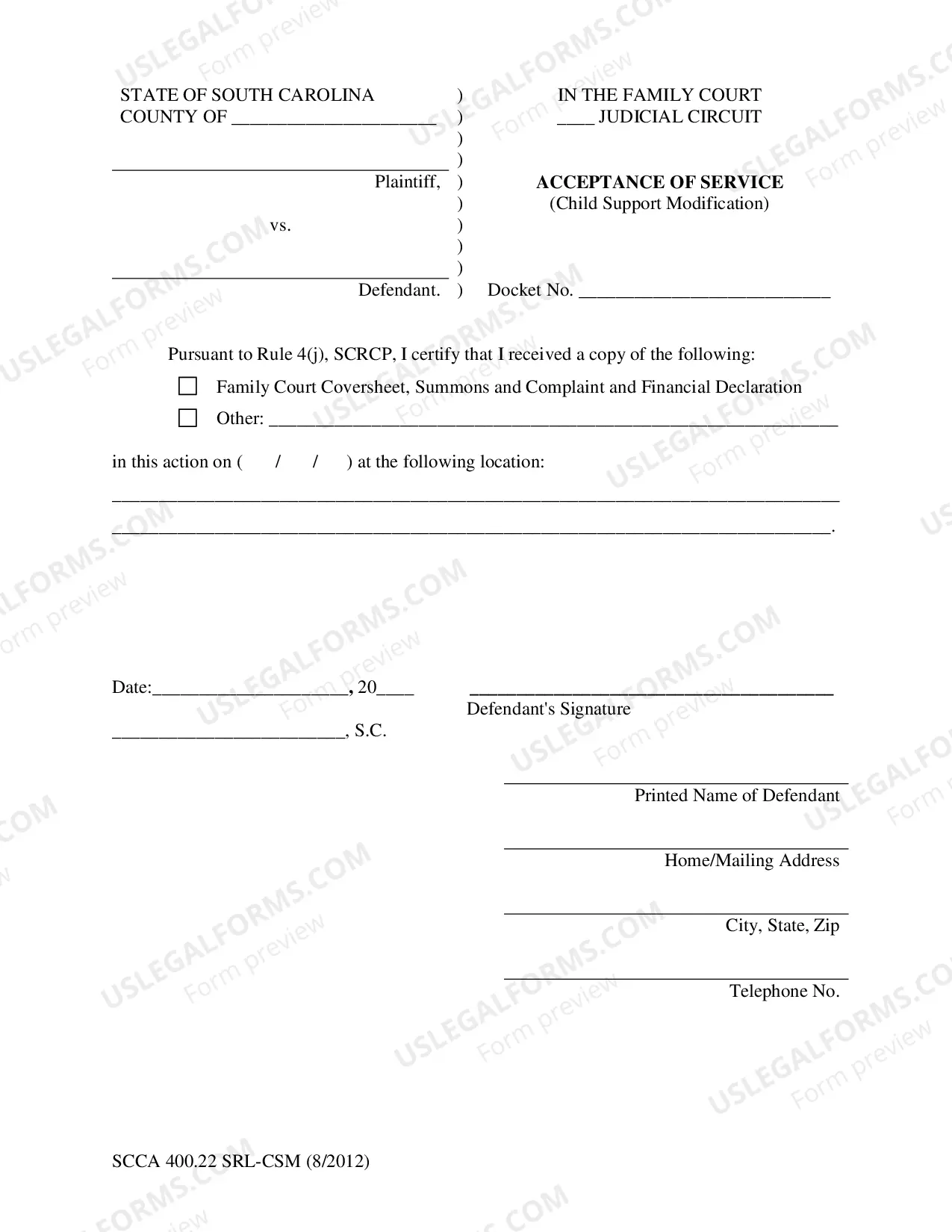
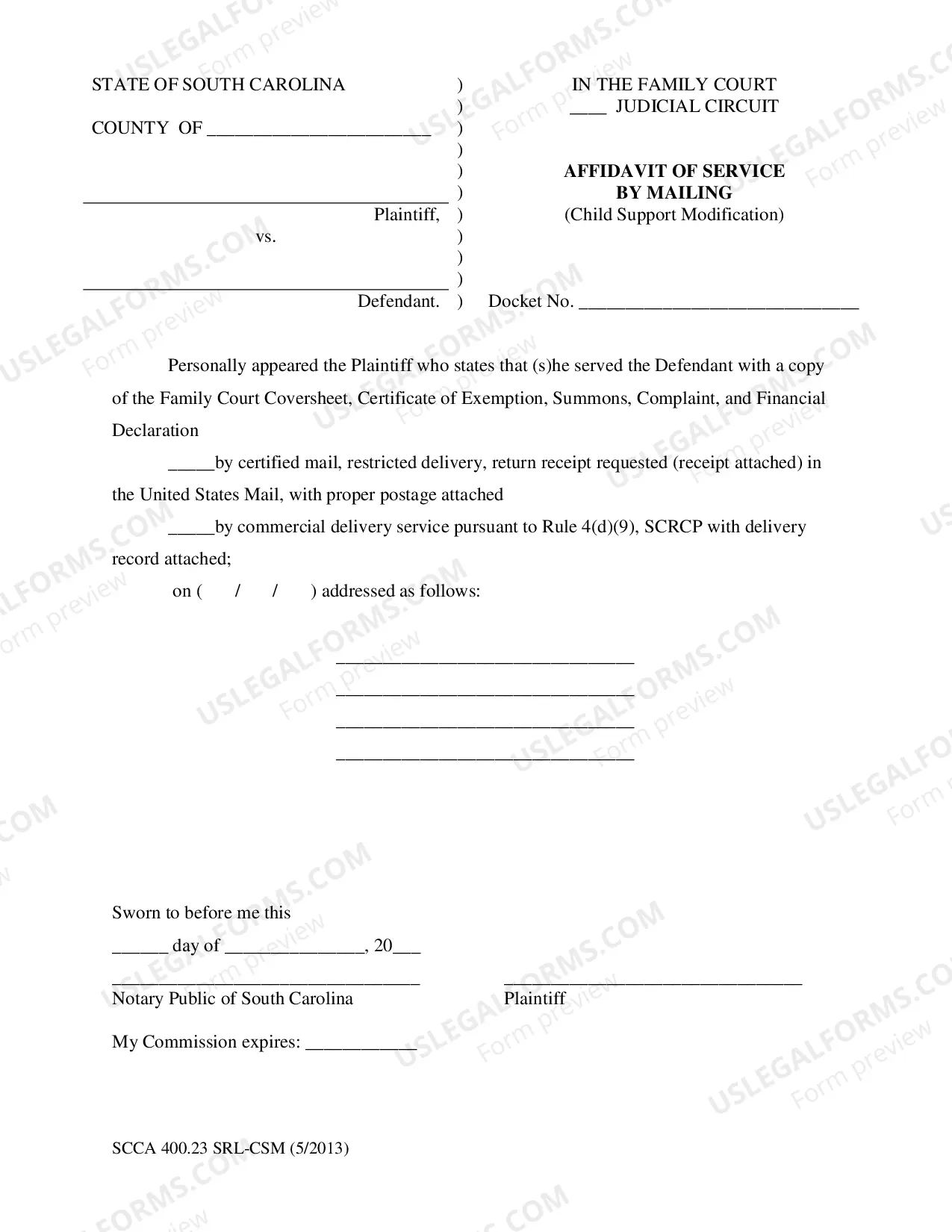
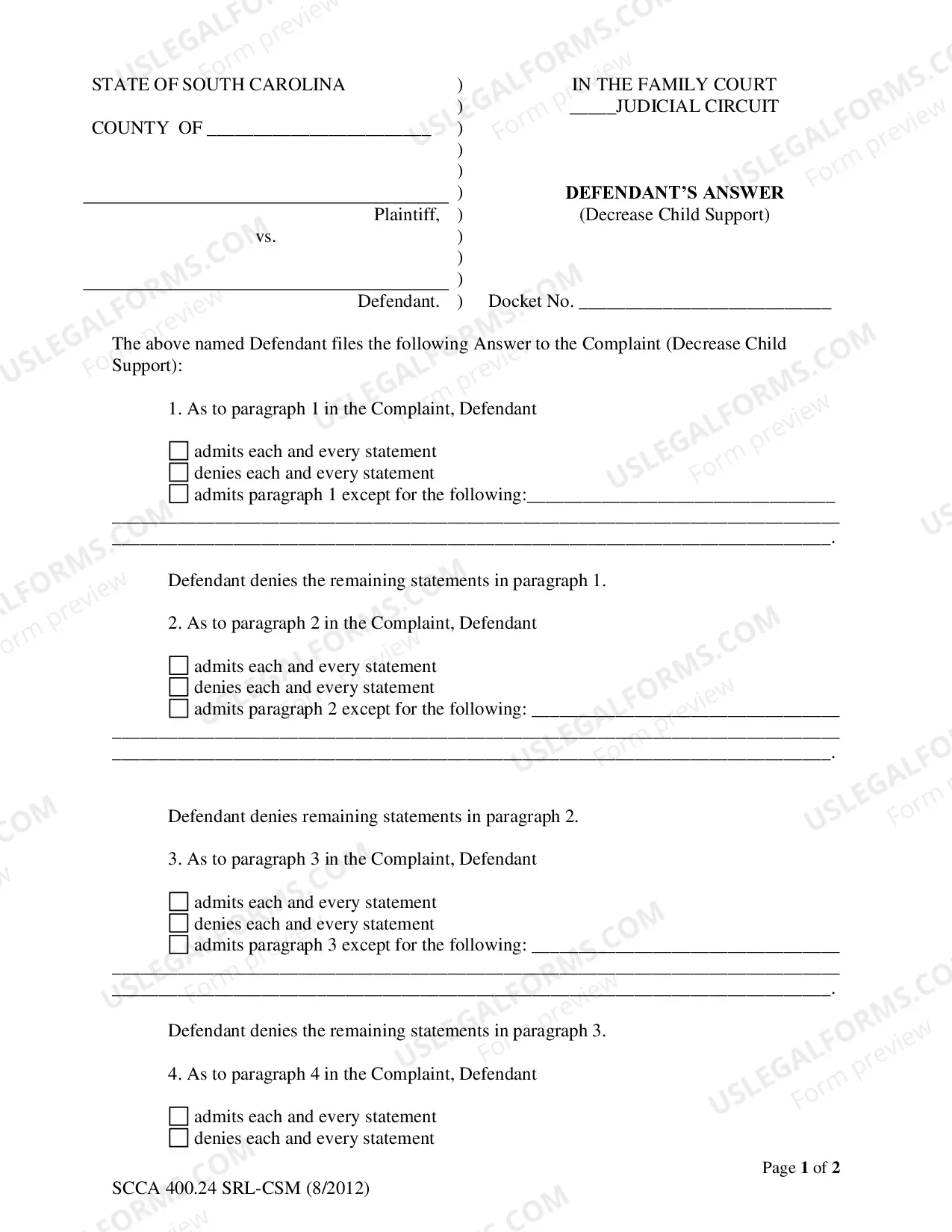
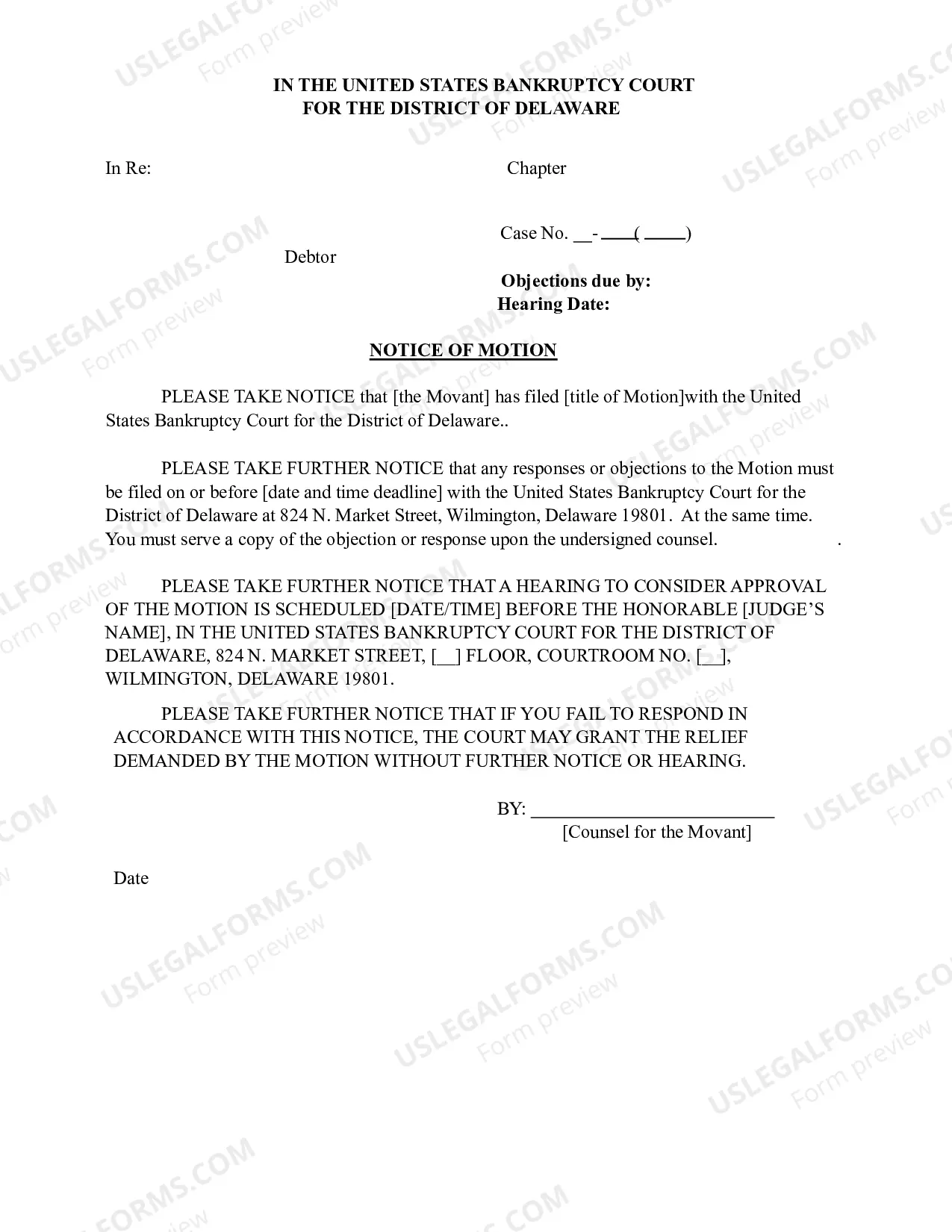
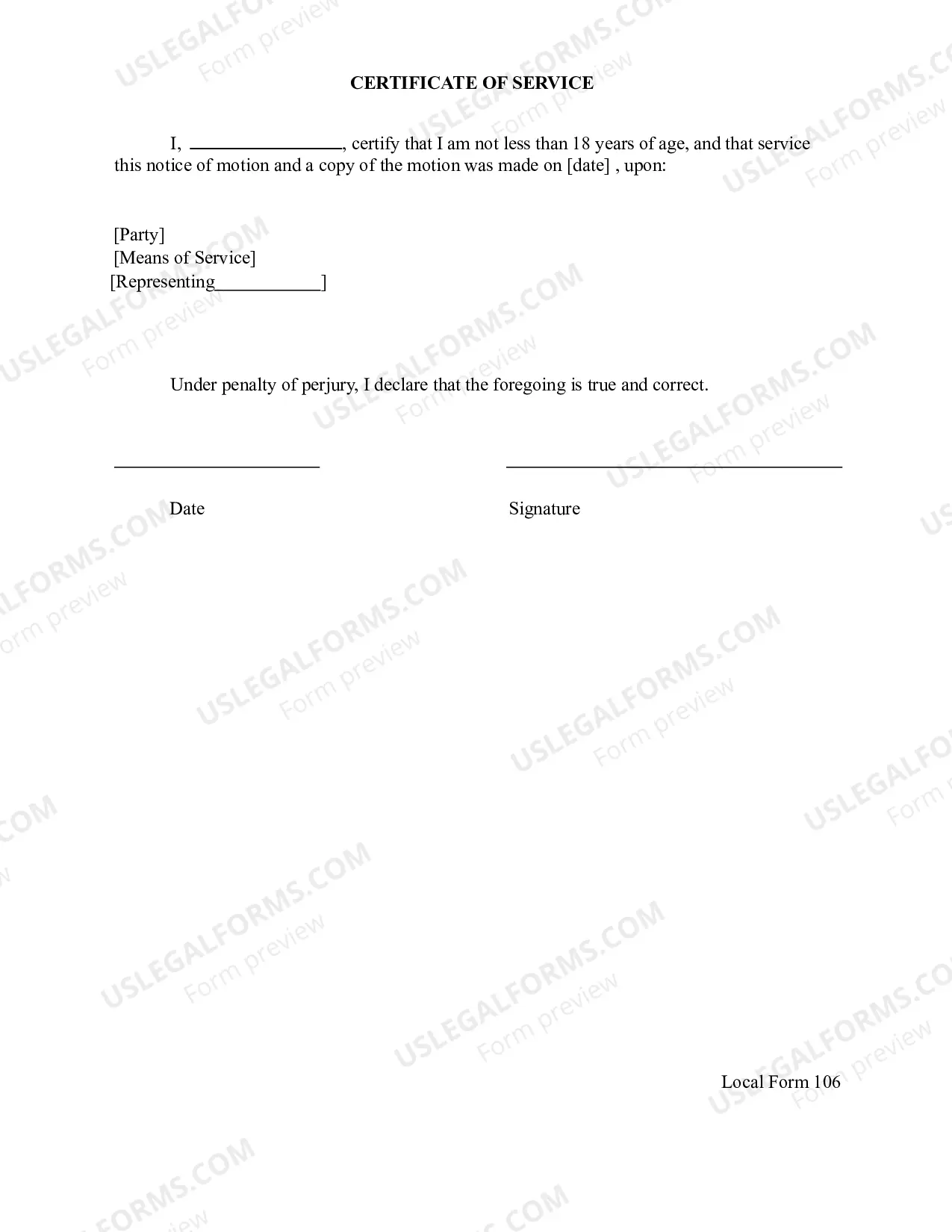
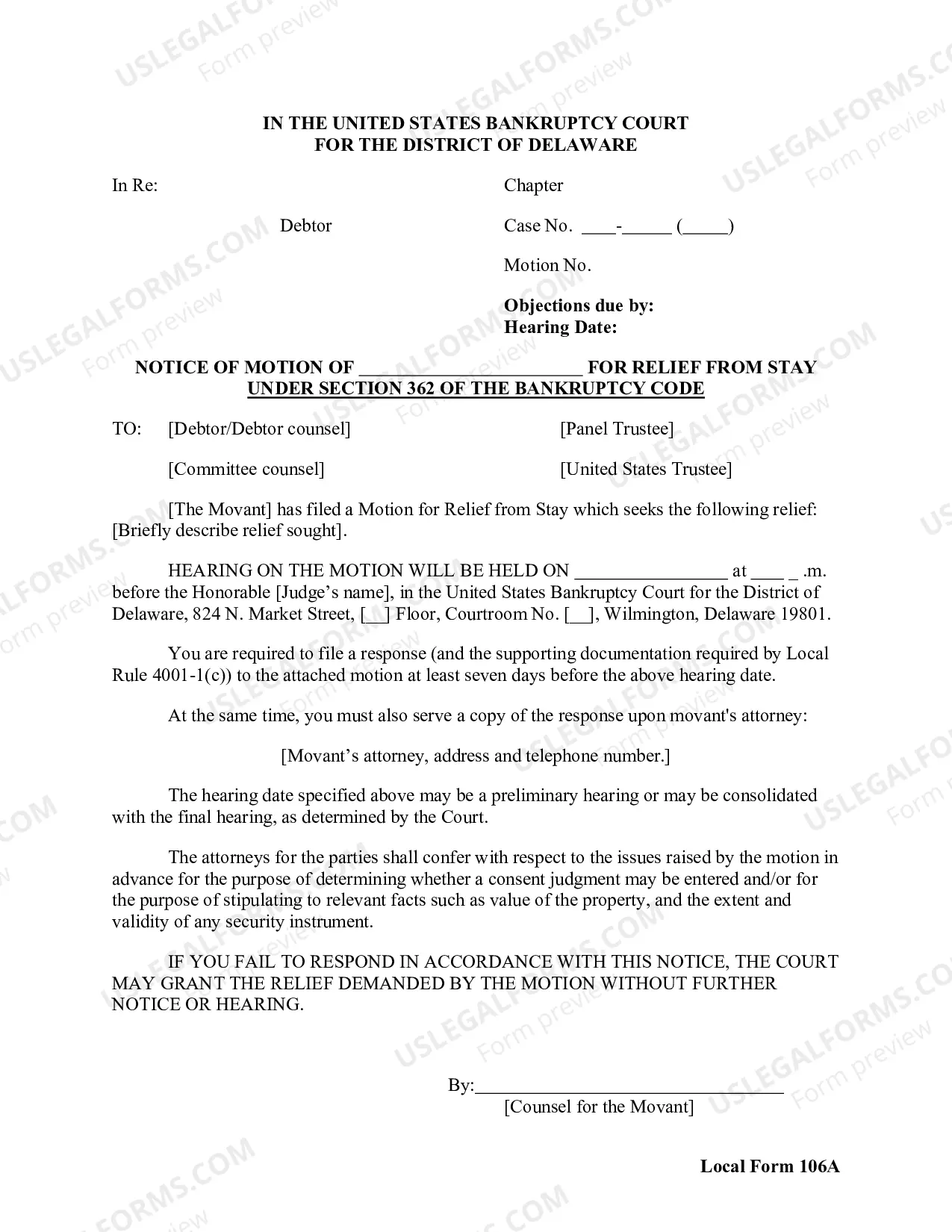
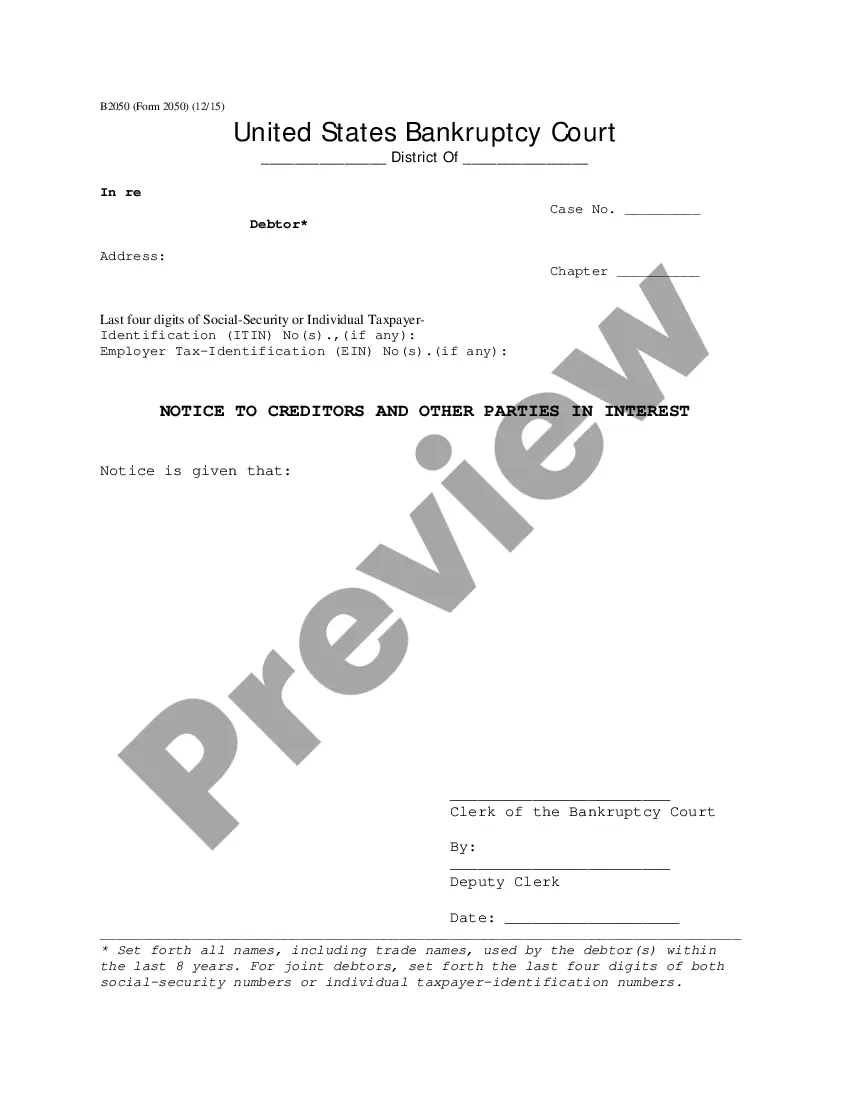
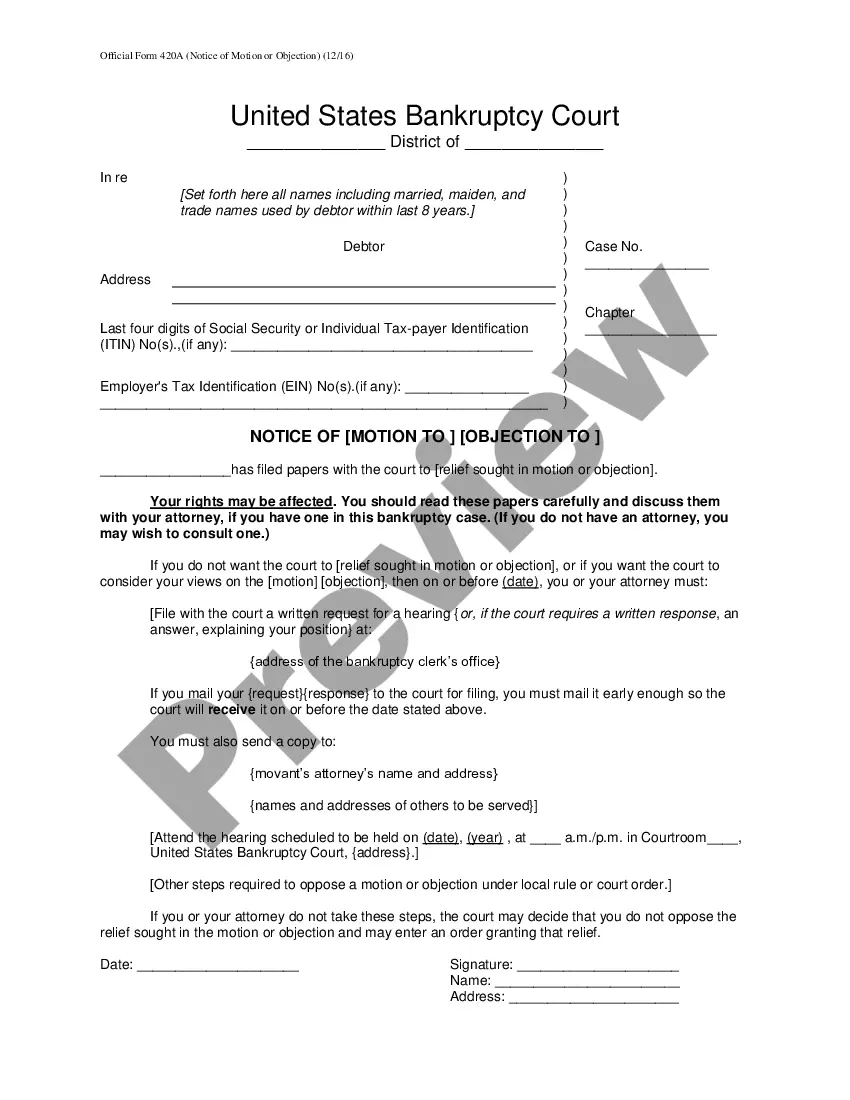
A Delaware Notice of Motion is a legal document used in the state of Delaware to bring a motion before a court. A motion is a request to the court to make an order or ruling on an issue. A Delaware Notice of Motion must be filed with the court prior to the hearing on the motion. The Notice must include the date and time of the hearing, the name of the party filing the motion, the name of the party against whom the motion is being brought, the relief requested, and the reasons why the relief is being sought. There are several types of Delaware Notice of Motion, including a Motion for Summary Judgment, Motion to Reopen Case, Motion to Compel, Motion for Continuance, Motion to Dismiss, Motion to Vacate, Motion to Strike, Motion for Summary Disposition, Motion for Reconsideration, Motion for Relief from Stay, and Motion to Change Venue.
Delaware Notice of Motion
Description

Get your form ready online
Our built-in tools help you complete, sign, share, and store your documents in one place.
Make edits, fill in missing information, and update formatting in US Legal Forms—just like you would in MS Word.
Download a copy, print it, send it by email, or mail it via USPS—whatever works best for your next step.
Sign and collect signatures with our SignNow integration. Send to multiple recipients, set reminders, and more. Go Premium to unlock E-Sign.
If this form requires notarization, complete it online through a secure video call—no need to meet a notary in person or wait for an appointment.
We protect your documents and personal data by following strict security and privacy standards.

Make edits, fill in missing information, and update formatting in US Legal Forms—just like you would in MS Word.

Download a copy, print it, send it by email, or mail it via USPS—whatever works best for your next step.

Sign and collect signatures with our SignNow integration. Send to multiple recipients, set reminders, and more. Go Premium to unlock E-Sign.

If this form requires notarization, complete it online through a secure video call—no need to meet a notary in person or wait for an appointment.

We protect your documents and personal data by following strict security and privacy standards.
Looking for another form?
How to fill out Delaware Notice Of Motion?
If you’re looking for a method to properly craft the Delaware Notice of Motion without engaging a lawyer, then you’ve come to the correct location.
US Legal Forms has established itself as the most comprehensive and trustworthy collection of official templates for every personal and business circumstance.
Another beneficial aspect of US Legal Forms is that you will never misplace the documents you have obtained - you can access any of your downloaded templates in the My documents tab of your profile whenever necessary.
- Verify the document displayed on the page aligns with your legal circumstances and state laws by reviewing its text description or examining the Preview mode.
- Input the document title in the Search tab located at the top of the page and select your state from the dropdown to find an alternative template in case of any discrepancies.
- Repeat the content validation process and click Buy now when you are confident that the paperwork meets all the necessary requirements.
- Log in to your account and click Download. Create an account with the service and choose a subscription plan if you do not yet have one.
- Utilize your credit card or the PayPal option to acquire your US Legal Forms subscription. The template will be ready for download immediately thereafter.
- Select the format in which you wish to save your Delaware Notice of Motion and download it by clicking the respective button.
- Import your template into an online editor to fill out and sign it quickly or print it out to prepare your physical copy manually.
Form popularity
FAQ
To file a motion notice in Delaware, you will first need to prepare the Delaware Notice of Motion and ensure it meets the court's requirements. After drafting it, file the document with the appropriate court and serve it to all involved parties. This process ensures that everyone is informed and has the opportunity to respond. Platforms like USLegalForms can help simplify the filing process with templates and guidance tailored to your needs.
In Delaware, you typically have 10 days to respond to a Delaware Notice of Motion. This timeframe is crucial for ensuring that you provide your arguments or objections clearly and promptly. Failing to respond within the period can lead to the motion being granted by default. It is essential to stay on top of deadlines to protect your interests.
During a notice of motion hearing, the judge reviews the arguments presented by both parties. Each party has the opportunity to present their case, including evidence and witness testimonies, if applicable. The outcome of this hearing can influence subsequent legal steps, making it crucial to prepare adequately for the proceedings. For accurate guidance on navigating these hearings, consider reviewing relevant documents and templates available on the US Legal Forms site.
A notice of motion informs parties involved in a case about a request being made to the court. The term 'motion' itself refers to the formal request to obtain a specific ruling or order from a judge. Understanding these terms is essential as they lay the groundwork for various legal processes, including those related to a Delaware Notice of Motion. Explore the nuances of these terms further through resources on the US Legal Forms platform.
A Rule 56 motion is a request for summary judgment that a party files in court. It asserts that there are no material facts requiring a trial, thus justifying a judgment in the movant's favor. Effectively utilizing a Rule 56 motion can streamline legal proceedings and save time for all parties involved, especially when paired with a Delaware Notice of Motion. For assistance in drafting such motions, US Legal Forms offers helpful templates and examples.
Rule 59 in Delaware outlines the procedures for a new trial or alteration of a judgment. This rule is particularly significant when a party believes the outcome of a trial was unjust or flawed. Motions under Rule 59 can effectively challenge a decision and are often coupled with a Delaware Notice of Motion to seek appropriate remedies. To handle such legal challenges, the resources available at US Legal Forms can provide you with the necessary templates and information.
Rule 41 of the Delaware Rules of Civil Procedure governs the dismissal of actions. It provides the conditions under which a plaintiff can voluntarily dismiss their case, either with or without prejudice. Knowing how to navigate Rule 41 can impact your legal strategy, especially if you're considering filing a Delaware Notice of Motion regarding the dismissal of your case. Proper guidance can be found through platforms like US Legal Forms.
Rule 56 in Delaware refers to the procedural rule concerning summary judgment in civil cases. This rule allows a party to seek a judgment in their favor without a trial when there is no genuine dispute over material facts. Understanding Rule 56 can be particularly beneficial if you are involved in litigation and are considering a Delaware Notice of Motion for summary judgment. For more details, legal resources like US Legal Forms may assist you.
The Delaware retirement income exclusion allows residents to exclude a portion of their retirement income from state taxes. This exclusion is designed to benefit retirees and encourage long-term residency in Delaware. According to Delaware tax law, a specific amount of retirement income can be excluded each year, aiding financial stability in retirement. To learn more about maximizing this benefit, consider exploring resources on the US Legal Forms platform.
Yes, you can file a motion by yourself with a Delaware Notice of Motion. It's important to prepare the document carefully and follow the court's procedures to avoid delays. While self-representation is an option, seeking assistance, especially from resources like USLegalForms, can enhance your chances of success by providing clear guidelines and templates.