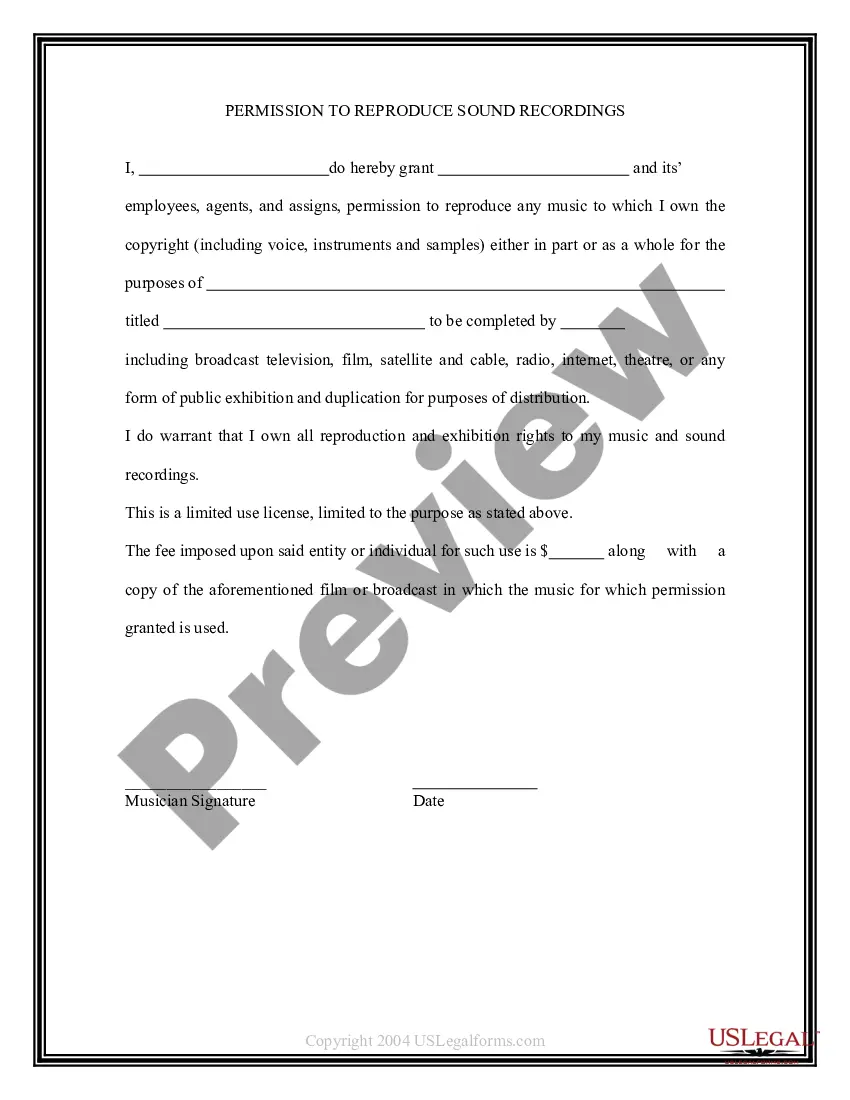
This is a form signed by a musician or owner of music granting permission to reproduce copyrighted music for use in a film, television, Internet, radio etc.
District of Columbia Permission To Reproduce Sound Recordings
State:
Multi-State
Control #:
US-PRM-23
Format:
Word;
Rich Text
Instant download
Description

How to fill out Permission To Reproduce Sound Recordings?
Are you presently in a position where you need documents for both business or personal reasons every day.
There are numerous legal document templates available online, but locating versions you can rely on is not easy.
US Legal Forms offers thousands of form templates, such as the District of Columbia Permission To Reproduce Sound Recordings, which are designed to comply with state and federal regulations.
- If you are already familiar with the US Legal Forms website and have an account, simply Log In.
- Then, you can download the District of Columbia Permission To Reproduce Sound Recordings template.
- If you don't have an account and wish to start using US Legal Forms, follow these steps.
- Find the form you need and ensure it is for your specific city/state.
- Use the Review option to verify the form.
- Check the details to make sure you have selected the correct form.
- If the form is not what you are looking for, utilize the Search field to find a form that meets your needs and requirements.
- Once you find the right form, click Get now.
- Choose the pricing plan you prefer, fill in the required information to create your account, and complete the transaction using your PayPal or Visa or Mastercard.
- Select a convenient file format and download your copy.
- Access all the document templates you have purchased in the My documents section. You can obtain an additional copy of District of Columbia Permission To Reproduce Sound Recordings at any time if needed. Just click the necessary form to download or print the document template.
- Utilize US Legal Forms, one of the largest collections of legal forms, to save time and avoid mistakes.
- The service provides expertly crafted legal document templates that can be used for a variety of purposes.
- Create an account on US Legal Forms and start making your life easier.
Form popularity
FAQ
You can record a conversation with your boss in Washington, D.C., if you are a participant in the conversation and provide consent. This aligns with the one-party consent law, which allows recordings as long as one person agrees. However, it is wise to communicate openly with your boss about the recording, as transparency can foster trust in your working relationship. For detailed legal guidance regarding the District of Columbia Permission To Reproduce Sound Recordings, consult resources like uslegalforms.
Recording someone without their consent in Washington, D.C., can be illegal depending on the context. The law mandates that at least one party must consent to the recording for it to be lawful. Violating this rule could lead to legal repercussions, so it's important to understand your rights. If you need guidance on this issue, consider visiting uslegalforms for more information.
Yes, recording consent is legal in Washington, D.C., as long as one party involved in the conversation gives permission. This law facilitates many business and personal interactions, ensuring that recordings can occur without extensive legal hurdles. However, it is crucial to remain aware of the specific circumstances and to respect privacy rights. You can find more information on the District of Columbia Permission To Reproduce Sound Recordings through reliable legal sources.
Yes, Washington, D.C. operates under a one-party consent rule for audio recordings. This means that as long as one person in the conversation consents to the recording, it is legal to do so. However, this does not apply to recordings made for malicious purposes. Understanding the implications of the District of Columbia Permission To Reproduce Sound Recordings can help protect your interests.
In the District of Columbia, it is generally illegal to record someone without their consent. The law requires that at least one party involved in the conversation gives permission for the recording. Therefore, if you are not part of the conversation and do not give consent, the recording may violate your rights. Always consider seeking legal advice if you believe your rights have been infringed upon.
DC Code 22 3214 addresses the legal stipulations surrounding the recording of conversations and sound. This code outlines the conditions under which individuals can legally reproduce sound recordings in the District of Columbia. It is crucial to be aware of this code if you intend to engage in any activity that involves audio recordings. To ensure compliance and obtain the necessary District of Columbia Permission To Reproduce Sound Recordings, consider consulting resources like uslegalforms for guidance.
In the District of Columbia, recording someone's audio without their consent can lead to legal complications. Under the law, individuals have a reasonable expectation of privacy regarding their conversations. If someone records your audio without obtaining the proper District of Columbia Permission To Reproduce Sound Recordings, they may violate your rights. It is essential to understand your rights and seek guidance if you believe your audio has been recorded without permission.