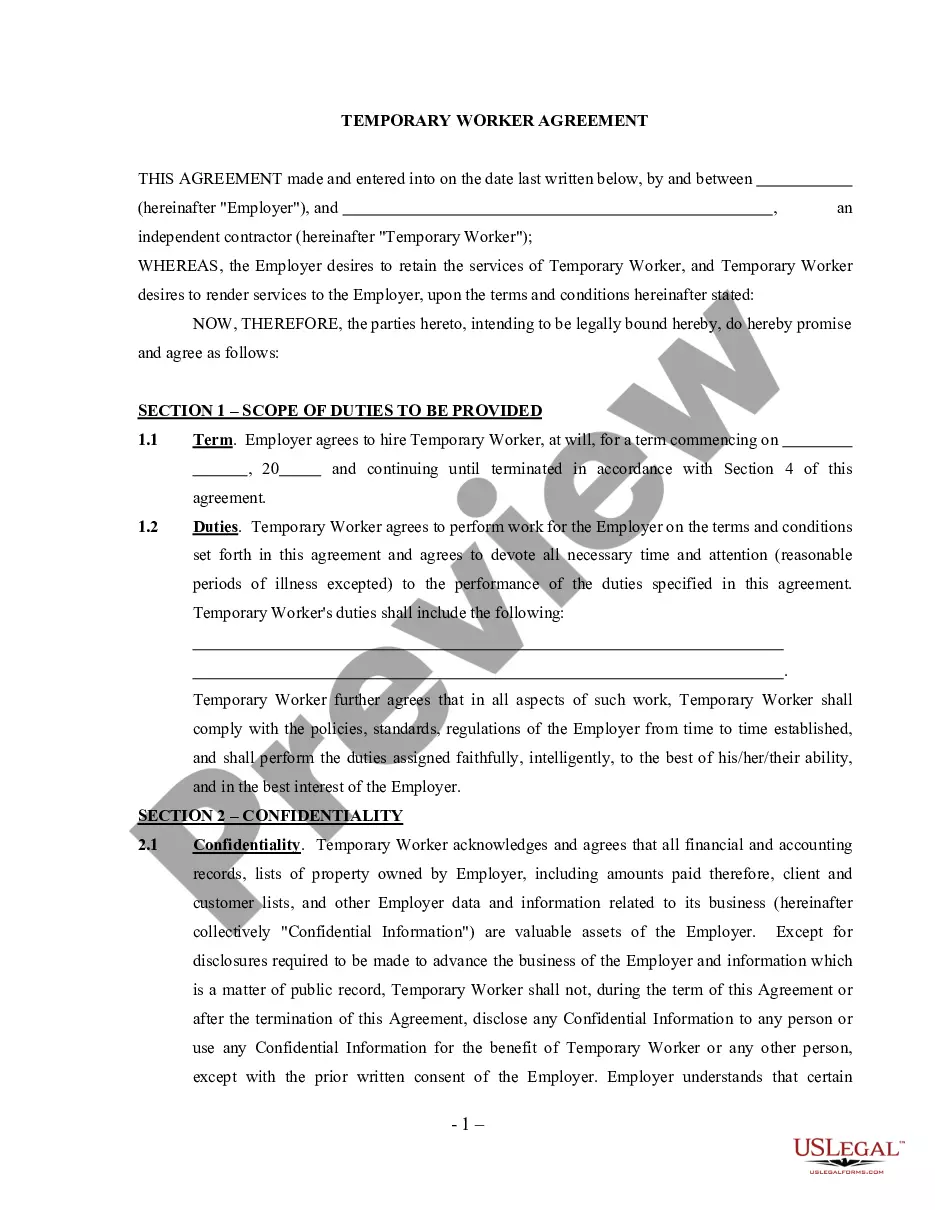
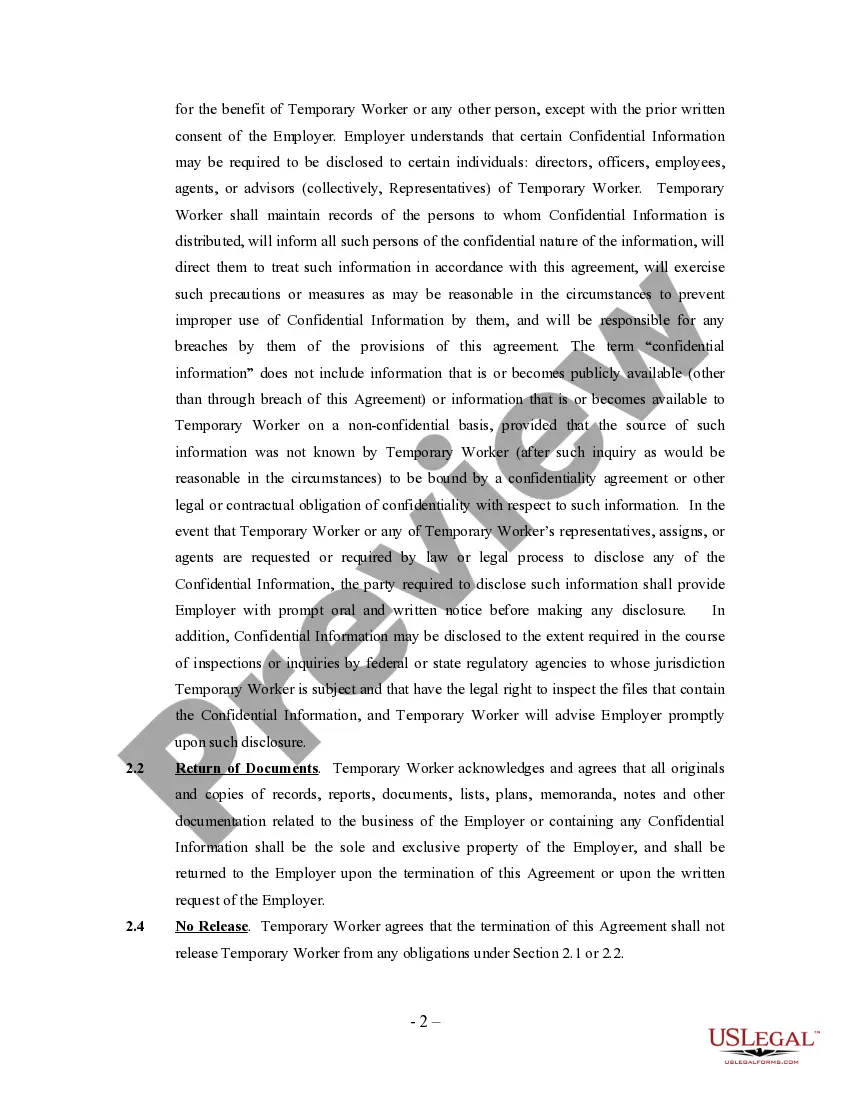
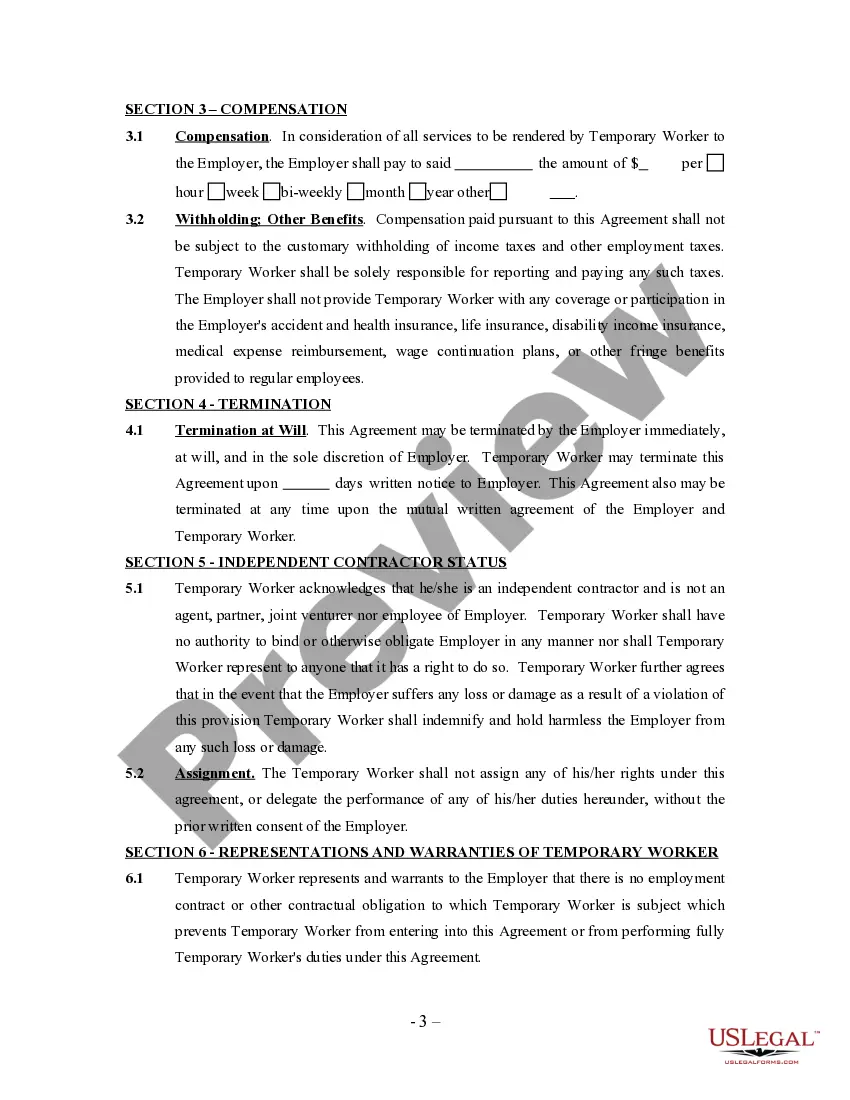
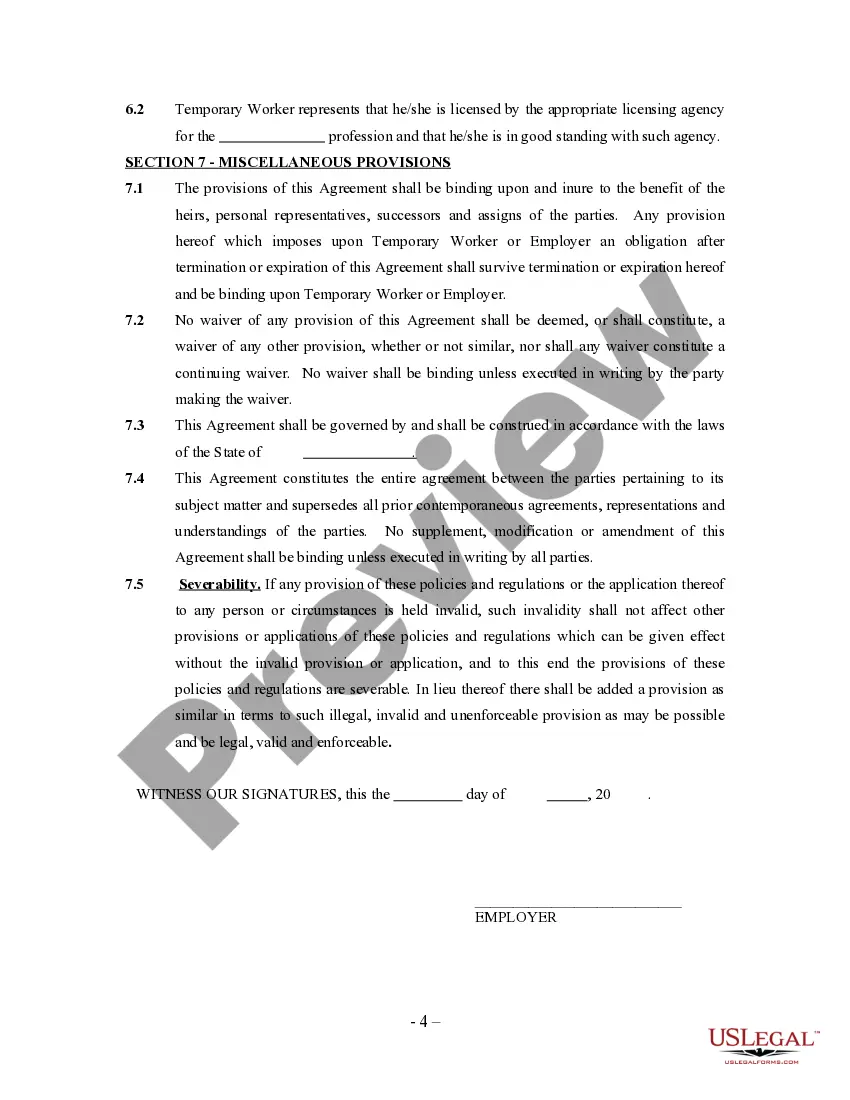
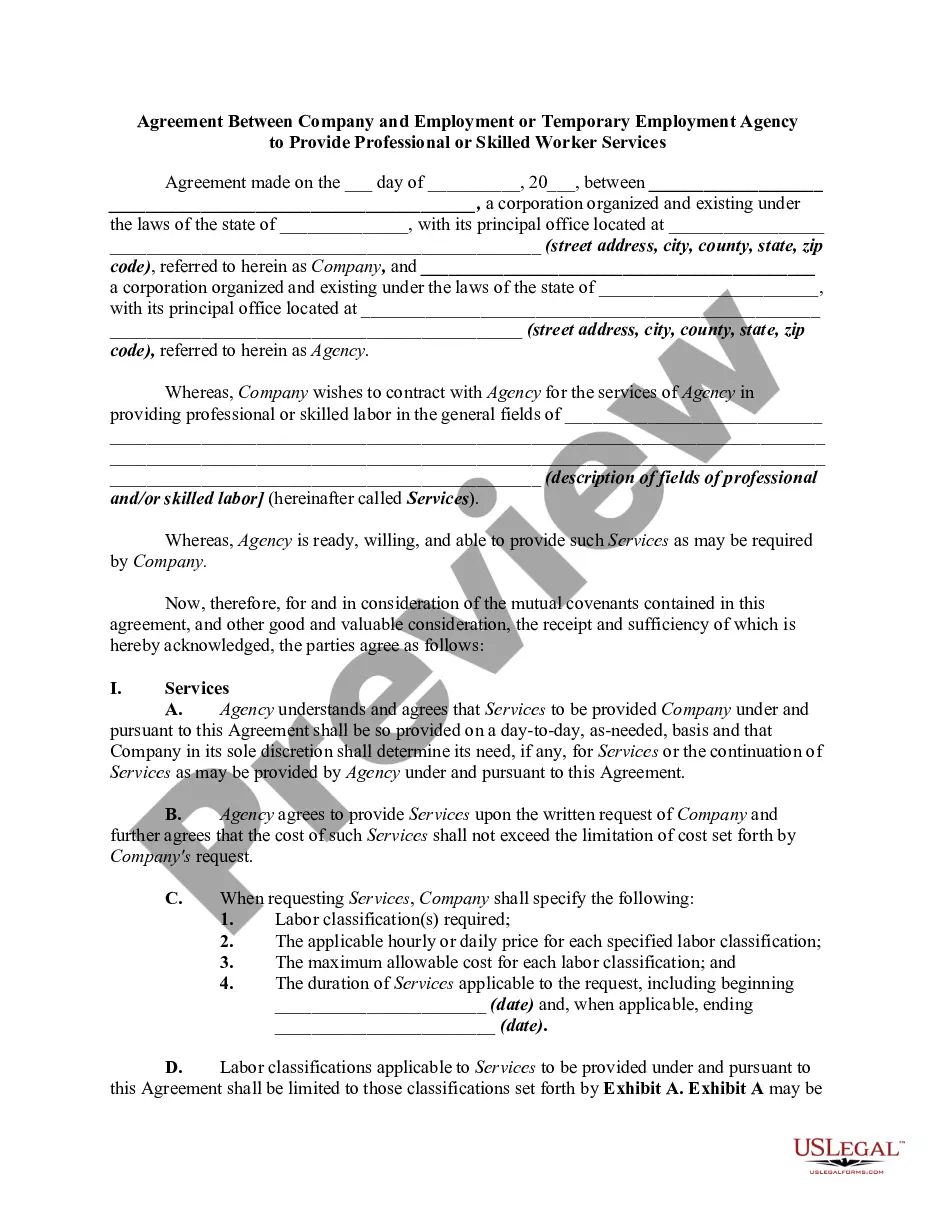
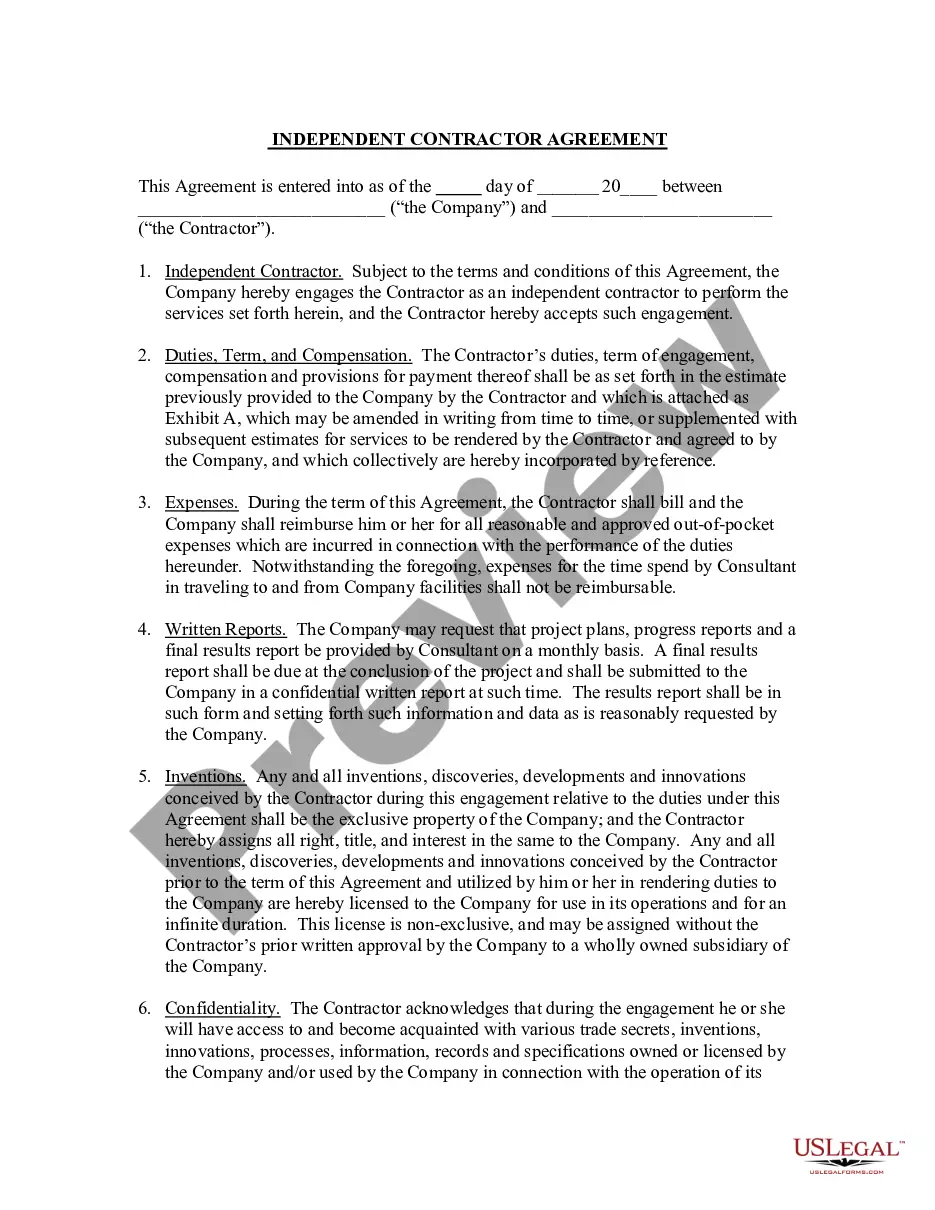
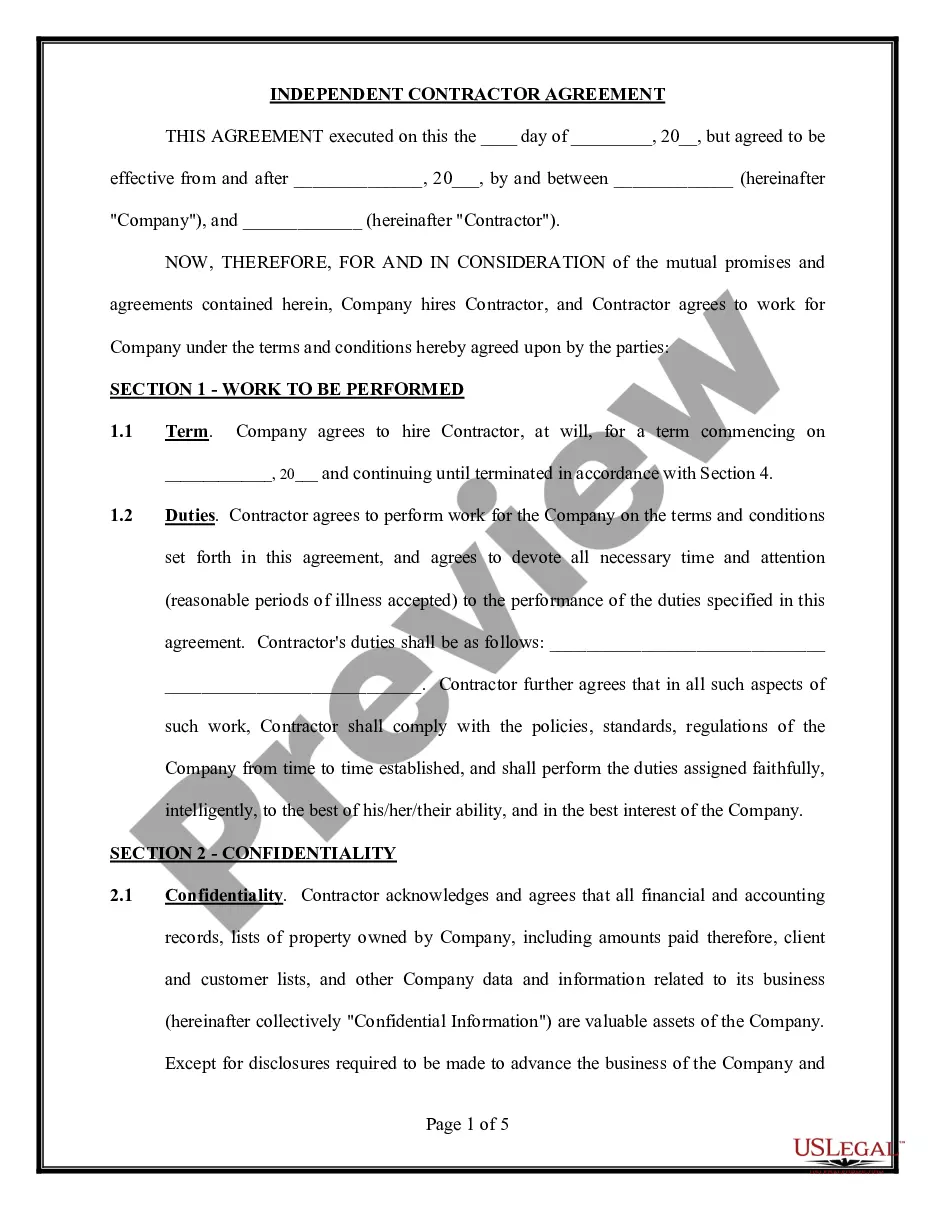
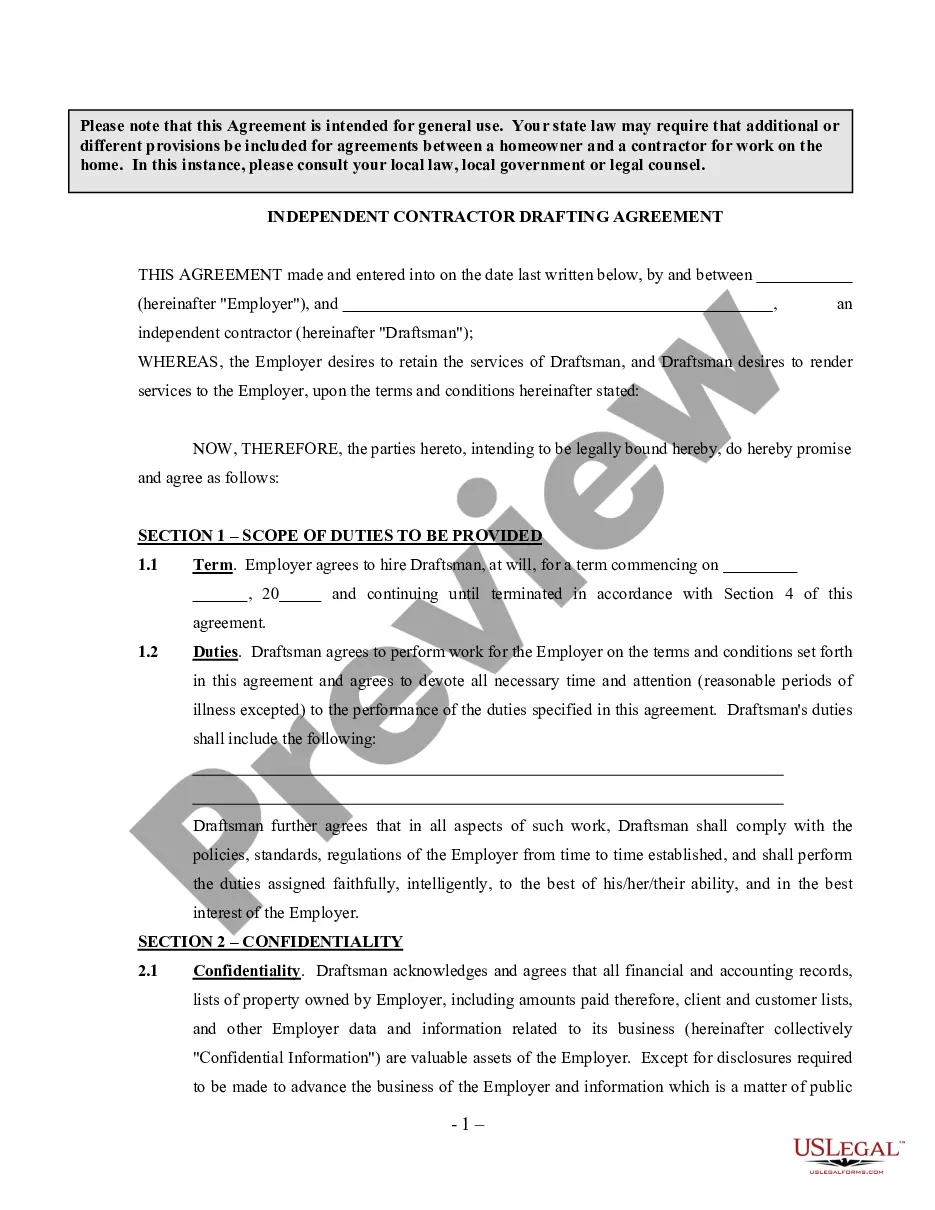
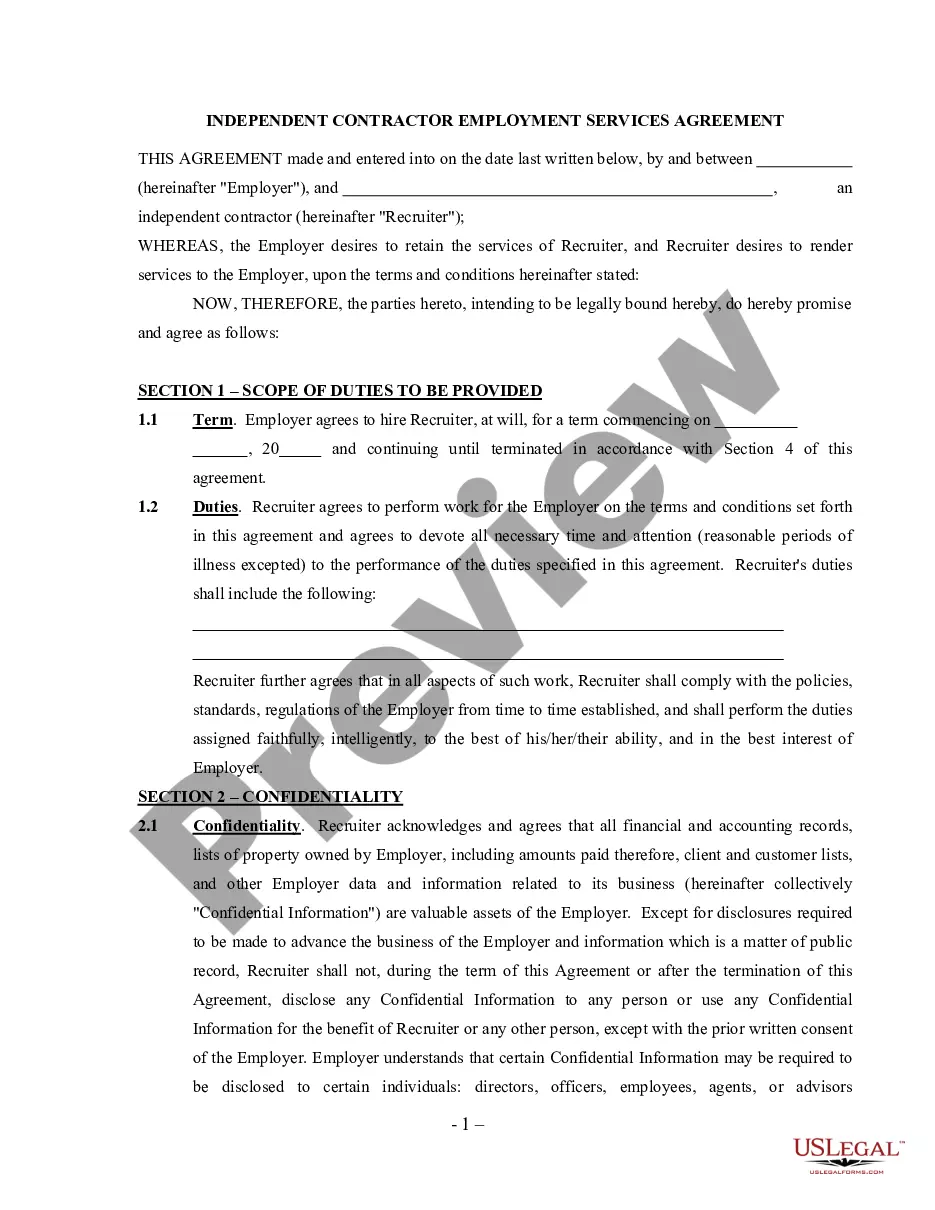
Employer hires a temporary worker or temporary staff as an independent contractor to provide services for Employer as specified in the Agreement. Confidentiality clause included.
Connecticut Temporary Worker Agreement - Self-Employed Independent Contractor
State:
Multi-State
Control #:
US-INDC-187
Format:
Word;
Rich Text
Instant download
Description
Free preview

Get your form ready online
Our built-in tools help you complete, sign, share, and store your documents in one place.
Built-in online Word editor
Make edits, fill in missing information, and update formatting in US Legal Forms—just like you would in MS Word.
Export easily
Download a copy, print it, send it by email, or mail it via USPS—whatever works best for your next step.
E-sign your document
Sign and collect signatures with our SignNow integration. Send to multiple recipients, set reminders, and more. Go Premium to unlock E-Sign.
Notarize online 24/7
If this form requires notarization, complete it online through a secure video call—no need to meet a notary in person or wait for an appointment.
Store your document securely
We protect your documents and personal data by following strict security and privacy standards.

Make edits, fill in missing information, and update formatting in US Legal Forms—just like you would in MS Word.

Download a copy, print it, send it by email, or mail it via USPS—whatever works best for your next step.

Sign and collect signatures with our SignNow integration. Send to multiple recipients, set reminders, and more. Go Premium to unlock E-Sign.

If this form requires notarization, complete it online through a secure video call—no need to meet a notary in person or wait for an appointment.

We protect your documents and personal data by following strict security and privacy standards.
Looking for another form?
How to fill out Temporary Worker Agreement - Self-Employed Independent Contractor?
Are you in the situation where you frequently require documents for either business or particular purposes? There are numerous approved form templates accessible online, but obtaining ones you can trust isn't simple. US Legal Forms offers thousands of template forms, such as the Connecticut Temporary Worker Agreement - Self-Employed Independent Contractor, which are designed to comply with state and federal regulations.
If you are already aware of the US Legal Forms website and possess an account, simply Log In. Afterward, you will be able to download the Connecticut Temporary Worker Agreement - Self-Employed Independent Contractor template.
If you do not have an account and wish to start using US Legal Forms, follow these steps: Get the form you need and ensure it is for the correct city/region. Use the Review button to examine the form. Check the description to confirm you have selected the right form. If the form isn’t what you’re searching for, utilize the Search field to find the form that meets your needs and criteria. If you locate the appropriate form, click on Buy now. Choose the pricing plan you prefer, provide the necessary information to create your account, and pay for the order using your PayPal or credit card. Select a convenient file format and download your copy. You can find all the form templates you have purchased in the My documents section. You can obtain an additional copy of the Connecticut Temporary Worker Agreement - Self-Employed Independent Contractor at any time, if necessary. Just select the required form to download or print the document template.
- Utilize US Legal Forms, the most comprehensive collection of legal forms, to save time and avoid errors.
- The service provides professionally crafted legal document templates that you can use for various purposes.
- Create an account on US Legal Forms and start making your life simpler.
Form popularity
FAQ
As a 1099 contractor, you can show proof of income by presenting your 1099 forms, receipts, and bank statements reflecting payments from your clients. Keeping detailed records throughout the year streamlines this process. The Connecticut Temporary Worker Agreement - Self-Employed Independent Contractor may also be useful, as it outlines your terms and payment agreements. Always store these documents securely for future reference or verification.
To provide proof of employment as an independent contractor, compile your invoices, contracts, and any communication with clients. These documents illustrate your scope of work and payments received. A Connecticut Temporary Worker Agreement - Self-Employed Independent Contractor can serve as a foundational document to reinforce your status. Keeping organized records will boost your professional image.
In general, independent contractors do not need a work permit if they are self-employed and working within their own state. However, some specific industries or client requirements may call for a permit. Always check local regulations to ensure compliance while operating under a Connecticut Temporary Worker Agreement - Self-Employed Independent Contractor. It's essential to stay informed to avoid any legal issues.
An independent contractor can show proof of employment through various methods. Common documents include contracts, invoices, and client correspondence that outline the nature of the work performed. Utilizing a Connecticut Temporary Worker Agreement - Self-Employed Independent Contractor can further validate your status. Remember, clear and organized records enhance credibility with future clients.
Often Independent Contractors are completely unaware that they are not Employees as defined in South African labour legislation and therefore unprotected by labour legislation.
The Labour Relations Act applies to all employers, workers, trade unions and employers' organisations.
The IRS says that someone is self-employed if they meet one of these conditions:Someone who carries on a trade or business as a sole proprietor or independent contractor,A member of a partnership that carries on a trade or business, or.Someone who is otherwise in business for themselves, including part-time business.
If you are an independent contractor, then you are self-employed. The earnings of a person who is working as an independent contractor are subject to self-employment tax. To find out what your tax obligations are, visit the Self-Employed Individuals Tax Center.
Becoming an independent contractor is one of the many ways to be classified as self-employed. By definition, an independent contractor provides work or services on a contractual basis, whereas, self-employment is simply the act of earning money without operating within an employee-employer relationship.
The other contract (Independent contractor) is a Contract for Service, and is usually a contract where the contractor undertakes to perform a specific service or task, and upon completion of the agreed service or task, or upon production of the result agreed upon, the contractor will be paid.