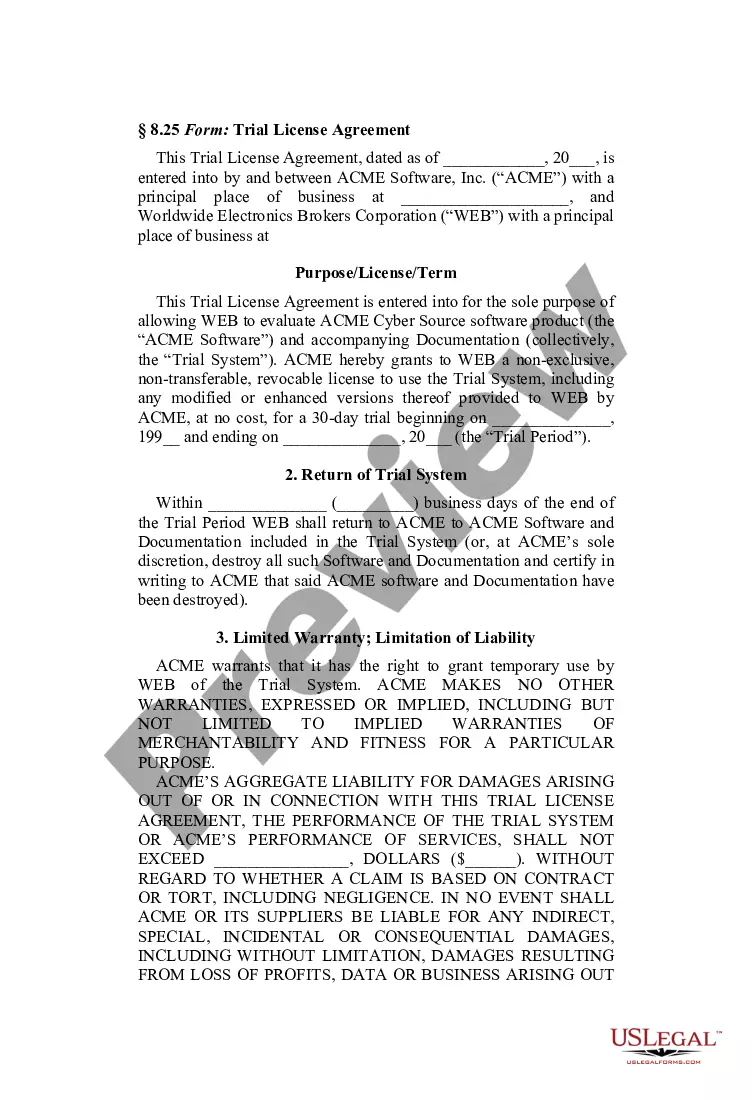
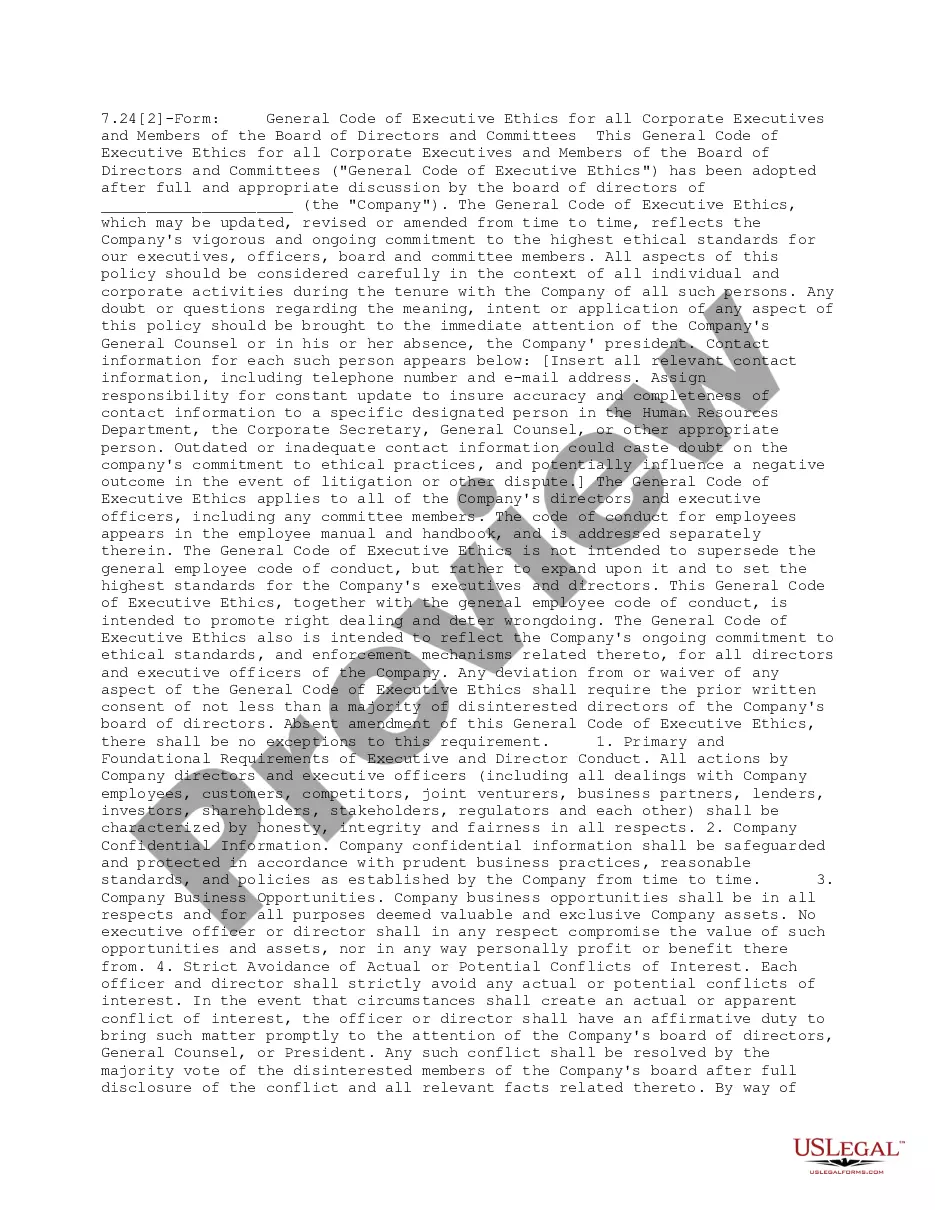
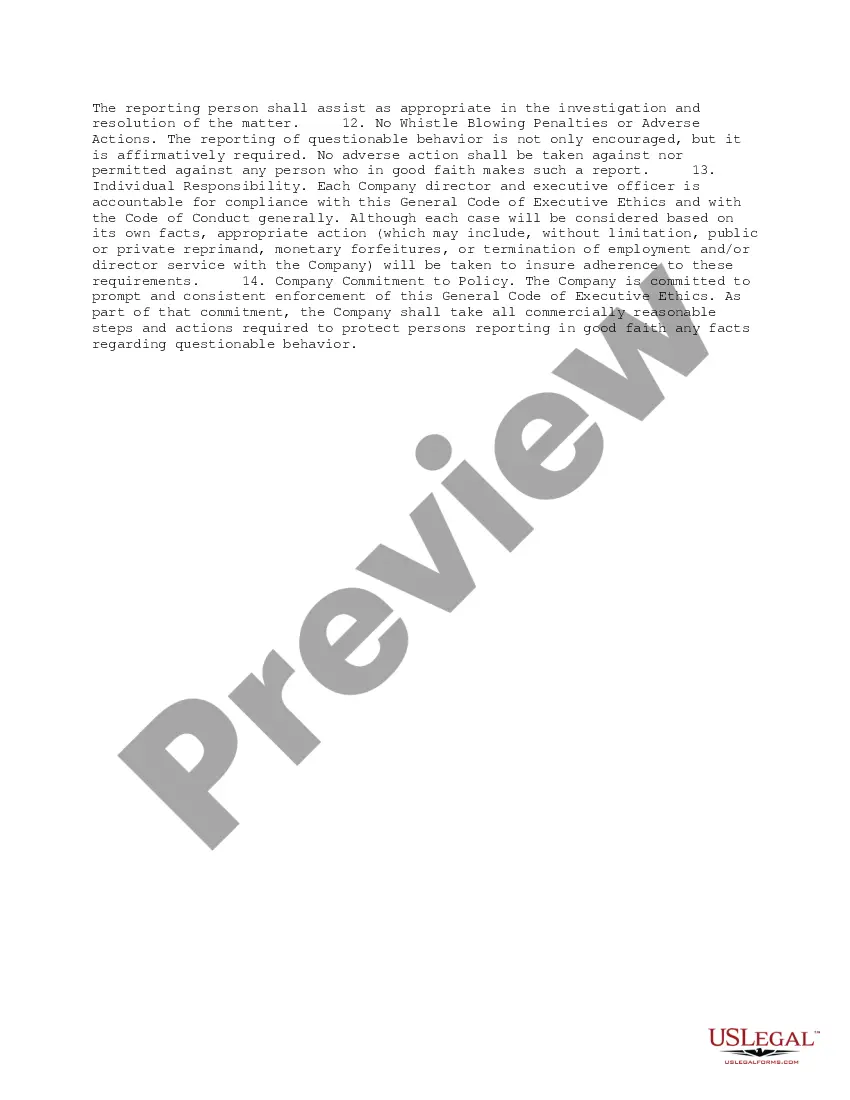
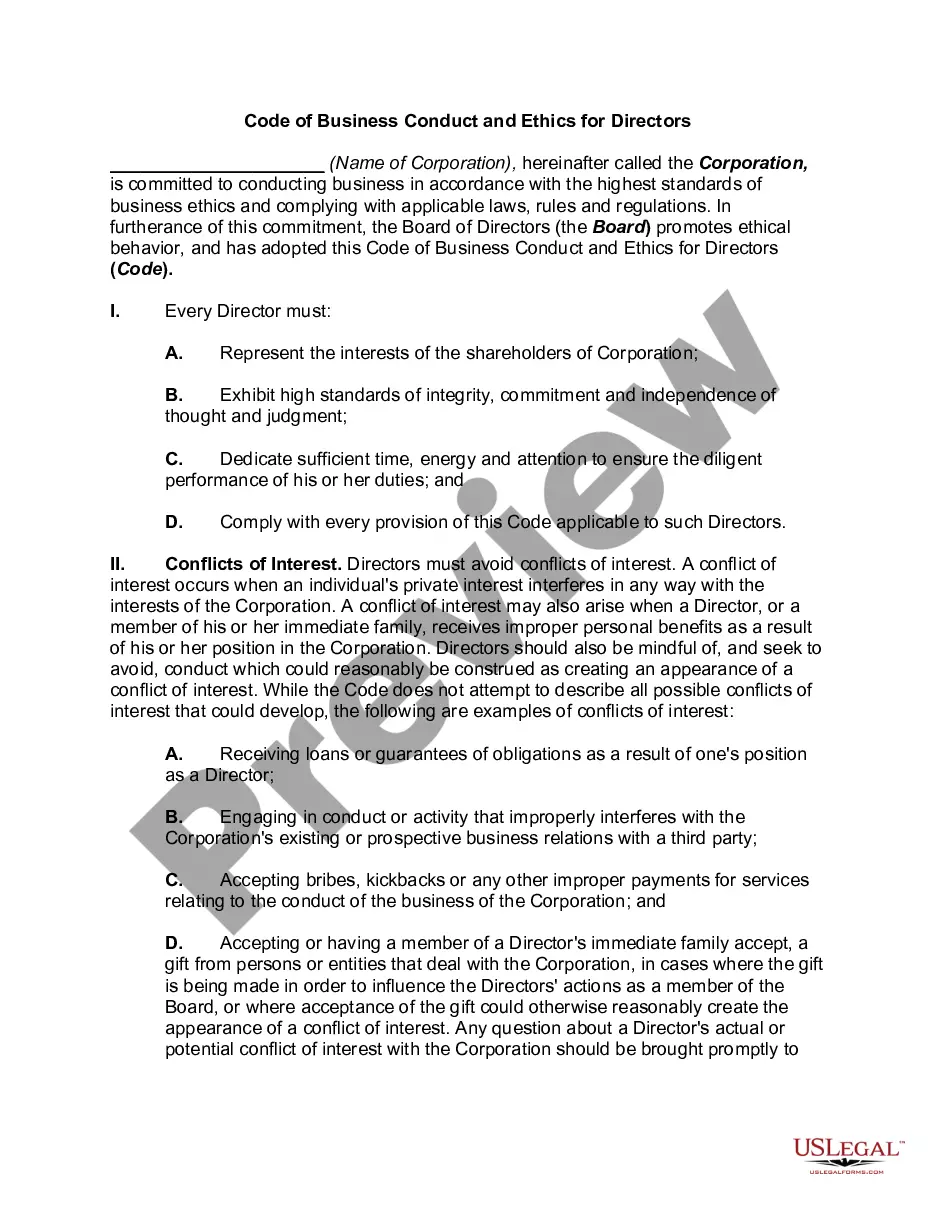
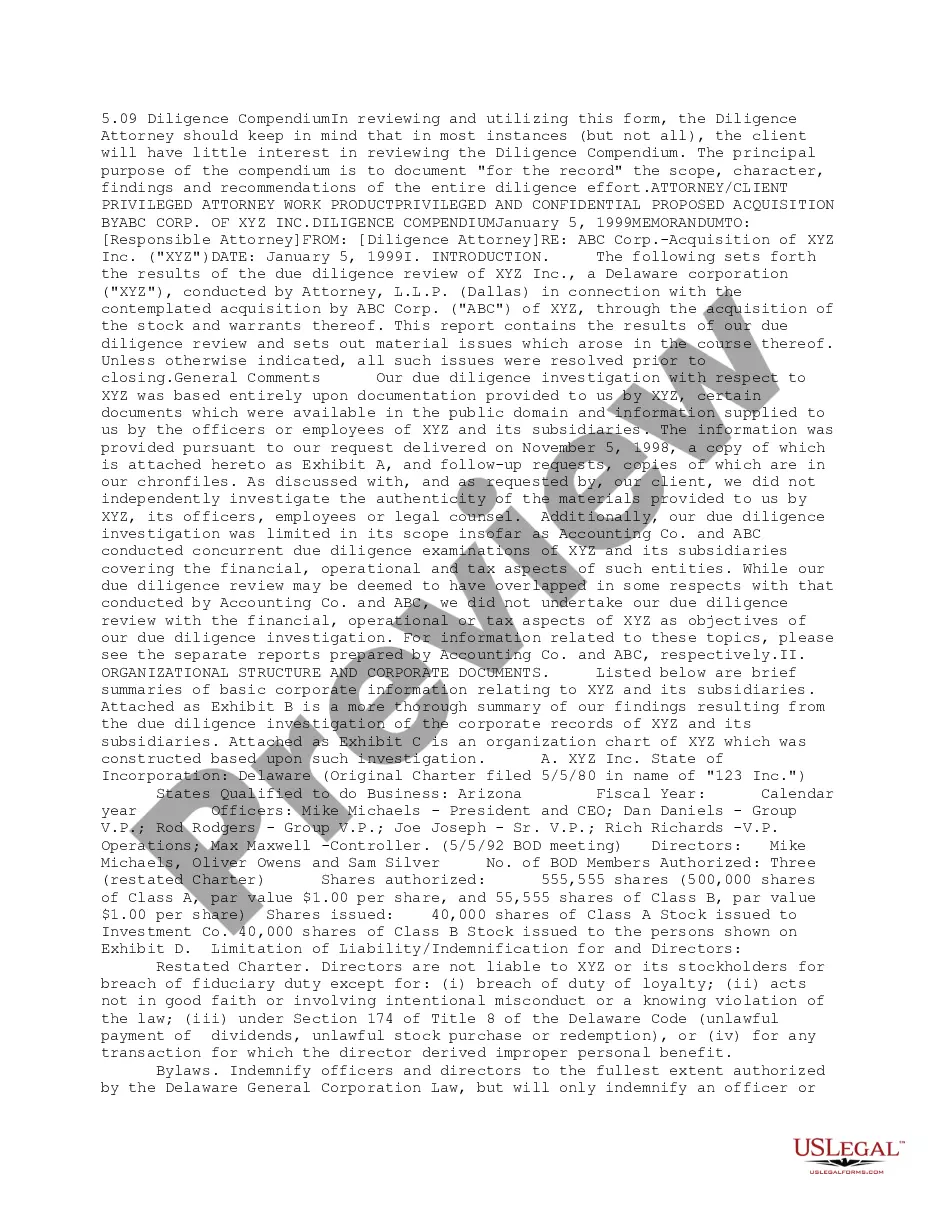
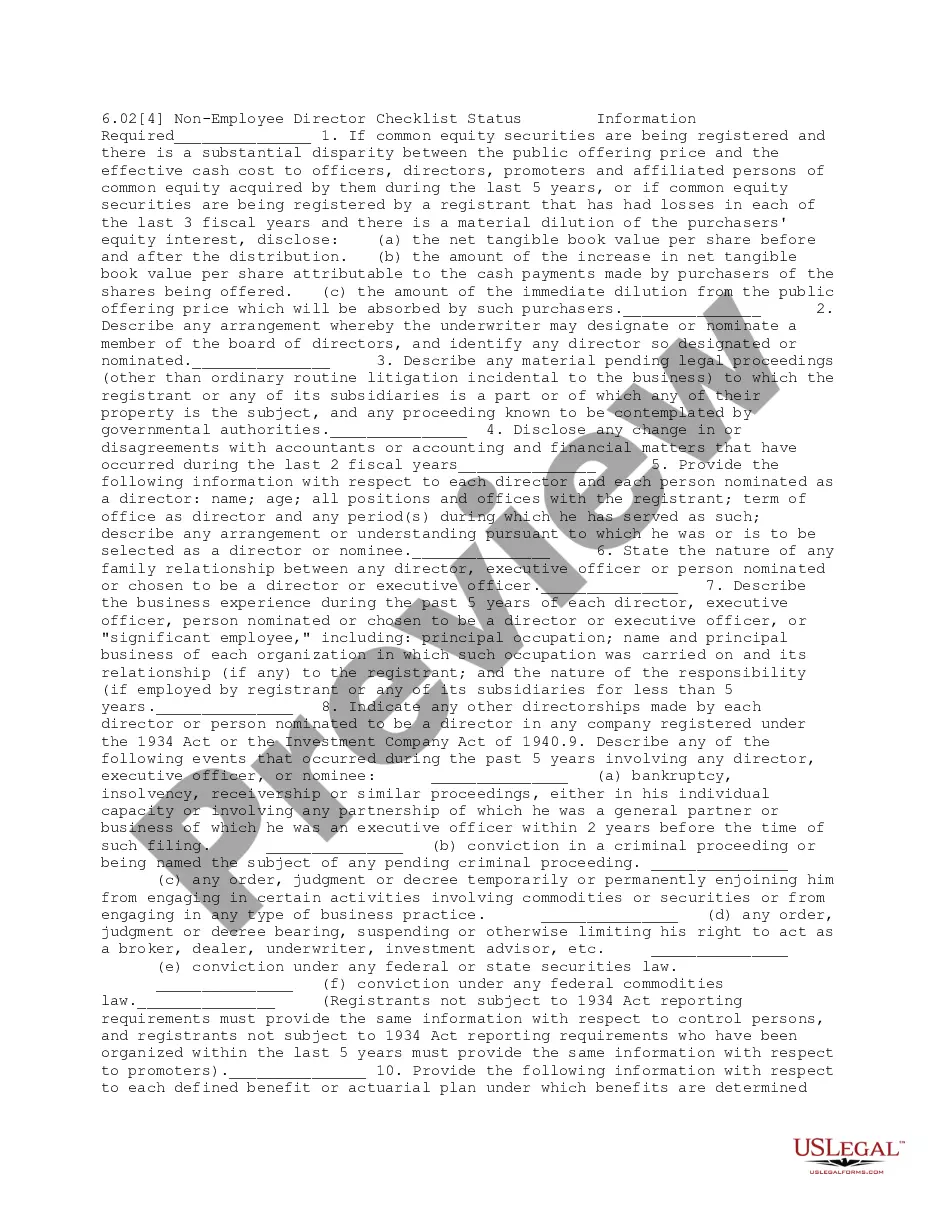
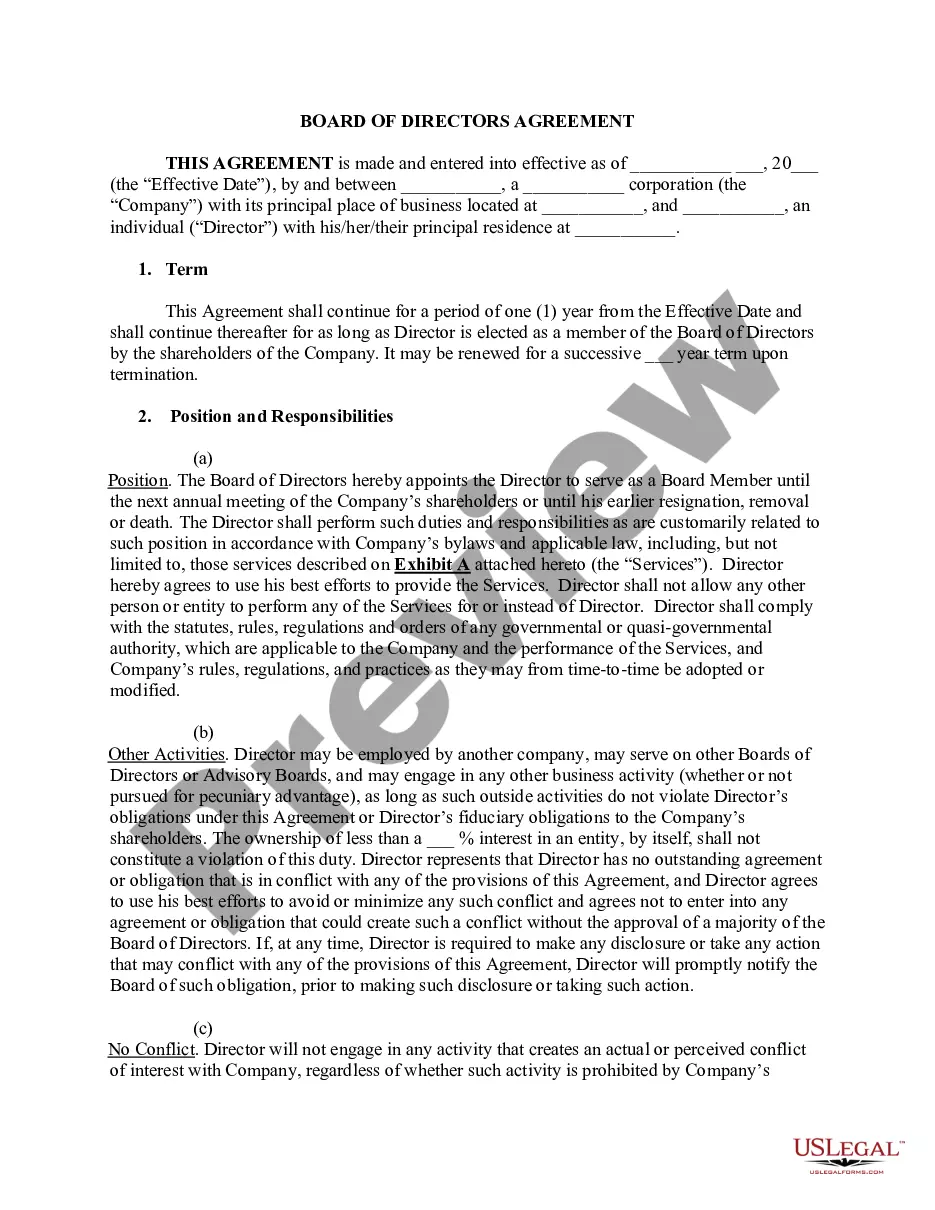
This due diligence form describes the General Code of Executive Ethics for all Corporate Executives and Members of the Board of Directors and Committees that has been adopted by the board of directors of a company. It reflects the company's vigorous and ongoing commitment to the highest ethical standards for its executives, officers, and board and committee members.
Connecticut General Code of Executive Ethics for all Corporate Executives and Members of the Board of Directors and Committees
Category:
State:
Multi-State
Control #:
US-DD07242
Format:
Word;
PDF;
Rich Text
Instant download
Description
Free preview

Get your form ready online
Our built-in tools help you complete, sign, share, and store your documents in one place.
Built-in online Word editor
Make edits, fill in missing information, and update formatting in US Legal Forms—just like you would in MS Word.
Export easily
Download a copy, print it, send it by email, or mail it via USPS—whatever works best for your next step.
E-sign your document
Sign and collect signatures with our SignNow integration. Send to multiple recipients, set reminders, and more. Go Premium to unlock E-Sign.
Notarize online 24/7
If this form requires notarization, complete it online through a secure video call—no need to meet a notary in person or wait for an appointment.
Store your document securely
We protect your documents and personal data by following strict security and privacy standards.

Make edits, fill in missing information, and update formatting in US Legal Forms—just like you would in MS Word.

Download a copy, print it, send it by email, or mail it via USPS—whatever works best for your next step.

Sign and collect signatures with our SignNow integration. Send to multiple recipients, set reminders, and more. Go Premium to unlock E-Sign.

If this form requires notarization, complete it online through a secure video call—no need to meet a notary in person or wait for an appointment.

We protect your documents and personal data by following strict security and privacy standards.
Looking for another form?



How to fill out General Code Of Executive Ethics For All Corporate Executives And Members Of The Board Of Directors And Committees?
If you wish to finalize, download, or print lawful document templates, utilize US Legal Forms, the largest collection of legal forms available online.
Take advantage of the site’s simple and user-friendly search to locate the documents you require.
Numerous templates for business and personal uses are organized by categories and states, or by keywords.
Step 4. Once you have found the form you need, click the Get now button. Select the pricing plan you prefer and provide your information to create an account.
Step 5. Complete the transaction. You can use your Visa or MasterCard or PayPal account to finalize the purchase.
- Utilize US Legal Forms to discover the Connecticut General Code of Executive Ethics for all Corporate Executives and Members of the Board of Directors and Committees with just a few clicks.
- If you are already a US Legal Forms customer, Log In to your account and click the Acquire button to locate the Connecticut General Code of Executive Ethics for all Corporate Executives and Members of the Board of Directors and Committees.
- You can also access forms you previously obtained in the My documents section of your account.
- If you are using US Legal Forms for the first time, follow the instructions below.
- Step 1. Make sure you have chosen the form for the correct city/state.
- Step 2. Use the Review option to examine the form’s details. Remember to read the information.
- Step 3. If you are not satisfied with the form, use the Search field at the top of the screen to find alternative versions of the legal form template.
Form popularity
FAQ
The Connecticut General Code of Executive Ethics for all Corporate Executives and Members of the Board of Directors and Committees establishes guidelines to ensure integrity and accountability within companies. This code serves as a framework for ethical decision-making and outlines expected conduct for executives and board members. By adhering to these principles, organizations can promote transparency, protect their reputation, and foster trust among stakeholders. For ongoing compliance and understanding of this code, consider utilizing USLegalForms, which offers a comprehensive platform for legal resources and documentation.
To qualify for lobbying in Connecticut, individuals must register and disclose their lobbying activities in accordance with state laws. This includes reporting on expenditures and the types of issues they will be advocating for, ensuring transparency. Familiarizing yourself with the guidelines in the Connecticut General Code of Executive Ethics for all Corporate Executives and Members of the Board of Directors and Committees can help you understand your responsibilities in this area.
In Connecticut, entering an executive session requires a majority vote from the governing body after declaring the purpose of the session. This process ensures that discussions remain ethical and justifiable under the Connecticut General Code of Executive Ethics for all Corporate Executives and Members of the Board of Directors and Committees. Remember, the issues discussed must be strictly limited to those set forth at the time of the vote.
Rules for an executive session generally require that the topic discussed is confidential, and all participants should respect this confidentiality. The governing body must announce the reason for entering an executive session before proceeding. These guidelines align with the Connecticut General Code of Executive Ethics for all Corporate Executives and Members of the Board of Directors and Committees, promoting ethical conduct in private discussions.
According to Robert's Rules of Order, an executive session is a part of a meeting that is closed to the public. The primary purpose is to discuss sensitive issues confidentially, such as legal matters or personnel decisions. Members must follow established protocols to enter into this session, in line with the Connecticut General Code of Executive Ethics for all Corporate Executives and Members of the Board of Directors and Committees.
In Connecticut, the rules for executive sessions are outlined in the Connecticut General Code of Executive Ethics for all Corporate Executives and Members of the Board of Directors and Committees. These sessions must be held to discuss specific matters, such as personnel issues or legal strategies, that are not suitable for public discussion. Furthermore, a vote is required to enter into an executive session, ensuring transparency and accountability.
The ethical standards of the board of directors focus on ensuring that all actions reflect the best interests of the organization and its stakeholders. These standards include commitments to confidentiality, impartiality, and adherence to policies that govern corporate behavior. The Connecticut General Code of Executive Ethics for all Corporate Executives and Members of the Board of Directors and Committees emphasizes these principles, aiming to enhance corporate governance across organizations.
Section 1-101qq of the Connecticut General Statutes is part of the state's broader ethics laws that govern the conduct of public officials and state employees. It establishes regulations to prevent conflicts of interest and ensures that public officers act with integrity. Understanding Section 1-101qq within the context of the Connecticut General Code of Executive Ethics for all Corporate Executives and Members of the Board of Directors and Committees is essential for maintaining ethical standards in governance.
The code of conduct for executives defines the professional standards and ethical behavior expected from senior management. It encompasses aspects such as transparency, respect for employees, and commitment to ethical practices in decision-making. Following the Connecticut General Code of Executive Ethics for all Corporate Executives and Members of the Board of Directors and Committees helps executives navigate complex ethical dilemmas while reinforcing corporate governance principles.
The code of ethics for corporate governance serves as a guiding framework that outlines the principles and values expected of board members and executives. It emphasizes honesty, accountability, and compliance with laws and regulations while promoting ethical leadership. The Connecticut General Code of Executive Ethics for all Corporate Executives and Members of the Board of Directors and Committees supports these goals, helping organizations operate with transparency and respect.