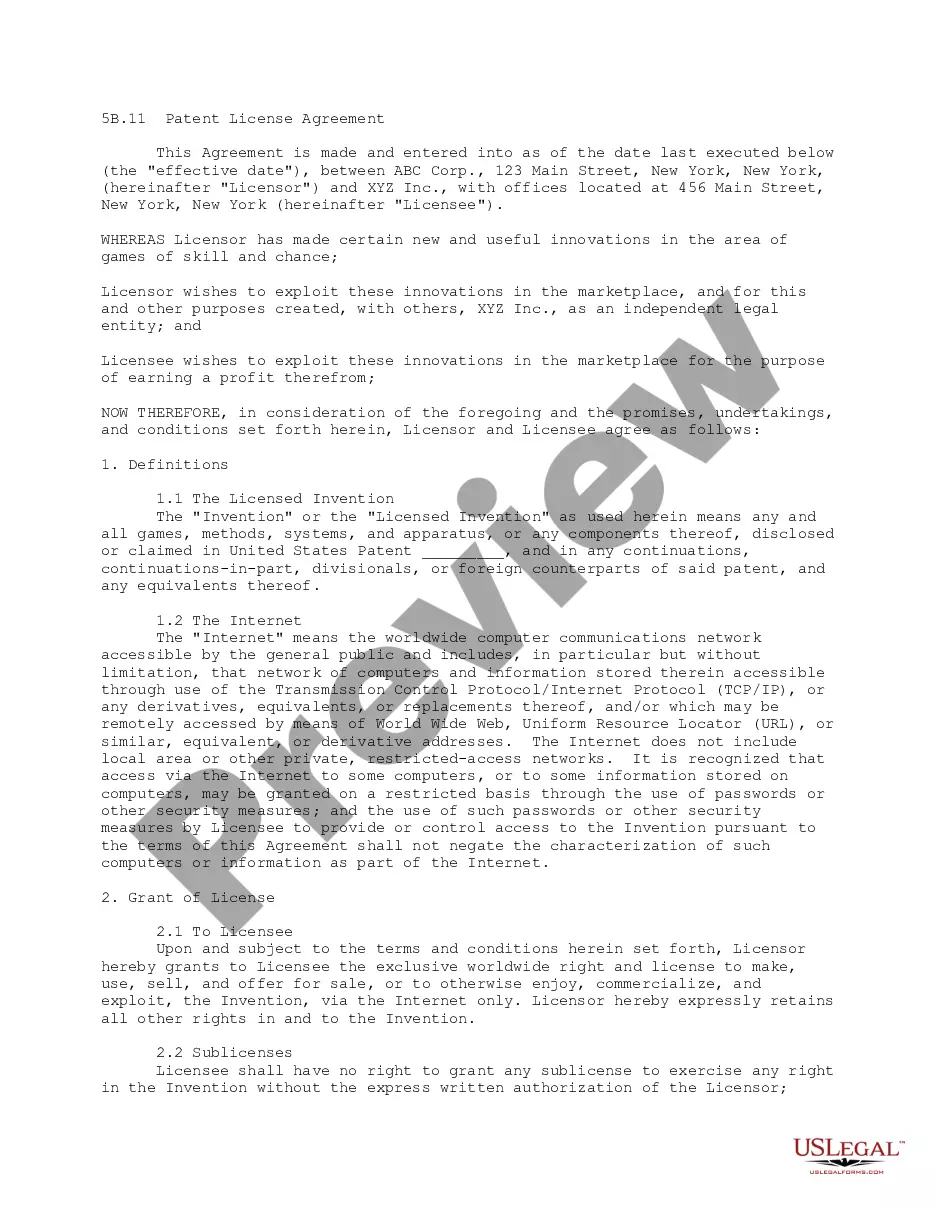
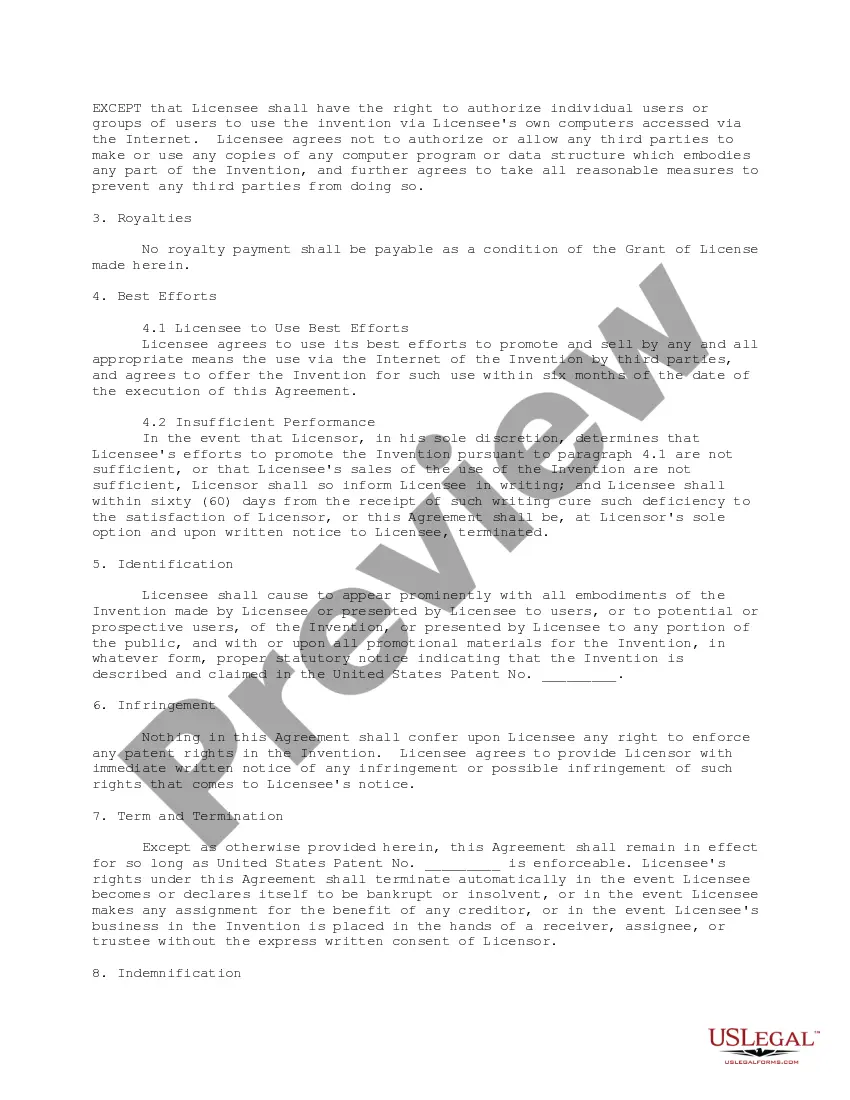
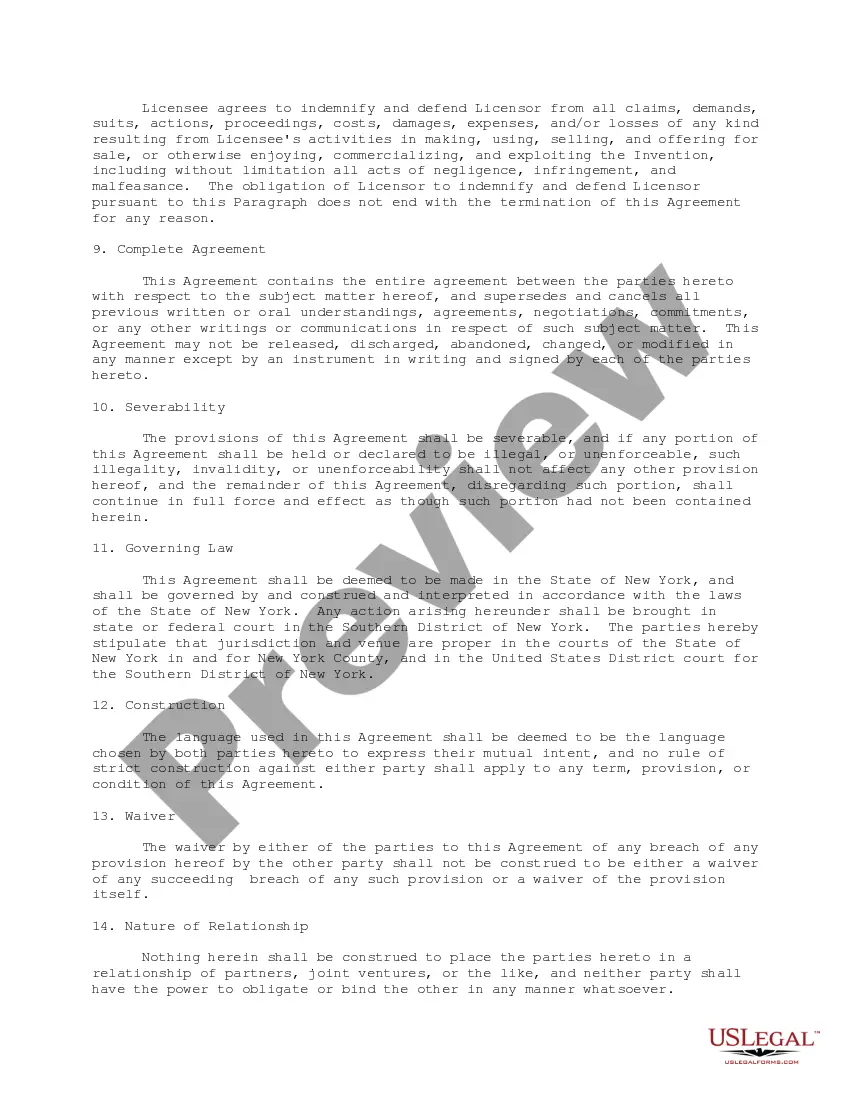
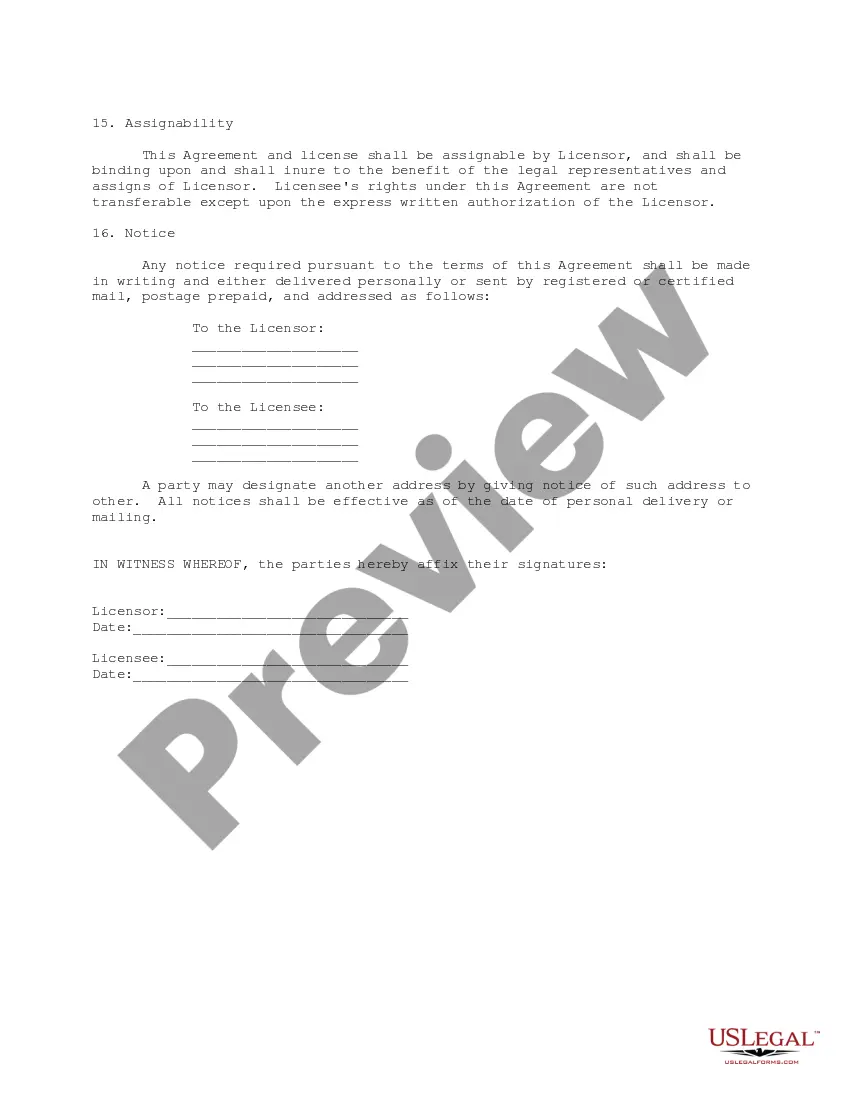
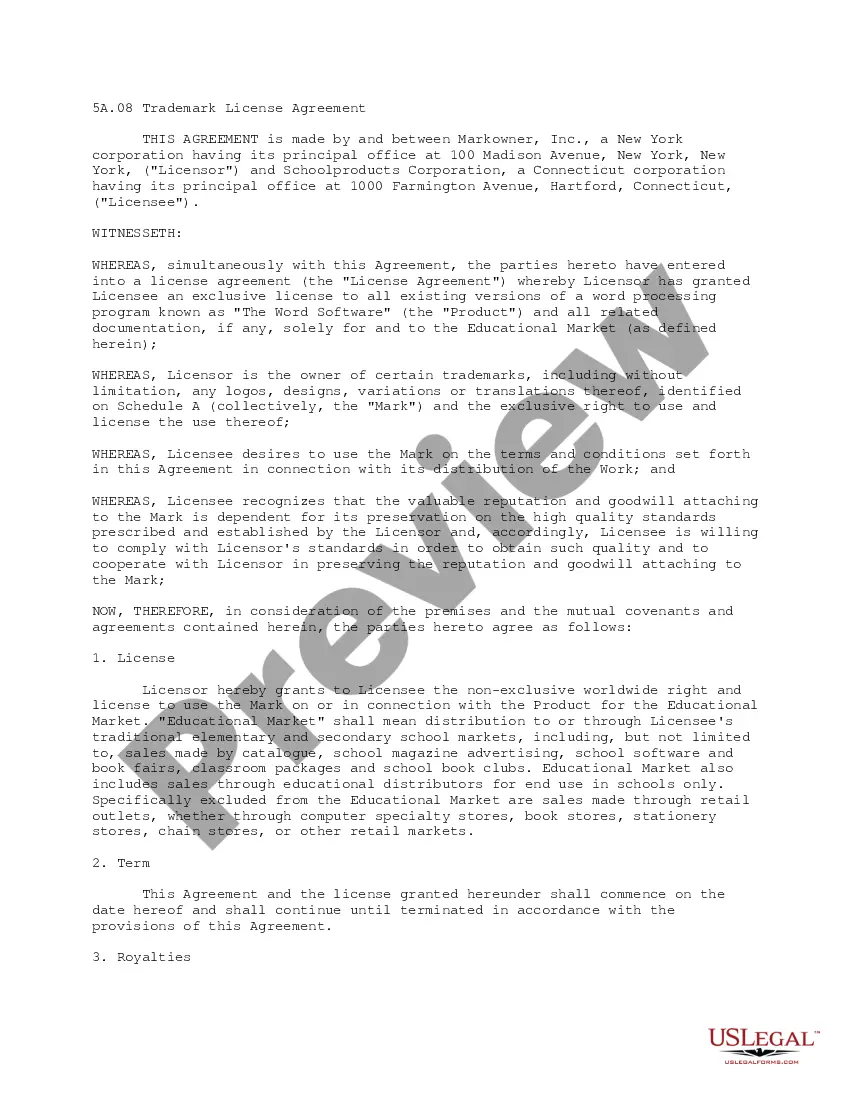
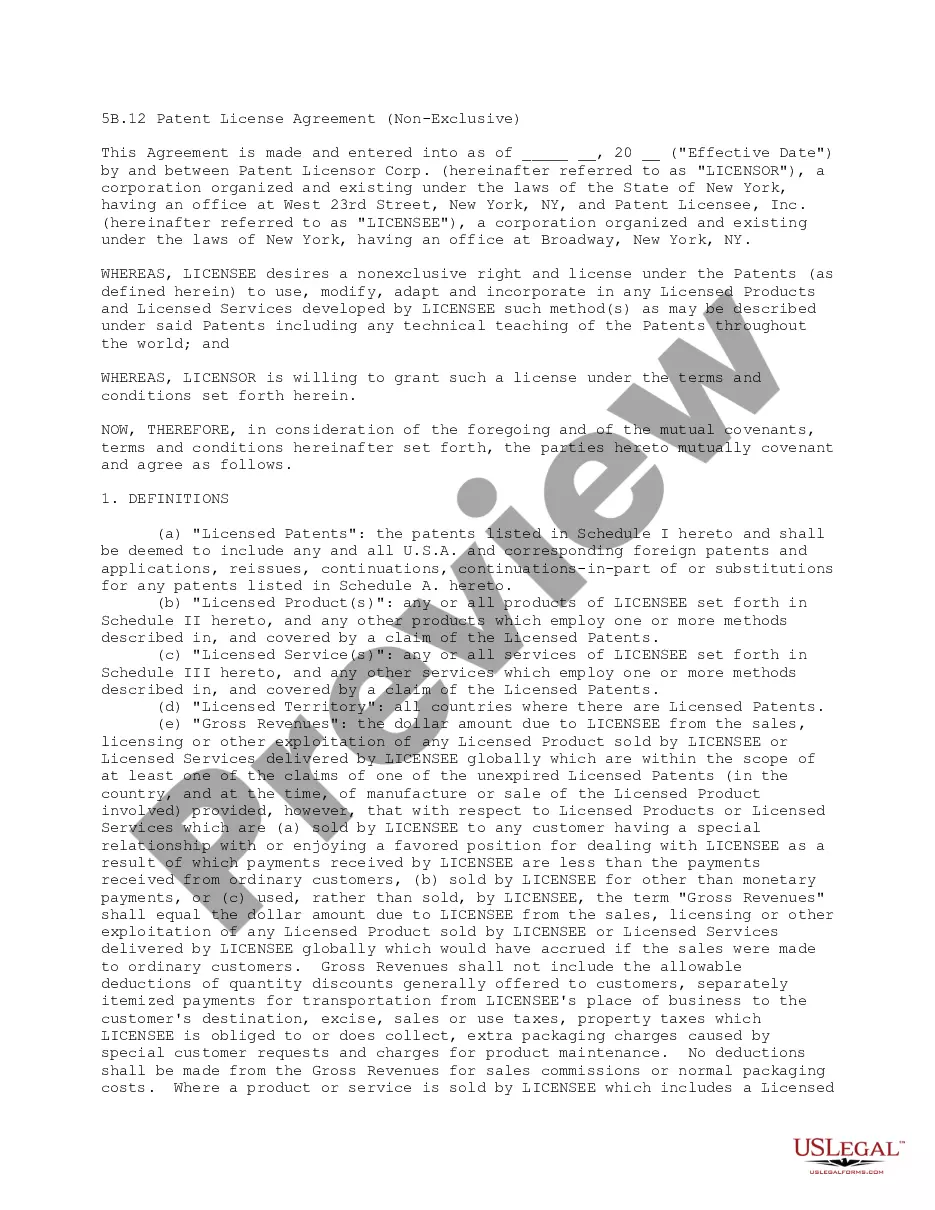
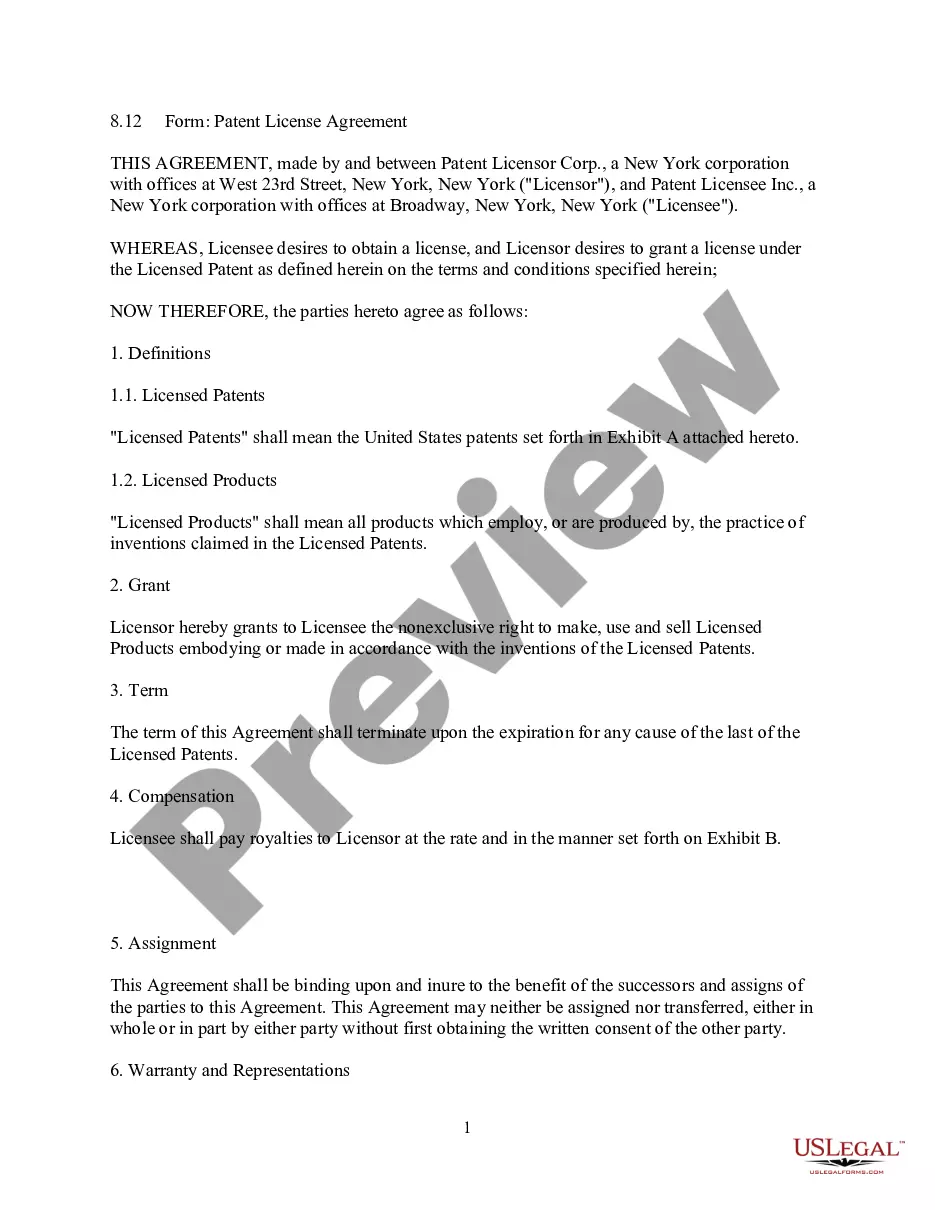
This agreement is used when a Licensor has made certain new and useful innovations. The agreement gives the Licensee a license to exploit these new and useful innovations in the marketplace and make a profit from them.
Connecticut Patent License Agreement
State:
Multi-State
Control #:
US-CP5B11
Format:
Word;
PDF;
Rich Text
Instant download
Description
Free preview
Get your form ready online
Our built-in tools help you complete, sign, share, and store your documents in one place.
Built-in online Word editor
Make edits, fill in missing information, and update formatting in US Legal Forms—just like you would in MS Word.
Export easily
Download a copy, print it, send it by email, or mail it via USPS—whatever works best for your next step.
E-sign your document
Sign and collect signatures with our SignNow integration. Send to multiple recipients, set reminders, and more. Go Premium to unlock E-Sign.
Notarize online 24/7
If this form requires notarization, complete it online through a secure video call—no need to meet a notary in person or wait for an appointment.
Store your document securely
We protect your documents and personal data by following strict security and privacy standards.

Make edits, fill in missing information, and update formatting in US Legal Forms—just like you would in MS Word.

Download a copy, print it, send it by email, or mail it via USPS—whatever works best for your next step.

Sign and collect signatures with our SignNow integration. Send to multiple recipients, set reminders, and more. Go Premium to unlock E-Sign.

If this form requires notarization, complete it online through a secure video call—no need to meet a notary in person or wait for an appointment.

We protect your documents and personal data by following strict security and privacy standards.
Looking for another form?

How to fill out Patent License Agreement?
If you aim to compile, obtain, or generate legal document templates, utilize US Legal Forms, the most comprehensive selection of legal forms accessible online.
Employ the site's simple and efficient search function to find the documents you require.
Various templates for business and personal use are organized by categories and states or keywords.
Step 5. Complete the transaction. You can use your credit card or PayPal account to finalize the purchase.
Step 6. Select the format of the legal document and download it to your device. Step 7. Complete, edit, and print or sign the Connecticut Patent License Agreement. Every legal document template you purchase is yours forever. You will have access to every form you saved in your account. Click on the My documents section and select a form to print or download again. Stay competitive and obtain, and print the Connecticut Patent License Agreement with US Legal Forms. There are numerous professional and state-specific forms available for your business or personal needs.
- Utilize US Legal Forms to acquire the Connecticut Patent License Agreement with just a few clicks.
- If you are already a US Legal Forms user, Log In to your account and click on the Download button to get the Connecticut Patent License Agreement.
- You can also access forms you have previously stored in the My documents section of your account.
- If this is your first time using US Legal Forms, follow the steps below.
- Step 1. Ensure you have selected the form for your correct region/state.
- Step 2. Use the Preview option to review the content of the form. Be sure to examine the details.
- Step 3. If you are dissatisfied with the form, use the Search box at the top of the screen to find other versions of the legal document template.
- Step 4. Once you have identified the form you need, click on the Get Now button. Choose the pricing plan you prefer and input your information to sign up for an account.
Form popularity
FAQ
The three types of patents are utility patents, design patents, and plant patents. Utility patents are issued for inventions that are novel and useful. Design patents protect the design or image of a product. Plant patents are issued to applicants for plants that can reproduce.
Practitioners and licensing executives often refer to three basic types of voluntary licenses: non-exclusive, sole, and exclusive. A non-exclusive licence allows the licensor to retain the right to use the licensed property and the right to grant additional licenses to third parties.
The Three Elements of PatentabilityMust Have Utility. Your invention may get accepted if you can prove that it has a useful purpose, but it will likely get rejected if it's difficult to identify some type of utility.Based on a Novel Concept.Cannot Be Obvious.Conclusion.05-Mar-2019
So, if any of these three things happen1) on sale, 2) public use, or 3) printed publication one year prior to the application date, you can't apply for a patent.
There are three types of patents: utility patents, design patents, and plant patents. Each type of patent has its own eligibility requirements and protects a specific type of invention or discovery; however, it's possible for one invention or discovery to potentially have more than one type of patent available for it.
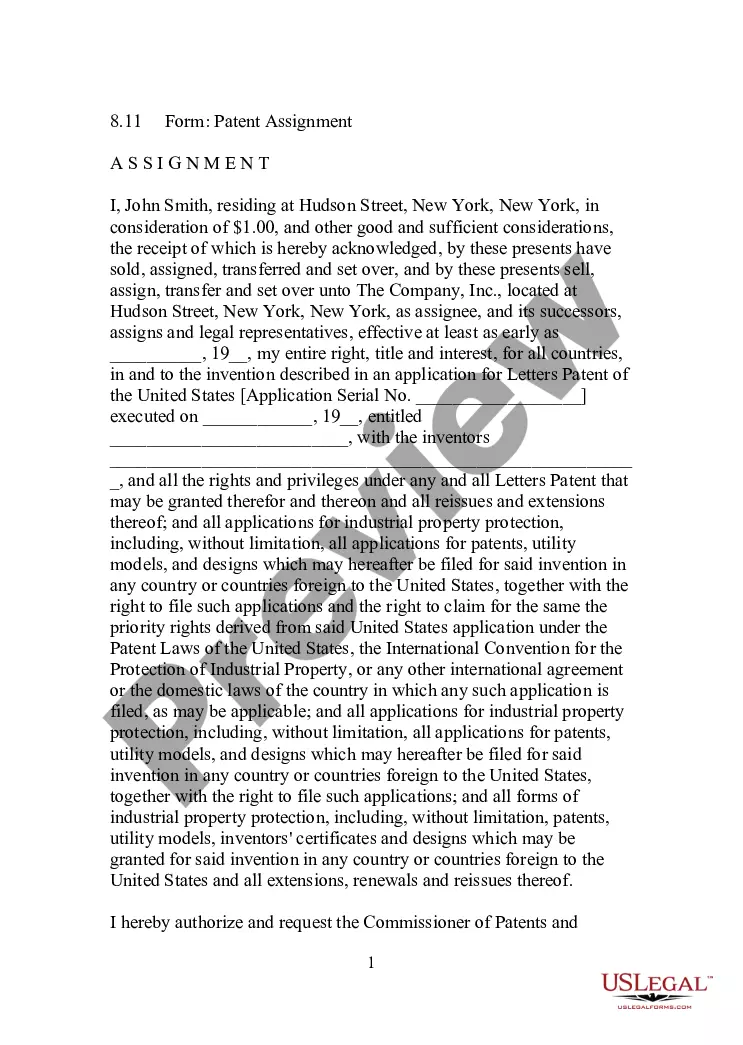
Do I Have to Put My License in Writing? Yes, any assignments of patent rights must be in writing in order to be valid.
To be patentable, the invention must be statutory, novel, useful, and nonobvious.
What kind of patent do you need?There are three types of patents - Utility, Design, and Plant.Utility Patent.Design Patent.Plant Patent.
A licensing agreement allows one party (the licensee) to use and/or earn revenue from the property of the owner (the licensor). Licensing agreements generate revenues, called royalties, earned by a company for allowing its copyrighted or patented material to be used by another company.
In short, a patent license agreement is a legal contract created to define the terms under which a licensee may create, sell, and use a patented invention from a licensor (or patent owner). This agreement also spells out how royalties will be paid to the licensor/patent owner.