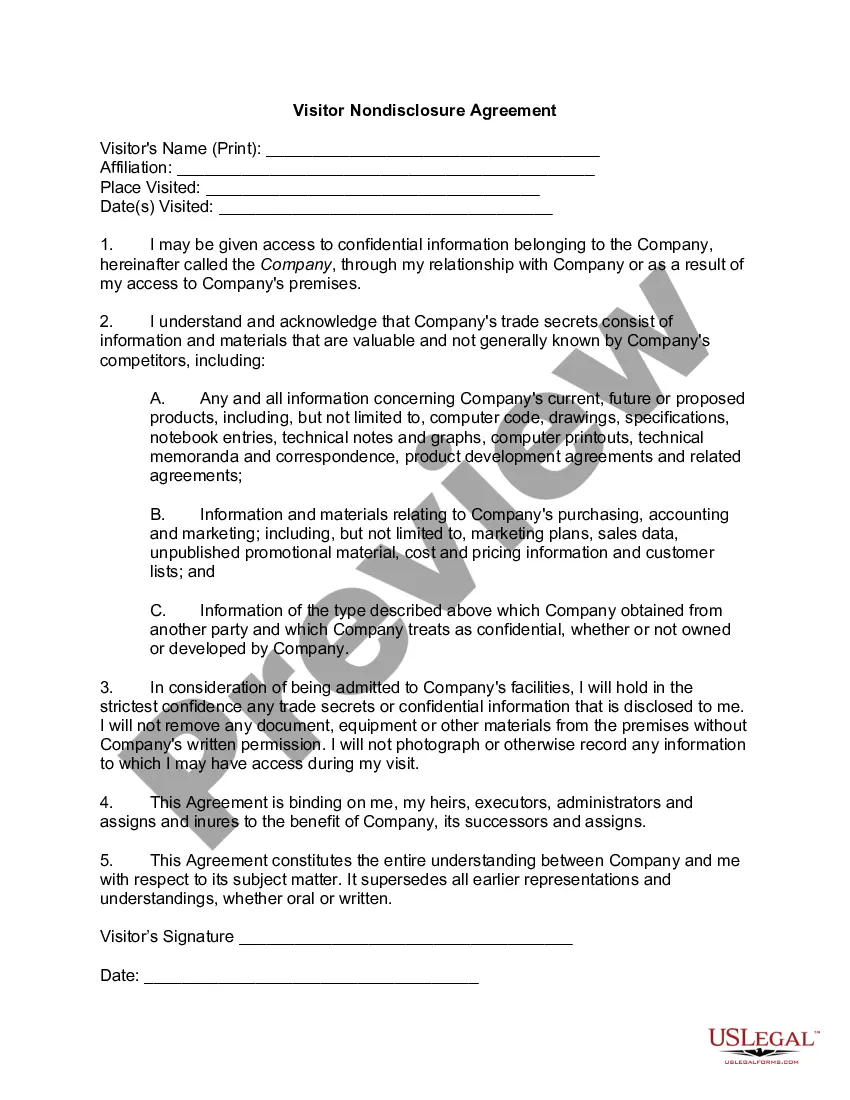
Connecticut Visitor Nondisclosure Agreement
Description
Get your form ready online
Our built-in tools help you complete, sign, share, and store your documents in one place.
Make edits, fill in missing information, and update formatting in US Legal Forms—just like you would in MS Word.
Download a copy, print it, send it by email, or mail it via USPS—whatever works best for your next step.
Sign and collect signatures with our SignNow integration. Send to multiple recipients, set reminders, and more. Go Premium to unlock E-Sign.
If this form requires notarization, complete it online through a secure video call—no need to meet a notary in person or wait for an appointment.
We protect your documents and personal data by following strict security and privacy standards.

Make edits, fill in missing information, and update formatting in US Legal Forms—just like you would in MS Word.

Download a copy, print it, send it by email, or mail it via USPS—whatever works best for your next step.

Sign and collect signatures with our SignNow integration. Send to multiple recipients, set reminders, and more. Go Premium to unlock E-Sign.

If this form requires notarization, complete it online through a secure video call—no need to meet a notary in person or wait for an appointment.

We protect your documents and personal data by following strict security and privacy standards.
Looking for another form?


How to fill out Visitor Nondisclosure Agreement?
You can invest hours online searching for the legal document template that meets the state and federal requirements you desire.
US Legal Forms provides a vast array of legal forms that have been reviewed by experts.
You can effortlessly download or print the Connecticut Visitor Nondisclosure Agreement from my services.
If available, utilize the Preview button to browse through the document template as well.
- If you already possess a US Legal Forms account, you can Log In and click on the Download button.
- Subsequently, you can complete, modify, print, or sign the Connecticut Visitor Nondisclosure Agreement.
- Every legal document template you acquire is yours indefinitely.
- To obtain another copy of a purchased form, navigate to the My documents tab and press the appropriate button.
- If you are using the US Legal Forms website for the first time, follow the straightforward instructions below.
- First, ensure that you have selected the correct document template for the county/town of your choice.
- Review the form description to confirm you have selected the correct form.
Form popularity
FAQ
A violation of a Connecticut Visitor Nondisclosure Agreement occurs when a party discloses confidential information without permission. For instance, if an invited guest discusses proprietary information shared during a business meeting, this would breach the agreement. It's crucial to understand that even casual sharing can lead to serious legal consequences. To prevent such violations, consider using a solid Connecticut Visitor Nondisclosure Agreement that clearly outlines the boundaries of confidentiality.
The difference between an NDA and a Mnda lies in the shared nature of the confidential information. An NDA often involves one party disclosing sensitive information to another, while a Mnda facilitates a scenario where both parties need to protect proprietary data they exchange. Utilizing a Connecticut Visitor Nondisclosure Agreement as a Mnda can ensure that both parties feel secure in their disclosures, fostering a collaborative atmosphere.
Mnda stands for mutual nondisclosure agreement, which signifies an arrangement where both parties involved in a contract agree to keep each other's confidential information protected. This is particularly important when businesses or organizations share sensitive data, ensuring that both sides are equally protected. Opting for a Connecticut Visitor Nondisclosure Agreement as a Mnda framework promotes transparency and security throughout the interaction.
NDA stands for nondisclosure agreement, while MDNA refers to mutual nondisclosure agreement; both serve to protect confidential information. An NDA can be unilateral, meaning only one party discloses information, whereas an MDNA ensures that both parties agree to keep each other's information private. When engaging in discussions where mutual sharing is necessary, leveraging a MDNA like the Connecticut Visitor Nondisclosure Agreement can enhance trust and cooperation.
The primary difference between an NDA and a Mnda lies in the nature of information shared. An NDA typically involves one party sharing confidential information with another, while a Mnda, or mutual nondisclosure agreement, accounts for both parties sharing secrets with each other. Therefore, if you're considering a collaboration where both sides need to share sensitive details, a Mnda might be more appropriate.
The NDA for visitors, often referred to as the Connecticut Visitor Nondisclosure Agreement, is designed to protect sensitive information shared with individuals who visit a business or organization. This agreement ensures that visitors do not disclose proprietary information they may encounter during their visit. It safeguards the business’s interests while promoting a secure environment for collaboration and innovation.
There are three primary types of nondisclosure agreements: unilateral NDAs, mutual NDAs, and multilateral NDAs. A unilateral NDA is where one party discloses information while the other party agrees to keep it confidential. With a mutual NDA, both parties share sensitive information and agree to protect it. Multilateral NDAs involve multiple parties, ensuring that all involved keep each other’s information secret, which is especially useful in business collaborations.
The five key elements of a Connecticut Visitor Nondisclosure Agreement include the identification of parties, definitions of confidential information, obligations of confidentiality, duration of the agreement, and remedies for breach. Each of these components plays a crucial role in ensuring both parties understand their responsibilities. Clearly defined terms minimize confusion and protect sensitive data. You can find detailed templates for each element on uslegalforms to help create a comprehensive agreement.
A typical Connecticut Visitor Nondisclosure Agreement is structured in sections that clearly outline the agreement's purpose, parties involved, and terms. It often starts with an introductory paragraph followed by definitions of key terms, obligations of the parties, and the duration of the agreement. The document should also include clauses for legal recourse in case of breaches. Using uslegalforms can help you easily create a professional-looking NDA.
An example of a Connecticut Visitor Nondisclosure Agreement could include a situation where a business shares proprietary information with a potential partner. This agreement would specify that the recipient cannot disclose or use the information for their own benefit. Including clear definitions and a defined term for confidentiality helps protect sensitive data. Check out templates on uslegalforms for examples that can guide you.