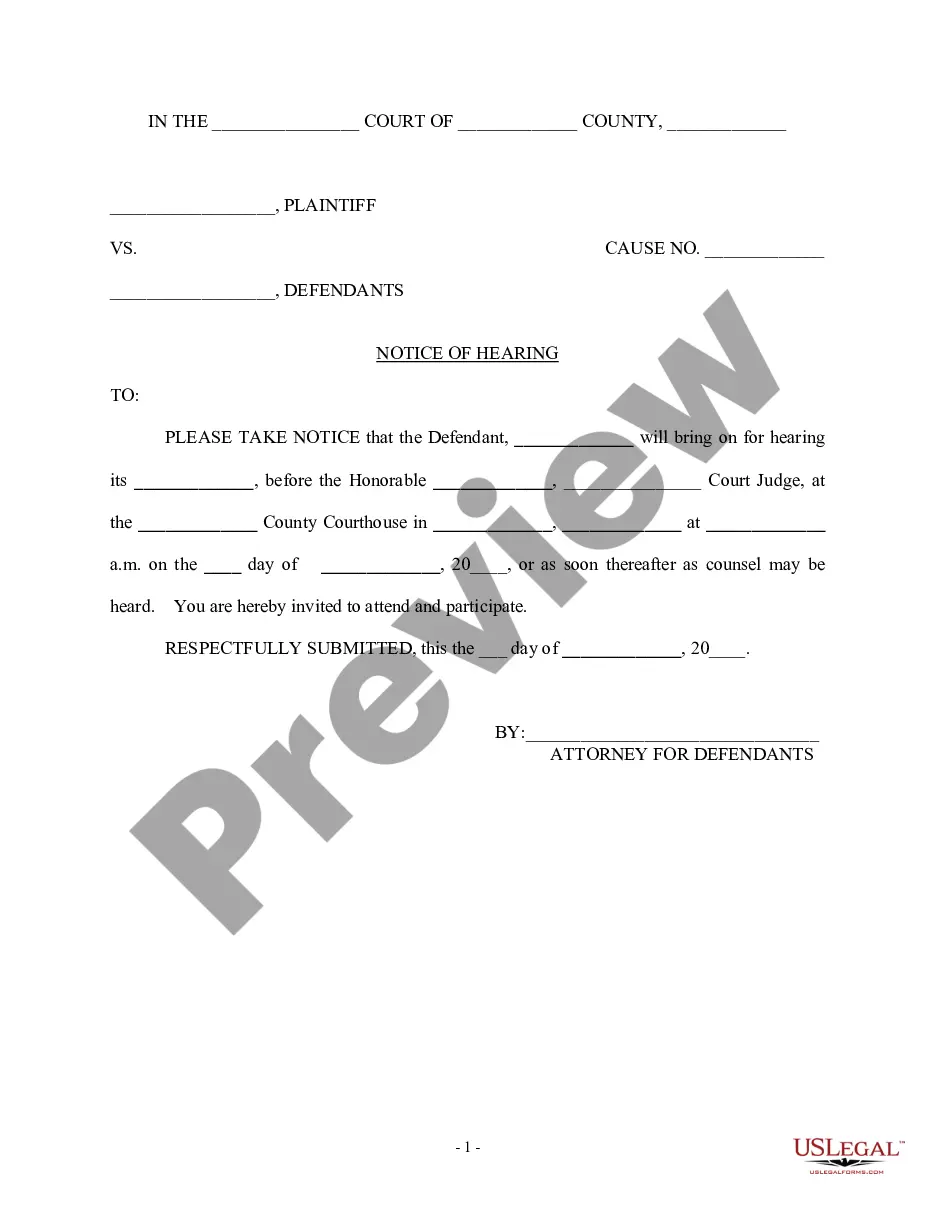
Connecticut Notice of Hearing
Description
Get your form ready online
Our built-in tools help you complete, sign, share, and store your documents in one place.
Make edits, fill in missing information, and update formatting in US Legal Forms—just like you would in MS Word.
Download a copy, print it, send it by email, or mail it via USPS—whatever works best for your next step.
Sign and collect signatures with our SignNow integration. Send to multiple recipients, set reminders, and more. Go Premium to unlock E-Sign.
If this form requires notarization, complete it online through a secure video call—no need to meet a notary in person or wait for an appointment.
We protect your documents and personal data by following strict security and privacy standards.

Make edits, fill in missing information, and update formatting in US Legal Forms—just like you would in MS Word.

Download a copy, print it, send it by email, or mail it via USPS—whatever works best for your next step.

Sign and collect signatures with our SignNow integration. Send to multiple recipients, set reminders, and more. Go Premium to unlock E-Sign.

If this form requires notarization, complete it online through a secure video call—no need to meet a notary in person or wait for an appointment.

We protect your documents and personal data by following strict security and privacy standards.
Looking for another form?


How to fill out Notice Of Hearing?
US Legal Forms - one of the most important collections of legal documents in the USA - offers a range of legal document templates that you can obtain or create.
Through the website, you can access thousands of documents for business and personal purposes, organized by type, state, or keywords. You can find the latest versions of forms like the Connecticut Notice of Hearing in just moments.
If you already have a subscription, Log In and retrieve the Connecticut Notice of Hearing from the US Legal Forms library.
If the form does not meet your needs, utilize the Search area at the top of the screen to find one that does.
If you are satisfied with the form, confirm your choice by clicking the Buy now button. Then, select the payment plan you prefer and enter your information to sign up for an account.
- The Download button will appear on each form you view.
- You can access all previously saved forms in the My documents tab of your account.
- If you wish to use US Legal Forms for the first time, here are simple instructions to get you started.
- Ensure you have selected the correct form for your city/state.
- Click the Preview button to review the form's content.
- Read the form description to confirm you have chosen the right form.
Form popularity
FAQ
The Connecticut Judicial Branch now has hearings and other proceedings by video-conference, known as. ?remote court proceedings,? in addition to in-person proceedings. This help guide will help answer questions. about how to participate in a remote court proceeding.
Local court clerks will commonly update the database regularly. To use the ?Case Look-up?, you will need at least the first and last name of the defendant. When using the ?Case Look- Up?, you can search by the party name or by the case number, this will provide all the upcoming court dates on that case.
You may also call the Centralized Services Unit at 860-263-2750. All requests for files must include the name of the case and docket number. Docket numbers may be available on-line at .jud.ct.gov by utilizing the case look-up function. Files should be available within one or two business days.
Putting your name and address on file allows the Court to mail notices of court dates and court rulings to you at the address on file. It also gives other parties and attorneys an address to send paperwork to you. Court rules state that defendants should file an appearance within 2 days after the Return date.
You might be able to get 3 extra months to move out if you are evicted because you did not pay the rent, but you must fill out a Stay of Execution (#JD-HM-21) form and pay the court all of the rent you owe within 5 days of the judgment. You must be prepared to pay for each month that you stay.
Disposition hearing definition: A disposition hearing is a type of court proceeding that occurs after a defendant is found guilty or enters a plea of guilty or no contest in a criminal case. At this hearing, the judge decides what type of sentencing or other legal outcomes will be imposed on the defendant.
For many people, privacy ? for themself, their spouse, and their children ? is a priority during and following a divorce. It's normal to wonder whether divorce is a matter of divorce records public in Connecticut. The short answer is yes, divorce filings are public records.
To obtain a copy of a Divorce Decree or Dissolution of Civil Union Decree, contact the CT Superior Court where the divorce or dissolution was granted (see Directory of Connecticut Superior Courts).