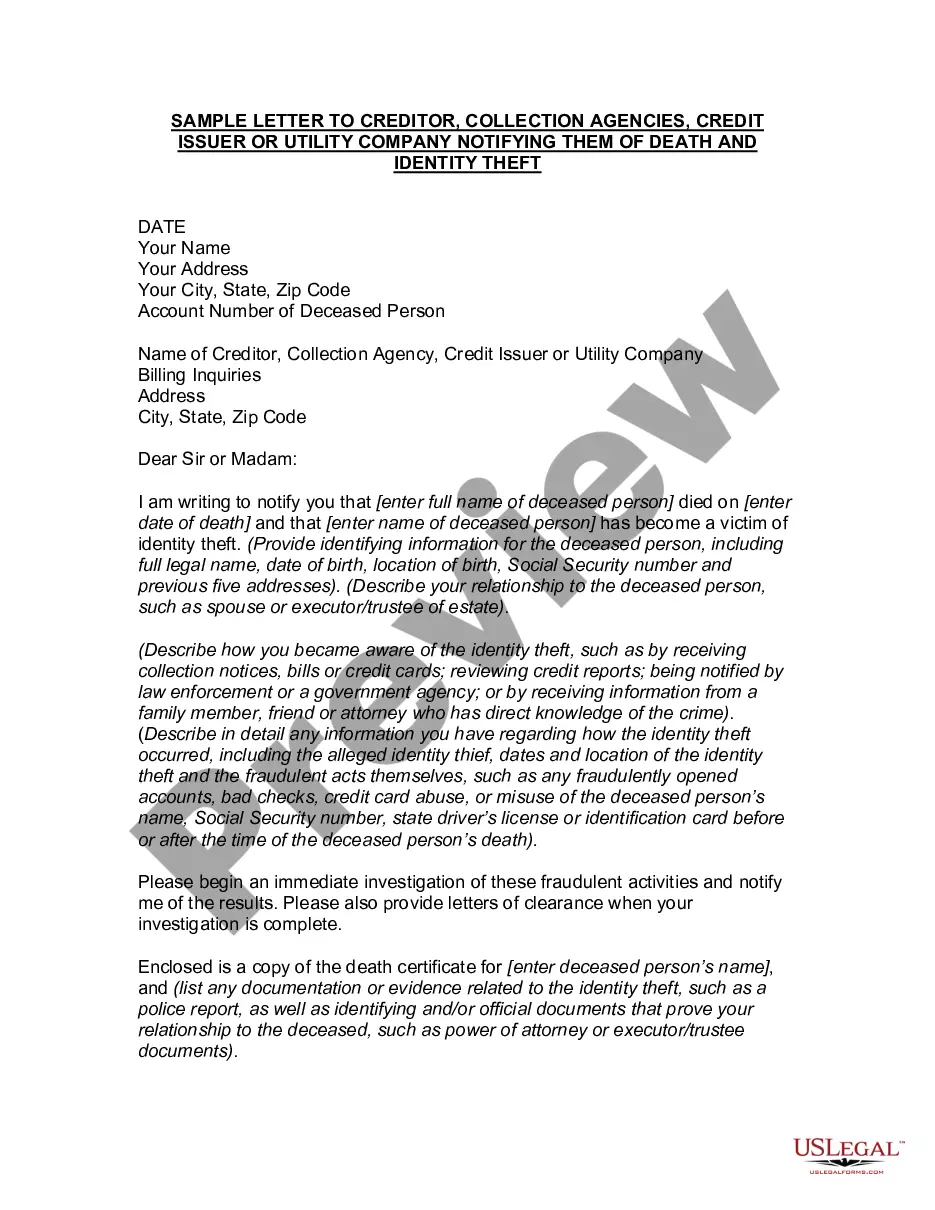
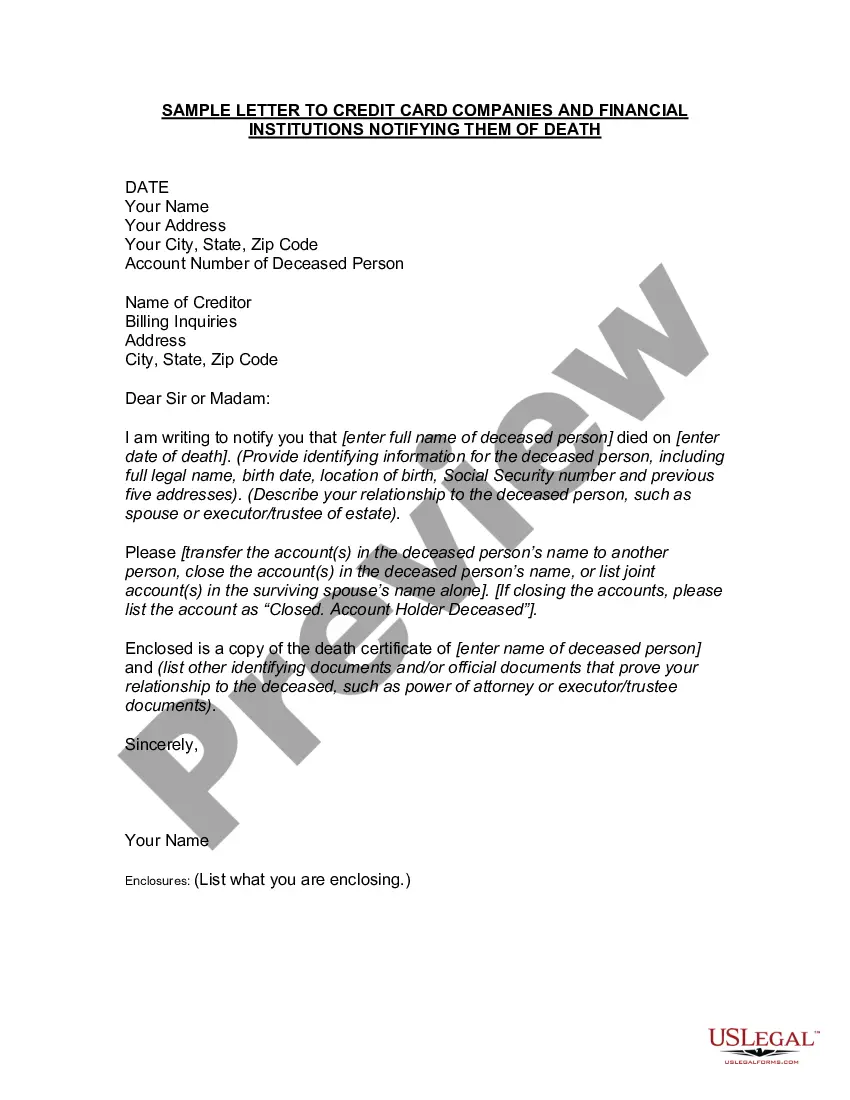
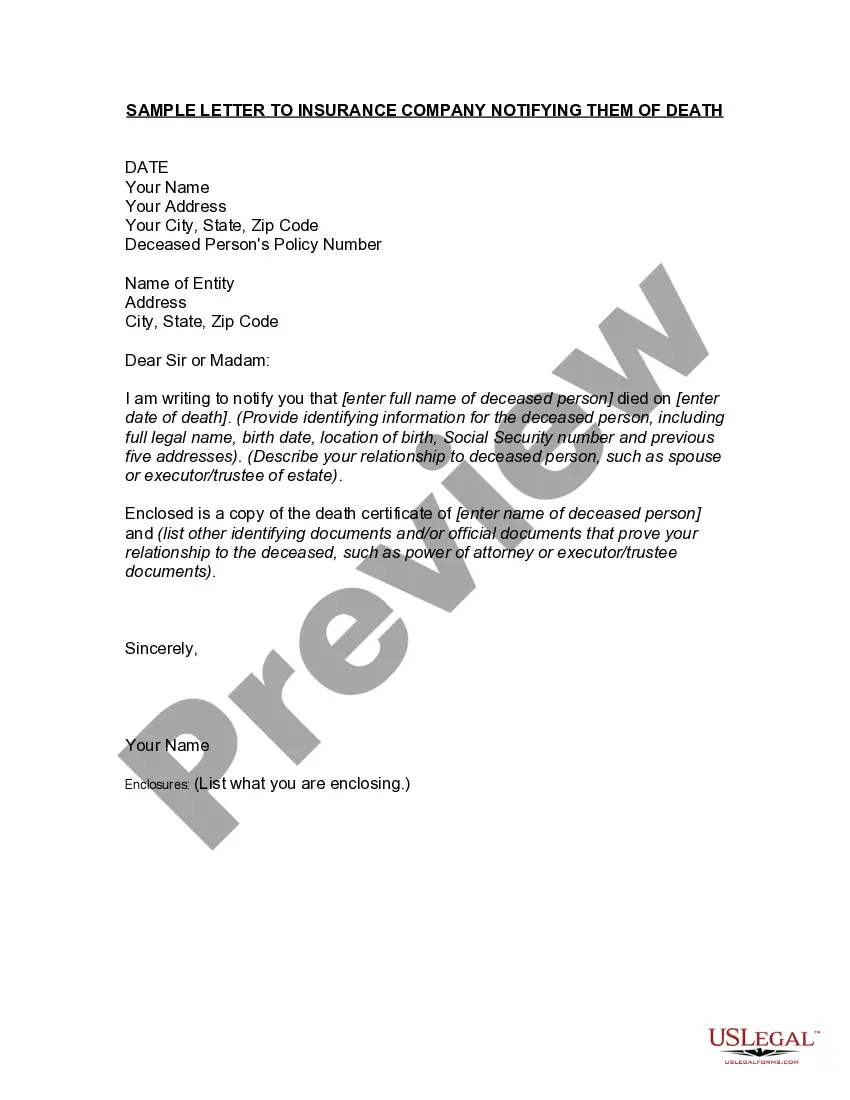
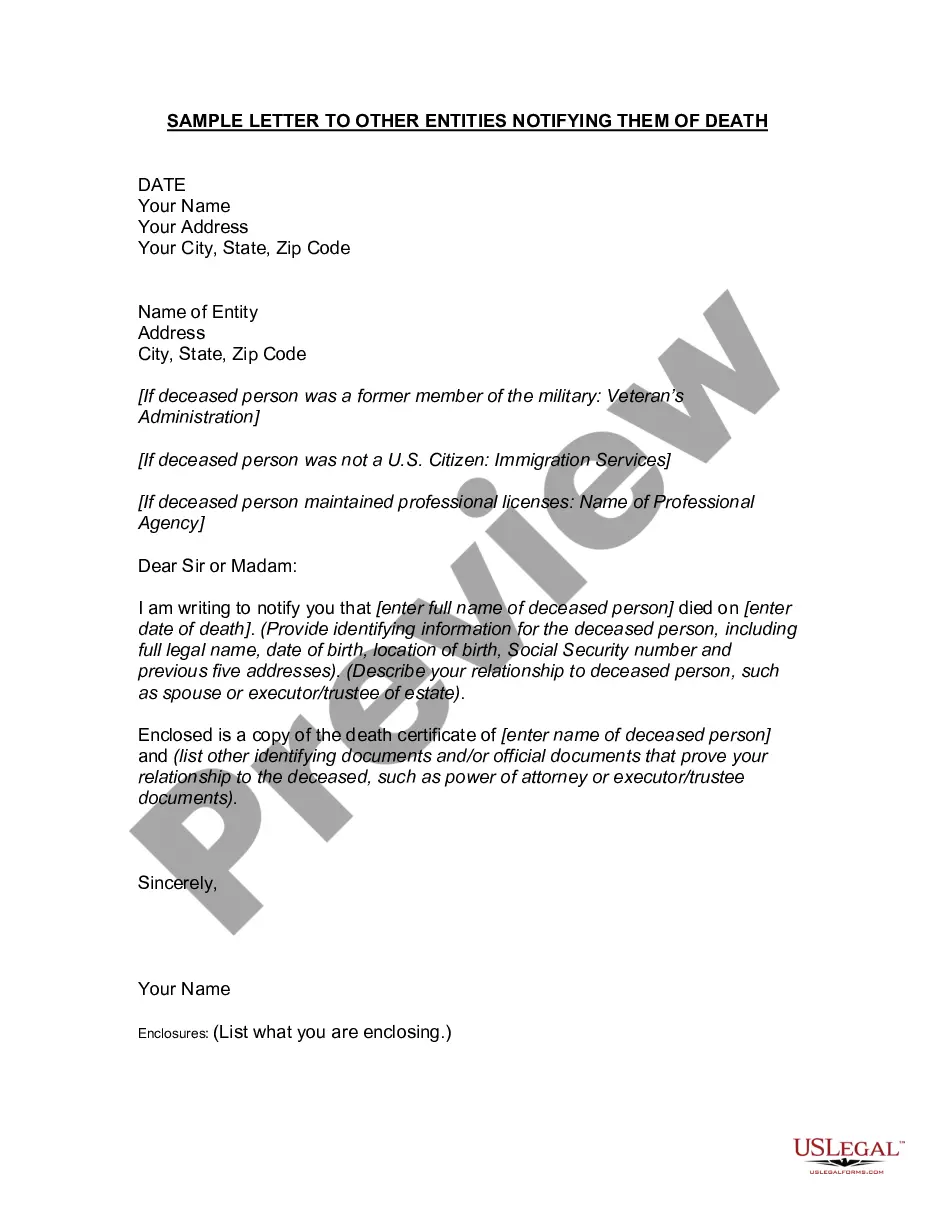
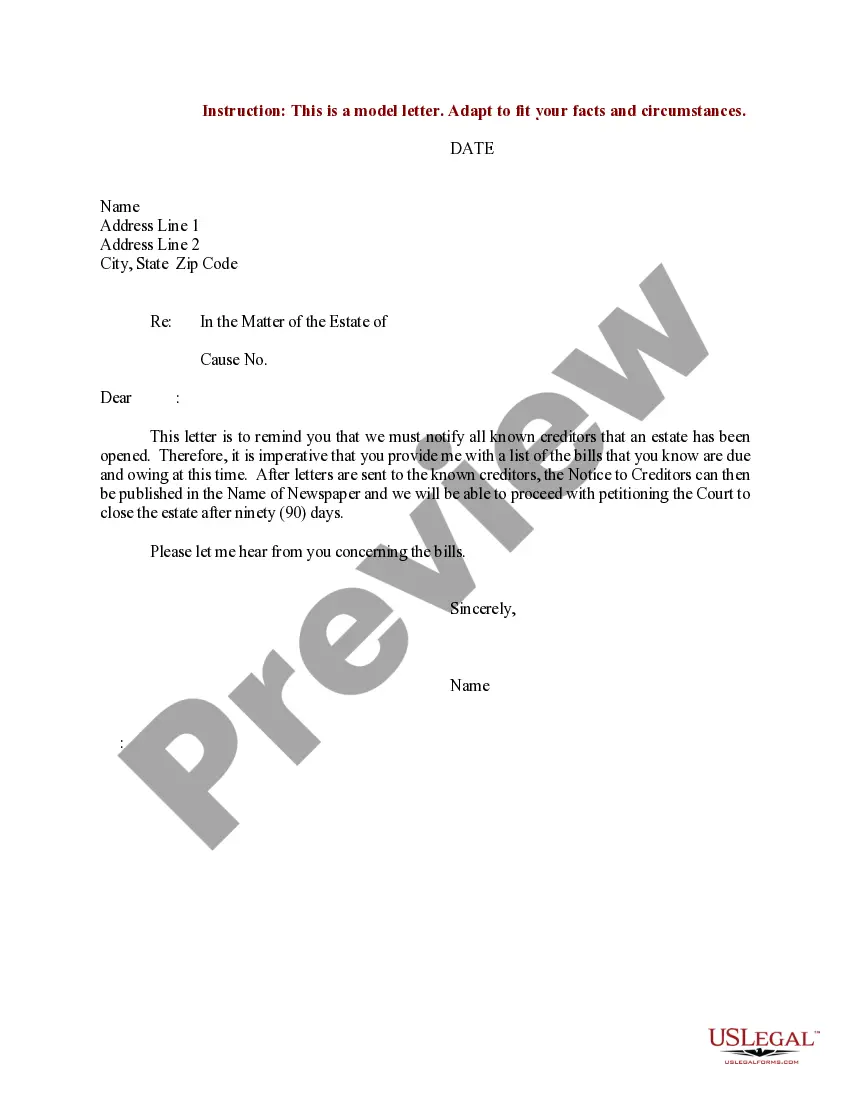
Connecticut Letter to Creditor, Collection Agencies, Credit Issuer or Utility Company Notifying Them of Death
Description

Get your form ready online
Our built-in tools help you complete, sign, share, and store your documents in one place.
Make edits, fill in missing information, and update formatting in US Legal Forms—just like you would in MS Word.
Download a copy, print it, send it by email, or mail it via USPS—whatever works best for your next step.
Sign and collect signatures with our SignNow integration. Send to multiple recipients, set reminders, and more. Go Premium to unlock E-Sign.
If this form requires notarization, complete it online through a secure video call—no need to meet a notary in person or wait for an appointment.
We protect your documents and personal data by following strict security and privacy standards.

Make edits, fill in missing information, and update formatting in US Legal Forms—just like you would in MS Word.

Download a copy, print it, send it by email, or mail it via USPS—whatever works best for your next step.

Sign and collect signatures with our SignNow integration. Send to multiple recipients, set reminders, and more. Go Premium to unlock E-Sign.

If this form requires notarization, complete it online through a secure video call—no need to meet a notary in person or wait for an appointment.

We protect your documents and personal data by following strict security and privacy standards.
Looking for another form?

How to fill out Letter To Creditor, Collection Agencies, Credit Issuer Or Utility Company Notifying Them Of Death?
If you wish to aggregate, acquire, or print out legal document templates, utilize US Legal Forms, the most extensive collection of legal forms available online.
Take advantage of the site’s straightforward and user-friendly search to locate the documents you need. Numerous templates for business and personal purposes are categorized by types and states, or keywords.
Utilize US Legal Forms to obtain the Connecticut Letter to Creditor, Collection Agencies, Credit Issuer or Utility Company Notifying Them of Passing with just a few clicks.
Every legal document template you acquire is yours permanently. You will have access to every form you saved in your account. Select the My documents section and choose a form to print or download again.
Be proactive and obtain, and print the Connecticut Letter to Creditor, Collection Agencies, Credit Issuer or Utility Company Notifying Them of Passing with US Legal Forms. There are millions of professional and state-specific templates you can use for your business or personal needs.
- If you are already a US Legal Forms user, Log In to your account and click the Download option to retrieve the Connecticut Letter to Creditor, Collection Agencies, Credit Issuer or Utility Company Notifying Them of Passing.
- You can also access forms you previously saved in the My documents section of your account.
- If you are using US Legal Forms for the first time, follow the steps below.
- Step 1. Ensure you have selected the form for the correct area/state.
- Step 2. Use the Review option to examine the form’s content. Don’t forget to read the description.
- Step 3. If you are not satisfied with the form, use the Search box at the top of the screen to find alternative templates in the legal form format.
- Step 4. Once you have found the form you need, select the Get now option. Choose the pricing plan you prefer and enter your details to register for the account.
- Step 5. Complete the transaction. You can use your credit card or PayPal account to finalize the purchase.
- Step 6. Choose the format of the legal form and download it to your device.
- Step 7. Complete, modify, and print or sign the Connecticut Letter to Creditor, Collection Agencies, Credit Issuer or Utility Company Notifying Them of Passing.
Form popularity
FAQ
It's important to remember that credit card debt does not automatically go away when someone dies. It must be paid by the estate or the co-signers on the account.
A deceased person's debt doesn't die with them but often passes to their estate. Certain types of debt, such as individual credit card debt, can't be inherited. However, shared debt will likely still need to be paid by a surviving debtholder.
However, once the three nationwide credit bureaus ? Equifax, Experian and TransUnion ? are notified someone has died, their credit reports are sealed and a death notice is placed on them. That notification can happen one of two ways ? from the executor of the person's estate or from the Social Security Administration.
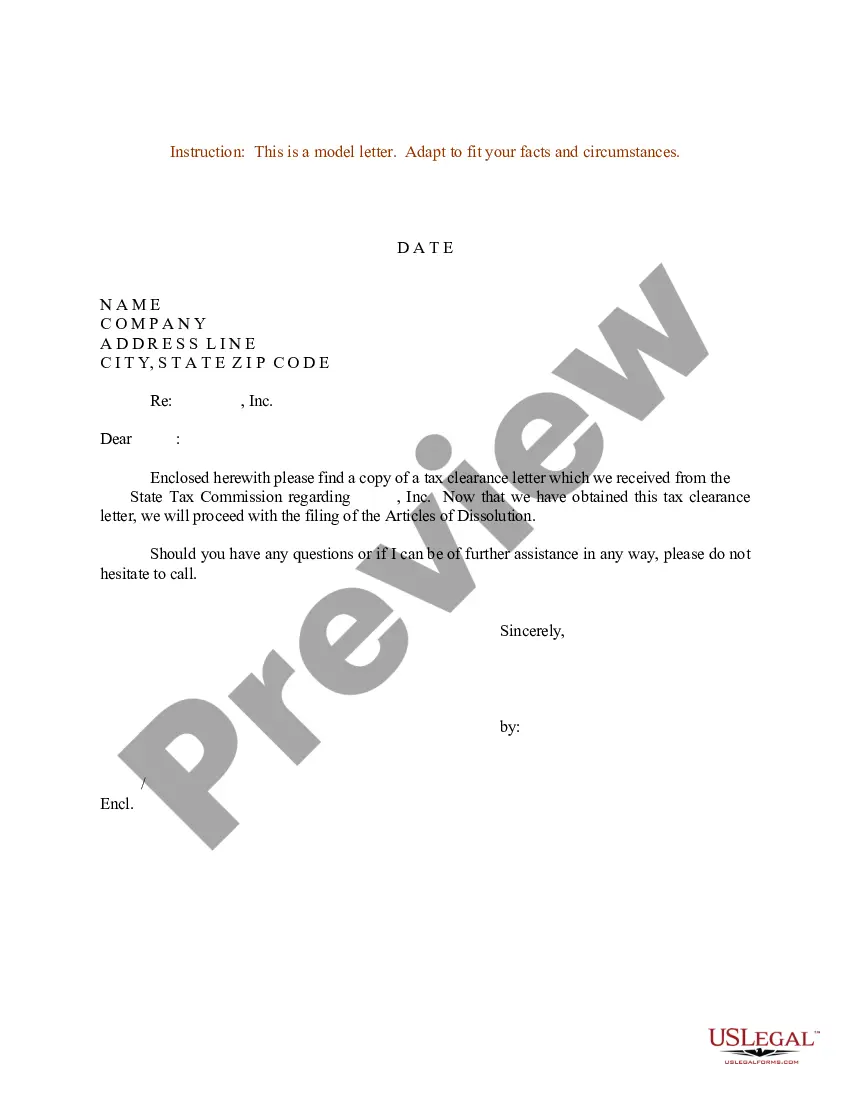
Unfortunately, ?(Detail Deceased's name) ?passed away on ?(Detail Date)?. I enclose a copy of their death certificate. They didn't leave behind any assets and there is no money to pay what they owe. Please consider writing off this debt because there is no prospect of you ever recovering any money towards it.
Your loved ones or the executor of your will should notify creditors of your death as soon as possible. To do so, they'll need to send each creditor a copy of your death certificate. Creditors generally pause efforts to collect on unpaid debts while your estate is being settled.
Additional examples of unsecured debt include medical debt and most types of credit card debt. If you die with unsecured debt, repayment becomes the responsibility of your estate. Your legal estate refers to all the assets, property and money left behind by you or another deceased person when they die.
After someone has passed, their estate is responsible for paying off any debts owed, including those from credit cards. Relatives typically aren't responsible for using their own money to pay off credit card debt after death.
After your loved one dies, you will need to inform creditors of their death. From there, creditors have a time limit to submit claims and you will have to respond within a certain time frame. Overall in California, creditors have only one year to collect on a debt. In general, you cannot inherit someone else's debt.