Application for Certificate Releasing Connecticut Estate Tax Lien
What this document covers
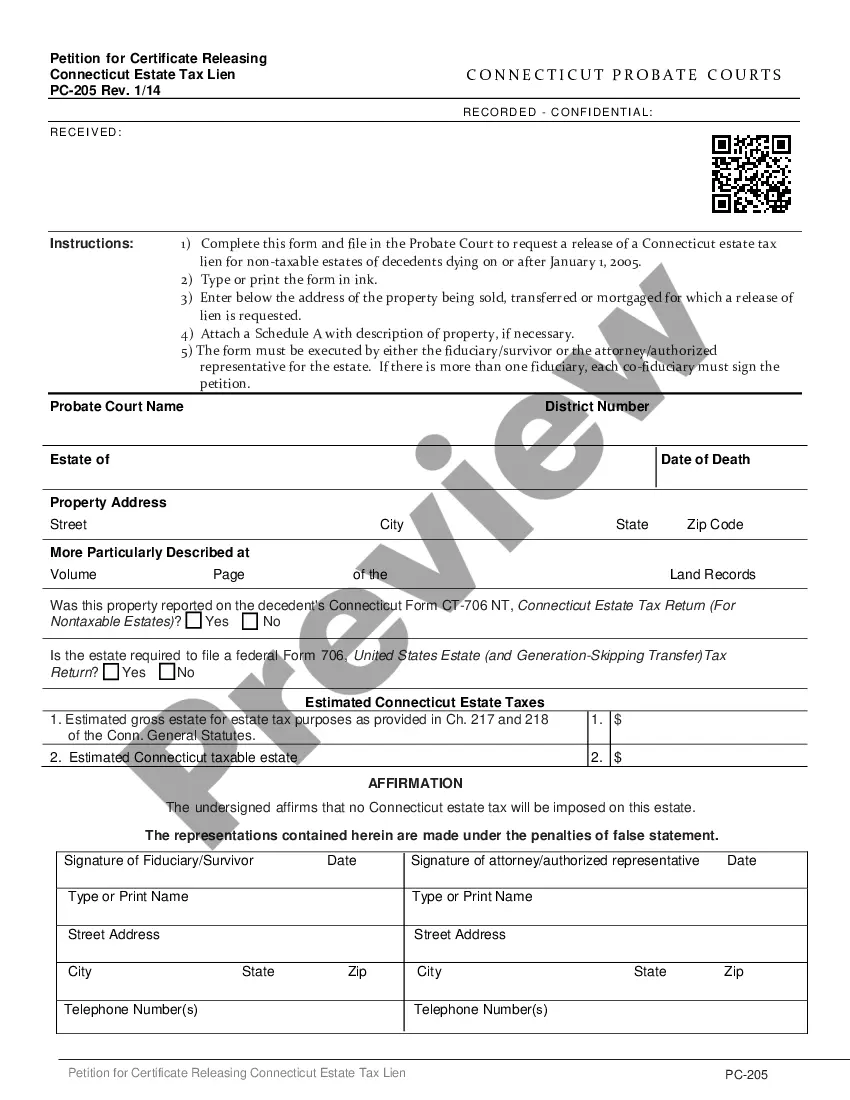
The Application for Certificate Releasing Connecticut Estate Tax Lien is an official form used to request the release of a lien placed against an estate for Connecticut estate taxes. This form is necessary for estates that are not subject to estate tax, ensuring that property can be sold, transferred, or mortgaged without tax-related encumbrances. It differs from other estate forms as it specifically addresses the release of tax liens for non-taxable estates, particularly those of decedents who died on or after January 1, 2005.
What’s included in this form
- Name and district of the Probate Court where the petition is filed.
- Details of the estate, including the decedent's name and date of death.
- Property address of the estate where the lien release is requested.
- Verification of whether the property was reported on the Connecticut estate tax return.
- Affirmation statement regarding the absence of Connecticut estate tax on the estate.
- Signatures of the fiduciary or authorized representative.

When to use this document
This form should be used when you need to release a Connecticut estate tax lien for estates that are not subject to tax. Typical scenarios include the sale or transfer of property for estates of decedents who died on or after January 1, 2005. Utilizing this form helps facilitate the smooth transfer of assets without tax liabilities hindering the process.
Who this form is for
- Fiduciaries of estates that are confirmed to be non-taxable under Connecticut law.
- Survivors of the decedent looking to manage the estate's property.
- Attorneys or authorized representatives acting on behalf of the estate.
Completing this form step by step
- Type or print the form clearly in ink.
- Provide the address of the property involved along with any necessary detailed descriptions attached as Schedule A.
- Indicate whether the property was reported on the Connecticut estate tax return.
- Confirm if the estate is required to file a federal Form 706.
- Have the form signed by the fiduciary or authorized representative, ensuring all necessary parties sign if applicable.
Notarization requirements for this form
This form does not typically require notarization unless specified by local law. It is advisable to check with the Probate Court for any additional requirements.
Get your form ready online
Our built-in tools help you complete, sign, share, and store your documents in one place.
Make edits, fill in missing information, and update formatting in US Legal Forms—just like you would in MS Word.
Download a copy, print it, send it by email, or mail it via USPS—whatever works best for your next step.
Sign and collect signatures with our SignNow integration. Send to multiple recipients, set reminders, and more. Go Premium to unlock E-Sign.
If this form requires notarization, complete it online through a secure video call—no need to meet a notary in person or wait for an appointment.
We protect your documents and personal data by following strict security and privacy standards.

Make edits, fill in missing information, and update formatting in US Legal Forms—just like you would in MS Word.

Download a copy, print it, send it by email, or mail it via USPS—whatever works best for your next step.

Sign and collect signatures with our SignNow integration. Send to multiple recipients, set reminders, and more. Go Premium to unlock E-Sign.

If this form requires notarization, complete it online through a secure video call—no need to meet a notary in person or wait for an appointment.

We protect your documents and personal data by following strict security and privacy standards.
Typical mistakes to avoid
- Failing to verify if the estate is non-taxable before submitting the form.
- Not including the required Schedule A when necessary.
- Missing signatures from all fiduciaries if there is more than one.
- Providing incomplete property details.
Why complete this form online
- Easy access to a legally compliant form drafted by licensed attorneys.
- Convenient downloading and editing options to fill the form accurately.
- Time-saving as you can complete it at your own pace without needing to visit an office.
Looking for another form?
Form popularity
FAQ
The CT form for releasing a lien is known as the Application for Certificate Releasing Connecticut Estate Tax Lien. This form serves as a formal request to remove any estate tax liens assessed by the state of Connecticut. Completing this application is essential for settling estate matters and facilitating asset distribution. At USLegalForms, we provide comprehensive guidance and the necessary forms to help you navigate this process smoothly.
No, Connecticut is not a no tax state. It has state income tax, sales tax, and various local taxes that contribute to its revenue. If you face difficulties with estate taxes, utilizing the Application for Certificate Releasing Connecticut Estate Tax Lien can be beneficial. It enables you to address estate tax liens efficiently, giving you peace of mind regarding your financial obligations.
Yes, Connecticut is a tax lien state where local municipalities can put liens on properties for unpaid taxes. When you submit the Application for Certificate Releasing Connecticut Estate Tax Lien, you can initiate the process to remove these liens. This process is crucial for homeowners who wish to sell or refinance their property without tax encumbrances.
With a tax lien certificate, you have the opportunity to collect the owed tax amount along with interest, or in some cases, acquire the property if debts remain unpaid. This investment can be lucrative, but it also requires a clear understanding of local tax laws and strategies. If you ever need to address any estate tax lien needs, consider using the Application for Certificate Releasing Connecticut Estate Tax Lien for better clarity and process efficiency.
A released tax lien means that the taxing authority no longer has a claim against your property due to unpaid taxes. This release allows you to freely sell, transfer, or refinance your property without encumbrances. It's important to ensure this status is properly documented, possibly through the Application for Certificate Releasing Connecticut Estate Tax Lien, to avoid future complications.
To apply for a certificate of discharge from a federal tax lien, you must submit Form 12277 to the IRS along with supporting documentation. This form provides details about the property and your circumstances that warrant the release. Effective management of this process can simplify your financial situation, especially if you are also dealing with state requirements like the Application for Certificate Releasing Connecticut Estate Tax Lien.
A certificate of release of tax lien is an official document that confirms the removal of a tax lien from your property records. It verifies that any outstanding tax obligations have been satisfied and legally restores clear title to the property. Obtaining this certificate is essential for homeowners looking to sell or refinance and can be processed through the Application for Certificate Releasing Connecticut Estate Tax Lien.