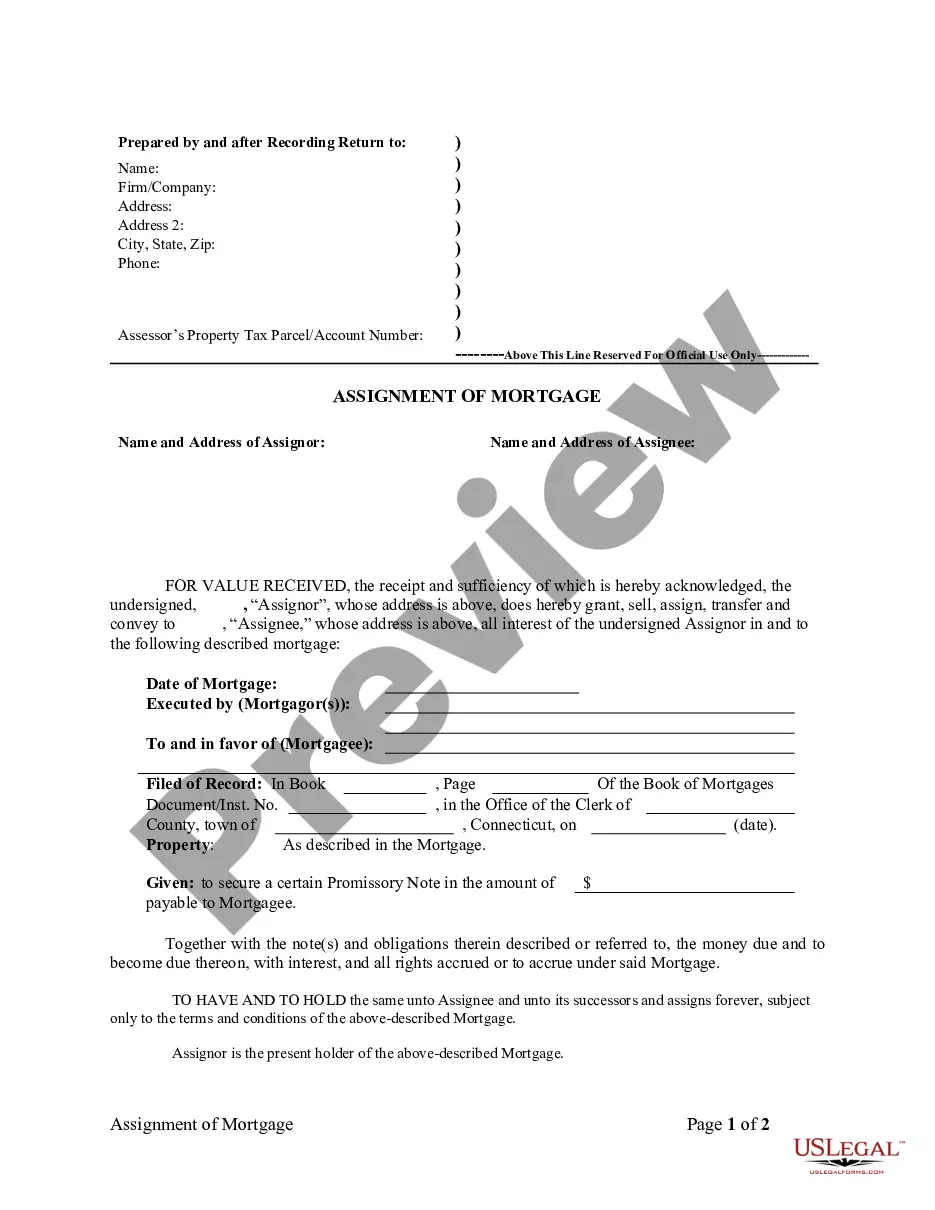
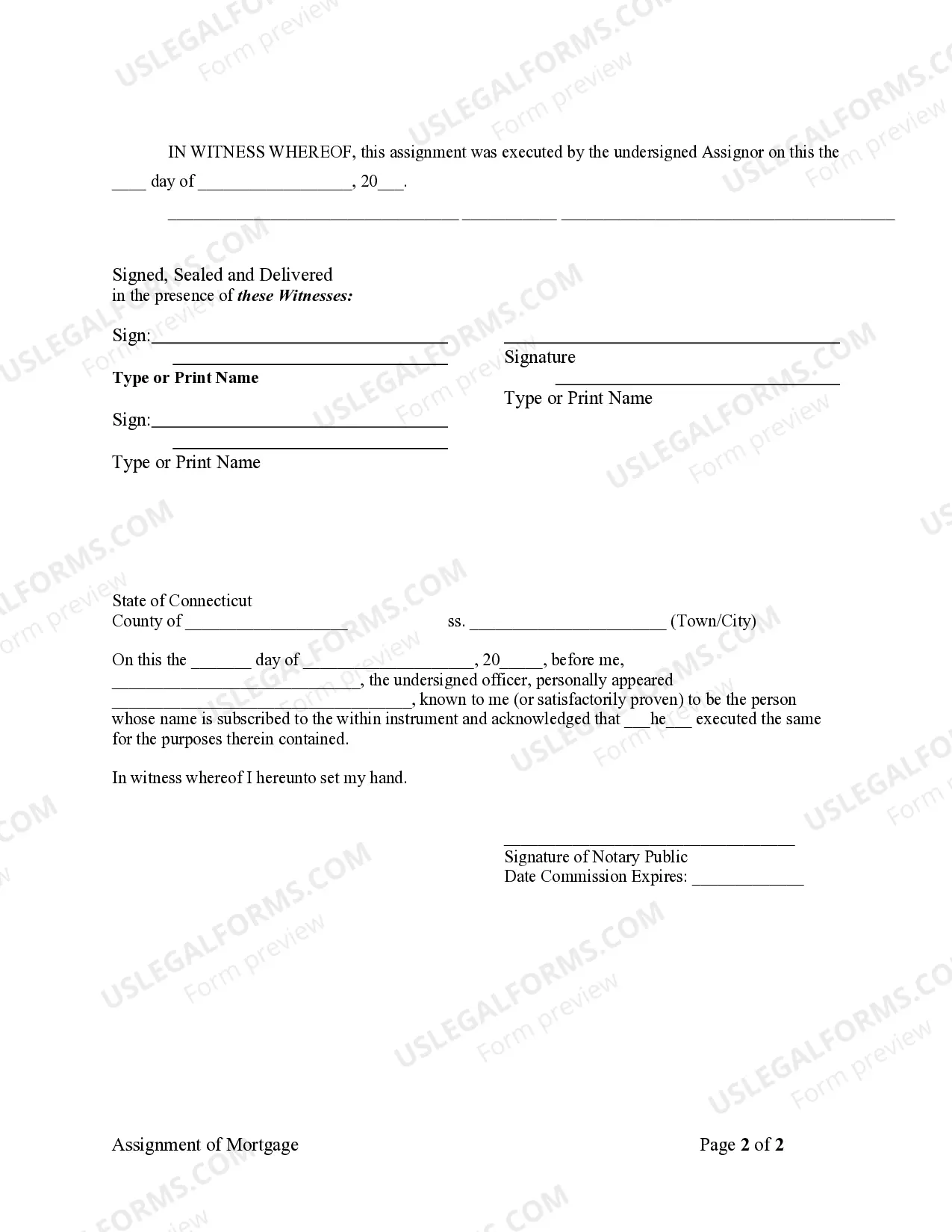
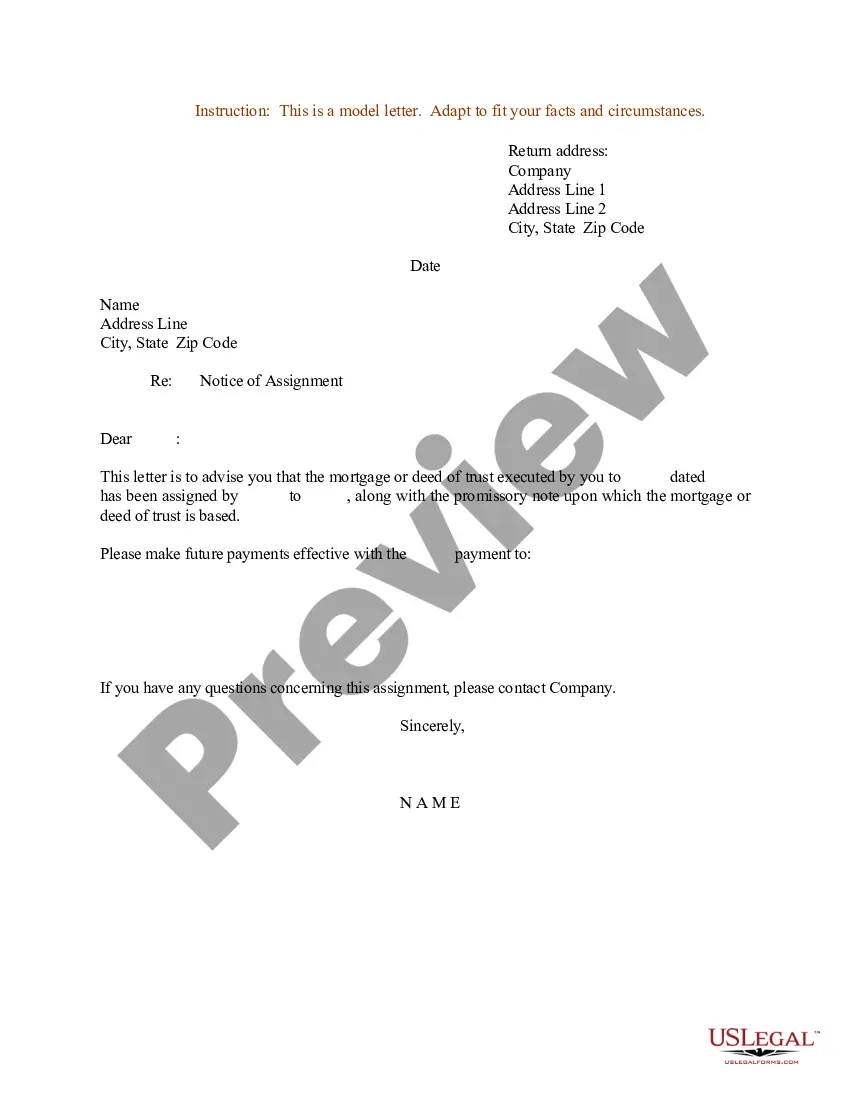
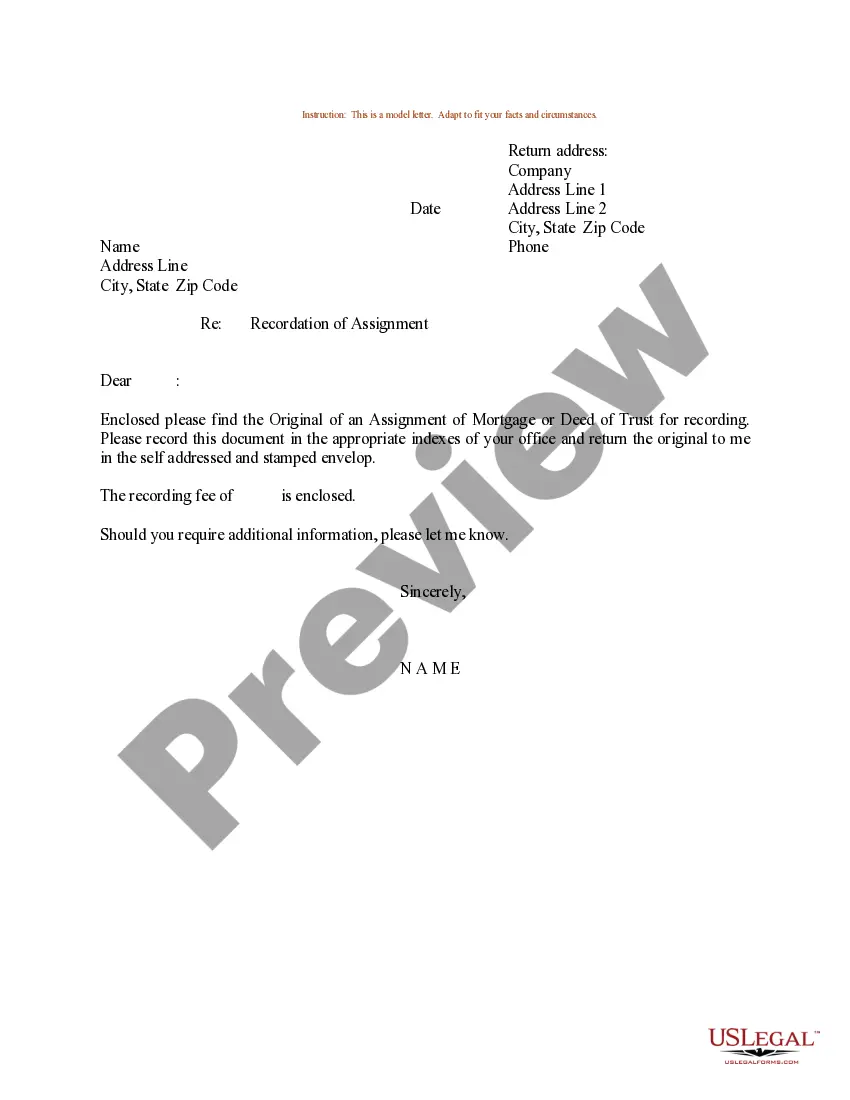
Assignment of Mortgage by Individual Mortgage Holder
Assignments Generally: Lenders,
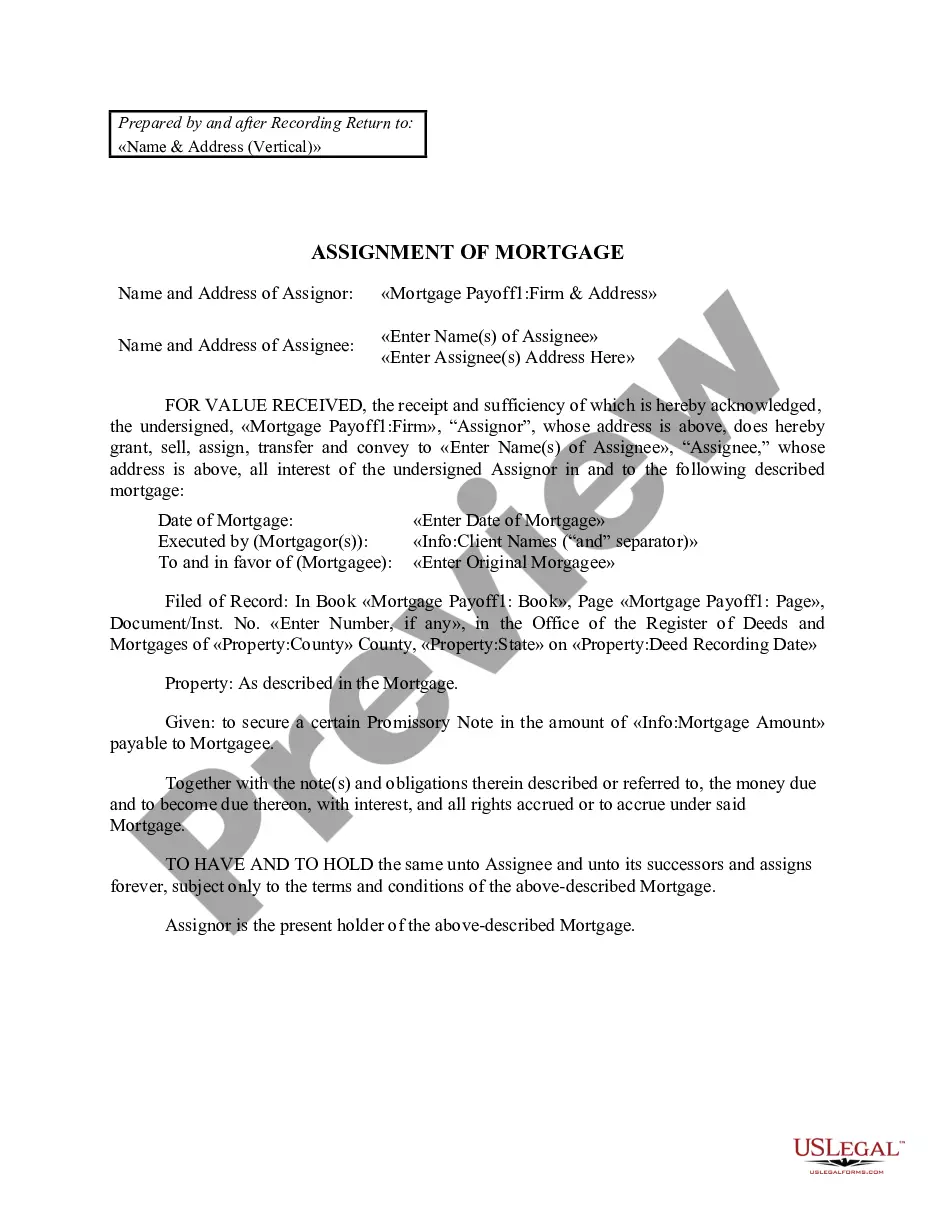
or holders of mortgages or deeds of trust, often assign mortgages or deeds
of trust to other lenders, or third parties. When this is done the
assignee (person who received the assignment) steps into the place of the
original lender or assignor. To effectuate an assignment, the general
rules is that the assignment must be in proper written format and recorded
to provide notice of the assignment.
Satisfactions Generally: Once a mortgage
or deed of trust is paid, the holder of the mortgage is required to satisfy
the mortgage or deed of trust of record to show that the mortgage or deed
of trust is no longer a lien on the property. The general rule is that
the satisfaction must be in proper written format and recorded to provide
notice of the satisfaction. If the lender fails to record a satisfaction
within set time limits, the lender may be responsible for damages set by
statute for failure to timely cancel the lien. Depending on your state,
a satisfaction may be called a Satisfaction, Cancellation, or Reconveyance.
Some states still recognize marginal satisfaction but this is slowly being
phased out. A marginal satisfaction is where the holder of the mortgage
physically goes to the recording office and enters a satisfaction on the
face of the the recorded mortgage, which is attested by the clerk.
Connecticut Law
Assignment: It is not necessary that an
assignment be recorded. When the assignment instrument is executed, attested
and acknowledged as required by law, it vests in the assignee. However,
it is recommended that the assignment be recorded to avoid complications
that might arise.
Demand to Satisfy: Following payoff, the
demand to satisfy should be by registered or certified mail to the mortgagee,
who then has 60 days to record satisfaction.
Recording Satisfaction: A mortgage may
be released by an instrument in writing executed, attested and acknowledged,
setting forth that the mortgage is discharged.
Penalty: If mortgagee fails to record satisfaction
of mortgage within 60 days of receipt of demand from mortgagor, mortgagee
shall be liable for damages at the rate of two hundred dollars for each
week after the expiration of such sixty days up to a maximum of five thousand
dollars or in an amount equal to the loss sustained, plus costs and reasonable
attorney's fees.
Acknowledgment: An assignment or satisfaction
must contain a proper Connecticut acknowledgment, or other acknowledgment
approved by Statute.
Connecticut Statutes
Sec. 49-8. Release of satisfied or partially satisfied mortgage
or ineffective attachment, lis pendens or lien.
Damages. (a) The mortgagee or a person authorized by law
to release the mortgage shall execute and deliver a release to the extent
of the satisfaction tendered before or against receipt of the release:
(1) Upon the satisfaction of the mortgage or (2) upon a bona fide
offer to satisfy the same in accordance with the terms of the mortgage
deed upon the execution of a release, or (3) when the parties in interest
have agreed in writing to a partial release of the mortgage where that
part of the property securing the partially satisfied mortgage is sufficiently
definite and certain, or (4) when the mortgagor has made a bona fide offer
in accordance with the terms of the mortgage deed for such partial satisfaction
on the execution of such partial release.
(b) The plaintiff or the plaintiff's attorney shall execute and
deliver a release when an attachment has become of no effect pursuant to
section 52-322 or section 52-324 or when a lis pendens or other lien has
become of no effect pursuant to section 52-326.
(c) The mortgagee or plaintiff or the plaintiff's attorney, as the
case may be, shall execute and deliver a release within sixty days from
the date a written request for a release of such encumbrance (1) was
sent to such mortgagee, plaintiff or plaintiff's attorney at the person's
last-known address by registered or certified mail, postage prepaid,
return receipt requested or (2) was received by such mortgagee, plaintiff
or plaintiff's attorney from a private messenger or courier service or
through any means of communication, including electronic communication,
reasonably calculated to give the person the written request or a copy
of it. The mortgagee or plaintiff shall be liable for damages to any
person aggrieved at the rate of two hundred dollars for each week after
the expiration of such sixty days up to a maximum of five thousand dollars
or in an amount equal to the loss sustained by such aggrieved person as
a result of the failure of the mortgagee or plaintiff or the plaintiff's
attorney to execute and deliver a release, whichever is greater, plus costs
and reasonable attorney's fees.
Sec. 49-8a. Release of mortgage. Affidavit. Recording of affidavit
with town clerk. Penalty for recording false information. (a) For purposes
of this section and section 49-10a:
(1) "Mortgage loan" means a loan secured by a mortgage on one, two,
three or four family residential real property located in the state of
Connecticut, including but not limited to, a residential unit in any common
interest community as defined in section 47-202.
(2) "Person" means an individual, corporation, limited liability
company, business trust, estate, trust, partnership, association, joint
venture, government, governmental subdivision or agency, or other legal
or commercial entity.
(3) "Mortgagor" means the grantor of a mortgage.
(4) "Mortgagee" means the grantee of a mortgage; provided, if the
mortgage has been assigned of record, "mortgagee" means the last person
to whom the mortgage has been assigned of record; provided further, if
the mortgage has been serviced by a mortgage servicer, "mortgagee" means
the mortgage servicer.
(5) "Mortgage servicer" means the last person to whom the mortgagor
has been instructed by the mortgagee to send payments of the mortgage loan.
The person who has transmitted a payoff statement shall be deemed to be
the mortgage servicer with respect to the mortgage loan described in that
payoff statement.
(6) "Attorney-at-law" means any person admitted to practice law
in this state and in good standing.
(7) "Title insurance company" means any corporation or other business
entity authorized and licensed to transact the business of insuring titles
to interests in real property in this state.
(8) "Payoff statement" means a statement of the amount of the unpaid
balance on a mortgage loan, including principal, interest and other charges
properly assessed pursuant to the loan documentation of such mortgage and
a statement of the interest on a per diem basis with respect to the unpaid
principal balance of the mortgage loan.
(b) If a mortgagee fails to execute and deliver a release of mortgage
to the mortgagor or to the mortgagor's esignated agent within sixty days
from receipt by the mortgagee of payment of the mortgage loan (1) in accordance
with the payoff statement furnished by the mortgagee or (2) if no payoff
statement was provided pursuant to a request made under section 49-10a,
in accordance with a good faith estimate by the mortgagor of the amount
of the unpaid balance on the mortgage loan using (A) a statement from the
mortgagee indicating the outstanding balance due as of a date certain and
(B) a reasonable estimate of the per diem interest and other charges due,
any attorney-at-law or duly authorized officer of a title insurance company
may, on behalf of the mortgagor or any successor in interest to the mortgagor
who has acquired title to the premises described in the mortgage or any
portion thereof, execute and cause to be recorded in the land records of
each town where the mortgage was recorded, an affidavit which complies
with the requirements of this section.
(c) An affidavit pursuant to this section shall state that:
(1) The affiant is an attorney-at-law or the authorized officer
of a title insurance company, and that the affidavit is made in behalf
of and at the request of the mortgagor or the current owner of the interest
encumbered by the mortgage;
(2) The mortgagee has provided a payoff statement with respect to
the mortgage loan or the mortgagee has failed to provide a payoff statement
requested pursuant to section 49-10a;
(3) The affiant has ascertained that the mortgagee has received
payment of the mortgage loan
(A) in accordance with the payoff statement or (B) in the absence
of a payoff statement requested pursuant to section 49-10a, in accordance
with a good faith estimate by the mortgagor of the amount of the unpaid
balance on the mortgage loan calculated in accordance with subdivision
(2) of subsection (b) of this section, as evidenced by a bank check, certified
check, attorney's clients' funds account check or title insurance company
check, which has been negotiated by the mortgagee or by other documentary
evidence of such receipt of payment by the mortgagee, including a confirmation
of a wire transfer;
(4) More than sixty days have elapsed since payment was received
by the mortgagee; and
(5) At least fifteen days prior to the date of the affidavit, the
affiant has given the mortgagee written notice by registered or certified
mail, postage prepaid, return receipt requested of intention to execute
and cause to be recorded an affidavit in accordance with this section,
with a copy of the proposed affidavit attached to such written notice;
and that the mortgagee has not responded in writing to such notification,
or that any request for additional payment made by the mortgagee has been
complied with at least fifteen days prior to the date of the affidavit.
(d) Such affidavit shall state the names of the mortgagor and the
mortgagee, the date of the mortgage, and the volume and page of the land
records where the mortgage is recorded. The affidavit shall provide similar
information with respect to every recorded assignment of the mortgage.
(e) The affiant shall attach to the affidavit (1) photostatic copies
of the documentary evidence that payment has been received by the mortgagee,
including the mortgagee's endorsement of any bank check, certified check,
attorney's clients' funds account check, title insurance company check,
or confirmation of a wire transfer and (2)
(A) a photostatic copy of the payoff statement, or (B) in the absence
of a payoff statement requested pursuant to section 49-10a, a copy of a
statement from the mortgagee that is in the possession of the mortgagor
indicating the outstanding balance due on the mortgage loan as of a date
certain and a statement setting out the mortgagor's basis for the estimate
of the amount due, and shall certify on each that it is a true copy of
the original document.
(f) Such affidavit, when recorded, shall constitute a release of
the lien of such mortgage or the property described therein.
(g) The town clerk shall index the affidavit in the name of the
original mortgagee and the last assignee of the mortgage appearing of record
as the grantors, and in the name of the mortgagors and the current record
owner of the property as grantees.
(h) Any person who causes an affidavit to be recorded in the land
records of any town in accordance with this section having actual knowledge
that the information and statements therein contained are false shall be
fined not more than five thousand dollars or imprisoned not less than one
year nor more than five years or both. (P.A. 86-341, S. 1; P.A. 95-79,
S. 173, 189; 95-102, S. 2.) History: P.A. 95-79 amended Subsec. (a) to
redefine "person" to include a limited liability company, effective May
31, 1995; P.A. 95-102 amended Subsec. (a) to replace definition of "mortgage"
with "mortgage loan", amended Subsec. (b) by changing time for release
from thirty to sixty days and adding Subdiv. (2) re remedy if no payoff
statement was provided pursuant to request made under Sec. 49-10a, amended
Subsec. (c) to include current owner of interest encumbered by mortgage
as person who may request affidavit, to include provision re failure to
provide payoff statement requested pursuant to Sec. 49-10a, to change time
for release from thirty to sixty days and require that written notice by
affiant be sent to mortgagee by registered or certified mail, postage prepaid,
return receipt requested, amended Subsec. (e) re requirements re affidavit
and amended Subsec. (h) changing "knowing" to "having actual knowledge
that" and increasing penalty for false statements from five hundred to
five thousand dollars or imprisonment of not less than one nor more than
five years or both fine and imprisonment.
Sec. 49-9. Form of release of mortgage, mechanic's lien or power
of attorney. Index.
(a) A mortgage of real or personal property, a mechanic's lien or
a power of attorney for the conveyance of land may be released by an
instrument in writing executed, attested and acknowledged in the same
manner as deeds of land, setting forth that the mortgage, mechanic's lien
or power of attorney for the conveyance of land is discharged or that the
indebtedness or other obligation secured thereby has been satisfied. That
instrument vests in the person or persons entitled thereto such legal title
as is held by virtue of the mortgage, or mechanic's lien. ...
(b) In the case of partial releases of mortgages as provided for
in section 49-8, the instrument shall state the extent to which the mortgage
is partially released and a sufficiently definite and certain description
of that part of the property securing the mortgage which is being released
therefrom.
(c) Town clerks shall note the discharge or partial release as by
law provided and shall index the record of each such instrument under the
name of the releasor and of the mortgagor.
Sec. 49-10. Requirements for assignments of obligations. Form
of instrument. Sufficient notice required. (a) As used in this section,
"mortgage debt" means a debt or other obligation secured by mortgage, assignment
of rent or assignment of interest in a lease.
(b) Whenever any mortgage debt is assigned by an instrument in
writing containing a sufficient description to identify the mortgage, assignment
of rent or assignment of interest in a lease, given as security for the
mortgage debt, and that assignment has been executed, attested and acknowledged
in the manner prescribed by law for the execution, attestation and acknowledgment
of deeds of land, the title held by virtue of the mortgage, assignment
of rent or assignment of interest in a lease, shall vest in the assignee.
...
(c) In addition to the requirements of subsection (b) of this section,
whenever an assignment of any residential mortgage loan (1) made by a lending
institution organized under the laws of or having its principal office
in any other state, and (2) secured by mortgage on residential real estate
located in this state is made in writing, the instrument shall contain
the name and business or mailing address of all parties to such assignment.
(d) If a mortgage debt is assigned, a party obliged to pay such
mortgage debt may discharge it, to the extent of the payment, by paying
the assignor until the party obliged to pay receives sufficient notice
in accordance with subsection (f) of this section that the mortgage debt
has been assigned and that payment is to be made to the assignee. In addition
to such notice, if requested by the party obliged to pay, the assignee
shall furnish reasonable proof that the assignment has been made, and until
the assignee does so, the party obliged to pay may pay the assignor. For
purposes of this subsection, "reasonable proof" means (1) written notice
of assignment signed by both the assignor and the assignee, (2) a copy
of the assignment instrument, or (3) other proof of the assignment as agreed
to by the party obliged to pay such mortgage debt.
(e) If a mortgage debt is assigned, a party obliged to pay such
mortgage debt who, in good faith and without sufficient notice of the assignment
in accordance with subsection (f) of this section, executes with the assignor
a modification or extension of the mortgage, assignment of rent or assignment
of interest in a lease, shall have the benefit of such modification or
extension, provided, the assignee shall acquire corresponding rights under
the modified or extended mortgage, assignment of rent or assignment of
interest in a lease. The assignment may provide that modification or extension
of the mortgage, assignment of rent or assignment of interest in a lease,
signed by the assignor after execution of the assignment, is a breach by
the assignor of the assignor's contract with the assignee.
(f) Notice of assignment is sufficient for purposes of subsections
(d) and (e) of this section if the assignee notifies a party obliged to
pay the mortgage debt (1) by mailing to the party obliged to pay, at the
party's last billing address, a notice of the assignment identifying the
instrument and mortgage debt assigned, the party obliged to pay such debt,
the names of the assignor and assignee, the date of the assignment, and
the name and address of the person to whom payments should be made, (2)
by giving notice of the assignment pursuant to 12 USC Section 2605, Section
6 of the federal Real Estate Settlement Procedures Act of 1974 and the
regulations promulgated pursuant to said section, as from time to time
amended, or (3) by giving actual notice of the assignment, reasonably identifying
the rights assigned, in any other manner. No signature on any such notice
is necessary to give sufficient notice of the assignment under this subsection
and such notice may include any other information.
(g) Recordation of an assignment of mortgage debt is not sufficient
notice of the assignment to the party obliged to pay for purposes of subsection
(d) or (e) of this section.