Connecticut Notice to Creditors
Overview of this form
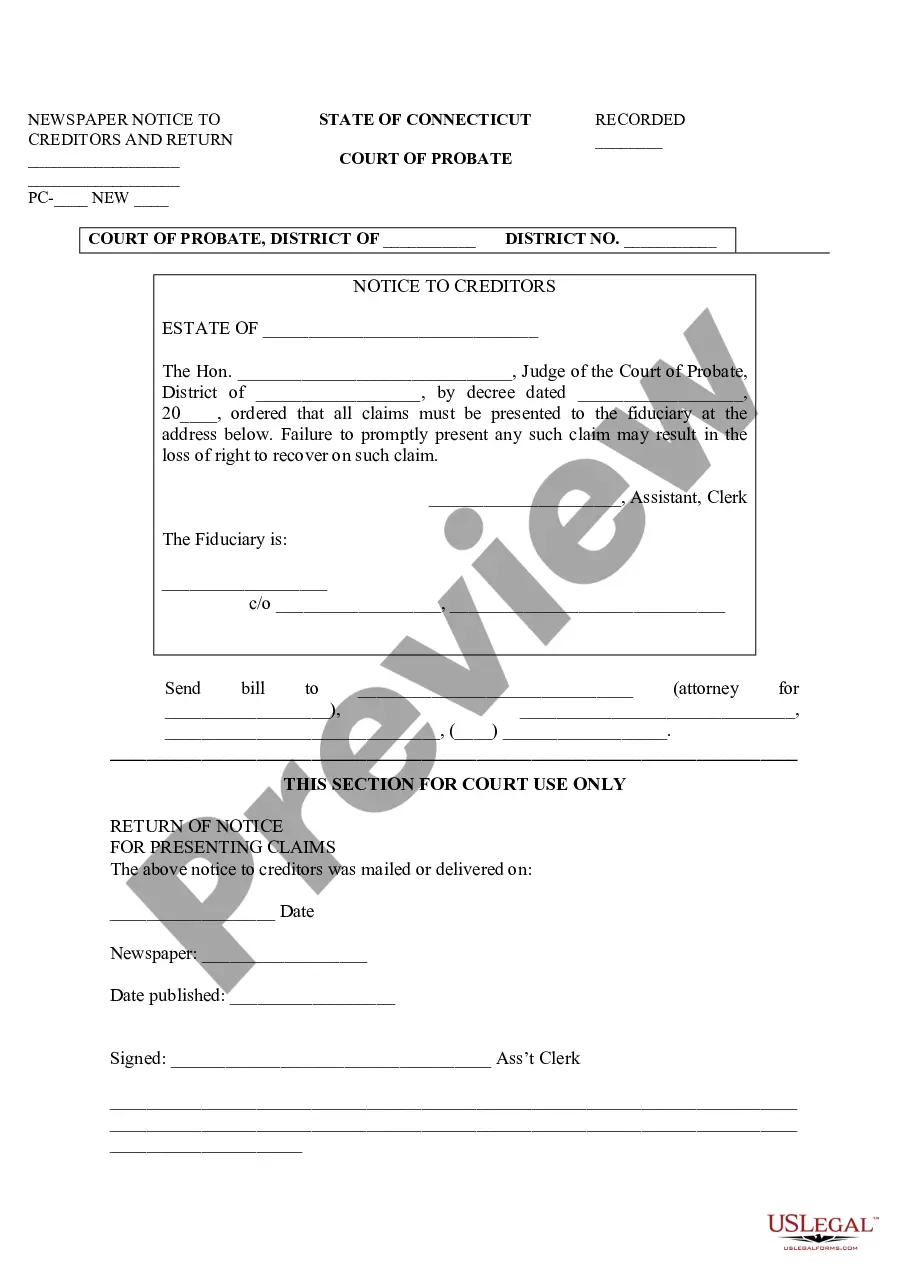
A Notice to Creditors is a public announcement made to inform creditors and debtors about the estate of a deceased person. This legal form is crucial for ensuring that all claims related to the deceased's estate are presented in a timely manner to those responsible for managing the estate. Unlike other estate-related forms, this notice specifically addresses the duty to notify potential claimants and highlights the consequences of failing to file a claim promptly.
Key components of this form
- Identification of the court and district where the notice is filed.
- Name of the deceased and the fiduciary responsible for the estate.
- Date by which claims must be presented to the fiduciary.
- Details regarding the delivery or mailing of the notice.
- Clerk's information for official records and communication.

When to use this document
This form is used when an estate is being settled after a person has passed away. It is essential to notify all creditors so they can present their claims within the specified time frame. This helps prevent the loss of rights for creditors who may wish to recover debts owed by the deceased. Use this notice to initiate the claims process as part of the probate proceedings.
Who can use this document
- The executor or administrator of the deceased's estate.
- Legal representatives handling the probate process.
- Anyone managing the financial obligations and debts of the deceased.
Completing this form step by step
- Identify the court and district where the probate case is filed.
- Fill in the name of the deceased and the appointed fiduciary.
- Specify the deadline for presenting claims.
- Provide the address where creditors can send their claims.
- Include details about the publication of the notice in local newspapers.
Does this document require notarization?
This form does not typically require notarization unless specified by local law. It is designed to be filed with the probate court as part of the estate administration process.
Get your form ready online
Our built-in tools help you complete, sign, share, and store your documents in one place.
Make edits, fill in missing information, and update formatting in US Legal Forms—just like you would in MS Word.
Download a copy, print it, send it by email, or mail it via USPS—whatever works best for your next step.
Sign and collect signatures with our SignNow integration. Send to multiple recipients, set reminders, and more. Go Premium to unlock E-Sign.
If this form requires notarization, complete it online through a secure video call—no need to meet a notary in person or wait for an appointment.
We protect your documents and personal data by following strict security and privacy standards.

Make edits, fill in missing information, and update formatting in US Legal Forms—just like you would in MS Word.

Download a copy, print it, send it by email, or mail it via USPS—whatever works best for your next step.

Sign and collect signatures with our SignNow integration. Send to multiple recipients, set reminders, and more. Go Premium to unlock E-Sign.

If this form requires notarization, complete it online through a secure video call—no need to meet a notary in person or wait for an appointment.

We protect your documents and personal data by following strict security and privacy standards.
Mistakes to watch out for
- Failing to include the correct name of the deceased and fiduciary.
- Not providing the appropriate deadline for claims submission.
- Neglecting to properly notify all relevant creditors.
- Overlooking the requirement to publish the notice in the appropriate newspaper.
Advantages of online completion
- Access to professionally drafted legal language that meets state requirements.
- Time-saving; quickly download and fill out the form at your convenience.
- Edit and customize the form to suit your specific needs.
- Reliable access to legal forms without the need for a physical visit to a law office.
Legal use & context
- This form serves as an official notice to creditors, ensuring compliance with state probate laws.
- Failure to publish this notice may affect the ability of creditors to claim their debts.
- The timeline for claims submission is legally binding and must be adhered to by all parties involved.
What to keep in mind
- The Notice to Creditors is essential for managing claims against a deceased person's estate.
- Carefully follow the instructions to avoid legal issues during the probate process.
- Ensure timely publication and notification of creditors to uphold their rights to claim debts.
Looking for another form?
Form popularity
FAQ
To post a notice to creditors in Connecticut, you must publish the notice in a local newspaper for three consecutive weeks. You should also provide the notice to known creditors directly. This dual approach ensures broader awareness and compliance with legal requirements. Consider using services from USLegalForms to simplify the preparation and distribution of such notices.
To write a notice to your creditors, you should include essential information such as the name of the deceased, the estate’s representative, and details surrounding the claims process. Make sure to clearly state the deadline for creditors to submit their claims, referencing the Connecticut Notice to Creditors. This will help ensure that all creditors receive fair notice and can respond in a timely manner. Platforms like USLegalForms offer templates and guidance to assist you in crafting an effective notice.
Creditors in Connecticut have six months from the date of the Connecticut Notice to Creditors to file their claims. This deadline is crucial for ensuring that all debts are settled appropriately before the estate is distributed. As an estate administrator, being aware of this timeframe allows you to plan accordingly. Utilizing resources like USLegalForms can help streamline the process of managing claims.
In Connecticut, creditors typically have a limited time frame to pursue claims against an estate. Generally, they have up to seven months from the date of the estate's notice to creditors to file a claim. This time limit helps ensure the timely resolution of the estate's affairs. By understanding the timeline, you can better manage your responsibilities when handling the Connecticut Notice to Creditors.
Yes, creditors must notify you of any debts they claim you owe. The Connecticut Notice to Creditors mandates that creditors communicate the details of any claims, including amounts and terms, in a clear manner. Being aware of your rights in these matters is crucial, and using resources like USLegalForms can assist you in managing debt notifications effectively. This ensures you remain informed and have the ability to address any outstanding obligations.
Creditors are typically notified of bankruptcies shortly after the bankruptcy filing. In Connecticut, the court sends a notice to creditors, usually within a few weeks, explaining the next steps in the bankruptcy process. Prompt notification allows creditors to understand their options and assess their claims. By knowing about the Connecticut Notice to Creditors, you can stay informed and prepared.
A notice to creditors is an important legal document informing creditors of a deceased person's estate. In Connecticut, this notice provides essential details about the probate process and invites creditors to submit claims for debts owed. Understanding the Connecticut Notice to Creditors can help you navigate your rights and responsibilities as a creditor or beneficiary. Utilizing platforms like USLegalForms can simplify accessing templates and guides for this process.
The notice to creditors in Connecticut generally runs for a period of six months, beginning from the date of publication. During this time, creditors can present their claims against the estate. Adhering to the timelines associated with the Connecticut Notice to Creditors is vital for effectively managing the estate and addressing any outstanding debts.
To give notice to creditors, you need to draft a Notice to Creditors according to Connecticut law and then publish it in a local newspaper. Additionally, file it with the probate court to officialize the notification process. By using the Connecticut Notice to Creditors format, you ensure that all potential creditors receive the necessary information in a timely manner.
Informing creditors of someone's death involves sending a formal notice to creditors, which is a required legal step in the probate process. This notice should provide key details about the deceased and outline how creditors can claim any debts owed. Following the proper procedures under the Connecticut Notice to Creditors framework will ensure that all necessary parties are informed.