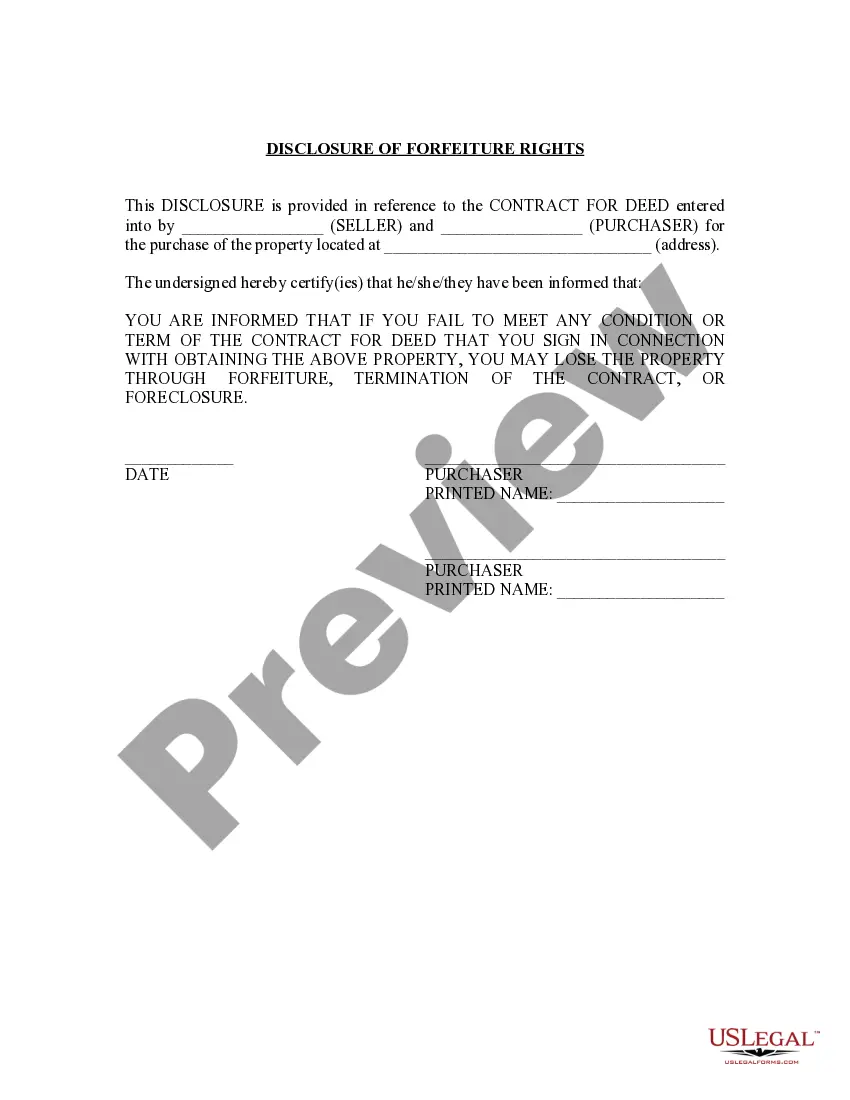
This Disclosure Notice of Forfeiture Rights form is provided by the Seller to the Purchaser at the time of the contract signing. Mandatory use of this form is rarely required; however, this form provides the Purchaser with a good understanding of forfeiture and how he or she can be affected by it in the event of a default. Should the courts become involved, the use of this form will help the Seller show that the Purchaser understood his side of the bargain and may help the Purchaser pursue the remedy of forfeiture if challenged by the Purchaser.
Connecticut Seller's Disclosure of Forfeiture Rights for Contract for Deed
State:
Connecticut
Control #:
CT-00470-22
Format:
Word;
Rich Text
Instant download
Description
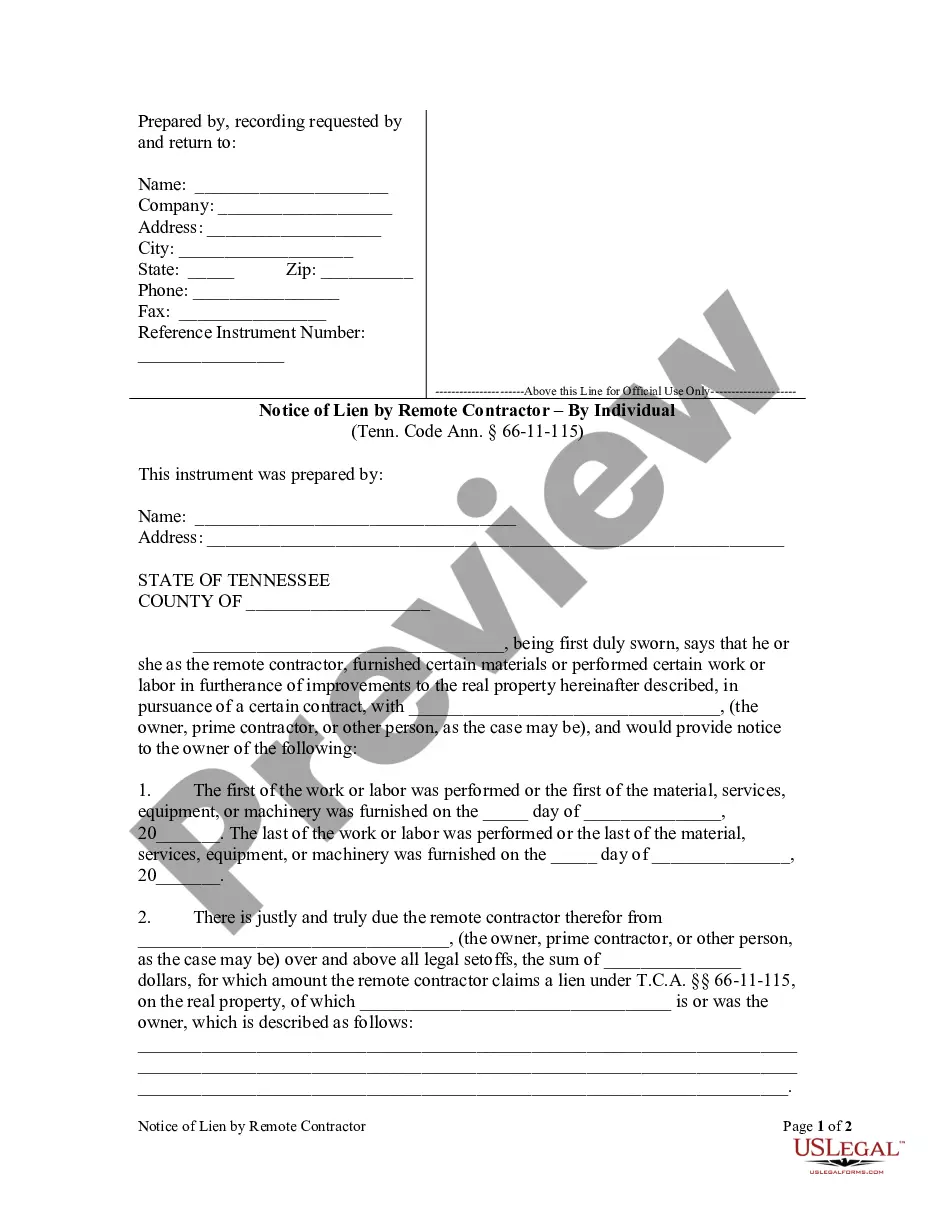
How to fill out Connecticut Seller's Disclosure Of Forfeiture Rights For Contract For Deed?
Utilize US Legal Forms to acquire a downloadable Connecticut Seller's Acknowledgment of Forfeiture Rights for Contract for Deed.
Our court-compliant documents are prepared and frequently refreshed by qualified attorneys. Ours is the most extensive Forms repository available online, offering reasonably priced and precise samples for clients, legal practitioners, and small to medium-sized businesses.
The documents are organized into state-specific categories, and many can be previewed before being saved.
Establish your account and pay through PayPal or credit card. Download the template to your device and feel free to use it repeatedly. Use the Search feature if you wish to find a different document template. US Legal Forms provides a vast array of legal and tax templates and packages for both business and personal purposes, including Connecticut Seller's Acknowledgment of Forfeiture Rights for Contract for Deed. Over three million users have successfully used our platform. Choose your subscription plan and access high-quality forms within just a few clicks.
- To obtain samples, customers must hold a subscription and Log In to their accounts.
- Click Download beside any template of your choice and locate it in My documents.
- For those without a subscription, follow these steps to easily access and download Connecticut Seller's Acknowledgment of Forfeiture Rights for Contract for Deed.
- Ensure you have selected the correct template concerning the necessary state.
- Examine the document by reading its description and utilizing the Preview option.
- Click Buy Now if it’s the template you require.
Form popularity
FAQ
The Property Condition Disclosure Act requires the seller of residential real property to cause this disclosure statement or a copy thereof to be delivered to a buyer or buyer's agent prior to the signing by the buyer of a binding contract of sale.
The law exempts landlords from providing written disclosure to prospective tenants if the presence of mold was remediated according to the mold remediation guidelines (Cal. Health & Safety Code § 26147).
A: Some states require just about all sellers to provide a seller disclosure form to a buyer, but in some cases, a seller is not required to deliver the disclosure. For example, if the seller's home is part of an estate or a foreclosure sale by a sheriff or court, a seller disclosure form may not be required.
Connecticut law does not consider death, no matter how it occurred, to be a material fact that is required to be disclosed. If a buyer asks the seller in writing, then the seller and/or agent must disclose the death, if they know.
Property disclosure statements essentially outline any flaws that the home sellers (and their real estate agents) are aware of that could negatively affect the home's value. These statements are required by law in most areas of the country so buyers can know a property's good and bad points before they close the deal.
In Connecticut, Delaware, Georgia, New Hampshire, New Jersey and South Carolina, sellers must disclose a death on the property only if asked.
The PCDS is a disclosure document a seller is required by law to complete and provide the buyer in addition to the purchase agreement. The PCDS forms part of the purchase agreement and the buyer is permitted to rely on the seller's disclosure as set out in it.
A disclosure document can be important for both home buyers and sellers. When an owner sells a property, they are typically required to disclose information in a written document.In general, a disclosure document is supposed to provide details about a property's condition that might negatively affect its value.
Connecticut law does not consider death, no matter how it occurred, to be a material fact that is required to be disclosed. If a buyer asks the seller in writing, then the seller and/or agent must disclose the death, if they know.