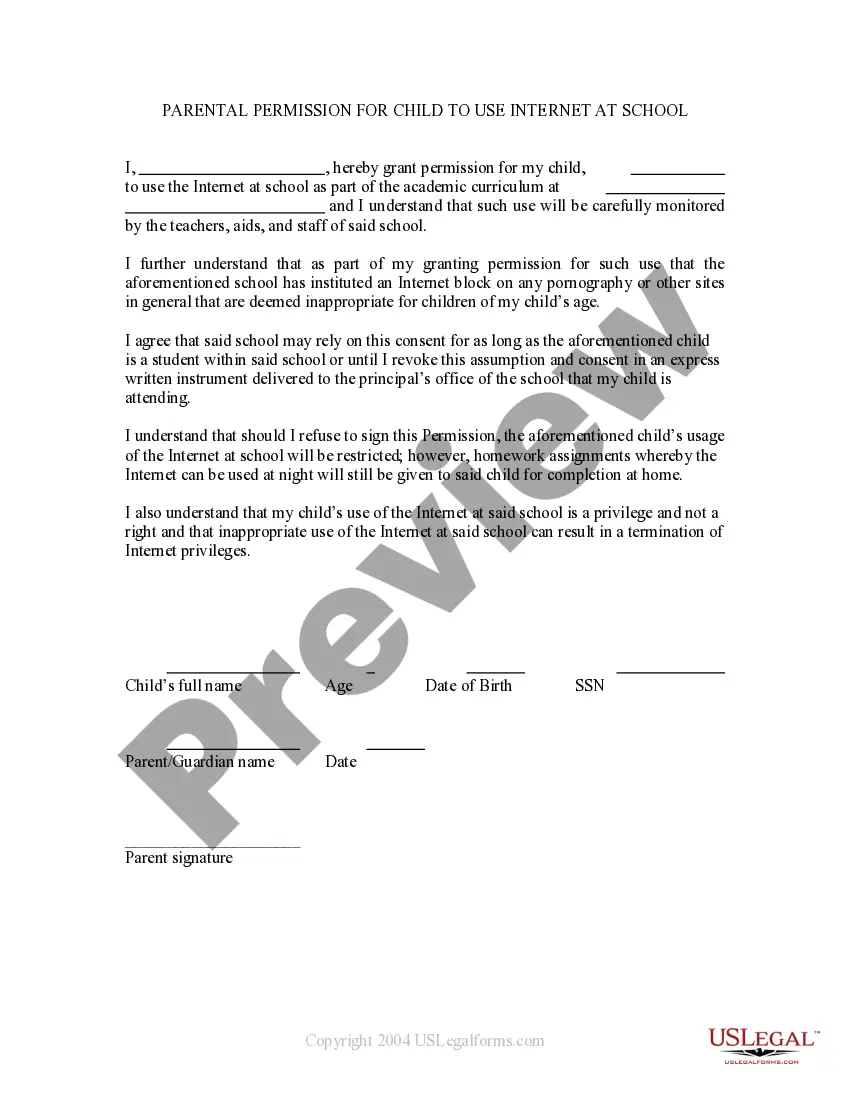
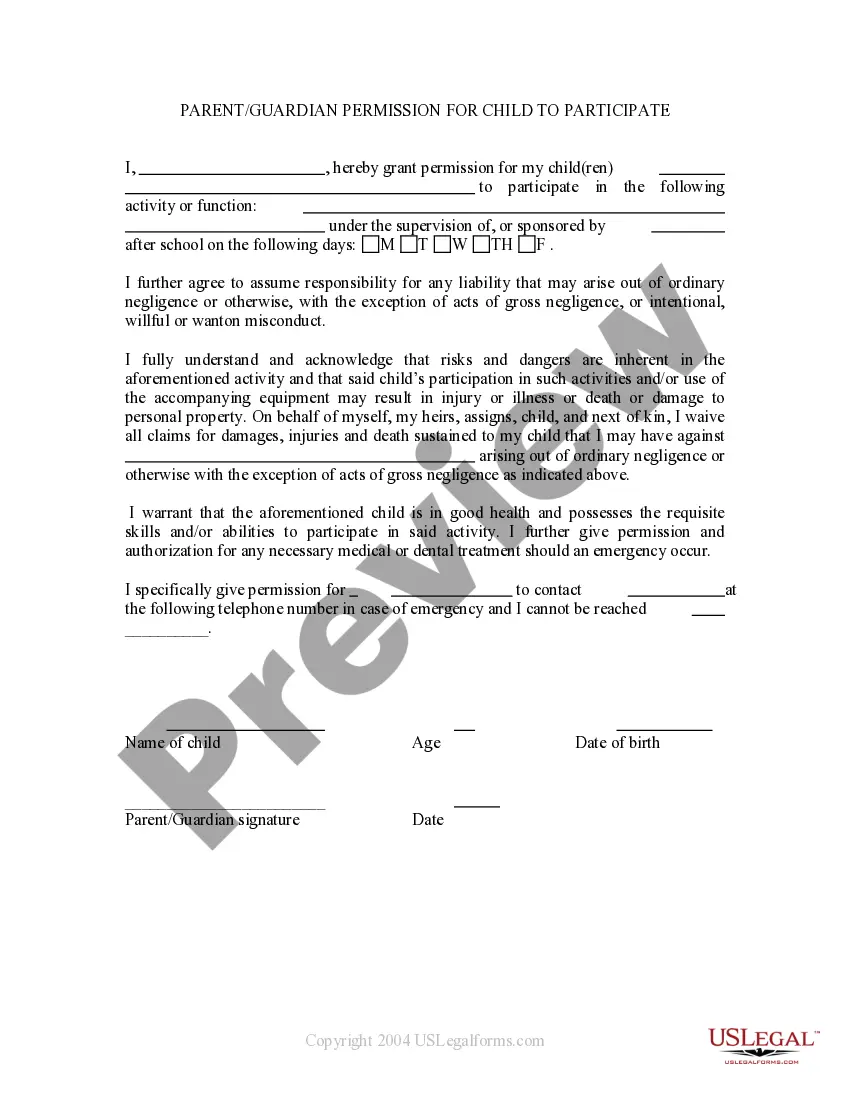
This form is signed by a parent who is granting permission for his/her child to use the Internet at school as part of the academic curriculum, and under the supervision of a teacher, aid, administrator etc.
Colorado Parental Permission For Child To Use Internet At School
Category:
State:
Multi-State
Control #:
US-PRM-28
Format:
Word;
Rich Text
Instant download
Description
How to fill out Parental Permission For Child To Use Internet At School?
US Legal Forms - one of the most important collections of legal documents in the United States - offers a vast selection of legal form templates you can download or create. By using the website, you can access thousands of forms for business and personal purposes, organized by categories, states, or keywords. You can obtain the latest forms such as the Colorado Parental Consent For Child To Use Internet At School in just moments.
If you already have a membership, Log In and retrieve the Colorado Parental Consent For Child To Use Internet At School from the US Legal Forms library. The Download button will appear on every form you view. You can access all previously downloaded forms in the My documents section of your account.
If you want to utilize US Legal Forms for the first time, here are simple steps to get started: Make sure you have selected the correct form for your city/county. Click the Review button to examine the form's details. Read the form description to confirm that you have chosen the appropriate form. If the form does not meet your needs, use the Search field at the top of the screen to find one that does. Once you are satisfied with the form, confirm your selection by clicking the Buy now button. Then, select the pricing plan you prefer and provide your information to sign up for an account. Complete the transaction. Use your credit card or PayPal account to finalize the transaction. Choose the format and download the form to your device. Make edits. Fill out, modify, and print and sign the downloaded Colorado Parental Consent For Child To Use Internet At School. Every template you add to your account has no expiration date and is yours forever. Therefore, if you wish to download or print another copy, simply go to the My documents section and click on the form you need.
US Legal Forms provides a comprehensive resource for all your legal documentation needs, ensuring you have the right forms at your fingertips.
Start your journey with US Legal Forms today to streamline your legal processes and access essential forms effortlessly.
- Gain access to the Colorado Parental Consent For Child To Use Internet At School with US Legal Forms, the most extensive collection of legal document templates.
- Utilize thousands of professional and state-specific templates that cater to your business or personal needs and requirements.
- Ensure proper selection of forms based on your locality.
- Easily navigate through the website for quick access to required documents.
- Enjoy the convenience of having permanent access to downloaded forms.
- Follow simple instructions to manage your account and documents effectively.
Form popularity
FAQ
Yes, it is advisable for parents to monitor and manage their children's online activities. Setting boundaries helps protect children from inappropriate content and online dangers. By actively engaging in their digital experiences, parents can foster safe internet habits. Understanding Colorado Parental Permission For Child To Use Internet At School can guide you in establishing those rules effectively.
The Colorado Privacy Act protects the personal information of minors by establishing strict guidelines for data collection and usage. This law requires organizations to obtain parental consent before processing data from children under 18. The act aims to enhance online safety and privacy for younger users. Familiarizing yourself with Colorado Parental Permission For Child To Use Internet At School ensures you are aware of your rights and responsibilities regarding your child's online presence.
To facilitate internet access for children at school, parents should first check with their school district about available programs. Many schools offer resources to help families secure internet access, especially for remote learning. Additionally, parents can explore community initiatives and grants designed to support digital education. Utilizing Colorado Parental Permission For Child To Use Internet At School ensures you can navigate these options effectively.
In Colorado, children under the age of 13 require parental permission for online activities, including internet use at school. The law emphasizes the importance of safeguarding minors' personal information. Therefore, parents must grant consent for their children to engage in digital platforms. Understanding Colorado Parental Permission For Child To Use Internet At School helps ensure compliance with these regulations.
Legislation signed into law June 30 allows parents and students over 18 to decide for themselves whether they or their kids should repeat their 2020-21 grade. In other years, the decision to hold students back is made by school officials and teachers.
A school is perfectly within its rights to refuse to release a child to a parent during school hours. Once school hours are over it is another matter. At that point they must release the child to anyone who has PR unless there is a court order stating otherwise.
Consider these other FERPA violation examples:Emailing protected student information to everyone in the class.Including social security numbers on shared documents.Posting grades and identifying information in public.Publicly disclosing a student athlete's academic status.
Colorado law (2-4-401(6)) defines a minor as a person who has not attained the age of 21, except as otherwise provided in the express language of another statute. The age of majority is the age when young people are considered adults for most matters.
The answer is yes!A parent's right to observe his or her child during the school day is supported by federal law.
The court declared that students and teachers do not shed their constitutional rights to freedom of speech or expression at the schoolhouse gate. The First Amendment ensures that students cannot be punished for exercising free speech rights, even if school administrators don't approve of what they are saying.