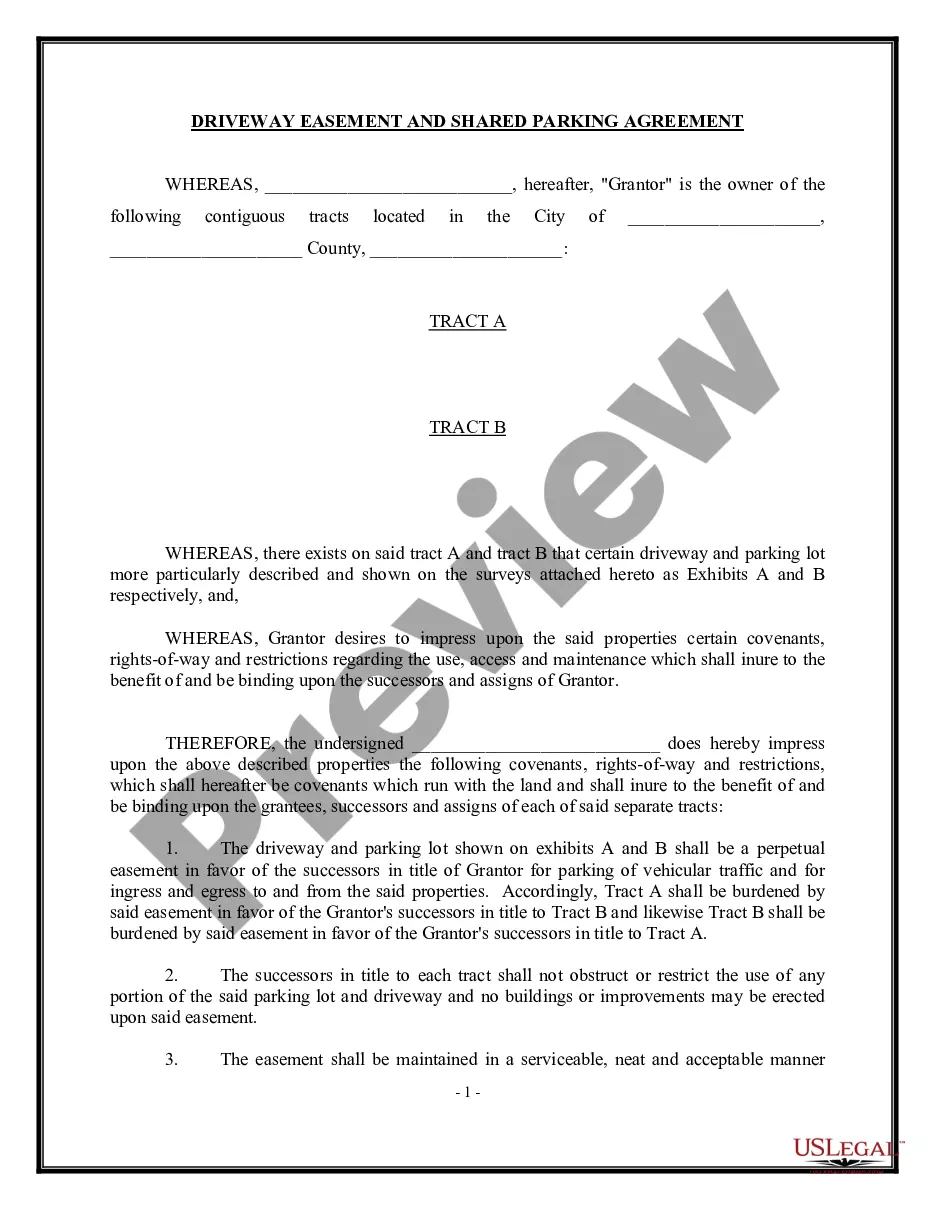
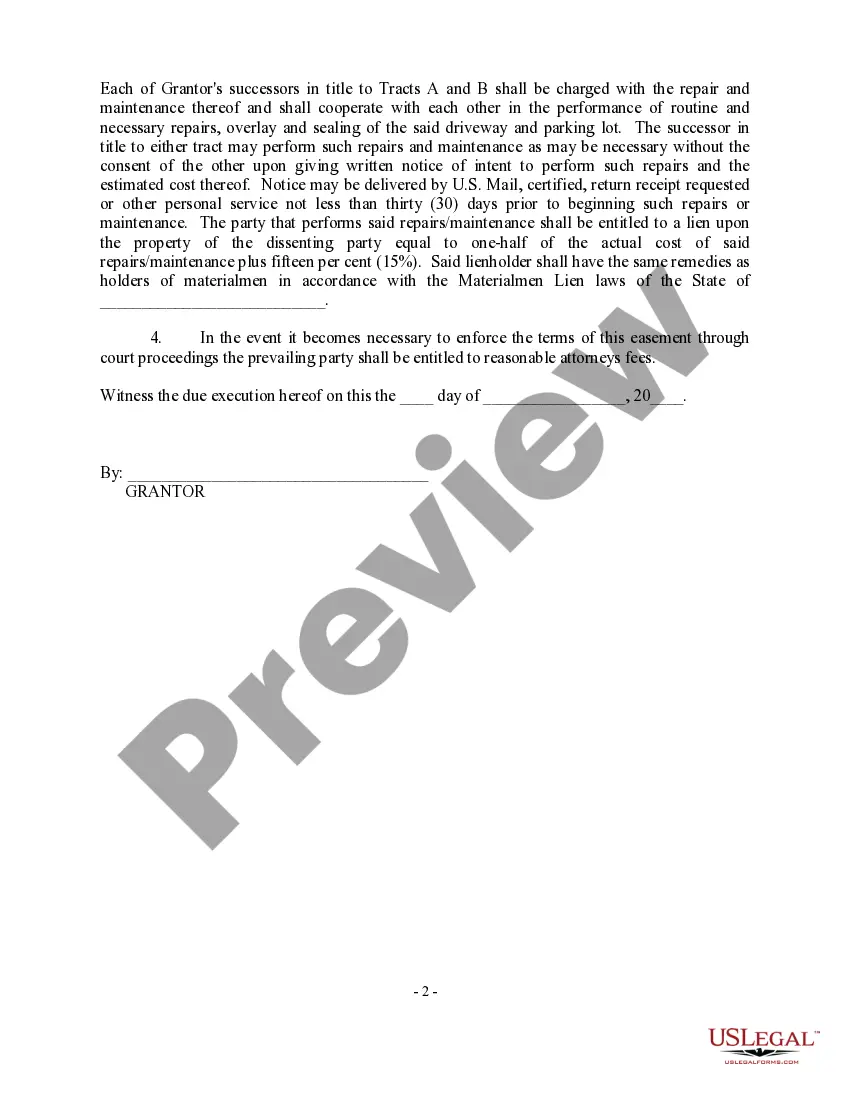
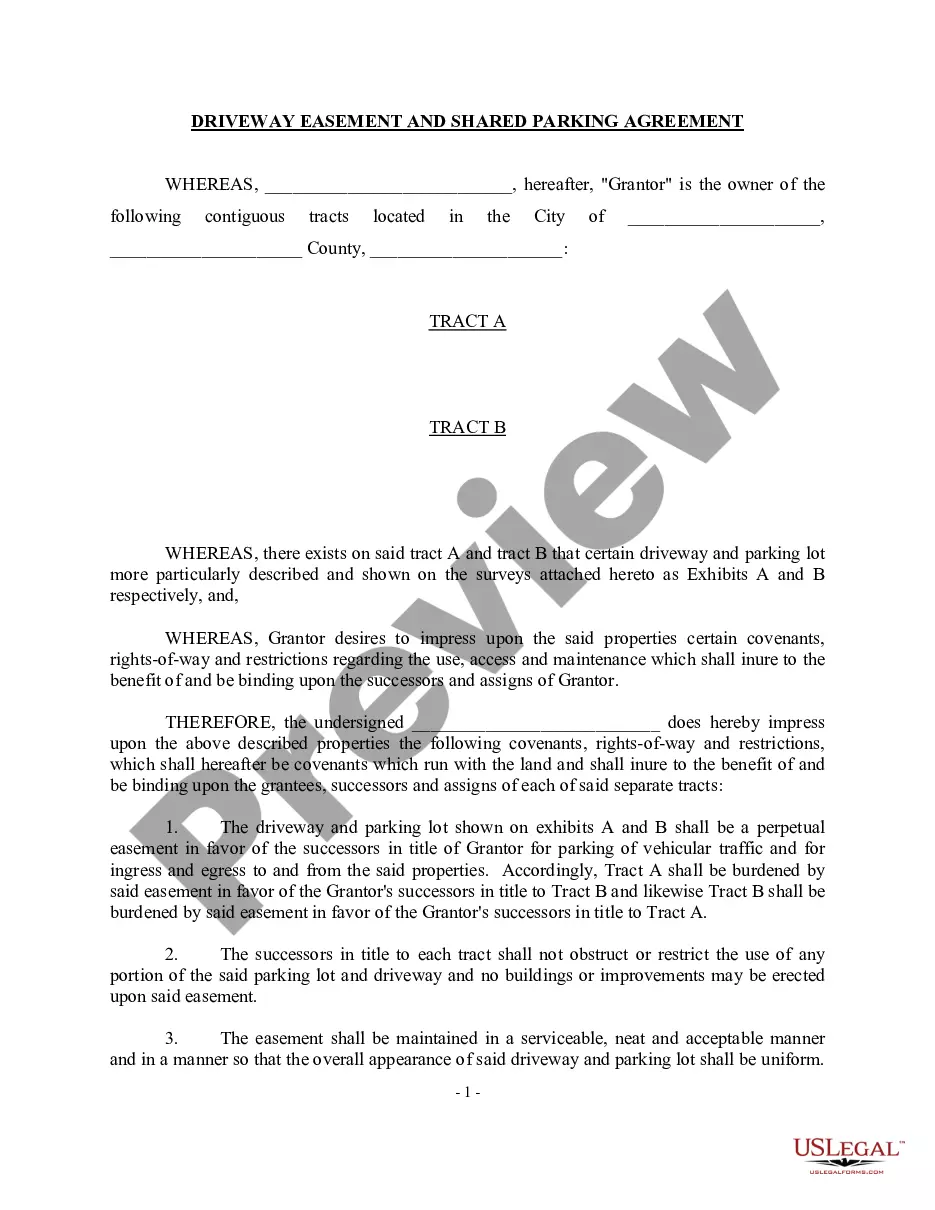
This form is a Driveway Easement and Shared Parking Agreement. The grantor conveys to the grantee certain covenants, rights-of-way, and restrictions regarding the use of a driveway and parking lot.
Colorado Easement - Shared Parking
State:
Multi-State
Control #:
US-00498
Format:
Word;
Rich Text
0 downloads
Description
Free preview
Get your form ready online
Our built-in tools help you complete, sign, share, and store your documents in one place.
Built-in online Word editor
Make edits, fill in missing information, and update formatting in US Legal Forms—just like you would in MS Word.
Export easily
Download a copy, print it, send it by email, or mail it via USPS—whatever works best for your next step.
E-sign your document
Sign and collect signatures with our SignNow integration. Send to multiple recipients, set reminders, and more. Go Premium to unlock E-Sign.
Notarize online 24/7
If this form requires notarization, complete it online through a secure video call—no need to meet a notary in person or wait for an appointment.
Store your document securely
We protect your documents and personal data by following strict security and privacy standards.

Make edits, fill in missing information, and update formatting in US Legal Forms—just like you would in MS Word.

Download a copy, print it, send it by email, or mail it via USPS—whatever works best for your next step.

Sign and collect signatures with our SignNow integration. Send to multiple recipients, set reminders, and more. Go Premium to unlock E-Sign.

If this form requires notarization, complete it online through a secure video call—no need to meet a notary in person or wait for an appointment.

We protect your documents and personal data by following strict security and privacy standards.
Looking for another form?
How to fill out Easement - Shared Parking?
It is feasible to spend hours online trying to locate the legal document template that complies with the state and federal requirements you need.
US Legal Forms provides thousands of legal templates that have been reviewed by experts.
You can download or print the Colorado Easement - Shared Parking from our platform.
If available, use the Preview button to view the document template as well. If you wish to find a different version of your form, use the Search field to locate the template that meets your needs. Once you have found the template you want, click Buy now to proceed. Choose the pricing plan you require, enter your details, and create a free account on US Legal Forms. Complete the transaction. You may use your credit card or PayPal account to pay for the legal document. Select the format of your document and download it to your device. Make modifications to your document if possible. You can complete, edit, sign, and print the Colorado Easement - Shared Parking. Download and print thousands of document templates using the US Legal Forms website, which offers the largest collection of legal forms. Utilize professional and state-specific templates to address your business or personal needs.
- If you already have a US Legal Forms account, you can Log In and click the Download button.
- Then, you can complete, modify, print, or sign the Colorado Easement - Shared Parking.
- Every legal document template you purchase is yours permanently.
- To obtain an additional copy of a purchased form, go to the My documents section and click the corresponding button.
- If you are using the US Legal Forms website for the first time, follow the simple instructions below.
- First, ensure you have selected the correct document template for the state/town of your choice.
- Review the form summary to confirm you have chosen the appropriate template.
Form popularity
FAQ
Green, 673 P. 2d 380, 383 (Colo. App. 1983) (?[T]he owner of the easement, or dominant estate, may do whatever is reasonably necessary to permit full use and enjoyment of the easement including the exercise of rights of ingress and egress for maintenance, operation, and repair.?). .
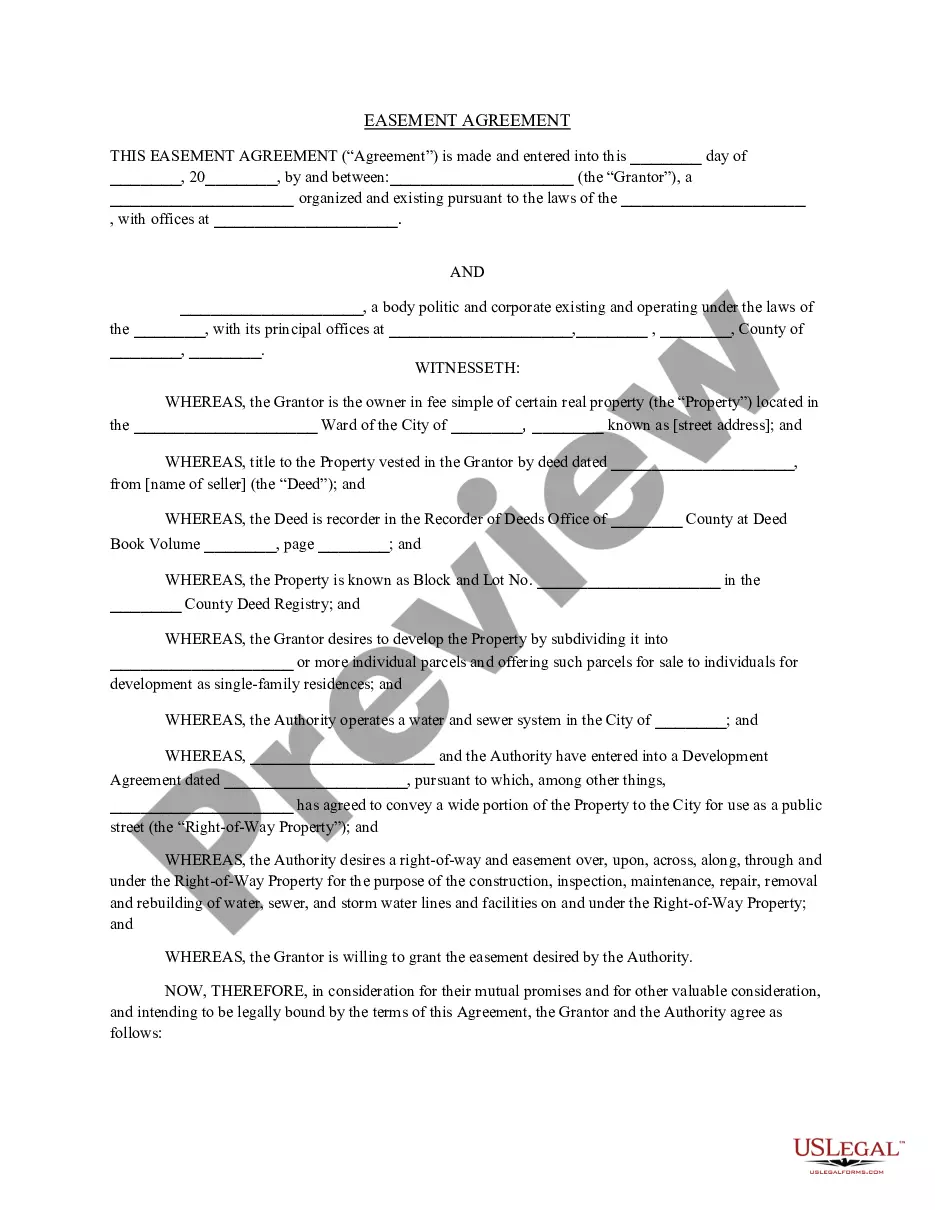
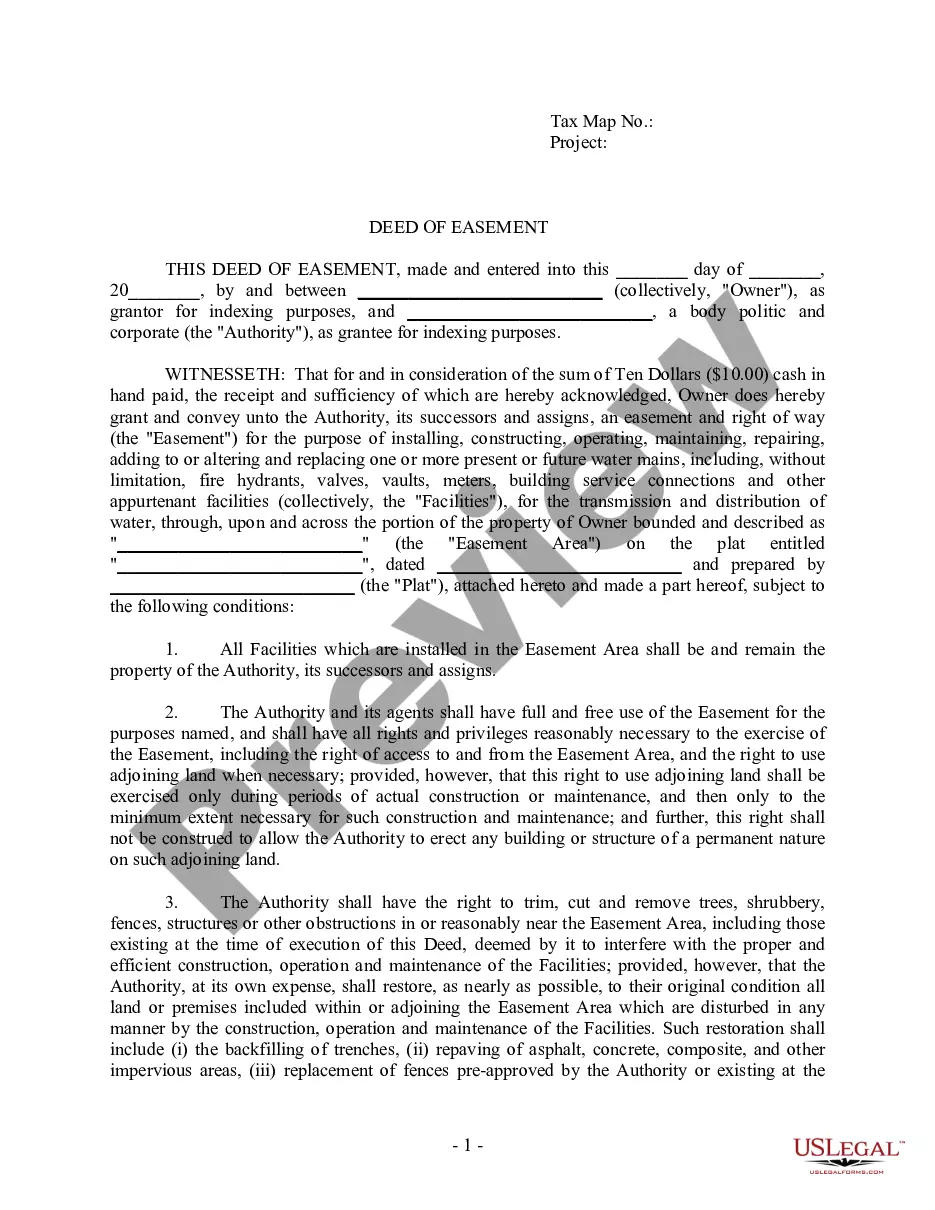
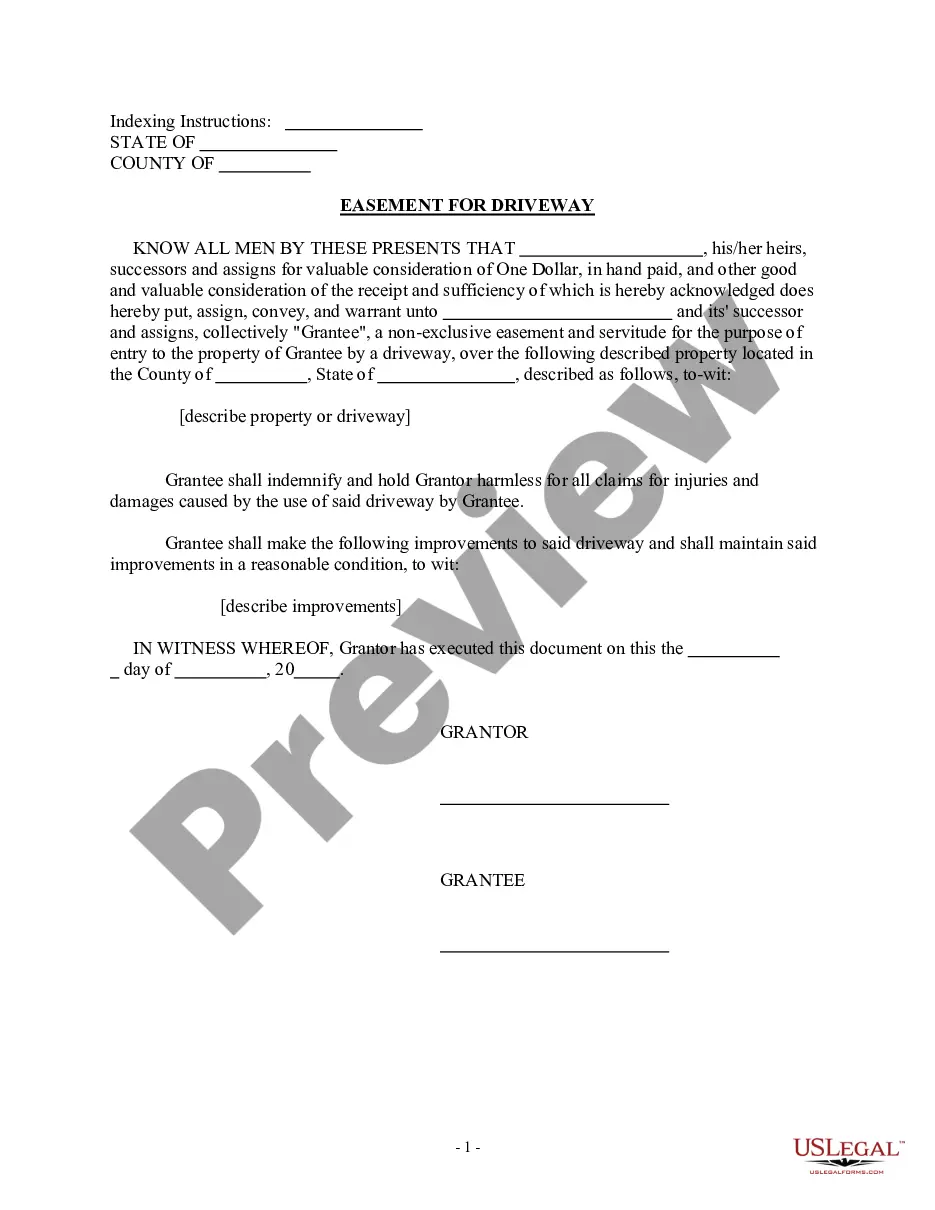
An easement is defined as the grant of a nonpossessory property interest that grants the easement holder permission to use another person's land.
It's a voluntary legal agreement between a landowner and another entity (usually a land trust) that places restrictions on the use of a piece of property. Conservation easements, including those that GOCO funds, restrict those uses forever, permanently conserving the property.
In Colorado a prescriptive easement applies when someone has made use of access to a property continuously, without the owner's consent, with no attempt of concealment of the use or access, for a period of 18 years. Most commonly, this is applied to thoroughfares crossing over someone's property.
The Property Owner continues to own the land and has only given up defined rights on the portion of land used for the easement. Maintenance of the property within the easement is the responsibility of the Property Owner.
A right of way allows parties to travel across a property?this may be granted to the general public or to a specific entity. Right of ways are more restrictive than easements because they do not allow the public or entity to use the property, just move through it.