Colorado Request for Satisfaction of Lien by Individual
Understanding this form
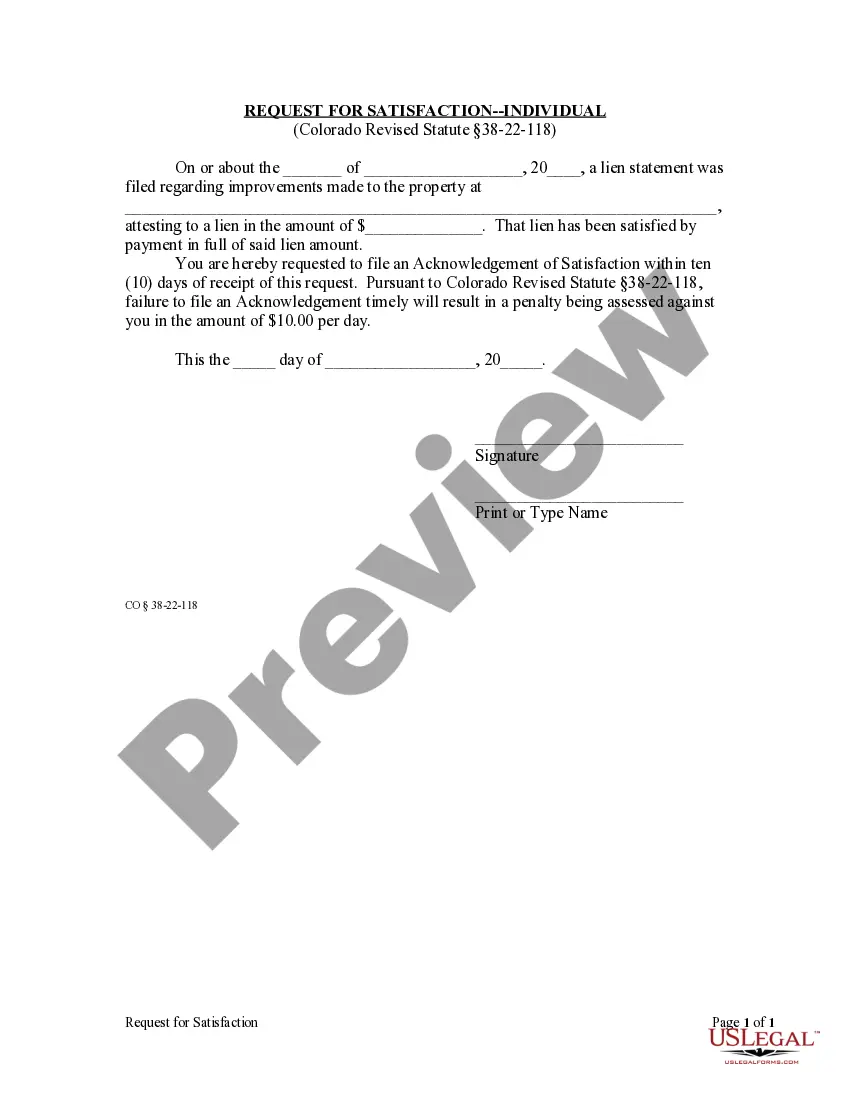
The Request for Satisfaction of Lien by Individual is a legal document used by property owners to formally request the removal of a lien after paying the owed amount. Unlike similar forms, which may address different types of liens or requests, this form specifically addresses a lien statement that has been satisfied by payment. By submitting this form, property owners ensure that their financial obligation is officially acknowledged as fulfilled, which is crucial for property title clearance.
What’s included in this form
- Property description: Include the full address of the property linked to the lien.
- Amount of lien: Specify the total amount that was first claimed in the lien statement.
- Date of lien filing: Note the date when the lien statement was officially filed.
- Payment confirmation: Acknowledge that the lien has been satisfied in full.
- Request for Acknowledgement: State the demand for an Acknowledgement of Satisfaction to be filed within ten days.
- Signature and name: Provide your signature along with printed or typed name to validate the request.
When this form is needed
This form is used when a property owner has paid off a lien in full and wishes to clear the associated lien from their property records. It may be used in situations such as after completing a construction project or settling a debt where a contractor or creditor previously placed a lien on the property. By requesting the satisfaction of the lien, the property owner can ensure their title is clear for future transactions.
Who this form is for
- Property owners who have had a lien placed on their property.
- Individuals who have paid the debt associated with a lien statement.
- Anyone needing to clear a lien from public records for property transactions.
Completing this form step by step
- Identify the date when the lien statement was filed.
- Provide the complete address of the property affected by the lien.
- Fill in the amount that was claimed in the lien statement.
- Sign and date the form to validate your request.
- Send the form to the lien claimant and keep a copy for your records.
Does this form need to be notarized?
Notarization is not commonly needed for this form. However, certain documents or local rules may make it necessary. Our notarization service, powered by Notarize, allows you to finalize it securely online anytime, day or night.
Get your form ready online
Our built-in tools help you complete, sign, share, and store your documents in one place.
Make edits, fill in missing information, and update formatting in US Legal Forms—just like you would in MS Word.
Download a copy, print it, send it by email, or mail it via USPS—whatever works best for your next step.
Sign and collect signatures with our SignNow integration. Send to multiple recipients, set reminders, and more. Go Premium to unlock E-Sign.
If this form requires notarization, complete it online through a secure video call—no need to meet a notary in person or wait for an appointment.
We protect your documents and personal data by following strict security and privacy standards.

Make edits, fill in missing information, and update formatting in US Legal Forms—just like you would in MS Word.

Download a copy, print it, send it by email, or mail it via USPS—whatever works best for your next step.

Sign and collect signatures with our SignNow integration. Send to multiple recipients, set reminders, and more. Go Premium to unlock E-Sign.

If this form requires notarization, complete it online through a secure video call—no need to meet a notary in person or wait for an appointment.

We protect your documents and personal data by following strict security and privacy standards.
Mistakes to watch out for
- Failing to accurately fill in the property address.
- Not including the original lien amount or date of filing.
- Forgetting to sign and date the form before submission.
- Ignoring the requirement to request the Acknowledgement within the specified time frame.
Why complete this form online
- Convenience: Easily fill out the form from any location.
- Editability: Make corrections immediately before final submission.
- Reliability: Forms are drafted by licensed attorneys for legal compliance.
Looking for another form?


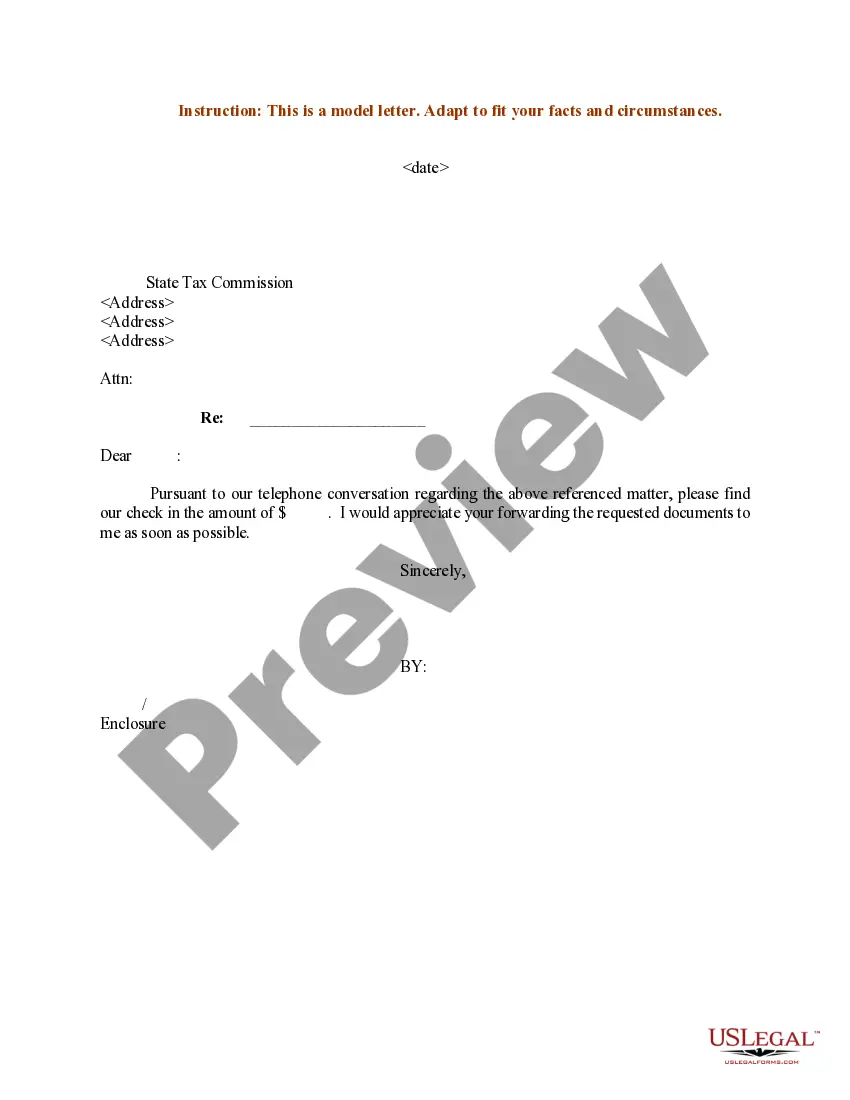
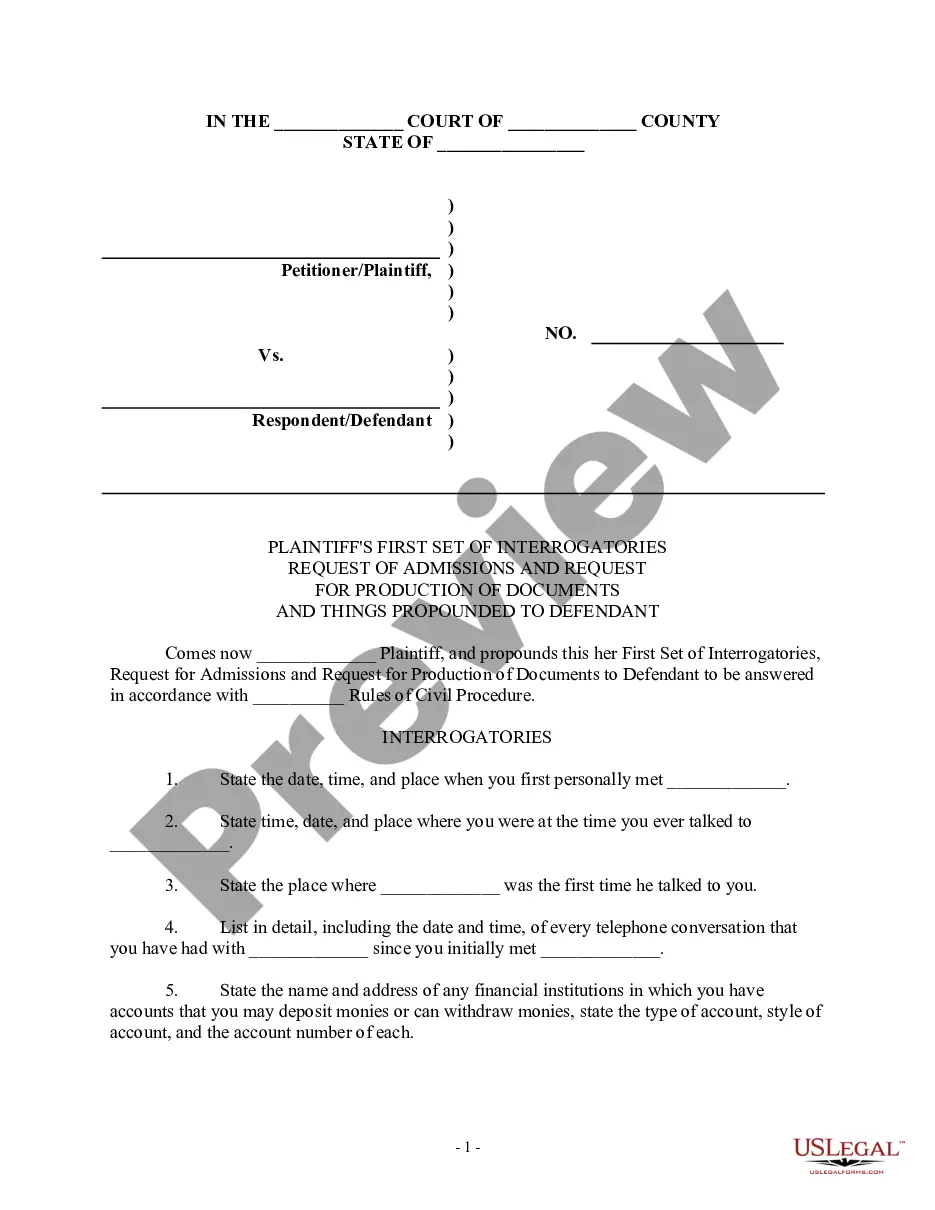
Form popularity
FAQ
Colorado law protects certain types of assets from being seized in a judgment. This includes essential personal items, basic household goods, and certain types of retirement accounts. Furthermore, the law also safeguards a portion of your wages and social security benefits from being collected upon. Knowing what is exempt can prevent wrongful seizures and allows you to navigate your financial situation confidently.
To file a satisfaction of judgment in Colorado, you need to complete the appropriate paperwork, which is often a form called the Colorado Request for Satisfaction of Lien by Individual. You should file this form with the court that issued the original judgment. After filing, ensure you provide a copy to the judgment debtor, confirming that the judgment has been satisfied. Using uslegalforms can simplify this process as it provides easy access to the necessary documents.
When writing a letter of intent to lien, be sure to include your contact information, the debtor's details, and a clear statement of the debt owed. Clearly outline the property you intend to place a lien on and the amount due. Taking the time to draft a comprehensive letter can simplify the process significantly. Once the debt is settled, don’t forget to file a Colorado Request for Satisfaction of Lien by Individual to formally close the matter.
In Colorado, you typically have six months to file an intent to lien after the debt becomes due. It’s essential to act swiftly in order to protect your rights. After filing the intent, you should also be prepared to file the actual lien promptly. Once the lien is satisfied, you can then file a Colorado Request for Satisfaction of Lien by Individual to clear the record.
To file a lien with intent in Colorado, you must complete the required form and submit it to the county clerk where the property is located. The form must include specific information about the property and the debt. After filing, consider using a Colorado Request for Satisfaction of Lien by Individual when the debt is repaid so that the public record reflects the satisfaction. This helps maintain accurate property records.
In Colorado, several types of personal property can be seized under a judgment, including bank accounts, wages, and other assets. Generally, any non-exempt property that belongs to the debtor may be subject to seizure. This process often requires a formal legal proceeding, during which you can utilize forms like the Colorado Request for Satisfaction of Lien by Individual to inform the court of satisfaction once debts are settled. Awareness of what can be seized is essential for any creditor.
To release a lien in Colorado, the creditor must file a Colorado Request for Satisfaction of Lien by Individual once the underlying obligation has been fully satisfied. This document formally indicates that the debtor has met their requirements and that the lien is no longer in effect. Ensuring that this is filed correctly is important for restoring the debtor's title to their property. For assistance with filing the right forms, consider using resources from USLegalForms, which simplifies the process.
Satisfaction of judgment refers to the conclusion of a legal process where the debtor meets the judgment requirements set by the court. This results in the case being marked as complete, freeing the debtor from further liabilities concerning that judgment. In Colorado, securing a formal acknowledgment is essential to maintain clear financial records. USLegalForms can help you through this necessary legal formality.
Acknowledgment of satisfaction of judgment signifies that all terms of a judgment have been completed. It serves as official documentation that confirms the creditor's acceptance of payment and discharge of any claims. This prevents further collection actions against the debtor and allows for financial fresh starts. For those navigating this process, USLegalForms offers user-friendly templates and guidance.
When a case is satisfied, it means that the obligations set by a court judgment have been fully met. This typically involves the debtor paying the specified amount to the creditor, resulting in the legal claim being resolved. In Colorado, once a case is satisfied, creditors must file an Acknowledgment of Satisfaction of Judgment to finalize this status. For assistance with filing, you can explore the resources available at USLegalForms.