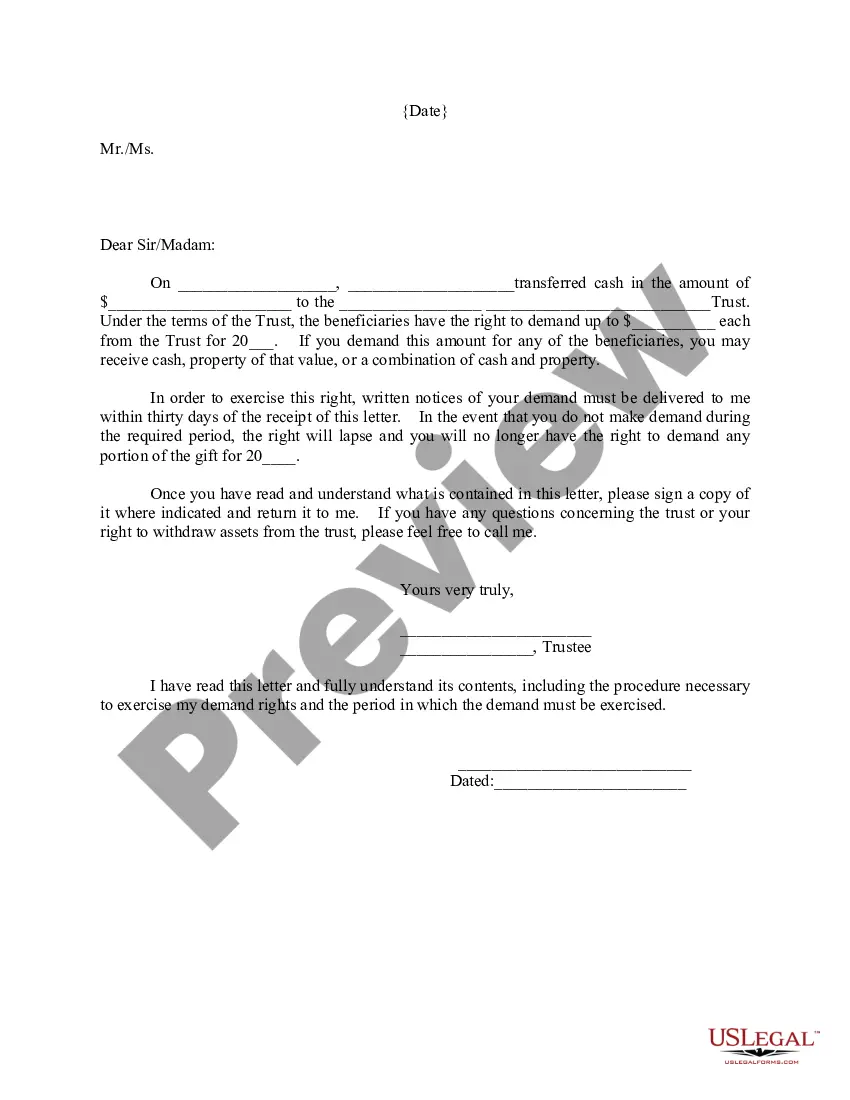
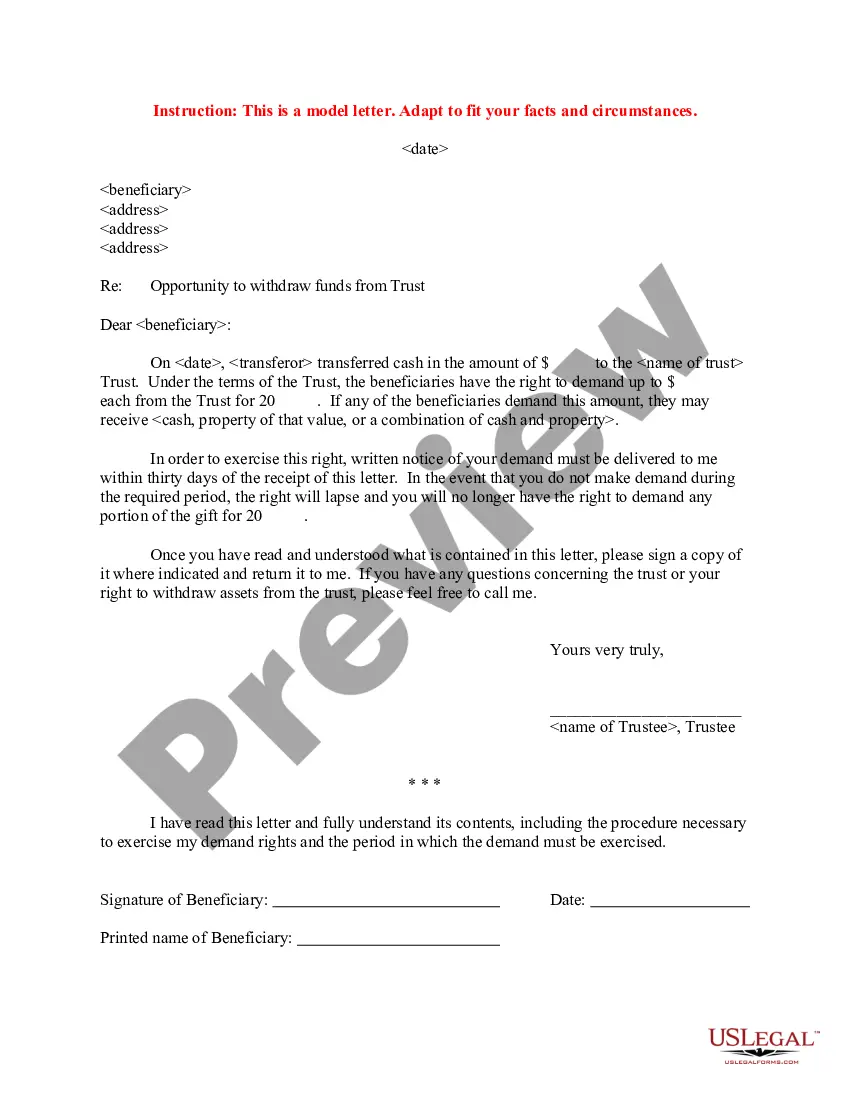
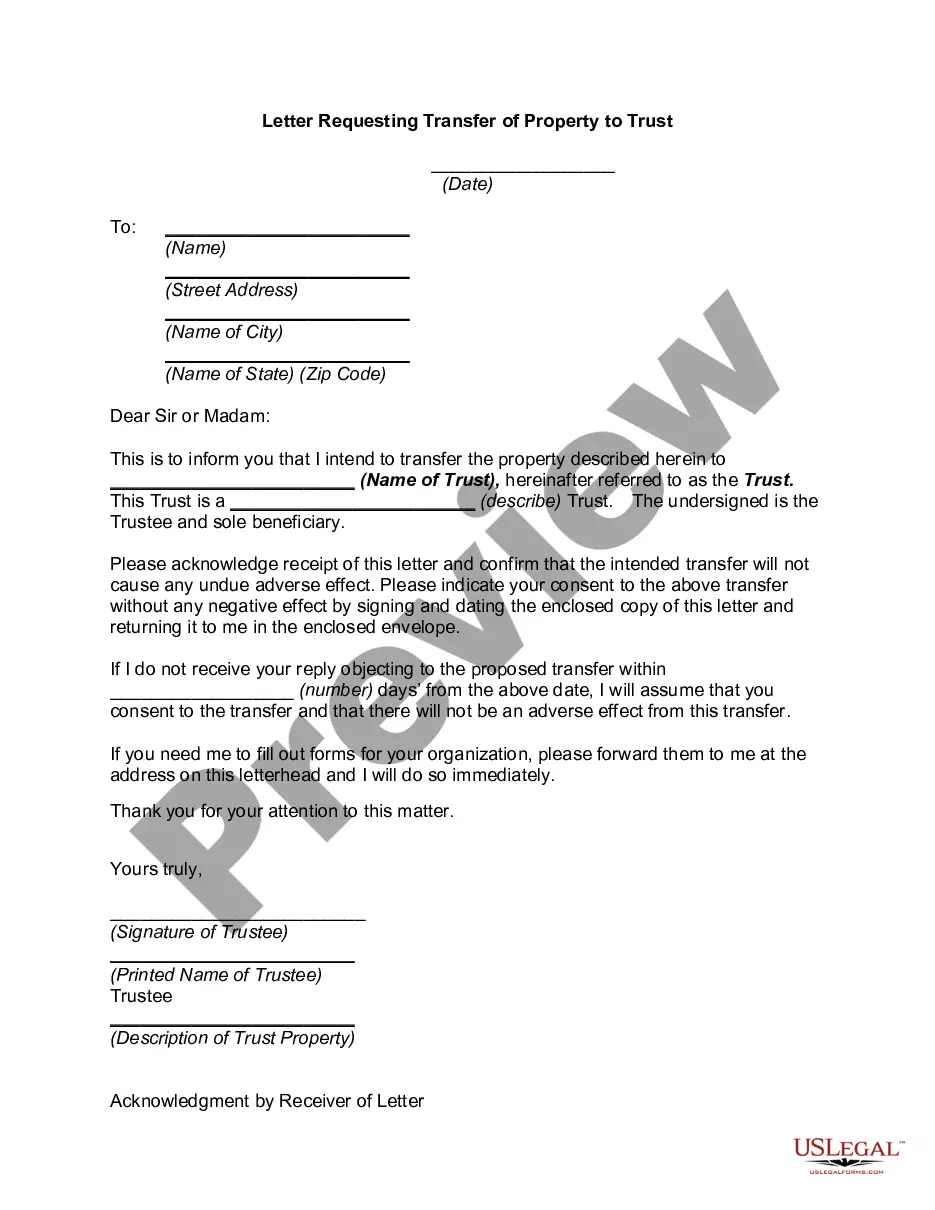
Trustee informs the trustor that he/she has the right to demand a certain amount of funds from the trust during the year. If the trustor demands a withdrawal for any of the beneficiaries, he/she may receive cash, property of that value, or a combination of cash and property.
California Letter regarding trust money
81 downloads
Description
Get your form ready online
Our built-in tools help you complete, sign, share, and store your documents in one place.
Built-in online Word editor
Make edits, fill in missing information, and update formatting in US Legal Forms—just like you would in MS Word.
Export easily
Download a copy, print it, send it by email, or mail it via USPS—whatever works best for your next step.
E-sign your document
Sign and collect signatures with our SignNow integration. Send to multiple recipients, set reminders, and more. Go Premium to unlock E-Sign.
Notarize online 24/7
If this form requires notarization, complete it online through a secure video call—no need to meet a notary in person or wait for an appointment.
Store your document securely
We protect your documents and personal data by following strict security and privacy standards.

Make edits, fill in missing information, and update formatting in US Legal Forms—just like you would in MS Word.

Download a copy, print it, send it by email, or mail it via USPS—whatever works best for your next step.

Sign and collect signatures with our SignNow integration. Send to multiple recipients, set reminders, and more. Go Premium to unlock E-Sign.

If this form requires notarization, complete it online through a secure video call—no need to meet a notary in person or wait for an appointment.

We protect your documents and personal data by following strict security and privacy standards.
Looking for another form?
How to fill out Letter Regarding Trust Money?
You can spend hours online searching for the legal document template that meets the state and federal requirements you need.
US Legal Forms offers a wide array of legal forms that can be assessed by specialists.
You can download or print the California Letter pertaining to trust money from our service.
- If you already have a US Legal Forms account, you may Log In and then click the Acquire button.
- Next, you can complete, modify, print, or sign the California Letter regarding trust money.
- Each legal document template you purchase is yours indefinitely.
- To obtain another copy of any purchased form, go to the My documents section and click the appropriate button.
- If you are visiting the US Legal Forms website for the first time, follow the simple instructions below.
- First, ensure you have selected the right document template for the area/city of your choice.
- Check the form description to confirm you have chosen the correct document.
Form popularity
FAQ
To look up a trust in California, start by checking with the county clerk's office where the trust creator resided. Most office records can be accessed online or in person. If you're feeling overwhelmed, consider using services like US Legal Forms to help you navigate your search more efficiently and effectively.
A letter to notify beneficiaries of a trust serves to inform them about their rights and interests in the trust. This document is crucial for ensuring transparency and legal compliance. It's essential to craft this letter with care, and resources like US Legal Forms can offer templates and guidance to help you write an effective notification.
In California, a certificate of trust can be obtained by requesting it from the trustee. This certificate summarizes the main provisions of the trust without disclosing sensitive details. If you're unsure how to approach this, consider using US Legal Forms to obtain the required templates and guidelines to streamline the process.
Getting a copy of a trust document in California involves reaching out to the trustee, who holds the document's original copy. They may ask for identification or proof of your status as a beneficiary. If you encounter difficulties, using platforms like US Legal Forms can help you understand your legal rights and options.
To obtain a copy of a trust document in California, you typically need to be a beneficiary or have permission from the trust creator. Contact the trustee directly, as they are responsible for managing the trust and can guide you through the process. If you face challenges, consider consulting resources like US Legal Forms for assistance in navigating the requirements.
Yes, in California, certain trust documents can become part of the public record, especially after the death of the trust creator. This means that the details of the trust can be accessed by anyone who wants to look for them. If you are involved in a trust, it's wise to be aware that some information may not remain confidential.
In general, beneficiaries have: 1.) The right to a true, complete and final copy of the trust, any written amendments thereto, and any written instructions that could impact the distribution of trust assets.
The Legal Rights of Heirs-At-Law in California Under California law, everyone who would be an heir at law of the decedent is entitled to certain information, including a copy of the will and trust.
California statutory law requires a trustee to account annually to current trust beneficiaries, i.e., those who are currently entitled to receive distributions of income and principal during the accounting period. Any trustee, other than the settlor(s) who established the trust, has a duty to account.
Notice to beneficiaries and heirs: If the trust becomes irrevocable when the settlor dies, the trustee has 60 days after becoming trustee or 60 days after the settlor's death, whichever happens later, to give written notice to all beneficiaries of the trust and to each heir of the decedent.