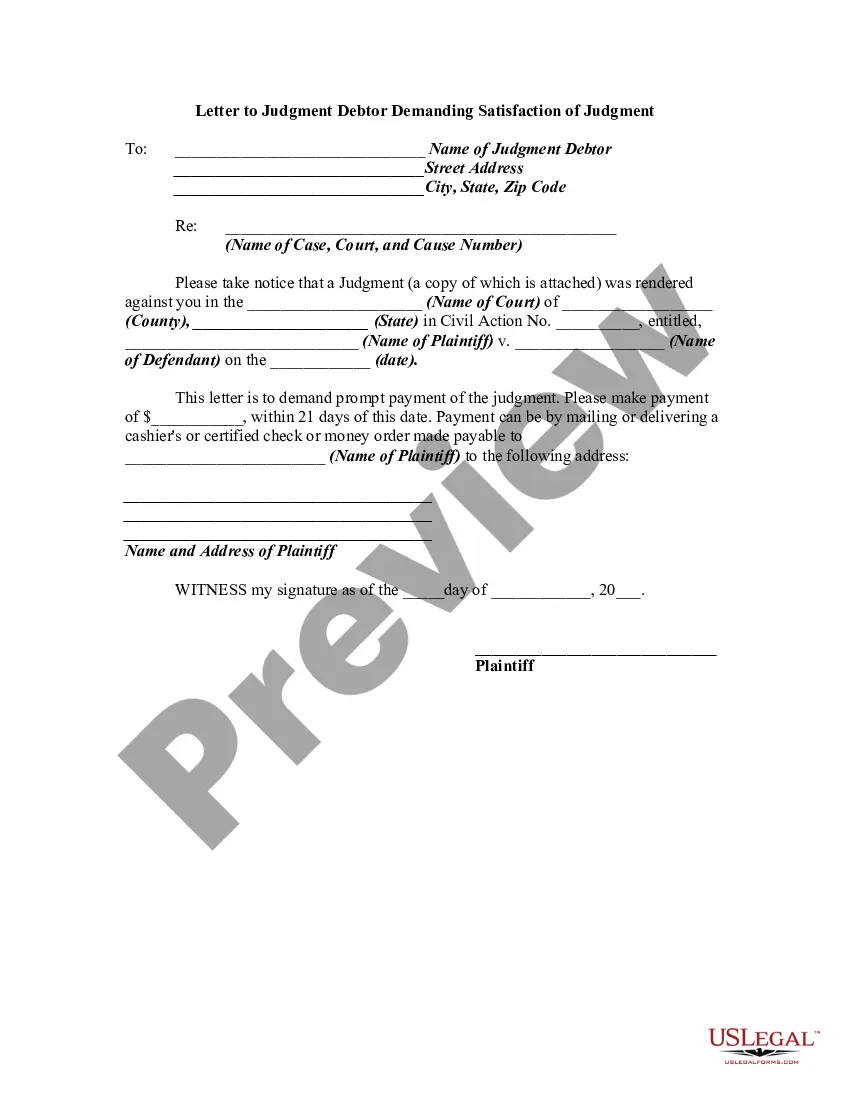
Pursuant to this form, a plaintiff who obtained a judgment against a defendant is demanding satisfaction of the judgment by payment of a sum of money sent to a specified address. If the parties are represented by an attorney, it would be preferable for the attorney representing the plaintiff to send such a letter to the attorney representing the defendant.
California Letter to Judgment Debtor Demanding Satisfaction of Judgment
State:
Multi-State
Category:
Control #:
US-00760BG
Format:
Word;
Rich Text
71 downloads
Description





Get your form ready online
Our built-in tools help you complete, sign, share, and store your documents in one place.
Built-in online Word editor
Make edits, fill in missing information, and update formatting in US Legal Forms—just like you would in MS Word.
Export easily
Download a copy, print it, send it by email, or mail it via USPS—whatever works best for your next step.
E-sign your document
Sign and collect signatures with our SignNow integration. Send to multiple recipients, set reminders, and more. Go Premium to unlock E-Sign.
Notarize online 24/7
If this form requires notarization, complete it online through a secure video call—no need to meet a notary in person or wait for an appointment.
Store your document securely
We protect your documents and personal data by following strict security and privacy standards.

Make edits, fill in missing information, and update formatting in US Legal Forms—just like you would in MS Word.

Download a copy, print it, send it by email, or mail it via USPS—whatever works best for your next step.

Sign and collect signatures with our SignNow integration. Send to multiple recipients, set reminders, and more. Go Premium to unlock E-Sign.

If this form requires notarization, complete it online through a secure video call—no need to meet a notary in person or wait for an appointment.

We protect your documents and personal data by following strict security and privacy standards.
Looking for another form?
How to fill out Letter To Judgment Debtor Demanding Satisfaction Of Judgment?
If you need to finalize, download, or create approved document templates, utilize US Legal Forms, the largest collection of legal forms available online.
Take advantage of the site's straightforward and convenient search to find the documents you require.
A range of templates for business and personal purposes are categorized by groups and states, or keywords.
Step 4. Once you have found the form you want, select the Get now button. Choose the pricing plan you prefer and enter your details to register for an account.
Step 5. Process the payment. You can use your credit card or PayPal account to complete the transaction. Step 6. Choose the format of your legal form and download it to your device. Step 7. Complete, modify, and print or sign the California Letter to Judgment Debtor Requesting Satisfaction of Judgment. Every legal document template you acquire is yours permanently. You have access to every form you saved in your account. Visit the My documents section and select a form to print or download again. Compete and download, and print the California Letter to Judgment Debtor Requesting Satisfaction of Judgment with US Legal Forms. There are thousands of professional and state-specific forms you can utilize for your business or personal needs.
- Use US Legal Forms to locate the California Letter to Judgment Debtor Requesting Satisfaction of Judgment with just a few clicks.
- If you are already a US Legal Forms user, sign in to your account and click the Download button to obtain the California Letter to Judgment Debtor Requesting Satisfaction of Judgment.
- You can also access forms you previously saved in the My documents section of your account.
- If you are using US Legal Forms for the first time, follow the guidelines below.
- Step 1. Make sure you have selected the form for the correct area/region.
- Step 2. Utilize the Preview option to review the form's content. Don't forget to read the summary.
- Step 3. If you are not satisfied with the form, use the Search field at the top of the screen to find other versions of the legal form template.
Form popularity
FAQ
Step 1: Complete the Form. The Judicial Council form commonly used in this procedure is: ... Step 2: Make Copies. Make photocopies of your unsigned Acknowledgment of Satisfaction of Judgment (EJ-100). Step 3: Notarize Your Forms. ... Step 4: Have your Acknowledgement Served. ... Step 5: Filing.
Tells the sheriff to take action to enforce a judgment. Used with instructions to the sheriff to levy bank accounts, garnish wages, or take possession of personal property.
If you do not pay the judgment, the judge can order you to appear in court. This is called an Application And Order For Appearance and Examination (EJ-125) . You can be ordered into court every 4 months to furnish information to aid in the enforcement of judgment until you pay the judgment.
The one-satisfaction rule is a common law principle that a plaintiff should only recover once for a particular injury, thereby preventing overcompensation of the plaintiff for their injury. Thus, a plaintiff who fully recovers from one tortfeasor may not recover more damages from a joint tortfeasor.
Tells the court and others that a judgment has been paid in full or in part. Can be recorded with a county to release a lien against the judgment debtor's land or filed with the Secretary of State to release a lien against the debtor's personal property.
For the sheriff to do this, you first need to get a Writ of Execution from the court. This directs the sheriff to enforce your judgment (try to collect the money). Once you have a Writ, you'll then need to fill out more forms that include written instructions to the sheriff that say where to collect the money.
Tells the court and others that a judgment has been paid in full or in part. Can be recorded with a county to release a lien against the judgment debtor's land or filed with the Secretary of State to release a lien against the debtor's personal property.