California Interspousal Grant Deed from Individual
What is this form?
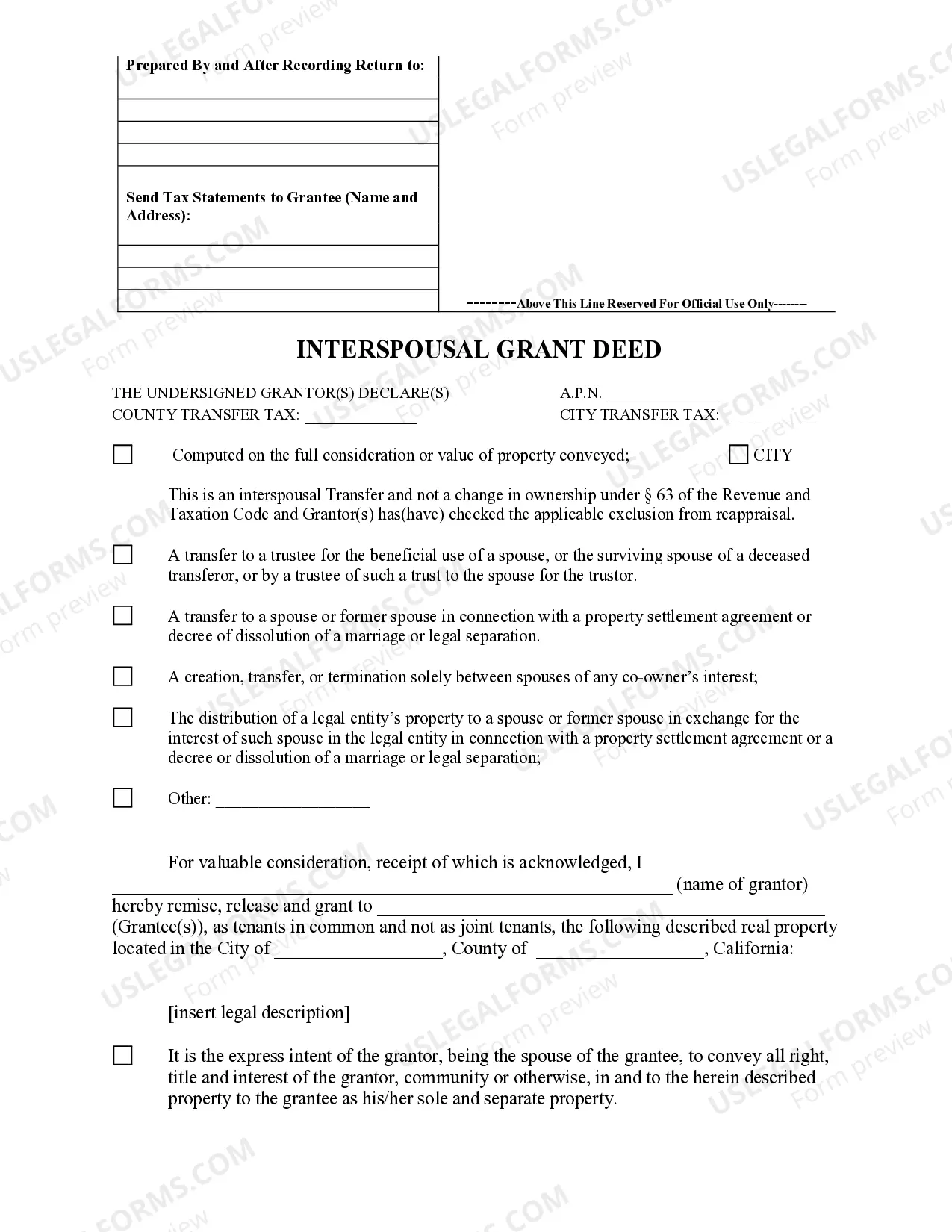
The Interspousal Grant Deed from Individual is a legal document used to transfer property ownership between spouses. This form facilitates property transactions during marriage and is especially useful for transferring title to real estate without incurring reassessment fees. Unlike other property transfer forms, it specifically addresses the unique circumstances of interspousal asset transfers under California law.
Form components explained
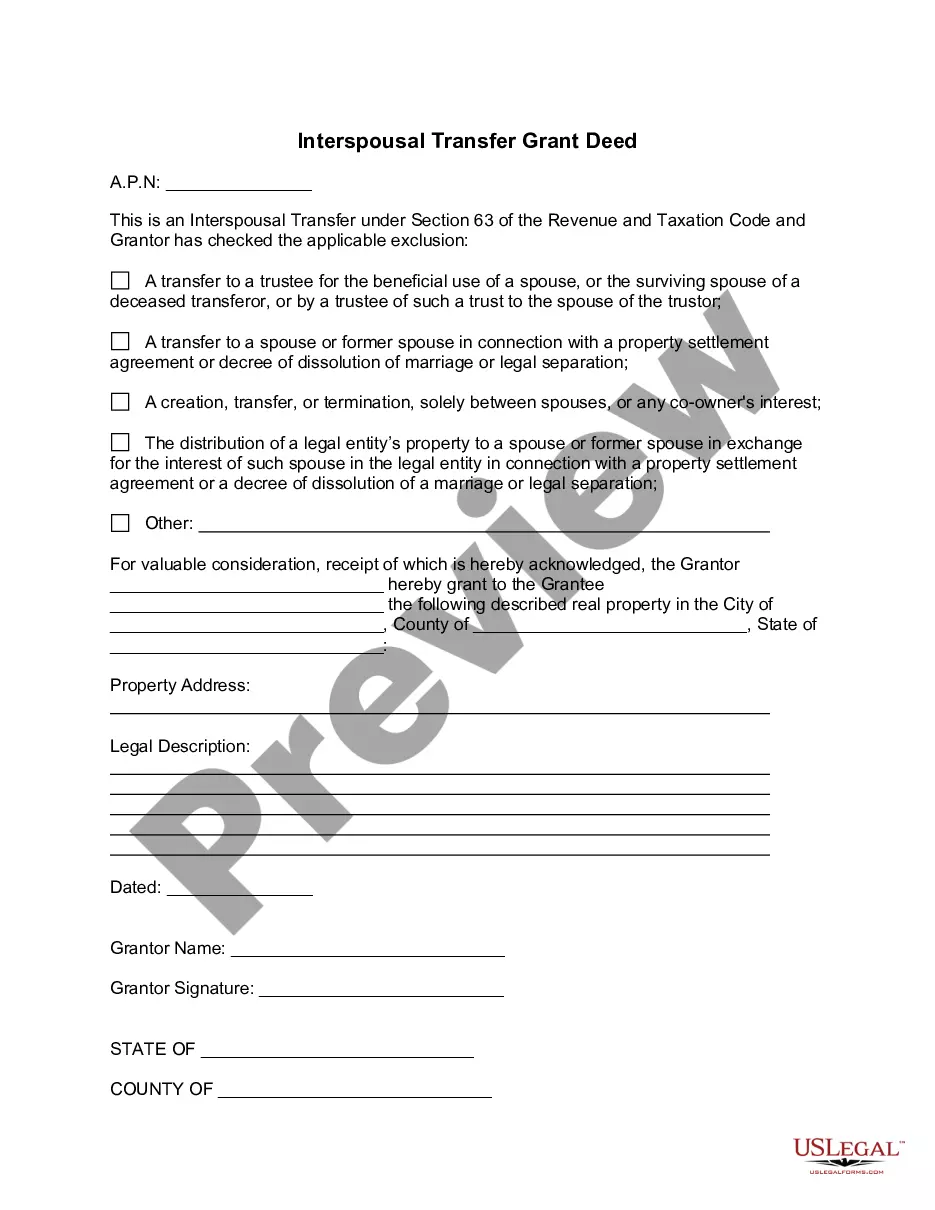
- Identification of the grantor(s) and grantee(s)
- Property description, including the address and legal description
- Details regarding transfer taxes
- Exclusion from reappraisal certification
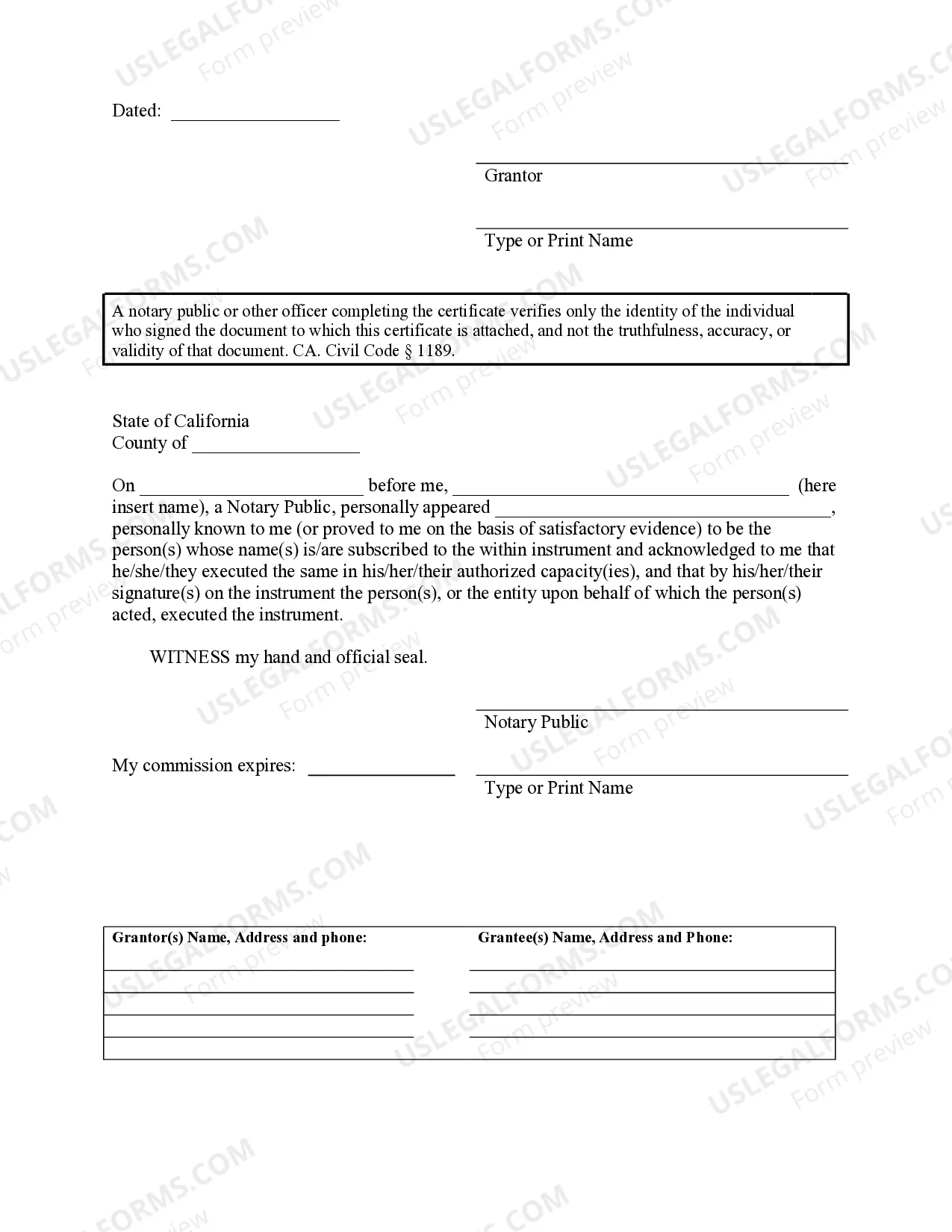
- Signatures of both grantor(s) and their acknowledgment


Common use cases
This form is typically used when one spouse wishes to transfer their interest in a property to their partner, often during a marriage, property settlement agreement, or legal separation. Situations for use include consolidating ownership of a marital home or affecting changes in the title of other jointly owned assets.
Intended users of this form
- Married couples looking to clarify property ownership
- Individuals involved in a property settlement during divorce or separation
- Spouses wishing to transfer property as part of estate planning
Steps to complete this form
- Identify the grantor(s) and grantee(s) by entering their names.
- Specify the property by providing its address and legal description.
- Fill in transfer tax information as applicable for your jurisdiction.
- Check the appropriate reasons for the transfer under state law.
- Sign the document in the presence of any required witnesses, if applicable, and ensure the form is correctly dated.
Does this document require notarization?
Notarization is required for this form to take effect. Our online notarization service, powered by Notarize, lets you verify and sign documents remotely through an encrypted video session, available 24/7.
Get your form ready online
Our built-in tools help you complete, sign, share, and store your documents in one place.
Make edits, fill in missing information, and update formatting in US Legal Forms—just like you would in MS Word.
Download a copy, print it, send it by email, or mail it via USPS—whatever works best for your next step.
Sign and collect signatures with our SignNow integration. Send to multiple recipients, set reminders, and more. Go Premium to unlock E-Sign.
If this form requires notarization, complete it online through a secure video call—no need to meet a notary in person or wait for an appointment.
We protect your documents and personal data by following strict security and privacy standards.

Make edits, fill in missing information, and update formatting in US Legal Forms—just like you would in MS Word.

Download a copy, print it, send it by email, or mail it via USPS—whatever works best for your next step.

Sign and collect signatures with our SignNow integration. Send to multiple recipients, set reminders, and more. Go Premium to unlock E-Sign.

If this form requires notarization, complete it online through a secure video call—no need to meet a notary in person or wait for an appointment.

We protect your documents and personal data by following strict security and privacy standards.
Common mistakes
- Failing to provide a complete legal description of the property.
- Not including signatures from both parties or witnesses when required.
- Ignoring local transfer tax requirements or exemptions.
Benefits of completing this form online
- Immediate access to legally compliant templates created by attorneys.
- Convenient digital completion that allows for easy edits.
- Immediate download for filing, reducing paperwork delays.
Looking for another form?


Form popularity
FAQ
To fill out a California grant deed, start by entering the complete names of both spouses, along with the property address and legal description. Ensure that you specify the nature of the transfer clearly and include the necessary signatures. For ease of use, templates offered by platforms such as US Legal Forms specifically for California Interspousal Grant Deed from Individual can offer step-by-step guidance to help you fill out the deed correctly.
In California, a grant deed can be prepared by the property owners themselves, or they can seek assistance from qualified professionals like attorneys or title companies. Choosing to use a service like US Legal Forms allows you to easily access professionally designed templates suitable for a California Interspousal Grant Deed from Individual. This ensures that your deed is prepared correctly and complies with state regulations.
Filling out a grant deed in California requires clear and accurate information. Start with the names of both spouses, followed by details about the property being transferred, such as its legal description. For clarity and ease, consider using templates offered by US Legal Forms specifically for California Interspousal Grant Deed from Individual to guide you in completing the document.
The interspousal transfer grant deed in California allows one spouse to transfer their interest in a property directly to the other spouse. This type of grant deed is beneficial during marriage or in the event of a divorce, as it helps avoid reassessment of property taxes. Utilizing a California Interspousal Grant Deed from Individual streamlines the process and ensures legal compliance.
To prepare a grant deed in California, you can either draft the document yourself using templates or seek help from professionals, such as attorneys or title companies. Using platforms like US Legal Forms can simplify this process by providing you with structured templates designed for California Interspousal Grant Deed from Individual. Ensure that all required information is included for smooth processing.
In California, both spouses must sign the grant deed when transferring property through a California Interspousal Grant Deed from Individual. This includes the spouse who is transferring their interest in the property and the spouse receiving it. By signing, both parties confirm their agreement to the transfer, making the deed legally effective.
Yes, a grant deed serves as proof of ownership in California. Once recorded, it establishes a public record of ownership, showing the transfer of property rights to the new owner. This is particularly important when using a California Interspousal Grant Deed from Individual, as it solidifies the ownership claim between spouses while providing a reliable trail of the property's history.
To change a grant deed in California, you will need to complete a new deed form that reflects the desired changes. This new deed must be executed, acknowledged before a notary public, and then recorded with the county recorder's office. Utilizing tools like USLegalForms can simplify this process; their platform provides guidance on how to properly create and file a California Interspousal Grant Deed from Individual to effectuate your changes effectively.
In California, when a court examines an interspousal transfer deed, it typically recognizes the deed as a means to change the nature of property from separate to community property, or vice versa. This legal recognition underscores the significance of using a California Interspousal Grant Deed from Individual in managing marital assets. Such a deed ensures clarity and protectiveness in property ownership between spouses.
To transfer property in California, you will need to execute a deed, such as a California Interspousal Grant Deed from Individual. This deed legally transfers ownership from one person to another, and it must be signed, notarized, and recorded with the county recorder's office. Using a California Interspousal Grant Deed can simplify this process between spouses, ensuring a clear transfer of property rights.