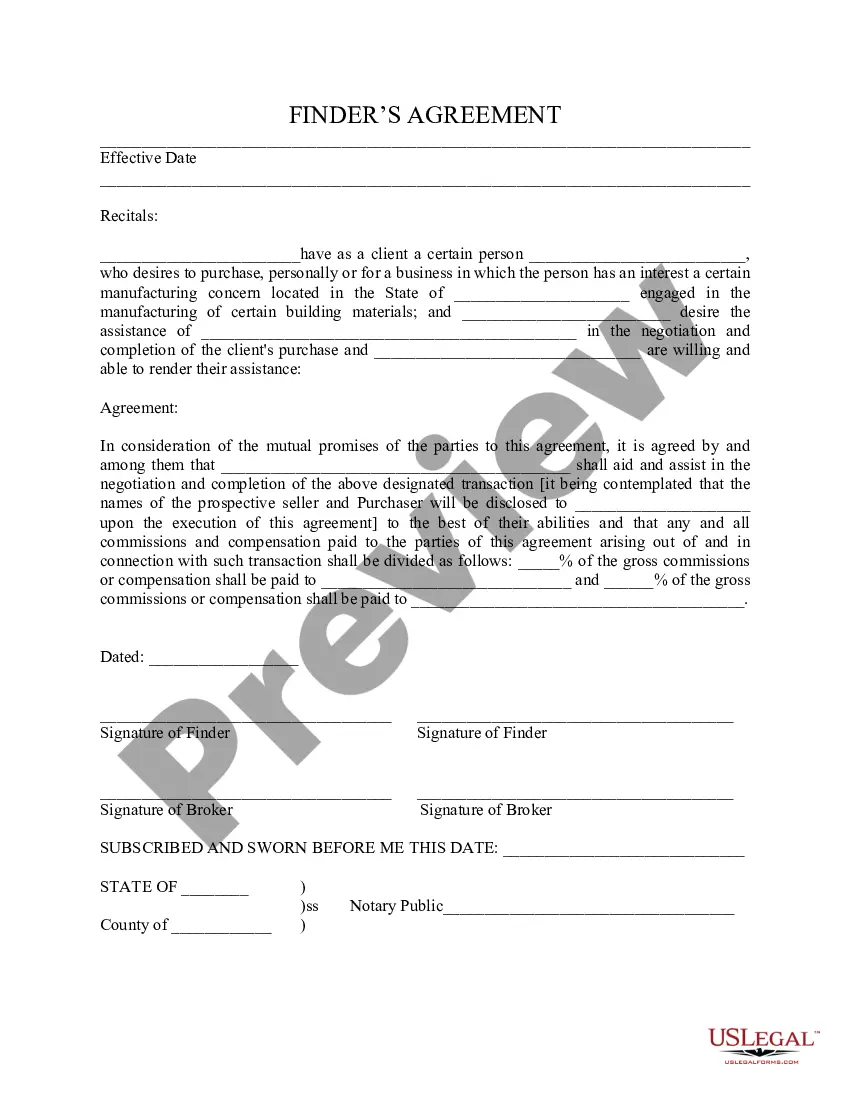
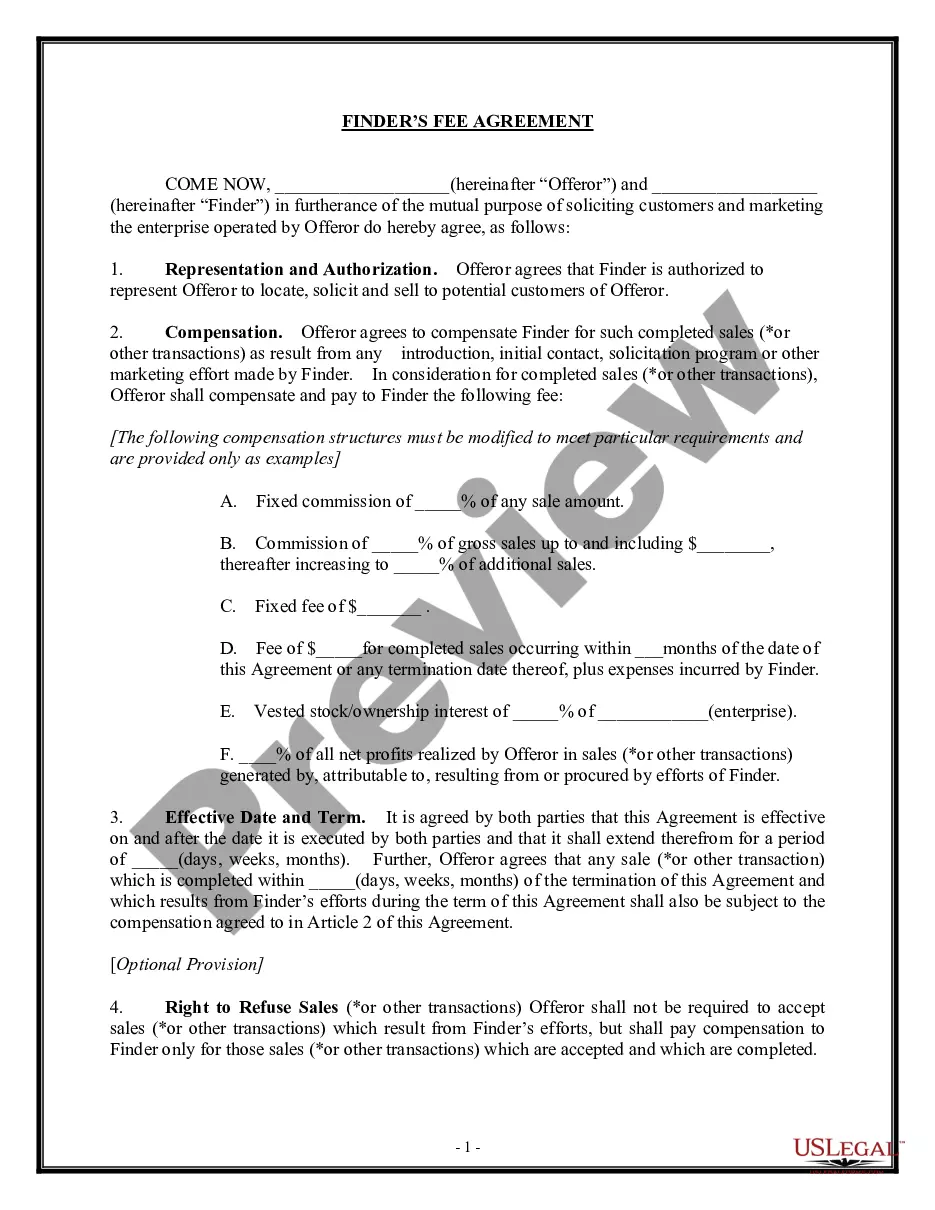
Arizona Finders Agreement
Description
Get your form ready online
Our built-in tools help you complete, sign, share, and store your documents in one place.
Make edits, fill in missing information, and update formatting in US Legal Forms—just like you would in MS Word.
Download a copy, print it, send it by email, or mail it via USPS—whatever works best for your next step.
Sign and collect signatures with our SignNow integration. Send to multiple recipients, set reminders, and more. Go Premium to unlock E-Sign.
If this form requires notarization, complete it online through a secure video call—no need to meet a notary in person or wait for an appointment.
We protect your documents and personal data by following strict security and privacy standards.

Make edits, fill in missing information, and update formatting in US Legal Forms—just like you would in MS Word.

Download a copy, print it, send it by email, or mail it via USPS—whatever works best for your next step.

Sign and collect signatures with our SignNow integration. Send to multiple recipients, set reminders, and more. Go Premium to unlock E-Sign.

If this form requires notarization, complete it online through a secure video call—no need to meet a notary in person or wait for an appointment.

We protect your documents and personal data by following strict security and privacy standards.
Looking for another form?


How to fill out Finders Agreement?
US Legal Forms - one of the largest repositories of legal documents in the United States - provides a range of legal form templates that you can download or create.
Using the website, you can find thousands of forms for business and personal purposes, organized by categories, states, or keywords. You can locate the latest versions of forms like the Arizona Finders Agreement in moments.
If you already have a monthly subscription, Log In and download the Arizona Finders Agreement from the US Legal Forms database. The Download button will appear on every form you view. You can access all previously acquired forms in the My documents section of your account.
Make modifications. Fill out, edit, print, and sign the downloaded Arizona Finders Agreement.
Every template you add to your account has no expiration date and is yours indefinitely. So, if you wish to download or print another copy, simply navigate to the My documents section and click on the form you need. Access the Arizona Finders Agreement with US Legal Forms, one of the most comprehensive collections of legal document templates. Utilize a vast selection of professional and state-specific templates that cater to your business or personal requirements.
- If you're using US Legal Forms for the first time, here are simple instructions to help you get started.
- Ensure you have selected the correct form for your city/state. Click the Preview button to view the content of the form.
- Review the form information to confirm that you have selected the right form.
- If the form does not meet your requirements, use the Search box at the top of the screen to find the appropriate one.
- If you're satisfied with the form, confirm your selection by clicking the Purchase now button. Then, select your preferred pricing plan and provide your credentials to register for an account.
- Process the payment. Use your credit card or PayPal account to complete the transaction.
- Choose the format and download the form to your device.
Form popularity
FAQ
Yes, finders fees are legal in Arizona, but they must comply with specific regulations. Under Arizona law, individuals who act as finders should ensure they have clear agreements in place, often referred to as an Arizona Finders Agreement. This agreement serves to outline the responsibilities of each party, helping to avoid potential disputes. If you need assistance drafting a compliant finders agreement, consider using the templates available at US Legal Forms to make the process easier.
Finder's fees are generally legal in Arizona as long as they comply with state regulations and are properly disclosed. However, the legality can depend on the specific context and circumstances surrounding the arrangement. Using an Arizona Finders Agreement can help clarify the terms and conditions involved, ensuring transparency in your dealings. If you have questions about finder's fees, US Legal Forms can guide you with the necessary legal documents and insights.
In Arizona, you typically have up to five years to claim unclaimed property before the state assumes ownership. This timeline can vary based on the type of property you are dealing with, so it is crucial to act promptly. To protect your rights and navigate the claiming process efficiently, consider using an Arizona Finders Agreement. US Legal Forms provides valuable resources to help you stay informed and expedite your claim.
To claim land in Arizona, you must first ensure that the property is unclaimed and verify its status with local authorities. Next, you should gather all necessary documentation that supports your claim, such as proof of ownership, maps, and property descriptions. Utilizing an Arizona Finders Agreement can help streamline this process and legally designate you as the rightful claimant. We recommend visiting US Legal Forms to access the appropriate forms and guidance tailored for your situation.
A finder's fee isn't legally binding, so it is often simply a gift from one party to another. This is commonly seen in real estate deals. If someone is selling their home and their friend connects them with a potential buyer, the seller might give their friend a small portion of the sale when the deal is finalized.
A finder's fee is a type of cash commission paid to the coordinator or intermediary in a transaction between two other parties (a business and a potential customer). The fee rewards the finder for bringing the interested parties together and facilitating the deal.
Most common, in my experience: a referral fee for 10% of revenue. Second most common: a referral fee for 5% of revenue. After that, it tends to be a mixfor instance, 20% of the first month's retainer, and nothing after that.
The terms of finder's fees can vary greatly, with some citing 5% to 35% of the total value of the deal being used as a benchmark. It's a staple of Fundera's business model. In many cases, the finder's fee may simply be a gift from one party to another, as no legal obligation to pay a commission exists.
Finder's fees are usually determined by how much money the finder's efforts bring in for the company. But a legal issue arises when the finder is not properly licensed as a broker-dealer. In that case, the finder's fee agreement "is an illegal contract and is likely unenforceable," Johnson writes for Inside Counsel.
A finder's fee isn't legally binding, so it is often simply a gift from one party to another. This is commonly seen in real estate deals. If someone is selling their home and their friend connects them with a potential buyer, the seller might give their friend a small portion of the sale when the deal is finalized.