Arizona Motion and Order for Telephonic Appearance
About this form
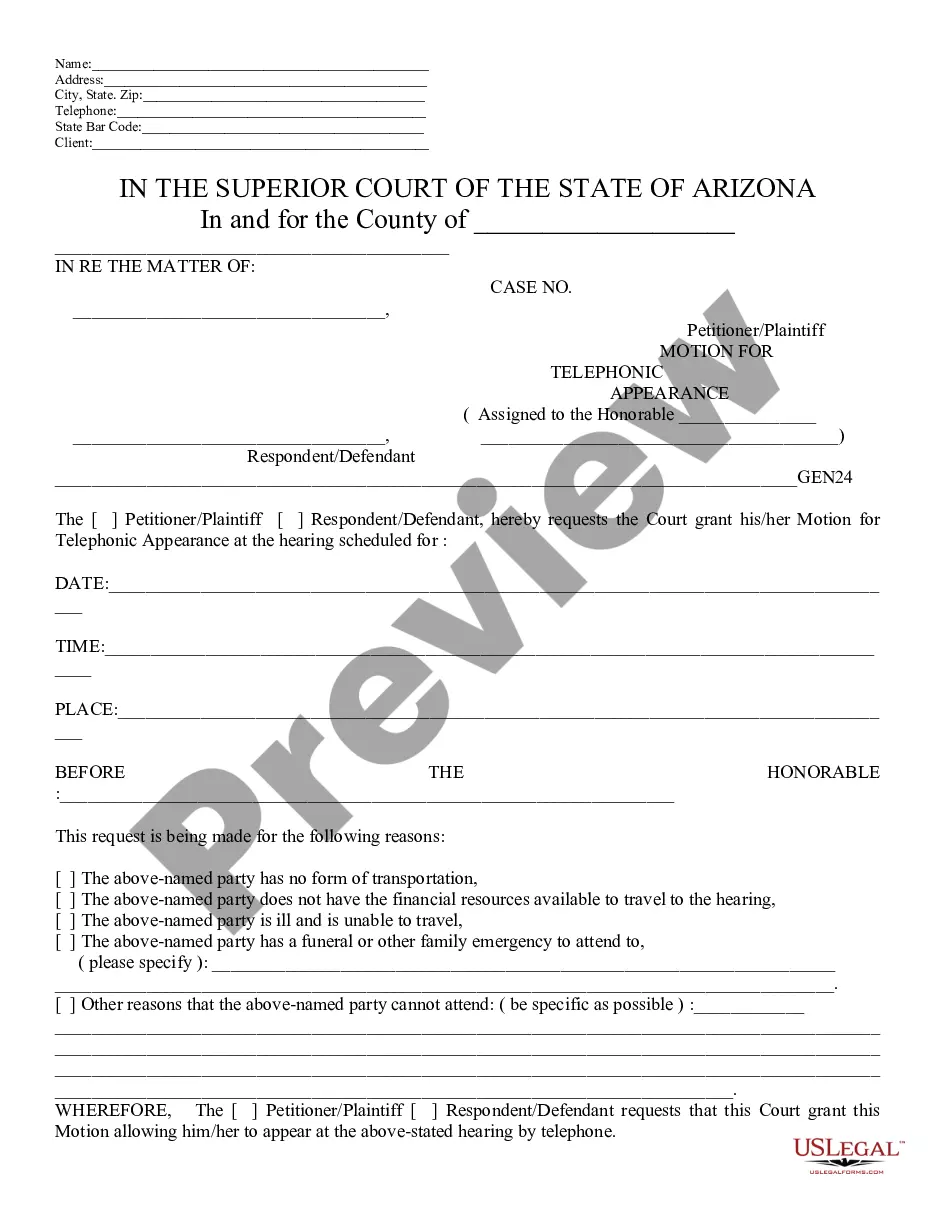
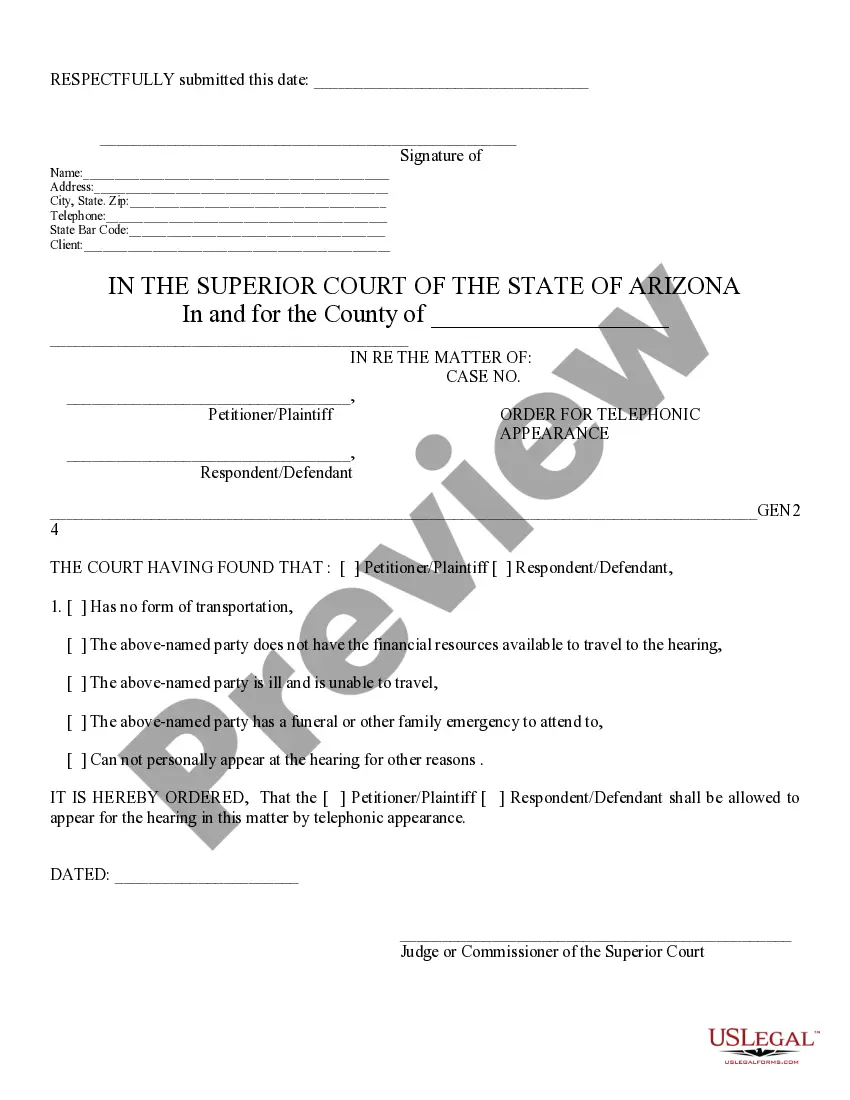
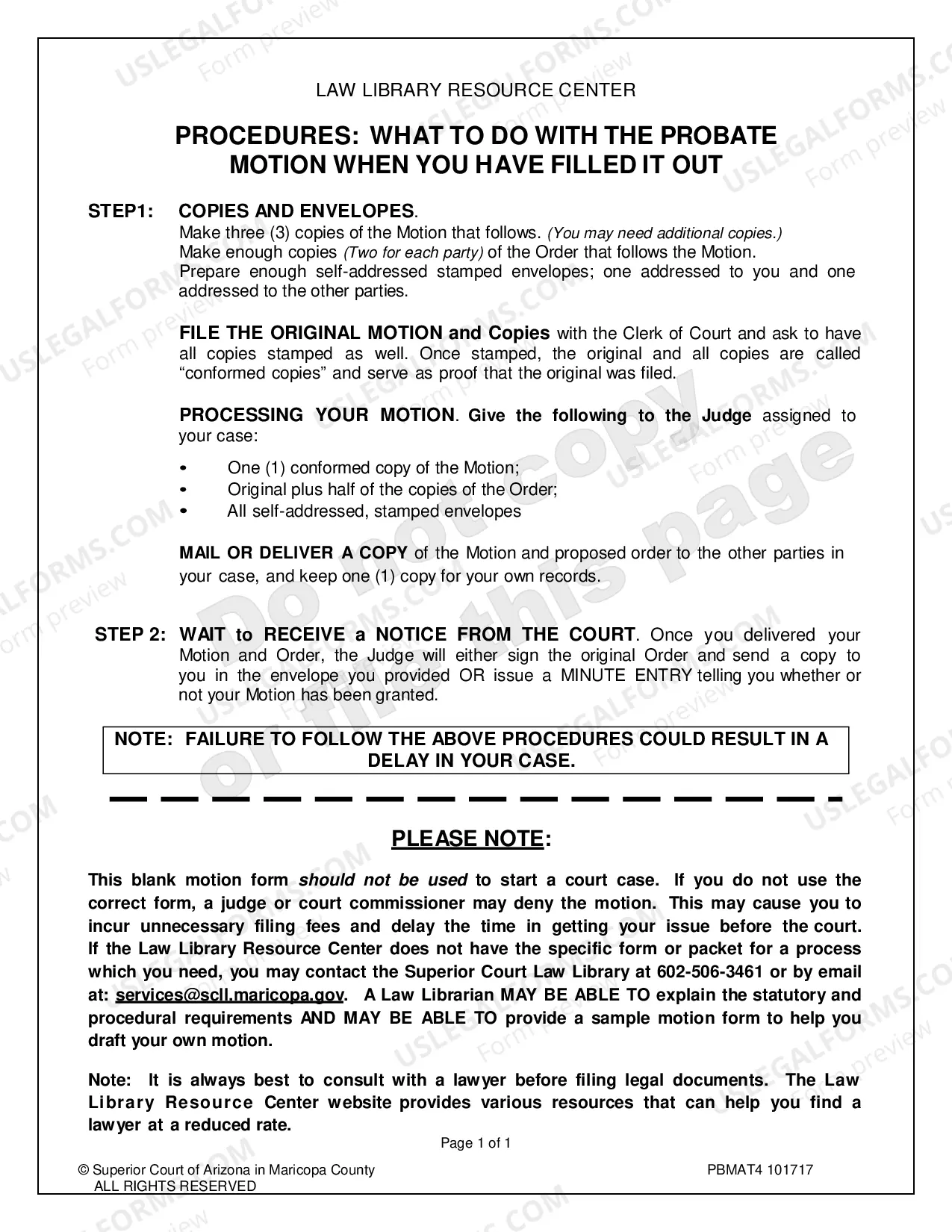
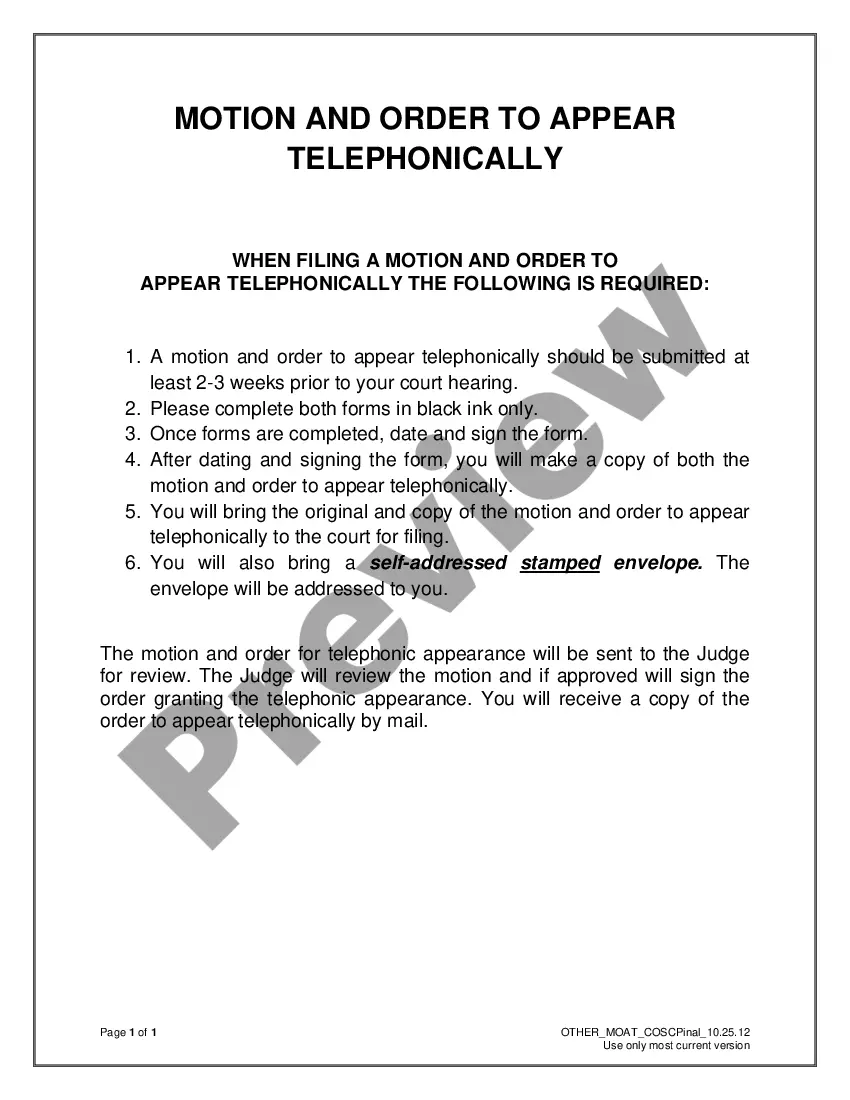
The Motion and Order for Telephonic Appearance is a legal document that allows a party involved in a court case to request permission to attend a hearing by phone rather than in person. This form differs from standard motion forms by specifically addressing telephonic appearances, which can be essential for individuals unable to travel due to various reasons. Download this form now for your legal needs.
Key parts of this document
- Contact information for the petitioner/plaintiff and respondent/defendant.
- Specific details about the hearing, including date, time, and location.
- Reasons for requesting a telephonic appearance.
- Signature of the requesting party.
- Order section allowing for the telephonic appearance, signed by a judge or commissioner.
When this form is needed
This form should be used when a party cannot physically attend a court hearing due to a lack of transportation, financial constraints, illness, or family emergencies. It is particularly useful for individuals who need to participate in legal proceedings but face challenges in attending in person.
Who should use this form
This form is intended for:
- Individuals involved in court cases who require a telephonic appearance.
- Petitioners or plaintiffs unable to attend hearings for valid reasons.
- Respondents or defendants who need to communicate their inability to travel to the court.
Steps to complete this form
- Enter your contact information at the top of the form.
- Specify the court location and the case number.
- Detail the hearing date, time, and judge's name.
- Clearly state the reasons for requesting a telephonic appearance.
- Sign and date the motion before submission to the court.
Notarization requirements for this form
Notarization is not commonly needed for this form. However, certain documents or local rules may make it necessary. Our notarization service, powered by Notarize, allows you to finalize it securely online anytime, day or night.
Get your form ready online
Our built-in tools help you complete, sign, share, and store your documents in one place.
Make edits, fill in missing information, and update formatting in US Legal Forms—just like you would in MS Word.
Download a copy, print it, send it by email, or mail it via USPS—whatever works best for your next step.
Sign and collect signatures with our SignNow integration. Send to multiple recipients, set reminders, and more. Go Premium to unlock E-Sign.
If this form requires notarization, complete it online through a secure video call—no need to meet a notary in person or wait for an appointment.
We protect your documents and personal data by following strict security and privacy standards.

Make edits, fill in missing information, and update formatting in US Legal Forms—just like you would in MS Word.

Download a copy, print it, send it by email, or mail it via USPS—whatever works best for your next step.

Sign and collect signatures with our SignNow integration. Send to multiple recipients, set reminders, and more. Go Premium to unlock E-Sign.

If this form requires notarization, complete it online through a secure video call—no need to meet a notary in person or wait for an appointment.

We protect your documents and personal data by following strict security and privacy standards.
Common mistakes
- Failing to provide specific reasons for the telephonic appearance.
- Not including all required contact information.
- Submitting the form without a signature.
- Missing deadlines for filing the motion.
Why use this form online
- Easy access to legal forms that can be downloaded and completed at your convenience.
- Editable templates allow for quick customization to fit your specific case.
- Reliable and compliant forms drafted by licensed attorneys.
Looking for another form?
Form popularity
FAQ
To file a motion for contempt in Arizona, you need to prepare a motion that outlines the grounds for contempt clearly. This often requires demonstrating that the opposing party has willfully failed to comply with a court order. By including an Arizona Motion and Order for Telephonic Appearance in your filing, you can request a hearing to address the contempt issue efficiently. Platforms like uslegalforms can assist you in drafting and filing these important documents.
When responding to a motion in Arizona, you typically have 10 days to file your response after the motion has been served to you. Make sure to carefully review the motion and prepare your response to address the issues presented. Utilizing tools from uslegalforms, such as templates and guidelines, can help you craft a thorough response. Don’t forget that timely responses are key in the legal process.
In Arizona, you have a limited time to file a motion to reconsider after a court ruling. Generally, you must file this motion within 10 days from the date of the order or judgment. Making use of the Arizona Motion and Order for Telephonic Appearance can streamline the process of filing this motion, allowing you to effectively present your case for reconsideration. Always check local court rules to confirm specific deadlines.
A Rule 11 motion in Arizona is a request that asks the court to impose sanctions for frivolous claims or defenses. This motion aims to ensure that all parties conduct themselves honestly and responsibly during litigation. By properly filing an Arizona Motion and Order for Telephonic Appearance, you can include a Rule 11 motion to address any misconduct that might arise in your case, ensuring the integrity of the judicial process.
In Arizona, a judge typically has a reasonable amount of time to rule on a motion, which can vary based on the case and court schedule. Generally, you can expect a ruling within a few weeks, but it may take longer depending on the complexity of the matters presented. If you need a quicker resolution, ensure your Arizona Motion and Order for Telephonic Appearance is well-prepared to facilitate the process. You can always inquire with the court for specific timelines.
In Arizona, a Rule 50 motion has the same purpose as elsewhere in the United States: to seek a judgment from the judge based on the strength of evidence presented. This motion aims to resolve the case before it goes to a jury decision. Utilizing the Arizona Motion and Order for Telephonic Appearance can greatly assist attorneys and clients in making these requests without the need to be physically present in court, enhancing convenience and efficiency.
A Rule 50 motion is a request made during a trial, typically asking the judge to rule in favor of the moving party because the opposing party has not provided sufficient evidence. This motion seeks a judgment as a matter of law, essentially stating that no reasonable jury could find for the other side. Incorporating the Arizona Motion and Order for Telephonic Appearance can be beneficial when filing such motions, allowing for a streamlined process.
In the context of court proceedings, 'telephonic' refers to participating in a hearing or a meeting via telephone. This option allows individuals to avoid physical presence in the courtroom, making legal processes more accessible. An Arizona Motion and Order for Telephonic Appearance enables parties to request this type of participation, thus saving time and resources for everyone involved.
An order to show cause hearing in Arizona is a court session where the judge reviews the reasons behind the order. During this hearing, both parties can present evidence and make their case. The judge will then decide whether to grant the requested relief or uphold the existing order. If you attend such a hearing, an Arizona Motion and Order for Telephonic Appearance can be a valuable option for your convenience.
An order to show cause in Arizona is issued by a judge to require a party to explain why a specific action should not be taken. This order typically follows a motion that raises legal concerns requiring judicial attention. The recipient must respond, presenting their arguments and supporting evidence. Utilizing an Arizona Motion and Order for Telephonic Appearance can simplify your response process.