Arizona Authorization to Send Orders and Judgments by Facsimile Transmission
About this form
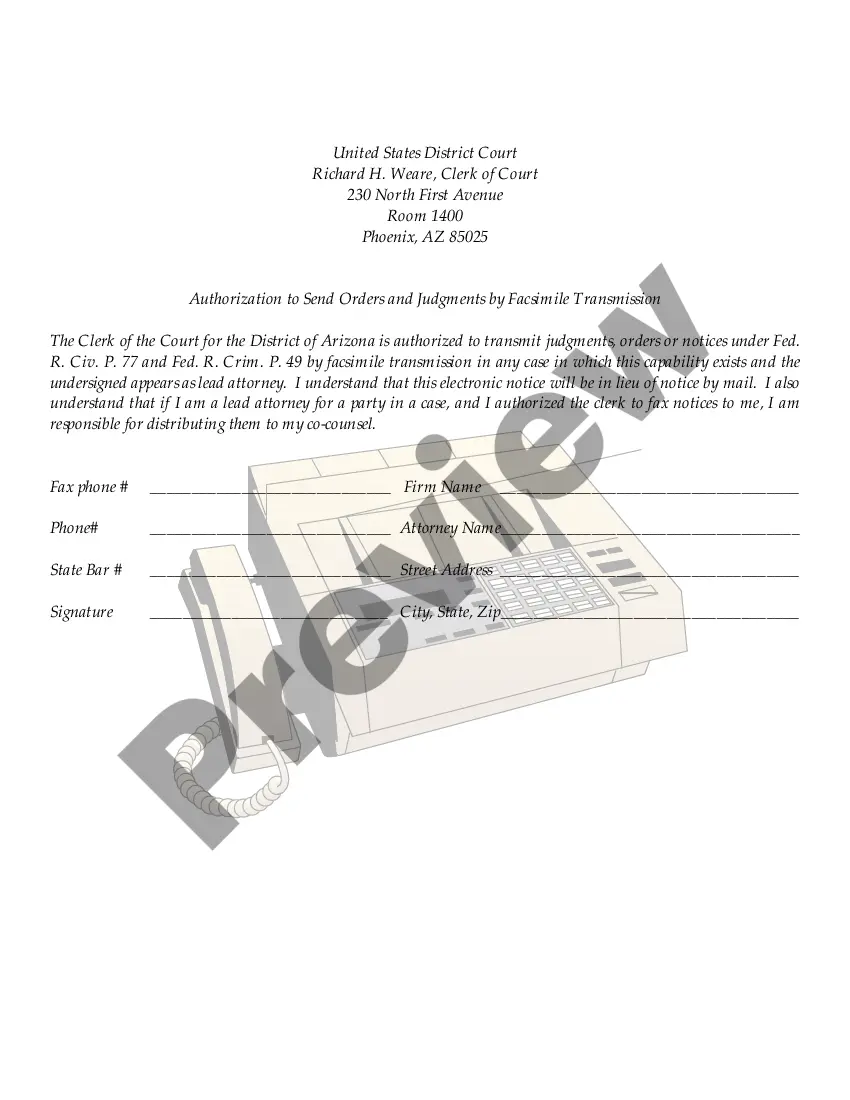
The Authorization to Send Orders and Judgments by Facsimile Transmission is a federal form used in the District Court of Arizona. It allows the Clerk of Court to send legal orders, judgments, or notices via fax instead of traditional mail. This form is particularly useful for attorneys who wish to receive faster updates on their cases. It differs from other notification methods by providing a quicker and more direct way to receive official communications from the court.
Main sections of this form
- Identification of the Clerk of Court and court location
- Authorization section indicating the attorney's agreement to receive communications by fax
- Contact information fields for fax number, firm name, attorney name, and state bar number
- Signature line for attorney approval
- Clause acknowledging responsibility for further distribution to co-counsel
Common use cases
This form should be used when an attorney wants to authorize the court to send legal documents via facsimile. It is applicable in cases where the attorney is the lead representative and prefers to receive immediate and secure communications regarding orders or judgments. Using this form can expedite the legal process and ensure timely updates.
Intended users of this form
This form is intended for:
- Lead attorneys representing clients in cases in the District of Arizona
- Legal firms that wish to streamline communication with the court
- Attorneys who need to distribute court judgments and orders to co-counsel quickly
How to prepare this document
- Enter the fax phone number where you wish to receive documents.
- Fill in your firm's name to identify your legal practice.
- Provide your name and state bar number for identification purposes.
- Include your business address, city, state, and zip code.
- Sign the form to authorize the Clerk of Court to send you communications via fax.
- Ensure all required fields are completed before submission.
Does this document require notarization?
This form does not typically require notarization unless specified by local law. It is important to check with the relevant court for any jurisdiction-specific requirements.
Get your form ready online
Our built-in tools help you complete, sign, share, and store your documents in one place.
Make edits, fill in missing information, and update formatting in US Legal Forms—just like you would in MS Word.
Download a copy, print it, send it by email, or mail it via USPS—whatever works best for your next step.
Sign and collect signatures with our SignNow integration. Send to multiple recipients, set reminders, and more. Go Premium to unlock E-Sign.
If this form requires notarization, complete it online through a secure video call—no need to meet a notary in person or wait for an appointment.
We protect your documents and personal data by following strict security and privacy standards.

Make edits, fill in missing information, and update formatting in US Legal Forms—just like you would in MS Word.

Download a copy, print it, send it by email, or mail it via USPS—whatever works best for your next step.

Sign and collect signatures with our SignNow integration. Send to multiple recipients, set reminders, and more. Go Premium to unlock E-Sign.

If this form requires notarization, complete it online through a secure video call—no need to meet a notary in person or wait for an appointment.

We protect your documents and personal data by following strict security and privacy standards.
Avoid these common issues
- Failing to fill in the fax number properly, which can prevent receipt of important documents.
- Not signing the form, making it invalid for processing.
- Submitting the form without confirming all details are accurate and up-to-date.
Advantages of online completion
- Convenient access to download and complete the form at any time.
- Easy editability allows for accurate and precise information entry.
- Reliable updates and versions ensure compliance with current federal laws.
Quick recap
- The Authorization to Send Orders and Judgments by Facsimile Transmission allows for quicker communication with the court.
- It is vital for lead attorneys in the District of Arizona who prefer to receive documents by fax.
- Accurate completion and timely submission are essential to ensure effectiveness.
Looking for another form?

Form popularity
FAQ
In Arizona, a process server can leave legal papers at your door if specific conditions are met. Generally, this method is acceptable if the server makes a reasonable effort to deliver the documents personally. However, understanding your rights and obligations under laws such as the Arizona Authorization to Send Orders and Judgments by Facsimile Transmission is crucial for navigating potential legal implications.
To set aside a default judgment in Arizona, you must file a motion with the court that issued the judgment. Your motion should outline valid reasons for why you did not respond or appear in court initially. Using the Arizona Authorization to Send Orders and Judgments by Facsimile Transmission can expedite your motion's delivery to the court, which may aid in a timely resolution.
If you choose to answer a summons without an attorney in Arizona, carefully read the summons and any attached complaints. Prepare a written response that addresses the claims, and file it with the appropriate court by the deadline stated. The Arizona Authorization to Send Orders and Judgments by Facsimile Transmission can facilitate this process by allowing you to send your answer quickly and securely.
Rule 16d, found in the Arizona Rules of Civil Procedure, relates to the case management process. This rule allows courts to establish timelines for filing motions and other essential documents. Understanding this rule can benefit you, especially if you take advantage of the Arizona Authorization to Send Orders and Judgments by Facsimile Transmission for timely communications with the court.
The best way to answer a summons is to provide a clear, concise written response addressing each claim made against you. Be sure to include your personal information, the case number, and the date you are answering. You can also leverage the Arizona Authorization to Send Orders and Judgments by Facsimile Transmission for timely filing with the court, which may assist in expediting your response.
To respond to a summons in Arizona, you should file an answer with the court where the summons originated. Your response must include your defenses and any counterclaims. By utilizing resources like the Arizona Authorization to Send Orders and Judgments by Facsimile Transmission, you can streamline the submission of your response. This helps ensure your documentation arrives promptly.
In Arizona, a summons typically must be served in person. This ensures the recipient receives the legal documents properly. However, under certain circumstances, such as the Arizona Authorization to Send Orders and Judgments by Facsimile Transmission, there may be alternative methods available. It is essential to understand the rules to ensure compliance.
A Rule 83 motion in Arizona allows parties to request a court to take specific actions, typically related to procedural issues. This motion can address various matters that arise during a case. Knowing how to file a Rule 83 motion can be vital when dealing with the Arizona Authorization to Send Orders and Judgments by Facsimile Transmission, ensuring that all procedures are followed accurately for effective legal communication. Many legal platforms, such as uslegalforms, provide guidance on this process.
To domesticate a judgment in Arizona, you must file an application in Arizona court that includes the foreign judgment and relevant documentation. This step is crucial for enforcing judgments made outside the state. By following proper procedures and referencing the Arizona Authorization to Send Orders and Judgments by Facsimile Transmission, you can expedite the process and make your collection efforts more efficient. Consulting with a legal expert can ensure your application meets all requirements.
To file a judgment in Arizona, complete the required forms accurately and ensure that all necessary signatures are obtained. These forms must be submitted to the court along with any applicable fees. Utilizing the Arizona Authorization to Send Orders and Judgments by Facsimile Transmission can enhance the efficiency of your filing and keep all parties informed.