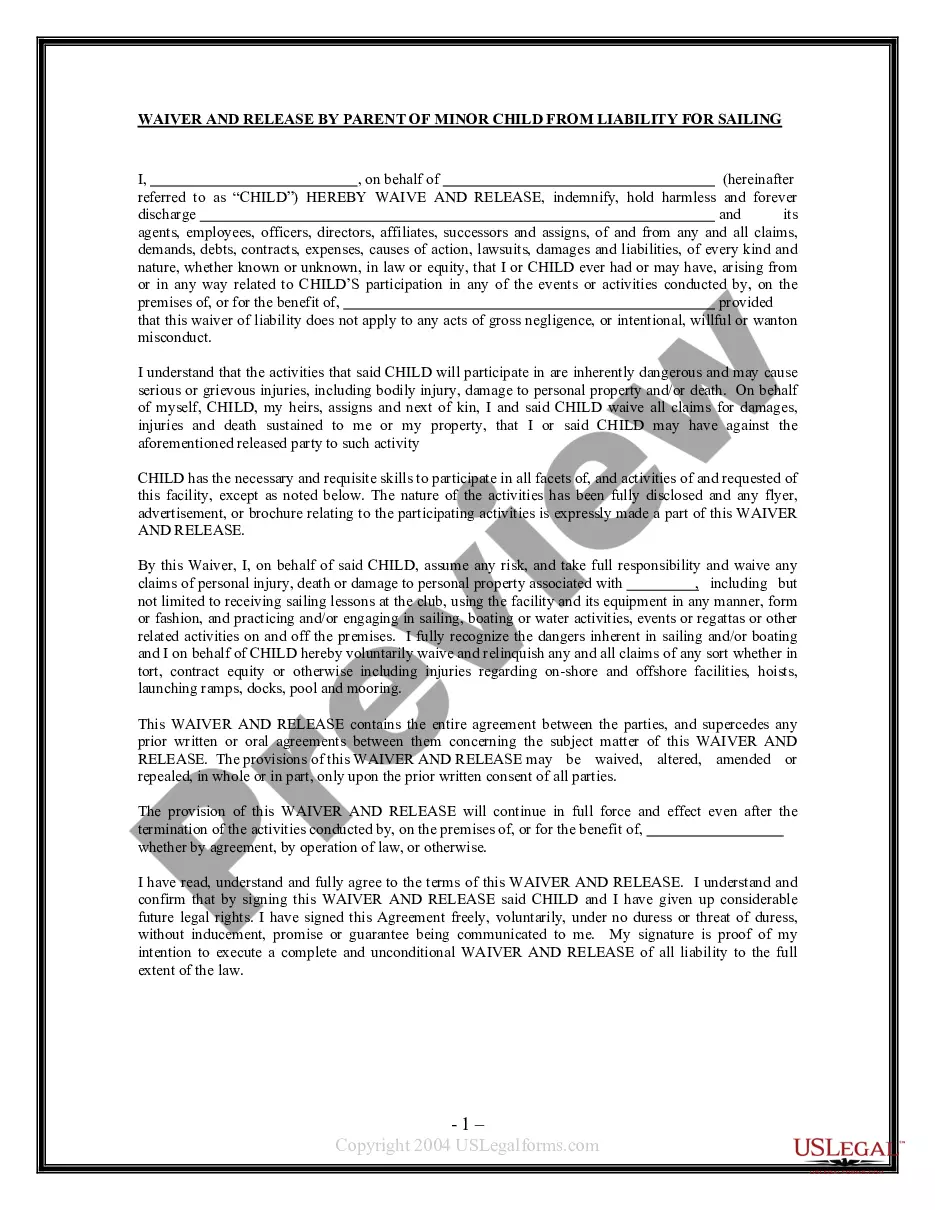
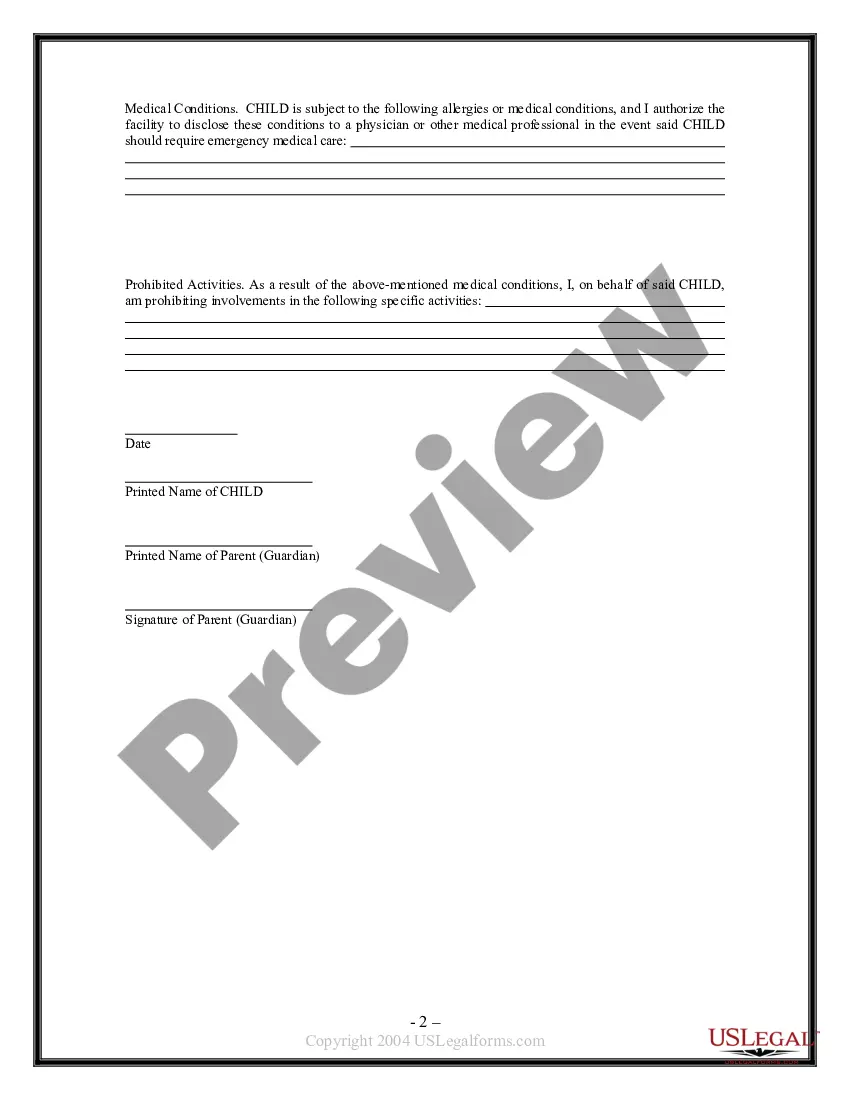
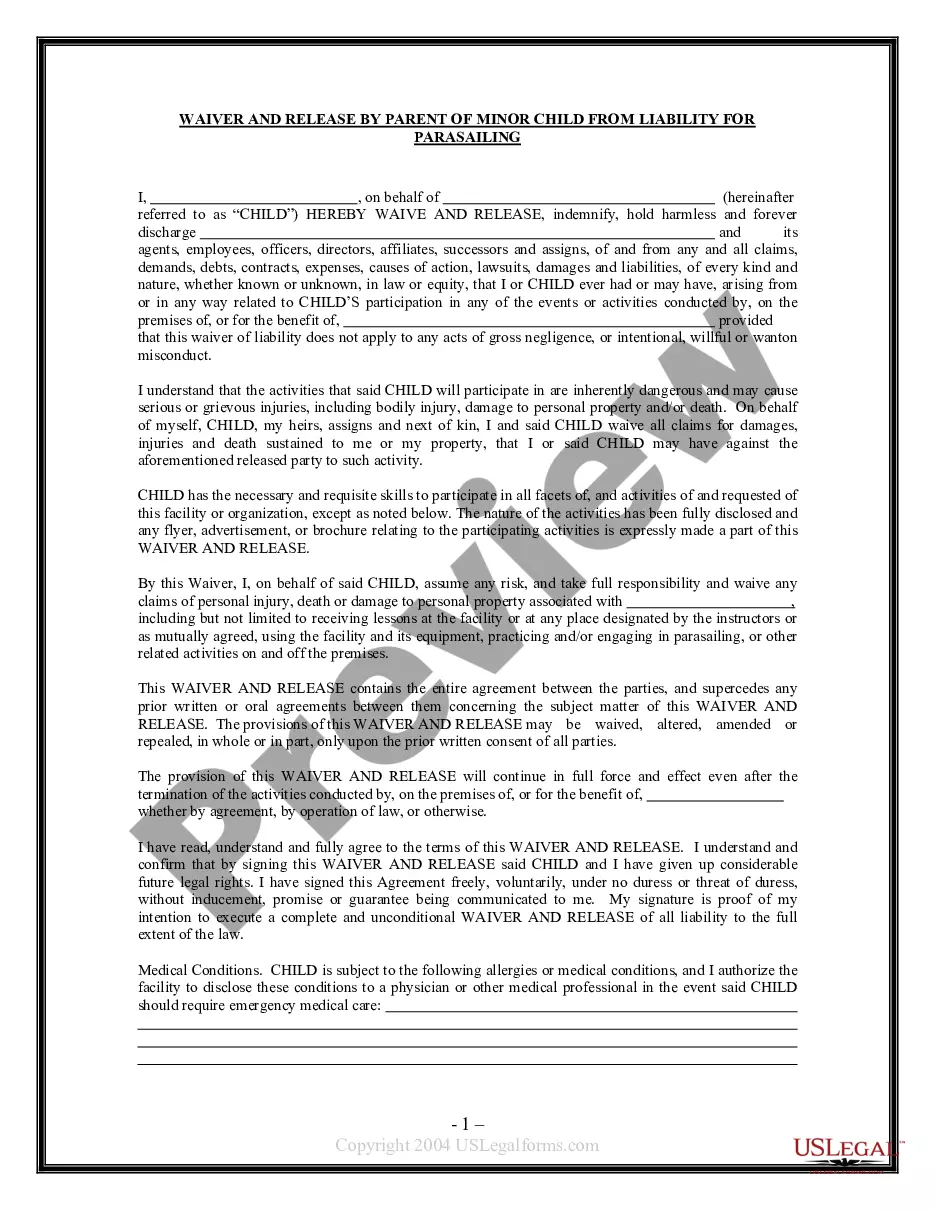
This form allows a parent or guardian to release a sailing facility from liability for injuries which may be incurred by a minor child while on the premises, taking part in activities, etc.
Arkansas Waiver and Release From Liability For Minor Child for Sailing
State:
Multi-State
Category:
Control #:
US-WAV-32M
Format:
Word;
Rich Text
38 downloads
Description
Free preview
Get your form ready online
Our built-in tools help you complete, sign, share, and store your documents in one place.
Built-in online Word editor
Make edits, fill in missing information, and update formatting in US Legal Forms—just like you would in MS Word.
Export easily
Download a copy, print it, send it by email, or mail it via USPS—whatever works best for your next step.
E-sign your document
Sign and collect signatures with our SignNow integration. Send to multiple recipients, set reminders, and more. Go Premium to unlock E-Sign.
Notarize online 24/7
If this form requires notarization, complete it online through a secure video call—no need to meet a notary in person or wait for an appointment.
Store your document securely
We protect your documents and personal data by following strict security and privacy standards.

Make edits, fill in missing information, and update formatting in US Legal Forms—just like you would in MS Word.

Download a copy, print it, send it by email, or mail it via USPS—whatever works best for your next step.

Sign and collect signatures with our SignNow integration. Send to multiple recipients, set reminders, and more. Go Premium to unlock E-Sign.

If this form requires notarization, complete it online through a secure video call—no need to meet a notary in person or wait for an appointment.

We protect your documents and personal data by following strict security and privacy standards.
Looking for another form?
How to fill out Waiver And Release From Liability For Minor Child For Sailing?
If you wish to complete, obtain, or create sanctioned document templates, utilize US Legal Forms, the premier collection of legal forms available online.
Employ the site’s straightforward and user-friendly search feature to locate the documents you require.
Various templates for business and individual purposes are organized by categories and titles, or keywords. Utilize US Legal Forms to locate the Arkansas Waiver and Release From Liability For Minor Child for Sailing with just a few clicks.
Every legal document template you acquire is yours permanently. You have access to every form you saved in your account. Click the My documents section and select a form to print or download again.
Compete and download, and print the Arkansas Waiver and Release From Liability For Minor Child for Sailing with US Legal Forms. There are numerous professional and state-specific forms available for your business or personal needs.
- If you are already a US Legal Forms user, sign in to your account and then click the Acquire button to obtain the Arkansas Waiver and Release From Liability For Minor Child for Sailing.
- You can also access forms you previously saved in the My documents section of your account.
- If you are using US Legal Forms for the first time, follow the instructions below.
- Step 1. Make sure you have selected the form for the correct city/state.
- Step 2. Use the Review option to check the form’s content. Don’t forget to read the details.
- Step 3. If you are not satisfied with the form, utilize the Search area at the top of the screen to find alternative versions of the legal form template.
- Step 4. Once you have found the form you need, click on the Purchase now button. Choose the pricing plan you prefer and enter your information to create an account.
- Step 5. Process the payment. You can use your Visa or Mastercard or PayPal account to finalize the transaction.
- Step 6. Select the format of your legal form and download it to your device.
- Step 7. Complete, modify and print or sign the Arkansas Waiver and Release From Liability For Minor Child for Sailing.
Form popularity
FAQ
Waivers do not completely stop you from suing, but they can limit your ability to do so. The effectiveness of a waiver, such as the Arkansas Waiver and Release From Liability For Minor Child for Sailing, depends on its wording and the specific circumstances surrounding the incident. If a waiver is deemed enforceable, it may restrict claims related to ordinary negligence. However, serious misconduct or failure to adhere to safety standards could still open the door for a lawsuit.
In Arkansas, children must be secured in a child safety seat until they reach the age of 6 or weigh 60 pounds. This law is designed to enhance the safety of young passengers during travel. When engaging in activities like sailing, it's important to ensure that children are properly secured, as highlighted in the Arkansas Waiver and Release From Liability For Minor Child for Sailing. Proper safety measures are essential for their protection.
Yes, you can still sue even if you signed a liability waiver, but it depends on the circumstances. If the waiver did not adequately disclose risks or if negligence can be proven, you may have grounds to pursue legal action. The Arkansas Waiver and Release From Liability For Minor Child for Sailing is designed to protect against liability, but it does not cover all situations. Consulting a legal expert can clarify your options.
Liability waivers can be legally binding in Arkansas if they fulfill the necessary legal requirements. They must clearly outline the rights being waived and the risks associated with the activity. When utilizing the Arkansas Waiver and Release From Liability For Minor Child for Sailing, it is essential that all parties understand and agree to the terms. This understanding contributes to the waiver's binding nature.
Yes, liability waivers can be enforceable in Arkansas, provided they meet certain legal criteria. To ensure enforceability, the waiver must be clear, specific, and unambiguous in its language. Additionally, the Arkansas Waiver and Release From Liability For Minor Child for Sailing should explicitly state the risks involved. This clarity helps protect both the provider and the participant.
A minor child power of attorney in Arkansas allows a parent or guardian to designate another adult to make decisions on behalf of their minor child, especially in situations where the parent cannot be present. This legal document can cover various aspects, including education, medical care, and other essential decisions. It's important to understand that this document does not replace the need for an Arkansas Waiver and Release From Liability For Minor Child for Sailing, which specifically addresses liability concerns during sailing activities. For those navigating these legal needs, the US Legal Forms platform provides easy access to templates and guidance to ensure proper documentation.
A liability waiver, or release waiver, is a legal document that a company or organization requires members of the public to sign in order to protect their organization from being sued if you sustain an injury.
So, if an accident happens and injury occurs, is a Waiver effective in protecting the institution from liability and preventing a lawsuit from the injured party? The answer is that, if properly worded and signed, the Waiver is likely valid and will preclude legal claims for injuries.
The purpose of waivers is to prevent teams from colluding to exchange players outside of the normal trade rules, as well as to encourage parity by giving lower-ranked teams the right of first refusal to claim players who are no longer wanted by their former club.
Ambiguous language or missing information can invalidate a waiver. The waiver contains errors that make it invalid. The language of the waiver must obey relevant state laws. An improperly worded or drafted waiver, as well as one that violates the law or public policy, may not hold up in court.