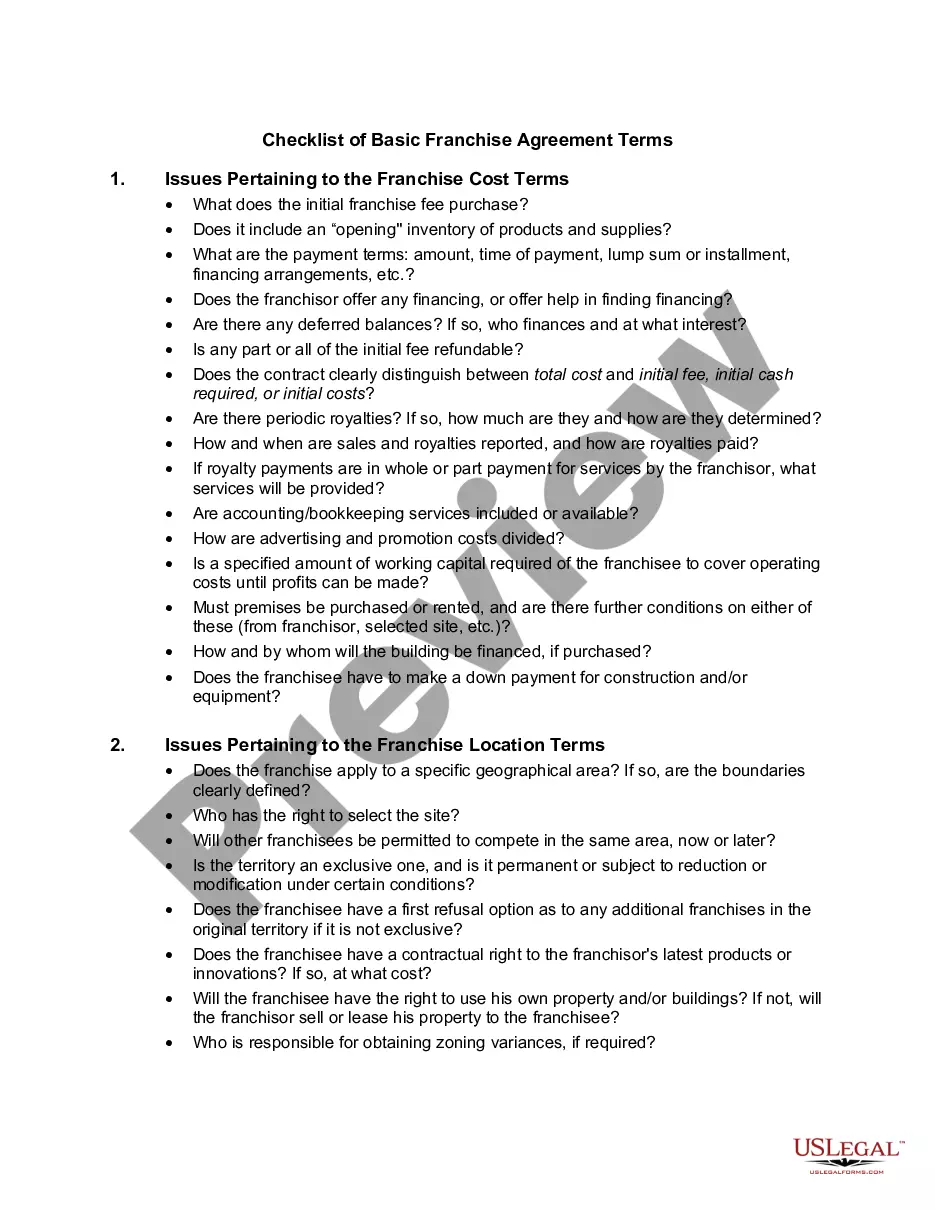
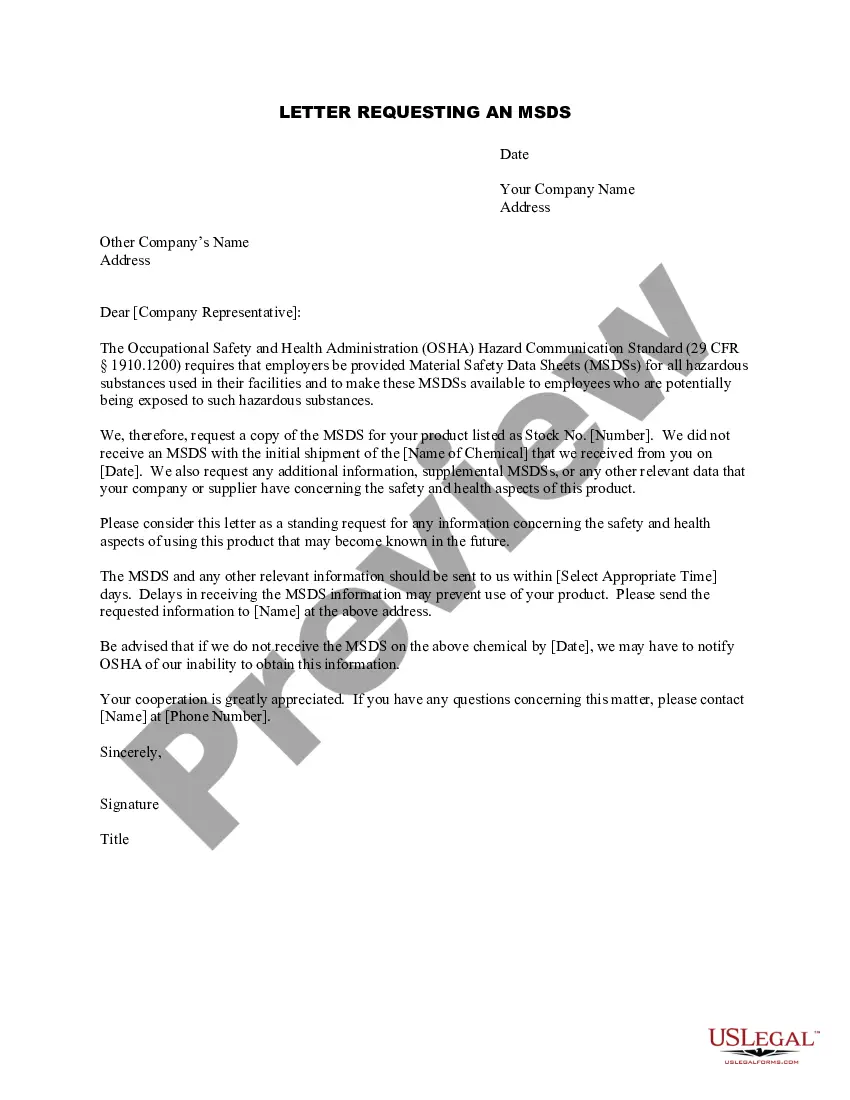
Arkansas Letter Requesting An MSDS
Description
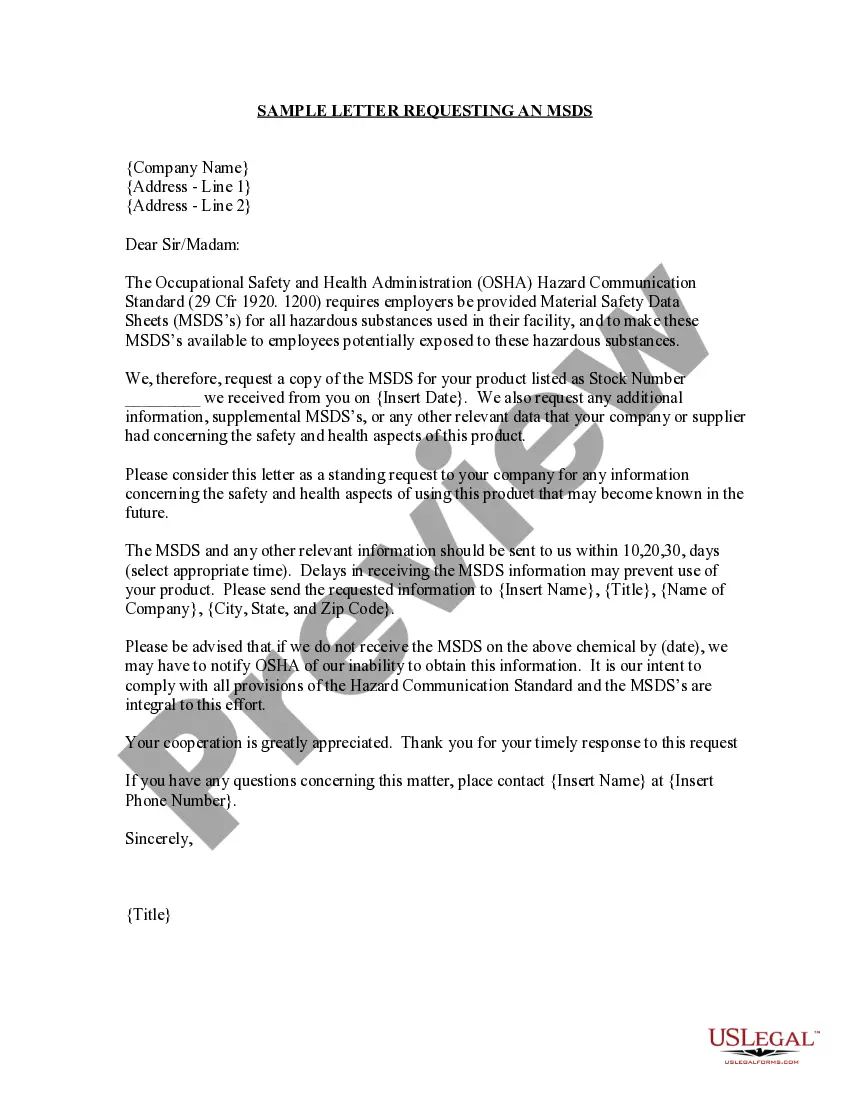
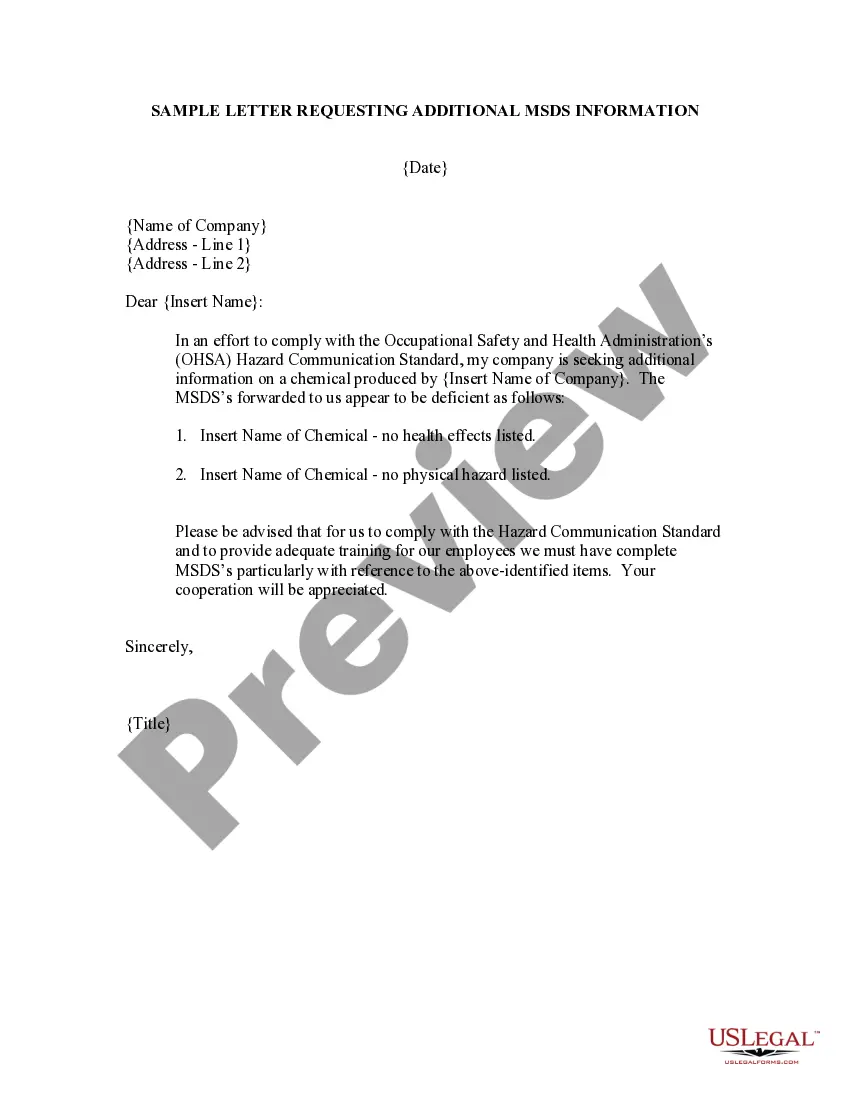
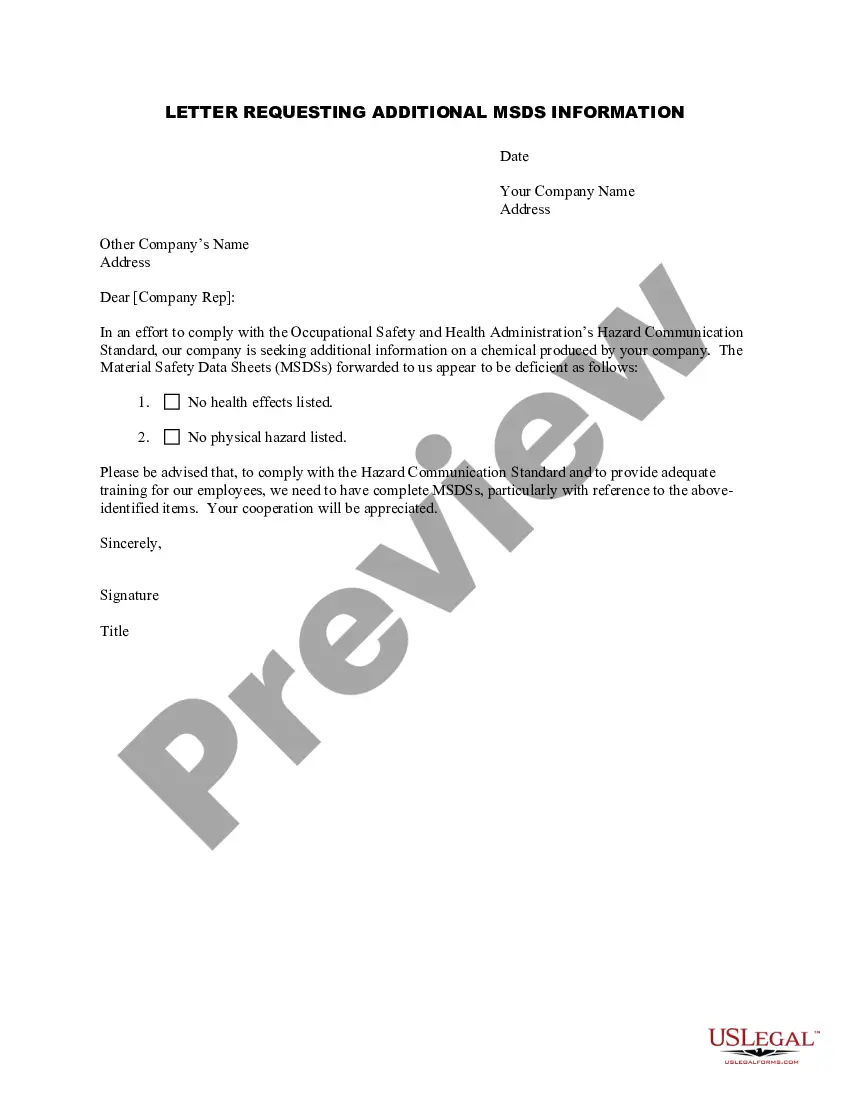
Get your form ready online
Our built-in tools help you complete, sign, share, and store your documents in one place.
Make edits, fill in missing information, and update formatting in US Legal Forms—just like you would in MS Word.
Download a copy, print it, send it by email, or mail it via USPS—whatever works best for your next step.
Sign and collect signatures with our SignNow integration. Send to multiple recipients, set reminders, and more. Go Premium to unlock E-Sign.
If this form requires notarization, complete it online through a secure video call—no need to meet a notary in person or wait for an appointment.
We protect your documents and personal data by following strict security and privacy standards.

Make edits, fill in missing information, and update formatting in US Legal Forms—just like you would in MS Word.

Download a copy, print it, send it by email, or mail it via USPS—whatever works best for your next step.

Sign and collect signatures with our SignNow integration. Send to multiple recipients, set reminders, and more. Go Premium to unlock E-Sign.

If this form requires notarization, complete it online through a secure video call—no need to meet a notary in person or wait for an appointment.

We protect your documents and personal data by following strict security and privacy standards.
Looking for another form?


How to fill out Letter Requesting An MSDS?
You might utilize countless hours online searching for the legal document template that meets the federal and state requirements you need.
US Legal Forms offers a vast selection of legal forms that are examined by professionals.
It is easy to acquire or print the Arkansas Letter Requesting An MSDS from our services.
If available, use the Review button to view the document template as well.
- If you already possess a US Legal Forms account, you can Log In and click the Download button.
- Afterward, you can complete, alter, print, or sign the Arkansas Letter Requesting An MSDS.
- Every legal document template you buy is yours for life.
- To obtain an additional copy of any purchased form, navigate to the My documents tab and click the respective button.
- If you are using the US Legal Forms site for the first time, follow the simple instructions below.
- First, ensure that you have chosen the right document template for the county/city of your choice.
- Review the form description to confirm you have selected the correct document.
Form popularity
FAQ
The Hazard Communication Standard (HCS) (29 CFR 1910.1200(g)), revised in 2012, requires that the chemical manufacturer, distributor, or importer provide Safety Data Sheets (SDSs) (formerly MSDSs or Material Safety Data Sheets) for each hazardous chemical to downstream users to communicate information on these hazards.
A Material Safety Data Sheet (MSDS) is a document that contains information on the potential hazards (health, fire, reactivity and environmental) and how to work safely with the chemical product. It is an essential starting point for the development of a complete health and safety program.
To obtain SDS, get them from the manufacturer.They may be sent with the chemical order (paper copy or e-mail attachment).Otherwise, go to the manufacturer's website and download it or request a copy.
Safety data sheets are an essential component of product stewardship, occupational safety and health. However, they are not required for every product or material. OSHA only requires safety data sheets (SDSs) for hazardous products or chemicals.
The Hazard Communication Regulation (Cal/OSHA, section 5194; Federal OSHA 29 CFR 1910.1200) requires that the chemical manufacturer, distributor, or importer provide safety data sheets (SDSs) (formerly MSDSs or material safety data sheets) for each hazardous chemical to downstream users to communicate information on
Use Guidelines. Chemical Safety's SDS and GHS database is a free service available to organizations of all types. For-profit organizations are granted permission to access Chemical Safety's SDS Search from Chemical Safety's website.
Overview. A Material Safety Data Sheet (MSDS) is required under the U.S. OSHA Hazard Communication Standard .
The Hazard Communication Standard (HCS) (29 CFR 1910.1200(g)), revised in 2012, requires that the chemical manufacturer, distributor, or importer provide Safety Data Sheets (SDSs) (formerly MSDSs or Material Safety Data Sheets) for each hazardous chemical to downstream users to communicate information on these hazards.
3.2 United States of America: In the US, MSDSs are mandated by the Occupational Safety and Health Administration (OSHA) through Hazard Communication Regulation. MSDSs are reviewed by US Chemical Safety and Hazard Investigation Board.
OSHA began requiring MSDS's for hazardous materials effective under 29 CFR 1910.1200, the OSHA Hazard Communication Standard.