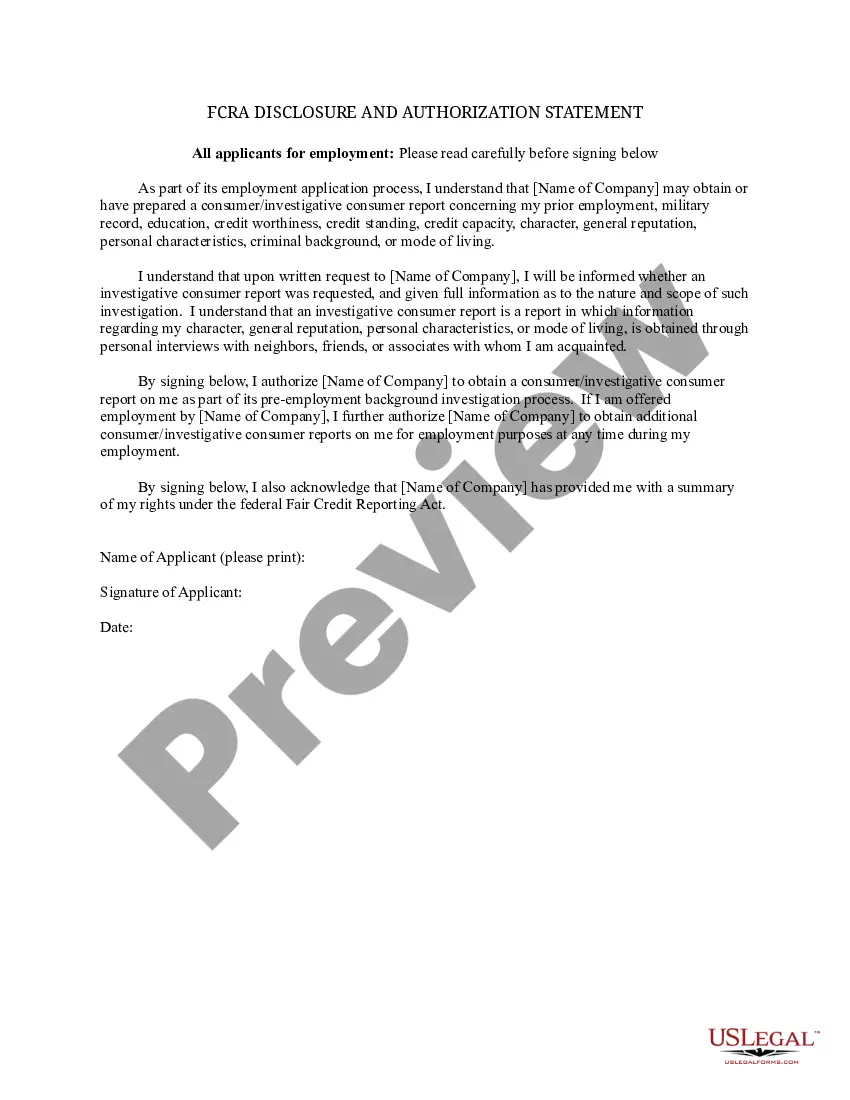
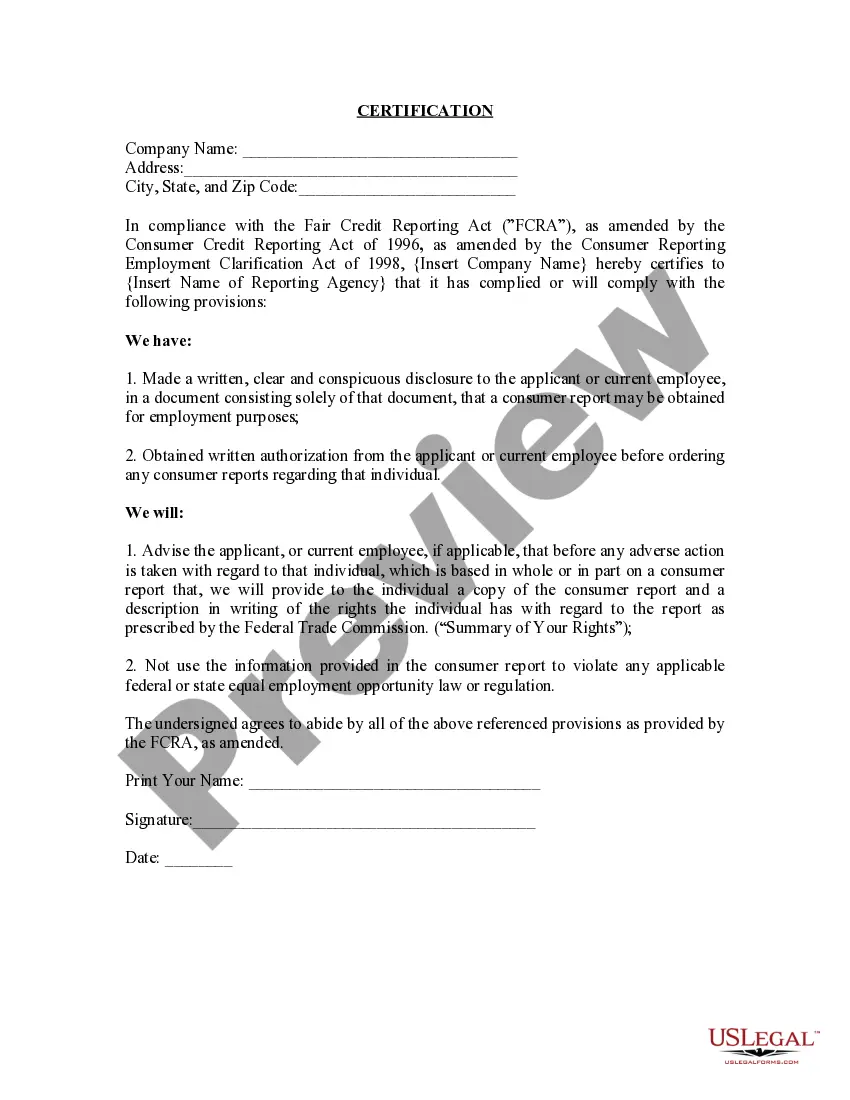
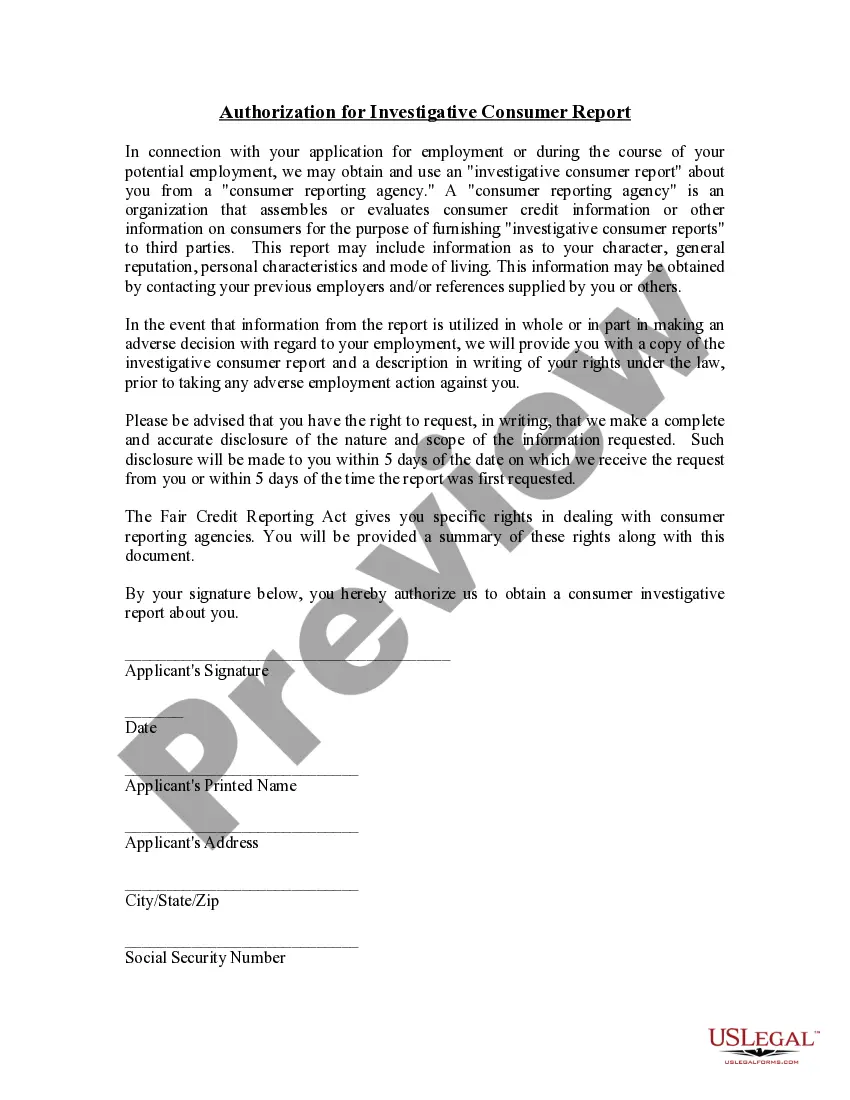
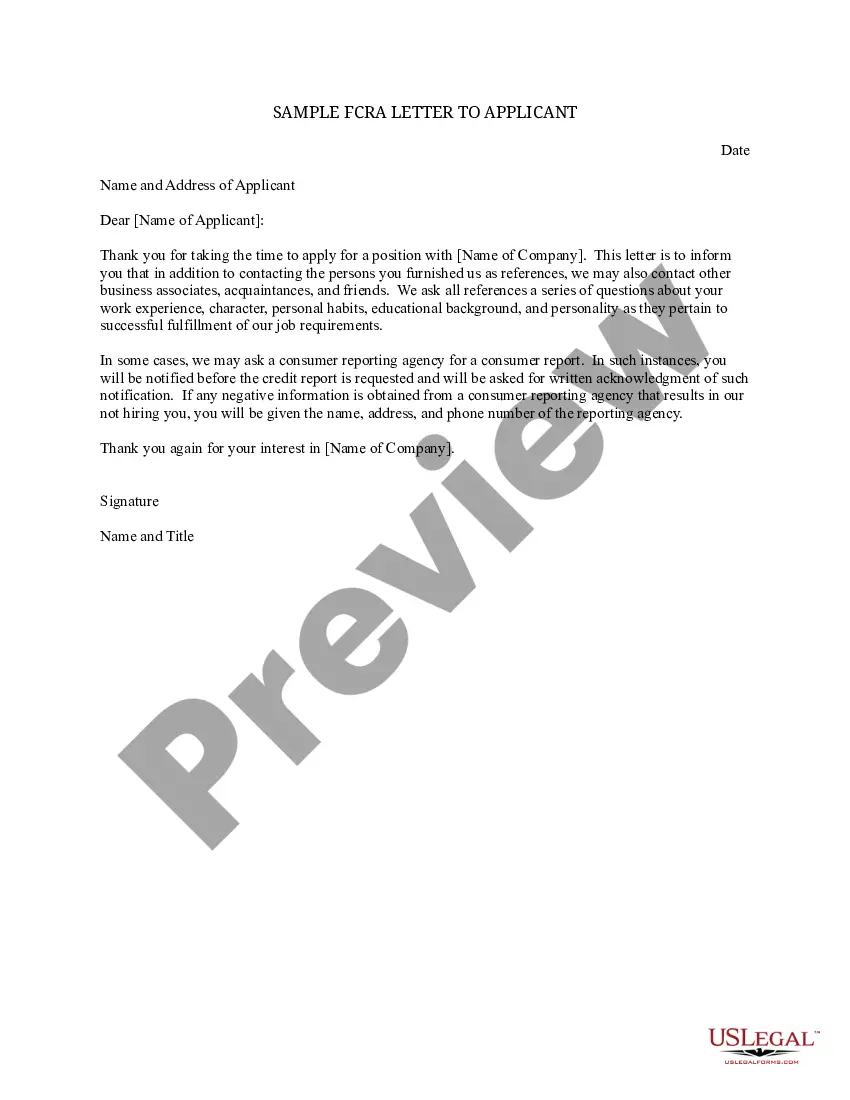
Arkansas FCRA Disclosure and Authorization Statement
Description
Get your form ready online
Our built-in tools help you complete, sign, share, and store your documents in one place.
Make edits, fill in missing information, and update formatting in US Legal Forms—just like you would in MS Word.
Download a copy, print it, send it by email, or mail it via USPS—whatever works best for your next step.
Sign and collect signatures with our SignNow integration. Send to multiple recipients, set reminders, and more. Go Premium to unlock E-Sign.
If this form requires notarization, complete it online through a secure video call—no need to meet a notary in person or wait for an appointment.
We protect your documents and personal data by following strict security and privacy standards.

Make edits, fill in missing information, and update formatting in US Legal Forms—just like you would in MS Word.

Download a copy, print it, send it by email, or mail it via USPS—whatever works best for your next step.

Sign and collect signatures with our SignNow integration. Send to multiple recipients, set reminders, and more. Go Premium to unlock E-Sign.

If this form requires notarization, complete it online through a secure video call—no need to meet a notary in person or wait for an appointment.

We protect your documents and personal data by following strict security and privacy standards.
Looking for another form?
How to fill out FCRA Disclosure And Authorization Statement?
You can spend hours online trying to find the legal document template that fulfills the state and federal requirements you need.
US Legal Forms offers thousands of legal documents that have been reviewed by professionals.
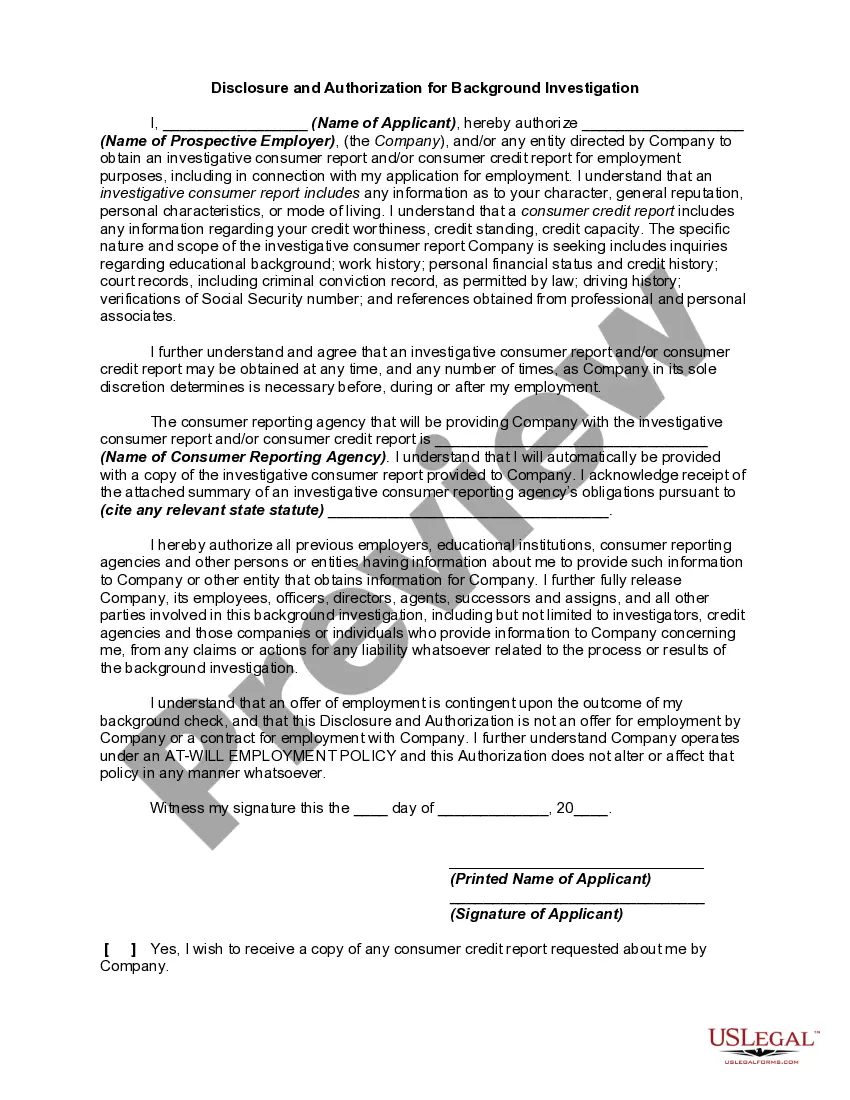
You can download or print the Arkansas FCRA Disclosure and Authorization Statement from this service.
If available, utilize the Preview button to view the document template as well.
- If you possess a US Legal Forms account, you can Log In and click the Obtain button.
- Afterwards, you can complete, modify, print, or sign the Arkansas FCRA Disclosure and Authorization Statement.
- Every legal document template you acquire is yours permanently.
- To retrieve another copy of a purchased form, navigate to the My documents section and click the corresponding button.
- If you are visiting the US Legal Forms website for the first time, follow the simple steps below.
- First, ensure you have selected the correct document template for your desired region/city.
- Review the document description to confirm you have chosen the correct one.
Form popularity
FAQ
The FCRA requires any prospective user of a consumer report, for example, a lender, insurer, landlord, or employer, among others, to have a legally permissible purpose to obtain a report. Legally Permissible Purposes.
The FCRA gives you the right to be told if information in your credit file is used against you to deny your application for credit, employment or insurance. The FCRA also gives you the right to request and access all the information a consumer reporting agency has about you (this is called "file disclosure").
The Fair Credit Reporting Act (FCRA) is a federal law that helps to ensure the accuracy, fairness and privacy of the information in consumer credit bureau files. The law regulates the way credit reporting agencies can collect, access, use and share the data they collect in your consumer reports.
The Fair Credit Reporting Act (FCRA) is a federal law that requires you to make a disclosure to employees or applicants informing them that you will obtain a consumer report about them for employment consideration purposes.
FCRA's Broad CoverageCredit worthiness.Credit standing.Credit capacity.Character.General reputation.Personal characteristics or.Mode of living.
Today, FCRA compliance is mandatory for any employer using a third party to conduct background checks. As an employer, when you are choosing a background check provider you need to ensure that your provider is a certified FCRA-compliant Credit Reporting Agency (CRA).
Today, FCRA compliance is mandatory for any employer using a third party to conduct background checks. As an employer, when you are choosing a background check provider you need to ensure that your provider is a certified FCRA-compliant Credit Reporting Agency (CRA).
A Summary of Your Rights Under the Fair Credit Reporting Act. The federal Fair Credit Reporting Act (FCRA) promotes the accuracy, fairness, and privacy of. information in the files of consumer reporting agencies.
FCRA Authorization: Obtain Permission for a Background Check A compliant FCRA authorization form is an acknowledgement that a pre-employment background check will be conducted. It can be presented as a self-contained document or jointly with an FCRA disclosure form.
Four Basic Steps to FCRA ComplianceStep 1: Disclosure & Written Consent. Before requesting a consumer or investigative report, an employer must:Step 2: Certification To The Consumer Reporting Agency.Step 3: Provide Applicant With Pre-Adverse Action Documents.Step 4: Notify Applicant Of Adverse Action.