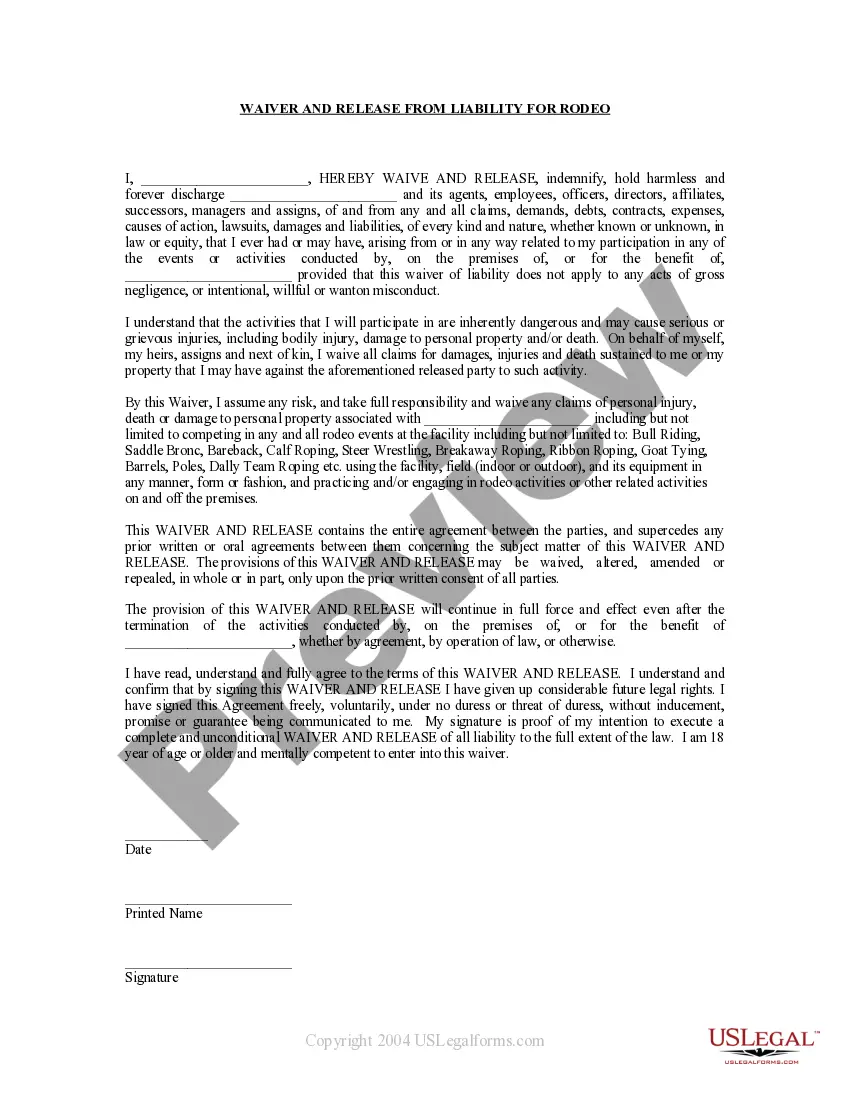
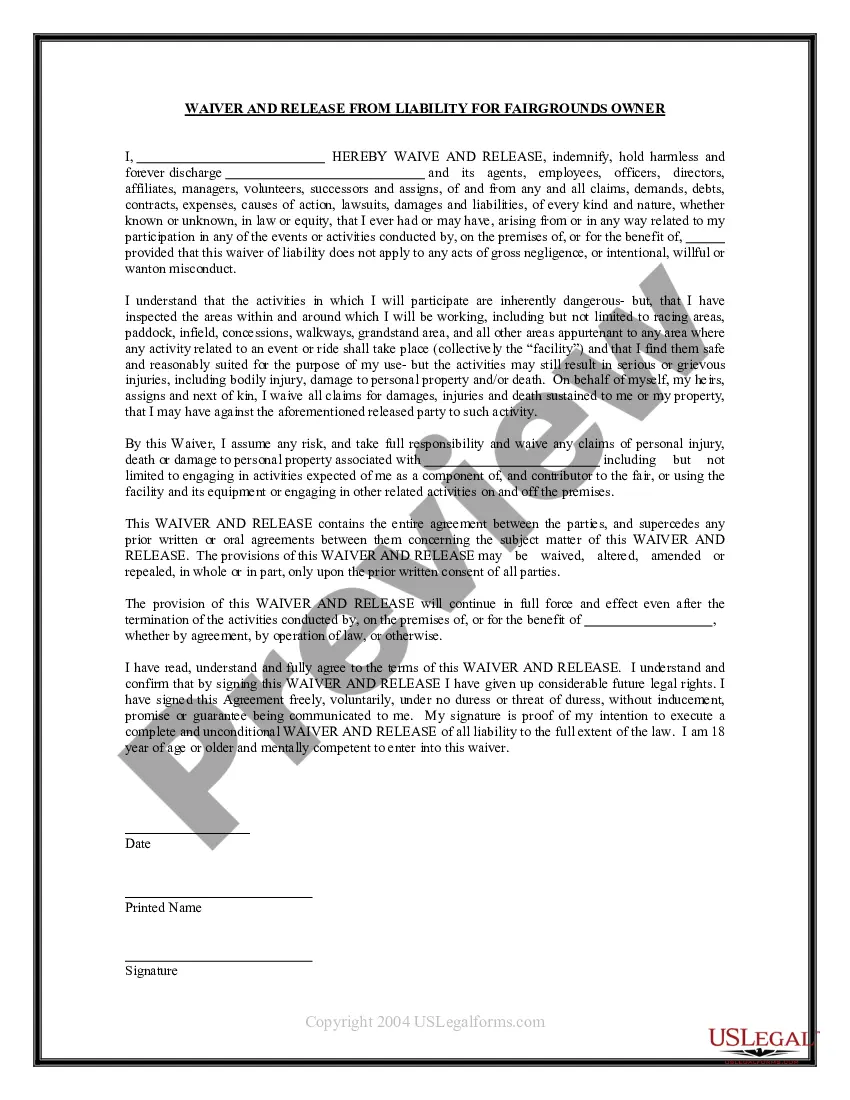
This form allows an adult to release a Rodeo facility from liability for injuries which may be incurred while on the premises, taking part in activities, etc.
Arkansas Waiver and Release From Liability For Adult for Rodeo
State:
Multi-State
Category:
Control #:
US-WAV-49A
Format:
Word;
Rich Text
50 downloads
Description
Get your form ready online
Our built-in tools help you complete, sign, share, and store your documents in one place.
Built-in online Word editor
Make edits, fill in missing information, and update formatting in US Legal Forms—just like you would in MS Word.
Export easily
Download a copy, print it, send it by email, or mail it via USPS—whatever works best for your next step.
E-sign your document
Sign and collect signatures with our SignNow integration. Send to multiple recipients, set reminders, and more. Go Premium to unlock E-Sign.
Notarize online 24/7
If this form requires notarization, complete it online through a secure video call—no need to meet a notary in person or wait for an appointment.
Store your document securely
We protect your documents and personal data by following strict security and privacy standards.

Make edits, fill in missing information, and update formatting in US Legal Forms—just like you would in MS Word.

Download a copy, print it, send it by email, or mail it via USPS—whatever works best for your next step.

Sign and collect signatures with our SignNow integration. Send to multiple recipients, set reminders, and more. Go Premium to unlock E-Sign.

If this form requires notarization, complete it online through a secure video call—no need to meet a notary in person or wait for an appointment.

We protect your documents and personal data by following strict security and privacy standards.
Looking for another form?
How to fill out Waiver And Release From Liability For Adult For Rodeo?
If you want to complete, acquire, or print sanctioned document templates, utilize US Legal Forms, the largest assortment of legal forms available online.
Leverage the site's straightforward and user-friendly search to find the documents you require.
Numerous templates for business and personal uses are sorted by categories and states, or keywords.
Once you find the form you need, click the Get now button. Choose the payment plan you prefer and provide your details to register for an account.
Complete the transaction. You can use your Visa or Mastercard or PayPal account to finish the purchase.
- Use US Legal Forms to obtain the Arkansas Waiver and Release From Liability For Adult for Rodeo in just a few clicks.
- If you are already a US Legal Forms user, Log In to your account and click the Obtain button to access the Arkansas Waiver and Release From Liability For Adult for Rodeo.
- You can also find forms you previously downloaded in the My documents section of your account.
- If this is your first time using US Legal Forms, follow the instructions below.
- Confirm you have selected the form for the appropriate city/state.
- Use the Review option to examine the form's content. Be sure to read the details.
- If you are not happy with the form, use the Lookup area at the top of the screen to find other versions in the legal form format.
Form popularity
FAQ
An effective waiver of liability, such as the Arkansas Waiver and Release From Liability For Adult for Rodeo, must meet three key requirements. First, it must clearly state the risks involved in the activity. Second, the waiver should be voluntarily signed by the participant, indicating their understanding and acceptance of those risks. Lastly, the language must be explicit enough to ensure that it is enforceable in court. Platforms like USLegalForms can guide you through these requirements, ensuring your waiver meets legal standards.
Yes, liability waivers are often worth the effort, especially in activities like rodeo where risks are inherent. An Arkansas Waiver and Release From Liability For Adult for Rodeo can protect event organizers from potential legal claims by participants. This protection not only offers peace of mind but also encourages more individuals to participate, knowing that safety measures are in place. Utilizing services like USLegalForms can help you ensure that your waiver is comprehensive and legally sound.
To create an Arkansas Waiver and Release From Liability For Adult for Rodeo, start by clearly identifying the parties involved. Next, outline the specific activities that the waiver covers and include a statement that the participant understands the risks associated with these activities. It is crucial to ensure that the language is clear and easy to understand. Using a platform like USLegalForms can simplify this process, providing templates that are tailored to meet state laws.
Yes, it is possible to sue even after signing a liability waiver, especially if the waiver does not cover the specific circumstances of the injury. The enforceability of an Arkansas Waiver and Release From Liability For Adult for Rodeo depends on its clarity and the context in which it was signed. If gross negligence or intentional wrongdoing is involved, courts may allow lawsuits to proceed despite the waiver.
To create a release of liability waiver, begin by outlining the specific activities and potential risks involved. Clearly state the intent to release the organization or individual from liability for injuries sustained during those activities. Using a reliable platform like uslegalforms can help you draft an Arkansas Waiver and Release From Liability For Adult for Rodeo that is both comprehensive and compliant with Arkansas law.
When writing a liability waiver form, start by identifying the parties involved and the activities covered. Include a detailed description of the risks associated with the activity, along with a statement that releases the organizer from liability. Utilizing a template for an Arkansas Waiver and Release From Liability For Adult for Rodeo can simplify this process and ensure all legal requirements are met.
Liability waivers can be legally binding if they are properly executed and adhere to state laws. An Arkansas Waiver and Release From Liability For Adult for Rodeo must be clear, concise, and voluntarily signed to be deemed enforceable. To avoid potential legal challenges, it is advisable to consult legal resources or professionals when drafting your waiver.
Yes, you can write your own liability waiver, but it is crucial to ensure that it includes all necessary legal elements. To make an effective Arkansas Waiver and Release From Liability For Adult for Rodeo, you should specify the activities covered, outline the risks, and include a clear statement of release. However, using a professionally drafted template can help ensure that your waiver is compliant with local laws and effectively protects your interests.
Yes, liability waivers can be enforceable in Arkansas, provided they meet specific legal requirements. The Arkansas Waiver and Release From Liability For Adult for Rodeo must clearly outline the risks involved and be signed voluntarily by all parties. Courts typically uphold these waivers unless they are deemed overly broad or ambiguous.
Waivers generally aim to limit the ability to sue for injuries that occur during the activity covered by the waiver. However, the enforceability of an Arkansas Waiver and Release From Liability For Adult for Rodeo can vary based on circumstances and the language used in the waiver. It is essential to understand that while waivers provide some legal protection, they may not prevent all lawsuits, especially in cases of gross negligence or intentional harm.