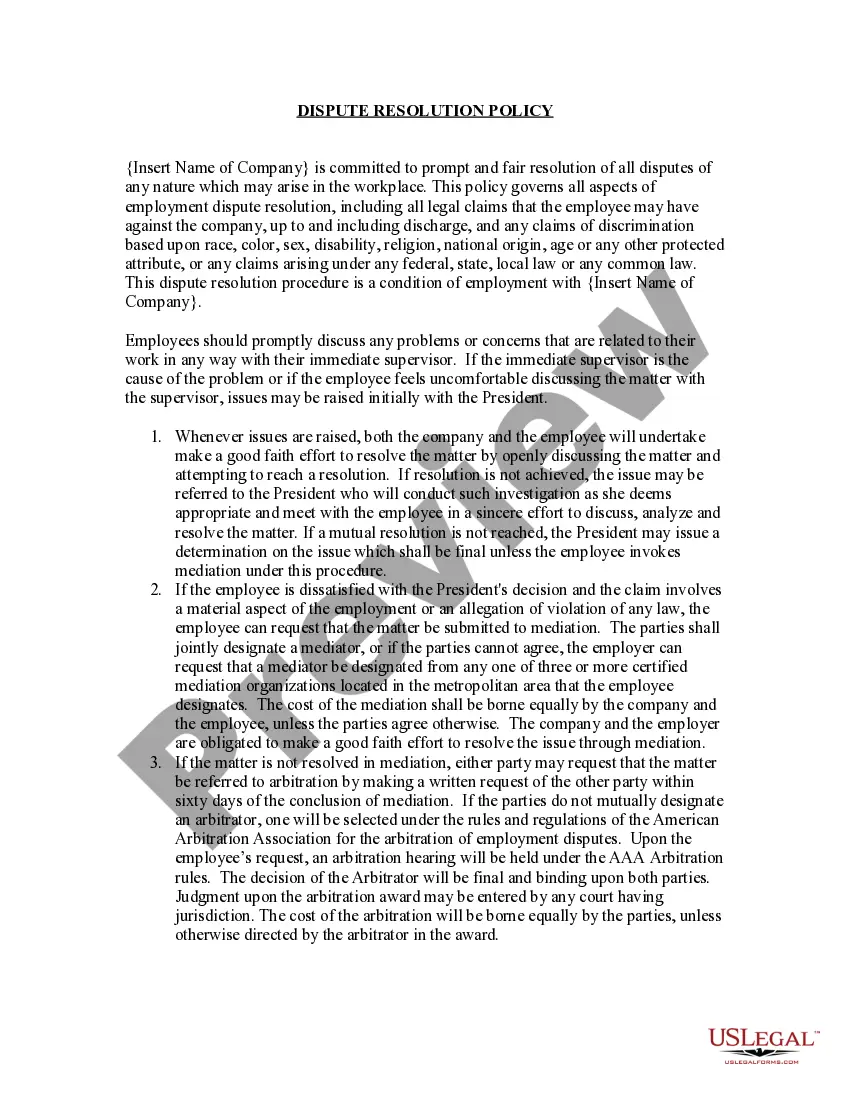
Arkansas Dispute Resolution Policy
Description
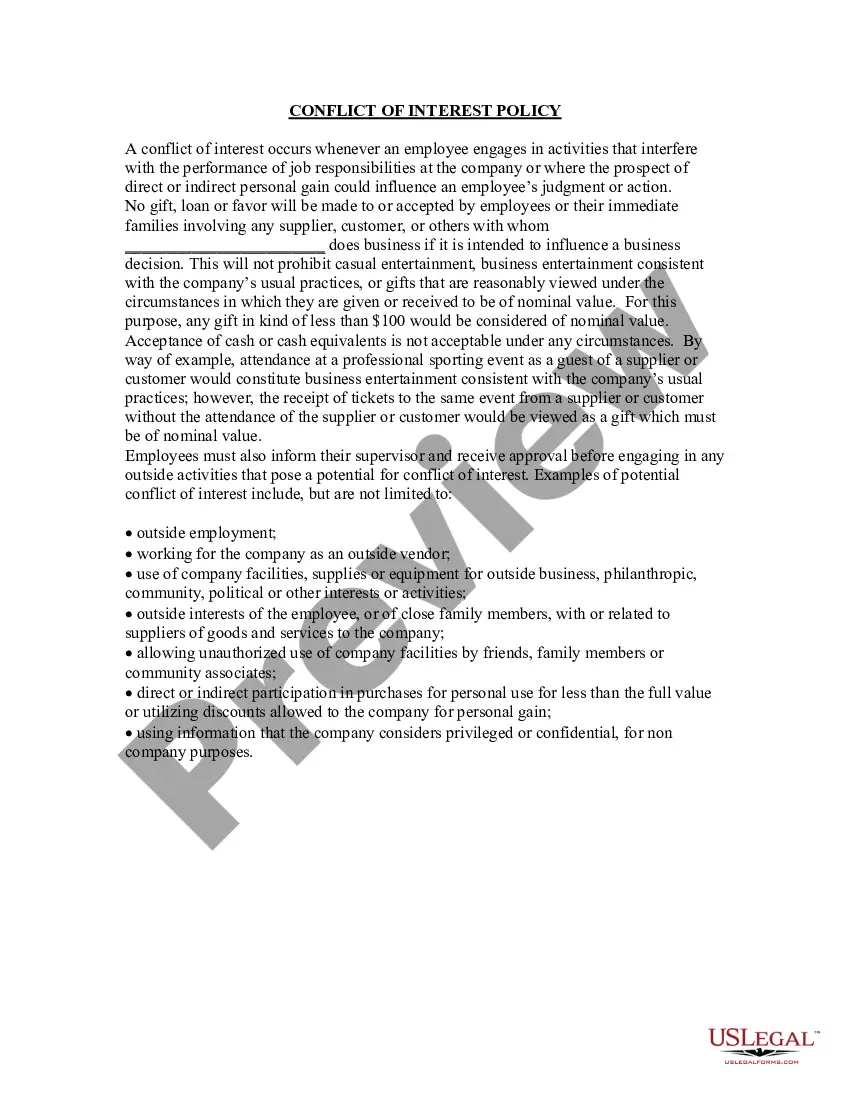
Get your form ready online
Our built-in tools help you complete, sign, share, and store your documents in one place.
Make edits, fill in missing information, and update formatting in US Legal Forms—just like you would in MS Word.
Download a copy, print it, send it by email, or mail it via USPS—whatever works best for your next step.
Sign and collect signatures with our SignNow integration. Send to multiple recipients, set reminders, and more. Go Premium to unlock E-Sign.
If this form requires notarization, complete it online through a secure video call—no need to meet a notary in person or wait for an appointment.
We protect your documents and personal data by following strict security and privacy standards.

Make edits, fill in missing information, and update formatting in US Legal Forms—just like you would in MS Word.

Download a copy, print it, send it by email, or mail it via USPS—whatever works best for your next step.

Sign and collect signatures with our SignNow integration. Send to multiple recipients, set reminders, and more. Go Premium to unlock E-Sign.

If this form requires notarization, complete it online through a secure video call—no need to meet a notary in person or wait for an appointment.

We protect your documents and personal data by following strict security and privacy standards.
Looking for another form?



How to fill out Dispute Resolution Policy?
You may spend time online trying to locate the official document template that satisfies the state and federal requirements you need.
US Legal Forms offers a vast selection of legal forms that have been assessed by experts.
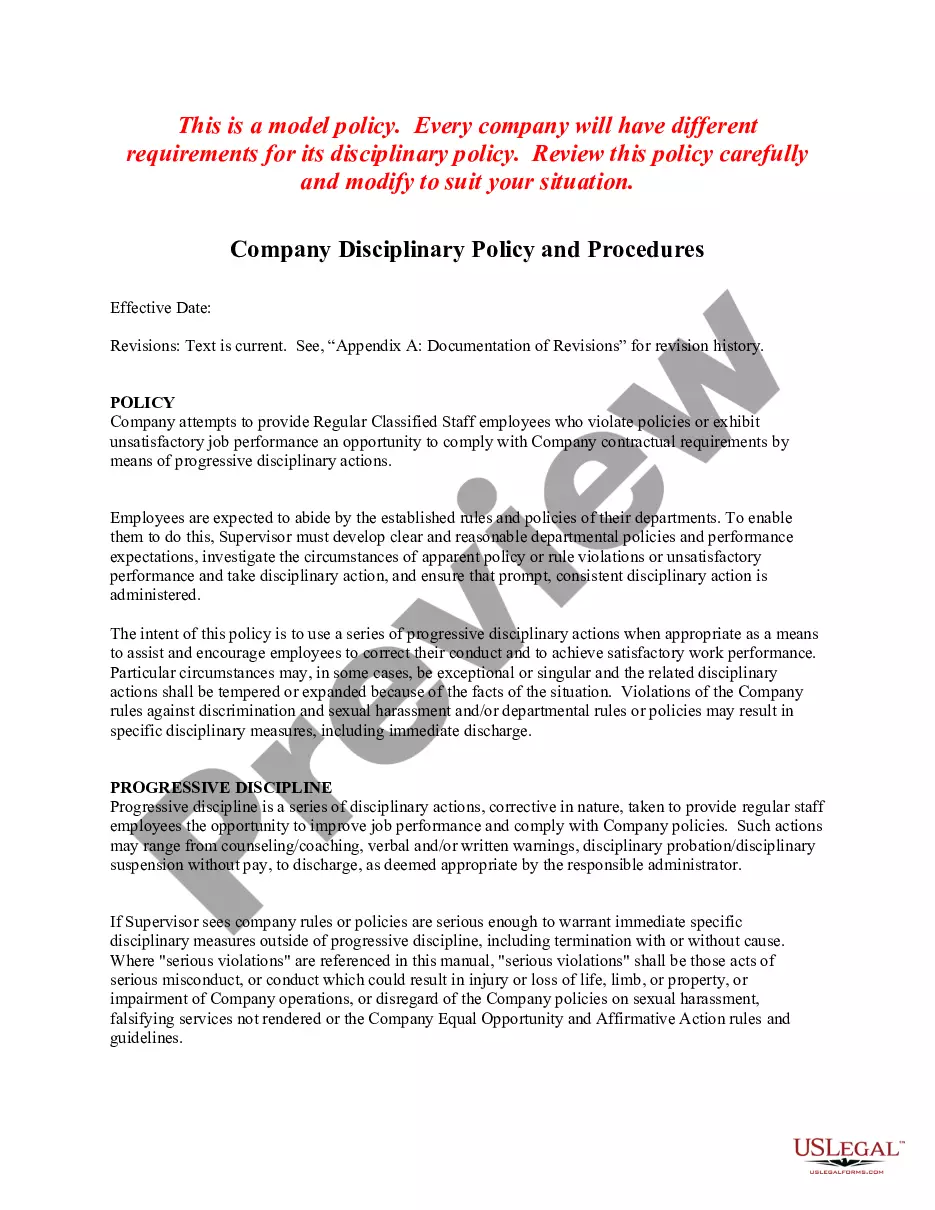
You can download or create the Arkansas Dispute Resolution Policy from our platform.
If available, use the Preview button to view the document template as well.
- If you already possess a US Legal Forms account, you can Log In and click the Download button.
- Subsequently, you can complete, modify, print, or sign the Arkansas Dispute Resolution Policy.
- Every legal document template you acquire is yours to keep permanently.
- To obtain another copy of a purchased form, visit the My documents tab and click the corresponding button.
- If this is your first time using the US Legal Forms website, follow the simple instructions below.
- First, ensure that you have selected the appropriate document template for your chosen state/city.
- Review the form summary to confirm you have chosen the right form.
Form popularity
FAQ
To make dispute resolution effective, focus on open communication and clearly defined processes. Encourage parties to express their concerns fully and seek solutions collaboratively. Utilize methods outlined in your Arkansas Dispute Resolution Policy, and consider training team members in conflict resolution techniques. A proactive approach can lead to lasting resolutions and improved relationships.
Alternative Dispute Resolution: 4 Main TypesNegotiation. Negotiation is often the first option for those wishing to resolve a dispute.Mediation. A mediator is a jointly instructed neutral party and their role is to assist the parties in reaching an agreement.Arbitration.Expert determination.
There are many types of dispute resolution processes, but arbitration; mediation; and negotiation are the three most common types of alternative dispute resolution. Negotiation is the least formal type of ADR.
Dispute resolution processes fall into two major types: Adjudicative processes, such as litigation or arbitration, in which a judge, jury or arbitrator determines the outcome. Consensual processes, such as collaborative law, mediation, conciliation, or negotiation, in which the parties attempt to reach agreement.
Types of disputeArbitration.Competition.Construction.Employment.Enforcement and Asset Recovery.Financial services.Fraud.General commercial.More items...
While the two most known forms of ADR are arbitration and mediation, negotiation is almost always attempted first to resolve a dispute.
There are many types of dispute resolution processes, but arbitration; mediation; and negotiation are the three most common types of alternative dispute resolution. Negotiation is the least formal type of ADR.
Learn about the methods we use to resolve disputes arbitration, mediation, conciliation and case appraisal.
Definition. A dispute resolution procedure is a method of resolving a conflict between parties.
The most common types of ADR for civil cases are mediation, settlement conferences, neutral evaluation, and arbitration.