Arkansas Redemption Deed
About this form
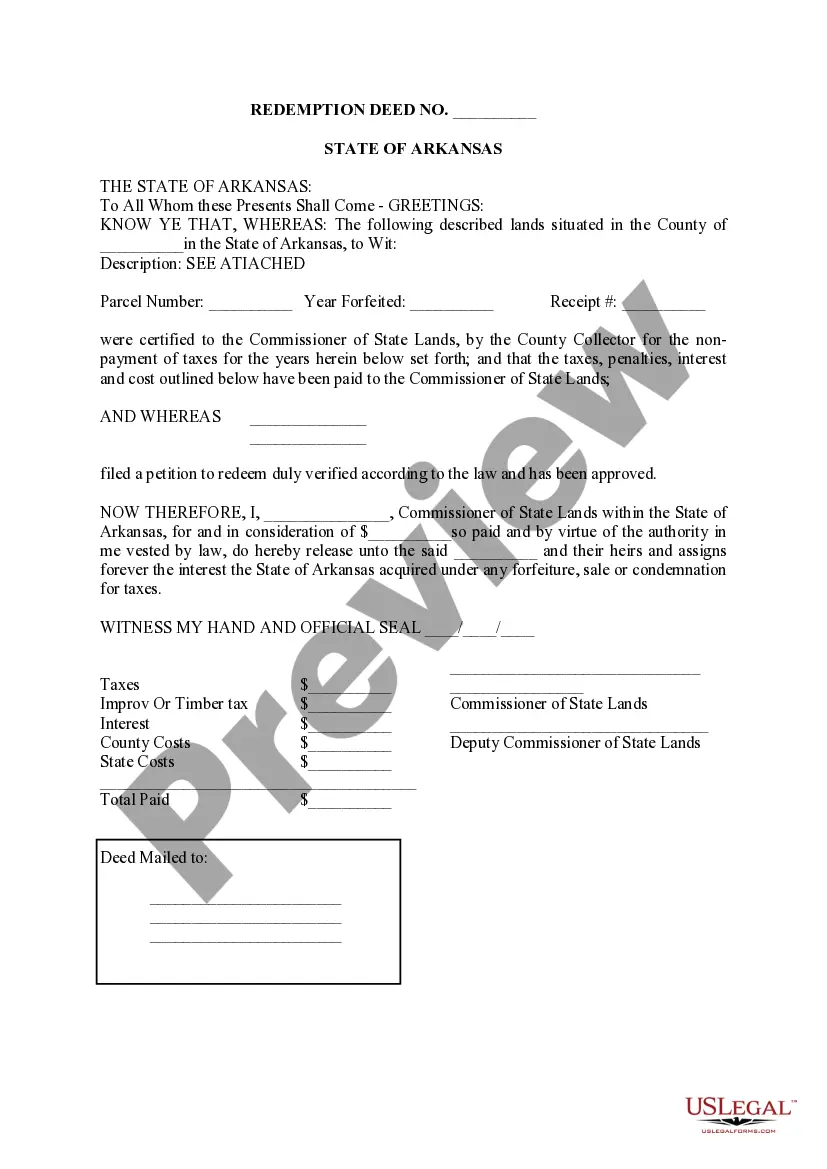
A redemption deed is a legal document that formalizes the transfer of property back to the original owner after they have redeemed it from a tax sale. This form is essential for anyone looking to reclaim their land that may have been forfeited due to unpaid taxes. Unlike other deed types, the redemption deed specifically addresses the restitution of property after a tax sale, distinguishing it from general deeds of conveyance or quitclaim deeds.
Key components of this form
- Parcel identification number to uniquely identify the property.
- Year forfeited to indicate when the taxes were unpaid.
- Receipt number for proof of payment to the Commissioner of State Lands.
- Statement of the amount paid for taxes, including penalties and costs.
- Signature of the Commissioner of State Lands, affirming the validity of the deed.
Situations where this form applies
This form is used when a property owner has successfully redeemed their property from a tax sale by paying the outstanding taxes, penalties, and associated costs. It is necessary for the property owner to have a legally recognized document that confirms their ownership rights have been restored following the redemption process.
Who this form is for
This form is intended for:
- Property owners who have lost their land due to tax sales.
- Individuals or entities acting on behalf of the property owner.
- Anyone seeking to formally document the redemption of a property in Arkansas.
How to prepare this document
- Fill in the parcel identification number to specify the property.
- Provide the year forfeited, indicating when taxes were not paid.
- Enter the receipt number obtained from the payment to the Commissioner of State Lands.
- Detail the total amount paid, including taxes, interest, and costs.
- Obtain the Commissioner of State Landsâ signature to validate the redemption deed.
Notarization guidance
This form does not typically require notarization unless specified by local law. However, consulting with a legal professional is advised to ensure all local regulations are followed appropriately.
Get your form ready online
Our built-in tools help you complete, sign, share, and store your documents in one place.
Make edits, fill in missing information, and update formatting in US Legal Forms—just like you would in MS Word.
Download a copy, print it, send it by email, or mail it via USPS—whatever works best for your next step.
Sign and collect signatures with our SignNow integration. Send to multiple recipients, set reminders, and more. Go Premium to unlock E-Sign.
If this form requires notarization, complete it online through a secure video call—no need to meet a notary in person or wait for an appointment.
We protect your documents and personal data by following strict security and privacy standards.

Make edits, fill in missing information, and update formatting in US Legal Forms—just like you would in MS Word.

Download a copy, print it, send it by email, or mail it via USPS—whatever works best for your next step.

Sign and collect signatures with our SignNow integration. Send to multiple recipients, set reminders, and more. Go Premium to unlock E-Sign.

If this form requires notarization, complete it online through a secure video call—no need to meet a notary in person or wait for an appointment.

We protect your documents and personal data by following strict security and privacy standards.
Mistakes to watch out for
- Failing to provide accurate parcel numbers, which may lead to confusion over property ownership.
- Not including the complete payment details, which can invalidate the form.
- Omitting to obtain the necessary signature from the Commissioner of State Lands.
Benefits of completing this form online
- Convenient access to the form anytime and anywhere.
- Editable template to customize it to your specific situation with ease.
- Reliability of professionally drafted forms, ensuring compliance with legal standards.
Legal use & context
- The redemption deed allows the former property owner to regain their rights after fulfilling their tax obligations.
- It serves as proof that the state has relinquished any claims to the property due to the owner's compliance in redeeming it.
Main things to remember
- A redemption deed is essential for reclaiming property after a tax sale.
- Accurate and complete information is crucial for the documentâs validity.
- Understanding state-specific laws will ensure a smooth redemption process.
Looking for another form?


Form popularity
FAQ
To transfer ownership of property in Arkansas, you generally need to create a deed, such as a quit claim deed or warranty deed, detailing the transfer. This involves filling out the deed with pertinent information, obtaining signatures, and having the document notarized. Finally, you must record the deed with the county to make the transfer official. For assistance, US Legal Forms provides easy access to the necessary forms and guidance tailored to your Arkansas Redemption Deed needs.
In Arkansas, a quit claim deed requires the names of the grantor and grantee, the property description, and each party's signature. Additionally, the deed must be notarized to be legally effective. Once complete, you should file the quit claim deed with your county's recorder's office. Using the resources available at US Legal Forms can ensure you have all necessary documents ready for your Arkansas Redemption Deed.
The primary beneficiaries of a quit claim deed are individuals looking to transfer property ownership quickly and without complicated legal issues. This deed is often beneficial between family members or in divorce settlements, as it facilitates the straightforward transfer of property rights. Moreover, the Arkansas Redemption Deed often fits well into this scenario, allowing seamless transitions in ownership for concerned parties.
To fill out a quit claim deed in Arkansas, start by obtaining the correct form, which you can find through platforms like US Legal Forms. Next, include your name, the grantee's name, and a legal description of the property. Ensure all information is accurate, then sign the document in the presence of a notary public. This serves as a vital step to establish the Arkansas Redemption Deed effectively.
Yes, deeds are public records in Arkansas, and anyone can access them through the county clerk's office. This transparency allows interested parties to verify property ownership and deed history. To find specific details about the Arkansas Redemption Deed, you can visit the office in person or access their online resources. Services like USLegalForms can help you navigate through public records with ease.
To obtain a quitclaim deed in Arkansas, you must first prepare the deed document, ensuring it includes relevant details such as the grantor and grantee information. After preparing the Arkansas Redemption Deed, you need to sign it in the presence of a notary public. Finally, record it at the county clerk's office where the property is located for it to take effect. Utilizing USLegalForms can simplify the entire process.
A redemption deed in Arkansas is a legal document that signifies the return of property to its original owner after the payment of delinquent taxes. This deed allows the property owner to reclaim their property from a tax sale. Understanding the financial implications of the Arkansas Redemption Deed is vital to maintaining your property rights. For thorough insights, USLegalForms can be an excellent resource.
If property is not redeemed within the two-year redemption period in Arkansas, it may be forfeited to the purchaser of the tax lien. The original owner will lose all rights to the property, and the new owner will receive a clear title. It’s crucial to understand the significance of the Arkansas Redemption Deed during this period to protect your property. Consider checking USLegalForms for detailed information about your rights in this context.
You can acquire a copy of your property deed by visiting your local county clerk's office or by searching their online database if available. Gather any information like your name or property details to make the search easier. With the information you need, you can quickly obtain your Arkansas Redemption Deed without complications. Platforms like USLegalForms can provide guidance in this search.
To obtain a copy of a deed in Arkansas, you need to contact the county clerk's office where the deed was originally recorded. Most counties offer both in-person requests and online access to records. You can easily search for your Arkansas Redemption Deed using the appropriate details such as the property address or legal description. Using services such as USLegalForms can assist you in this process.