Arkansas Quitclaim Deed from an Individual to a Trust
Overview of this form
The Quitclaim Deed from an Individual to a Trust is a legal document that allows an individual (the Grantor) to transfer ownership of property to a trust (the Grantee). This type of deed is distinct from others, like warranty deeds, as it only conveys the Grantor's interest in the property without guaranteeing that the title is clear. It is essential for individuals wishing to allocate property to a trust for estate planning or asset protection purposes.
Main sections of this form
- Grantor's name and signature: Identifies the individual transferring the property.
- Grantee's information: Specifies the trust receiving the property.
- Property description: Details on the property being transferred, including a legal description.
- Date of transfer: The date on which the property transfer takes effect.
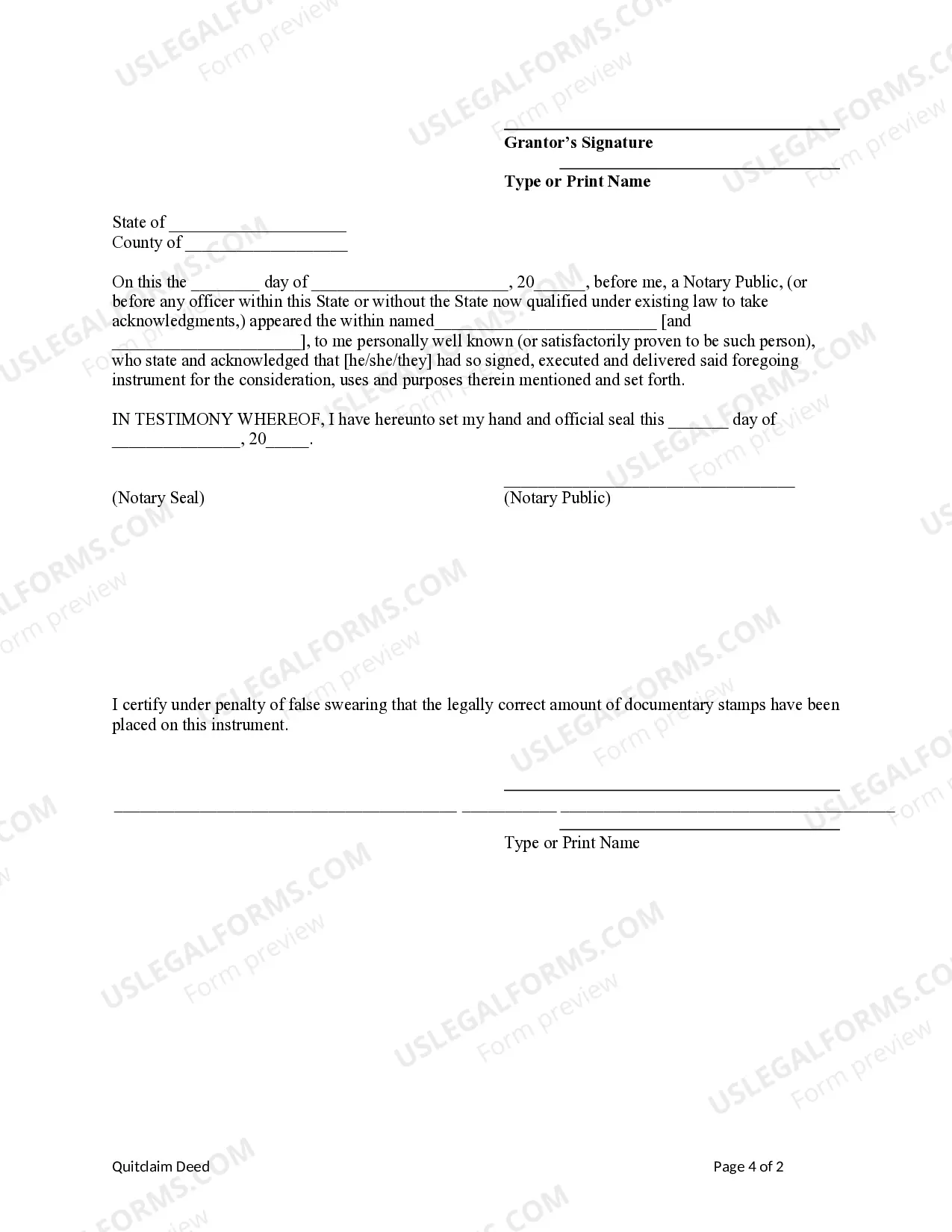
- Notary acknowledgment: A section for notarization, confirming the authenticity of the signatures.







When to use this form
This form is used when an individual wants to transfer property into a trust, which can provide various benefits such as avoiding probate, facilitating estate management, or protecting assets. Common scenarios include changing property ownership as part of estate planning or placing real estate into a family trust for future generations.
Intended users of this form
This form is suitable for:
- Individuals looking to transfer property to an established trust.
- Trustees or beneficiaries involved in estate planning.
- Anyone wishing to simplify property management within a trust.
How to prepare this document
- Identify the Grantor: Provide the full name and address of the individual transferring the property.
- Specify the Grantee: Enter the name of the trust and any additional identifying details.
- Describe the property: Include a complete legal description of the property being transferred.
- Enter the date of transfer: Write the effective date of the transfer in the designated field.
- Sign in the presence of a notary: The Grantor must sign the deed before a notary public for it to be valid.
Does this document require notarization?
This form needs to be notarized to ensure legal validity. US Legal Forms provides secure online notarization powered by Notarize, allowing you to complete the process through a verified video call, available anytime.
Get your form ready online
Our built-in tools help you complete, sign, share, and store your documents in one place.
Make edits, fill in missing information, and update formatting in US Legal Forms—just like you would in MS Word.
Download a copy, print it, send it by email, or mail it via USPS—whatever works best for your next step.
Sign and collect signatures with our SignNow integration. Send to multiple recipients, set reminders, and more. Go Premium to unlock E-Sign.
If this form requires notarization, complete it online through a secure video call—no need to meet a notary in person or wait for an appointment.
We protect your documents and personal data by following strict security and privacy standards.

Make edits, fill in missing information, and update formatting in US Legal Forms—just like you would in MS Word.

Download a copy, print it, send it by email, or mail it via USPS—whatever works best for your next step.

Sign and collect signatures with our SignNow integration. Send to multiple recipients, set reminders, and more. Go Premium to unlock E-Sign.

If this form requires notarization, complete it online through a secure video call—no need to meet a notary in person or wait for an appointment.

We protect your documents and personal data by following strict security and privacy standards.
Common mistakes
- Failing to accurately describe the property, which can lead to legal issues.
- Not having the deed notarized, rendering it legally ineffective.
- Omitting necessary information about the trust, which may cause confusion later.
Benefits of using this form online
- Convenience: Download and complete the form from the comfort of your home.
- Editability: Easily fill in the fields digitally for clarity and neatness.
- Time-saving: Bypass long waits for form availability in office supply stores.
Summary of main points
- The Quitclaim Deed enables the transfer of property from an individual to a trust.
- Accurate property descriptions and notarization are crucial for legal validity.
- This form is vital for effective estate planning and asset protection.
Looking for another form?


Form popularity
FAQ
To fill out the quitclaim deed form, start by entering the names of the grantor and grantee, followed by the property’s legal description, which can often be found in previous deeds or public records. For those utilizing an Arkansas Quitclaim Deed from an Individual to a Trust, be sure to indicate the trust's full name correctly. After completing these sections, sign the form in front of a notary public, and submit it to your local recorder’s office for filing.
Filling out a quitclaim deed in Arkansas involves specifying the type of deed, detail of the grantor and grantee, and the property description. When using an Arkansas Quitclaim Deed from an Individual to a Trust, it’s crucial to indicate that the trust is the new property owner. Don’t forget to sign and notarize the document before recording it with your local clerk to ensure it holds legal ground.
Generally, individuals who wish to transfer property quickly benefit the most from a quitclaim deed, especially in situations such as family transfers, estate planning, or transferring property into a trust. If you are considering an Arkansas Quitclaim Deed from an Individual to a Trust, it simplifies the property transfer process, allowing trustees to manage assets without delay. Thus, it serves both practical and administrative purposes for involved parties.
To fill out a quitclaim deed in Arkansas, you first need to gather the relevant information, including the names of the parties involved and the legal description of the property. Then, you'll complete the deed using clear language that reflects your intention to transfer ownership, particularly if you're using an Arkansas Quitclaim Deed from an Individual to a Trust. Finally, ensure that you sign the document in the presence of a notary public to make it legally valid.
A trustee deed transfers property from a trustee to a beneficiary, while a quitclaim deed, such as an Arkansas Quitclaim Deed from an Individual to a Trust, conveys whatever interest the grantor holds without any guarantees. This means that a quitclaim deed may release property interests without confirming ownership or condition, making it vital for specific situations. Essentially, a quitclaim deed serves a more straightforward purpose compared to the more formal trustee deed.
Determining whether an Arkansas Quitclaim Deed from an Individual to a Trust is better depends on your specific objectives. Trusts offer benefits like asset protection and avoiding probate, while quitclaim deeds facilitate quick property transfers without warranty. If your goal is to protect your assets and ensure smooth management of your estate, a trust may be the more effective choice. For straightforward property transfers, however, a quitclaim deed can suffice. Consulting uslegalforms can help you navigate your options and find the best solution.
You cannot use an Arkansas Quitclaim Deed from an Individual to a Trust in situations involving existing liens or disputes over property title. Quitclaim deeds provide no guarantee of ownership, which makes them unsuitable for transferring properties with financial claims. Additionally, if the transfer involves real estate sales, a quitclaim deed may not meet legal requirements. It's always advisable to consult with a legal expert to determine the best approach for your property transfer.
Yes, you can create and file a quitclaim deed yourself in Arkansas. This process involves obtaining the right form, filling it out accurately, and ensuring proper signatures and notarization. However, if you prefer guidance, using platforms like US Legal Forms can simplify the process. They provide user-friendly resources specifically for creating an Arkansas Quitclaim Deed from an Individual to a Trust.
To file a quitclaim deed in Arkansas, start by preparing the document according to state laws. Include vital information about the property, the current owner, and the trust receiving the property. After completing the form, you must sign it in front of a notary public. Finally, file the quitclaim deed with your county clerk's office to make the transfer legally recognized, especially when dealing with an Arkansas Quitclaim Deed from an Individual to a Trust.
You can prepare an Arkansas Quitclaim Deed from an Individual to a Trust yourself if you are familiar with the legal requirements and proper procedures. Resources such as USLegalForms can provide you with all necessary forms and guidance to ensure the deed is executed correctly. However, it's wise to consult with a legal professional to avoid potential pitfalls and ensure accuracy. Doing it right can save you time and prevent issues down the road.