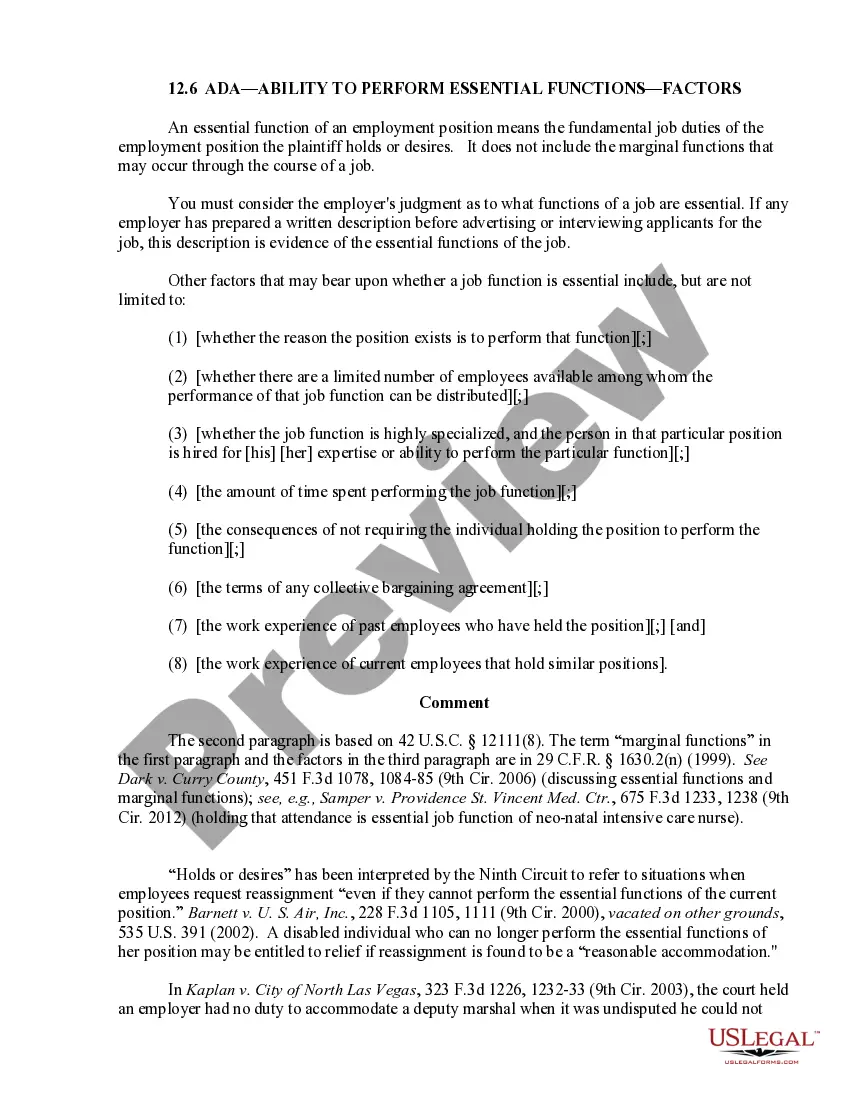
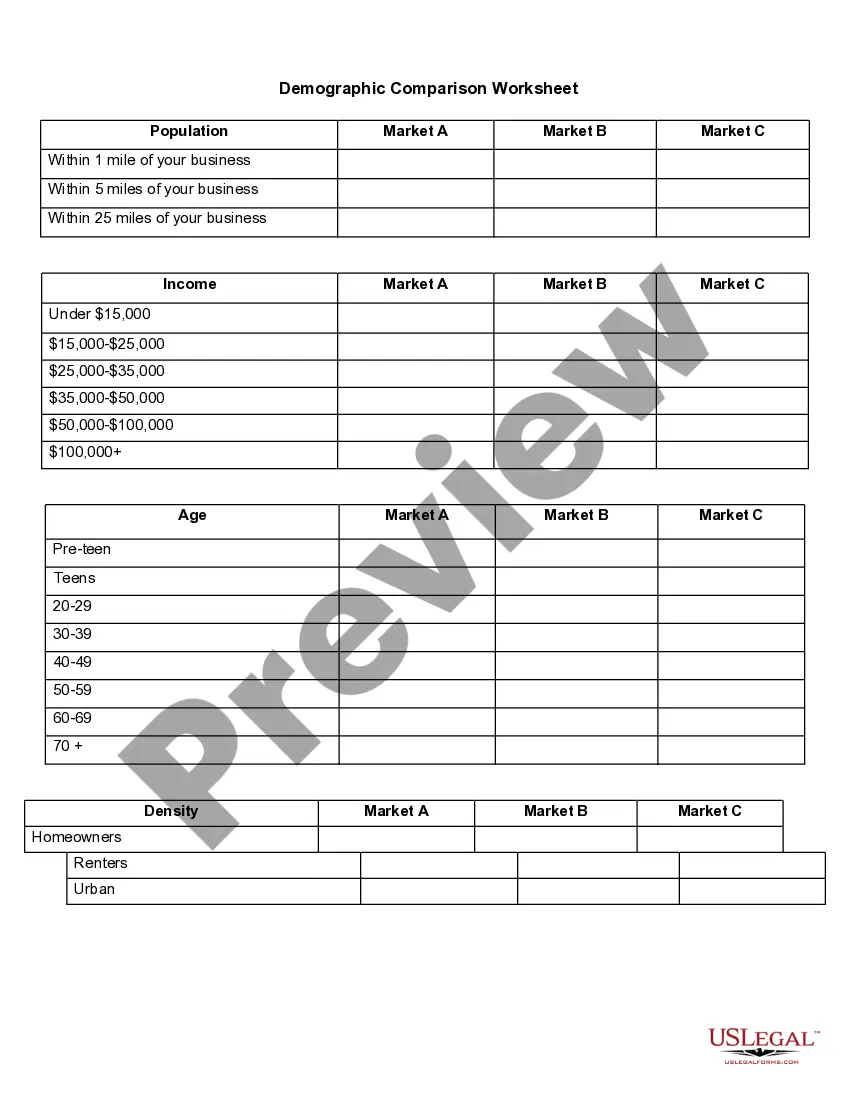
Alabama Demographic Comparison Worksheet
Description
Get your form ready online
Our built-in tools help you complete, sign, share, and store your documents in one place.
Make edits, fill in missing information, and update formatting in US Legal Forms—just like you would in MS Word.
Download a copy, print it, send it by email, or mail it via USPS—whatever works best for your next step.
Sign and collect signatures with our SignNow integration. Send to multiple recipients, set reminders, and more. Go Premium to unlock E-Sign.
If this form requires notarization, complete it online through a secure video call—no need to meet a notary in person or wait for an appointment.
We protect your documents and personal data by following strict security and privacy standards.

Make edits, fill in missing information, and update formatting in US Legal Forms—just like you would in MS Word.

Download a copy, print it, send it by email, or mail it via USPS—whatever works best for your next step.

Sign and collect signatures with our SignNow integration. Send to multiple recipients, set reminders, and more. Go Premium to unlock E-Sign.

If this form requires notarization, complete it online through a secure video call—no need to meet a notary in person or wait for an appointment.

We protect your documents and personal data by following strict security and privacy standards.
Looking for another form?
How to fill out Demographic Comparison Worksheet?
You can spend considerable time online trying to locate the appropriate legal document template that meets your state and federal requirements.
US Legal Forms provides a vast array of legal forms that can be reviewed by experts.
You can easily access or create the Alabama Demographic Comparison Worksheet through their service.
If available, utilize the Preview button to view the document template as well. To find another version of the form, use the Search field to locate a template that meets your needs and preferences.
- If you already have an account with US Legal Forms, you can Log In and click the Obtain button.
- Then, you can complete, amend, produce, or sign the Alabama Demographic Comparison Worksheet.
- Each legal document template you acquire is yours permanently.
- To obtain another copy of the downloaded form, navigate to the My documents section and select the applicable button.
- If you're using the US Legal Forms website for the first time, follow these simple instructions below.
- First, ensure you have selected the correct form template for your desired region/town.
- Review the form description to confirm you have chosen the appropriate template.
Form popularity
FAQ
White: 68.09% Black or African American: 26.64% Two or more races: 1.89% Other race: 1.45%
Texas has the highest Black population in the United States of 3,936,669, about 14% of Texas's total population. Texas is the second-most diverse state in the U.S. Following Texas is Florida with 3,867,495 (18%), New York with 3,763,977 (19%), and Georgia with 3,549,349 (34%).
This statistic shows the resident population distribution of Alabama in 2019, by race and ethnicity. In 2019, 27.8 percent of Alabama residents were Black or African American.
The number of Alabamians who identify as non-Hispanic white fell from about 3.2 million in 2010 down to about 3.17 million in 2020, a decline of roughly 33,000 people, or around 1%.
Alabama DemographicsWhite: 68.09% Black or African American: 26.64% Two or more races: 1.89% Other race: 1.45%
Alabama Demographics White: 68.09% Black or African American: 26.64% Two or more races: 1.89% Other race: 1.45%
Texas has the largest Black state population With more than 3.9 million Black people in 2019, Texas is home to the largest Black population in the U.S. Florida has the second largest population at 3.8 million, and Georgia is home to 3.6 million Black people.
The 5 largest ethnic groups in Alabama are White (Non-Hispanic) (65.1%), Black or African American (Non-Hispanic) (26.8%), White (Hispanic) (2.72%), Two+ (Non-Hispanic) (1.68%), and Asian (Non-Hispanic) (1.33%). 5.53% of the households in Alabama speak a non-English language at home as their primary language.
Annette Watters, manager of the State Data Center at the Culverhouse College of Commerce at The University of Alabama, said 11 of Alabama's 67 counties are majority black counties: Bullock (70 percent), Dallas (69 percent), Greene (81 percent), Hale (59 percent), Lowndes (74 percent), Macon (83 percent), Marengo (52
This statistic shows the resident population distribution of Alabama in 2019, by race and ethnicity. In 2019, 27.8 percent of Alabama residents were Black or African American.