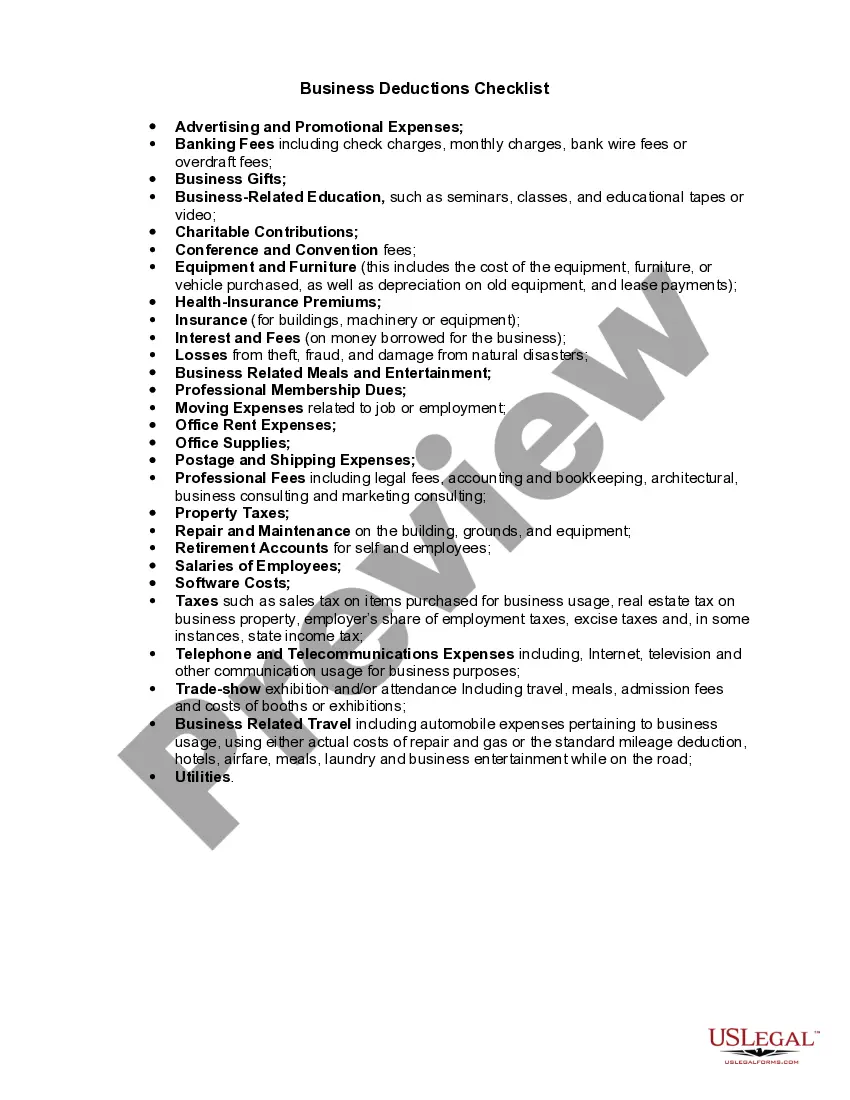
Alabama Business Deductions Checklist
Description
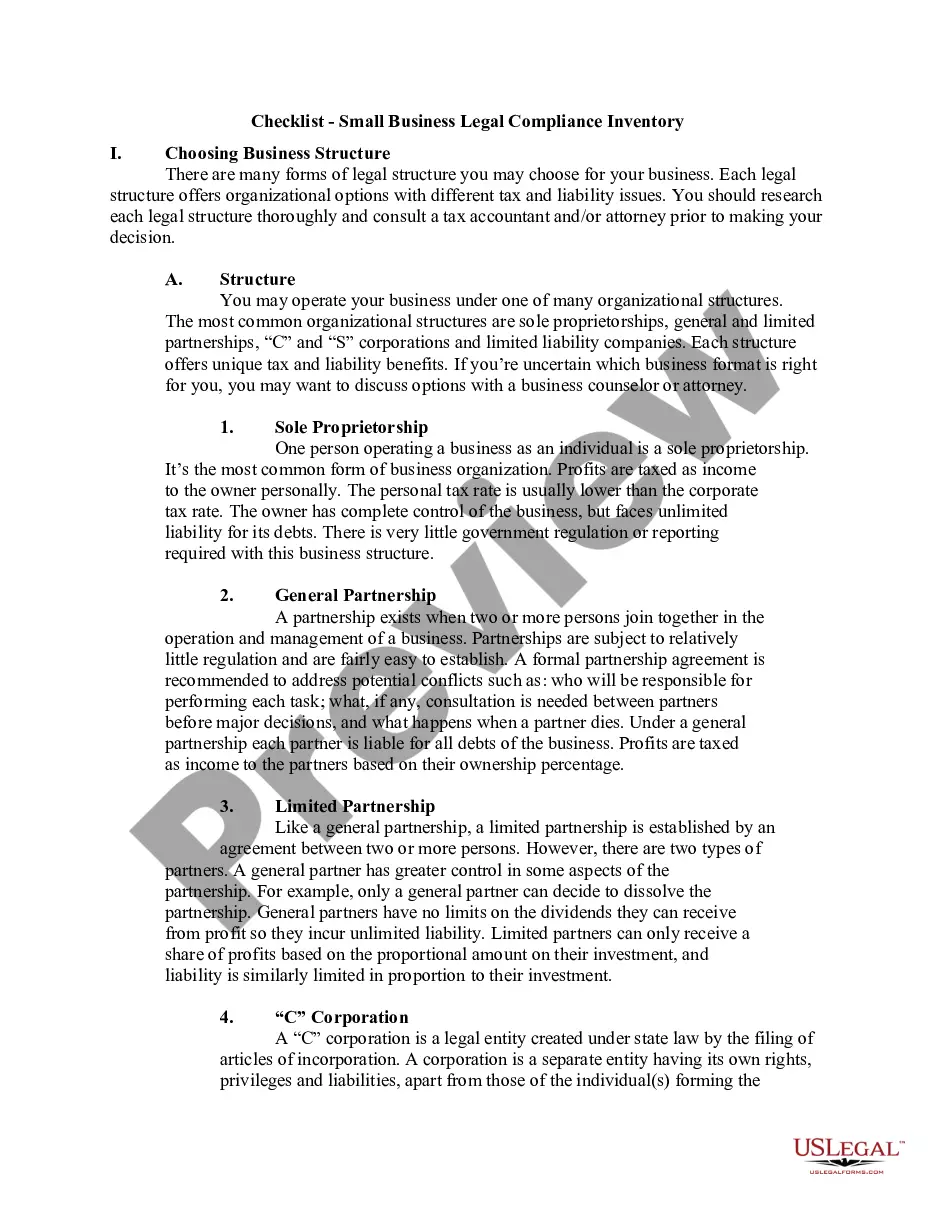
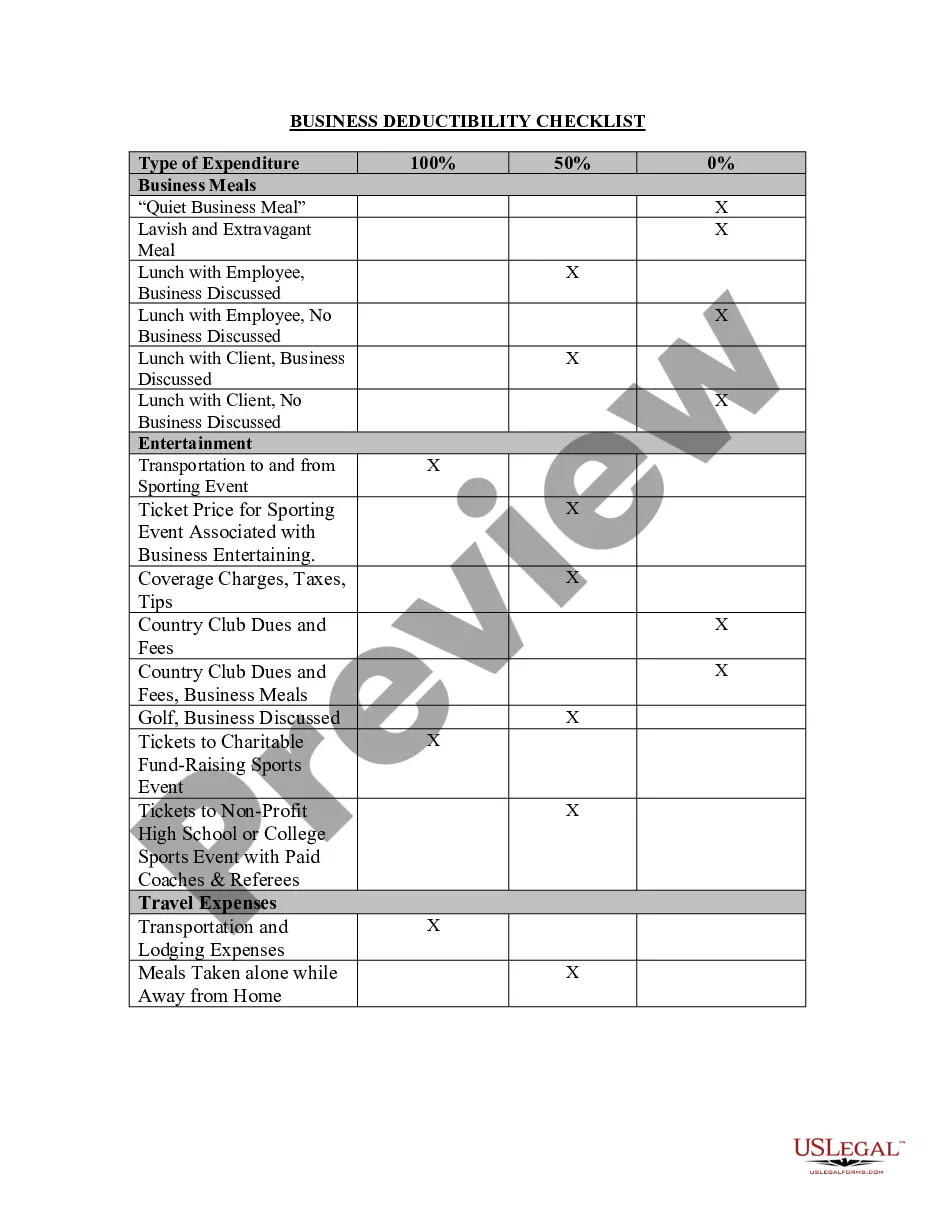
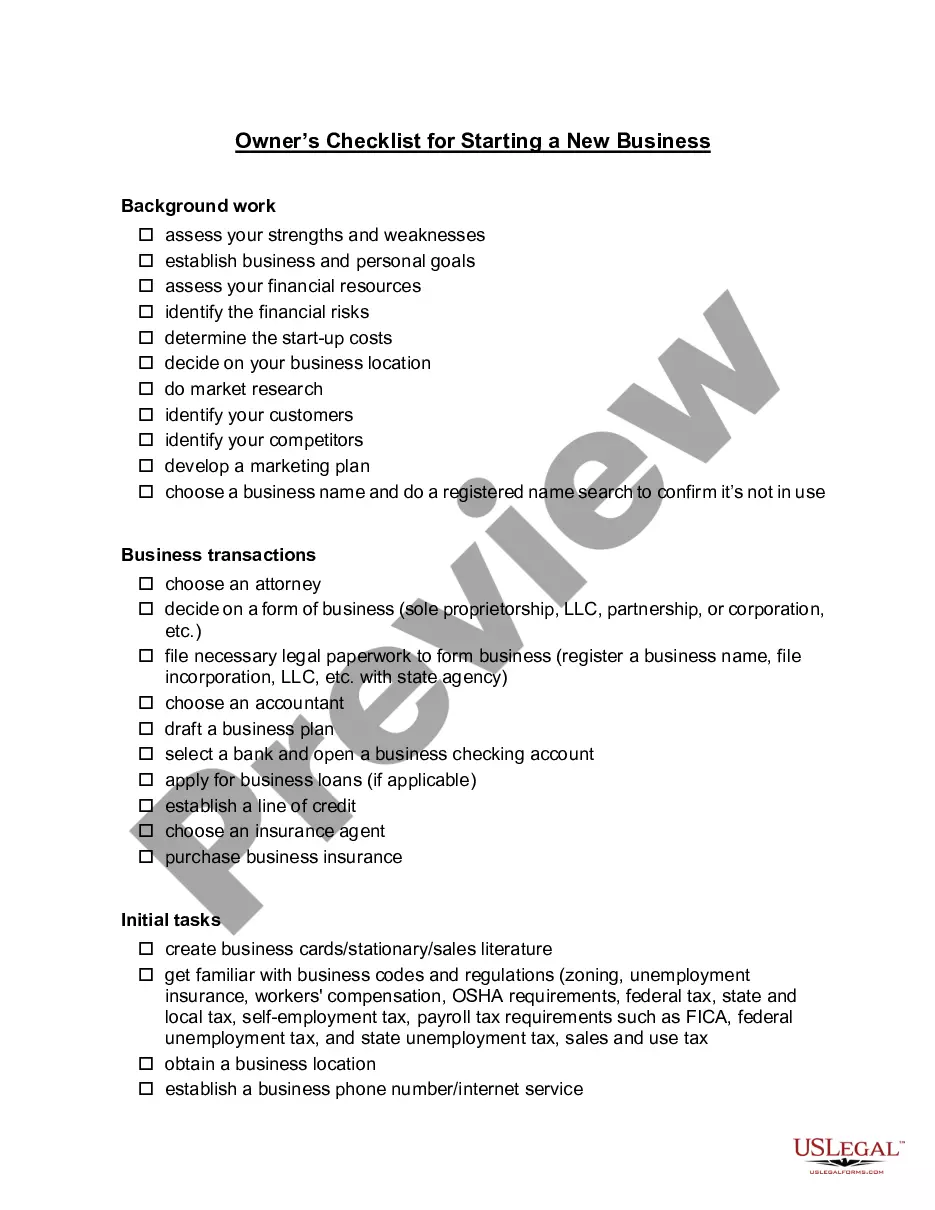
Get your form ready online
Our built-in tools help you complete, sign, share, and store your documents in one place.
Make edits, fill in missing information, and update formatting in US Legal Forms—just like you would in MS Word.
Download a copy, print it, send it by email, or mail it via USPS—whatever works best for your next step.
Sign and collect signatures with our SignNow integration. Send to multiple recipients, set reminders, and more. Go Premium to unlock E-Sign.
If this form requires notarization, complete it online through a secure video call—no need to meet a notary in person or wait for an appointment.
We protect your documents and personal data by following strict security and privacy standards.

Make edits, fill in missing information, and update formatting in US Legal Forms—just like you would in MS Word.

Download a copy, print it, send it by email, or mail it via USPS—whatever works best for your next step.

Sign and collect signatures with our SignNow integration. Send to multiple recipients, set reminders, and more. Go Premium to unlock E-Sign.

If this form requires notarization, complete it online through a secure video call—no need to meet a notary in person or wait for an appointment.

We protect your documents and personal data by following strict security and privacy standards.
Looking for another form?
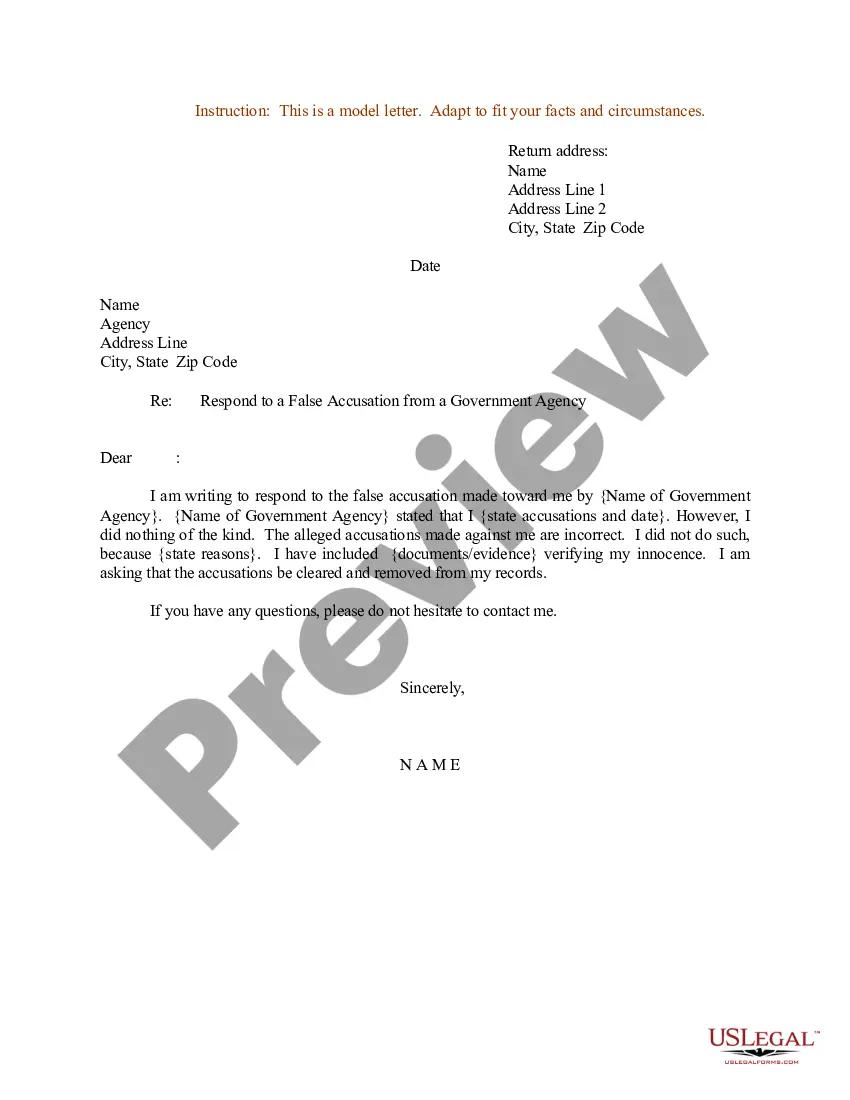





How to fill out Business Deductions Checklist?
Selecting the appropriate legal document format can be quite a challenge.
Of course, there are numerous templates available online, but how can you find the legal form you require.
Utilize the US Legal Forms website. This service offers thousands of templates, such as the Alabama Business Deductions Checklist, which can be utilized for business and personal needs.
If the form does not meet your requirements, use the Search field to find the correct form. Once you are certain that the form is suitable, click the Get now button to obtain it. Choose your desired pricing plan, provide the necessary information, create your account, and process the order using your PayPal account or credit card. Select the file format and download the legal document format to your device. Complete, edit, print, and sign the downloaded Alabama Business Deductions Checklist. US Legal Forms is indeed the largest repository of legal documents where you can find various document templates. Utilize the service to obtain professionally-crafted documents that adhere to state requirements.
- All forms are reviewed by professionals and comply with state and federal regulations.
- If you are already a member, Log In to your account and click the Obtain button to download the Alabama Business Deductions Checklist.
- Use your account to search through the legal forms you have purchased before.
- Go to the My documents section of your account to obtain another copy of the document you need.
- If you are a new user of US Legal Forms, here are easy steps you can follow.
- First, ensure that you have selected the correct form for your city/state. You can preview the form by clicking the Preview button and reviewing the form description to confirm it is the right one for you.
Form popularity
FAQ
Deciding between itemizing deductions or taking the standard deduction depends on your specific financial situation. Generally, if your itemized deductions exceed the standard deduction amount, it’s beneficial to itemize. To ensure you make the right choice, refer to your Alabama Business Deductions Checklist and consider using resources like uslegalforms for clarity.
The five standard deduction amounts vary for single filers, married filing jointly, married filing separately, head of household, and qualifying widow/widower. Each type of filer receives a different amount. Knowing these distinctions is essential to creating a comprehensive Alabama Business Deductions Checklist.
The standard deduction for seniors over 65 is higher than the regular standard deduction. This increase helps older taxpayers benefit from a larger deduction, which can significantly impact their tax situation. Keep this in mind when preparing your Alabama Business Deductions Checklist to maximize your savings.
Filling out an itemized deduction requires listing all qualified expenses on Form 1040, Schedule A. Gather your receipts and records to ensure accuracy. By organizing these details, you'll enhance the effectiveness of your Alabama Business Deductions Checklist.
Standard deduction amounts differ based on your filing status. For instance, individuals, married couples, and heads of households each have distinct amounts. Understanding these figures helps you make better decisions when reviewing your Alabama Business Deductions Checklist.
The standard deduction for each dependent varies based on the taxpayer's filing status. For the 2023 tax year, the deduction amount may change, so it’s crucial to stay updated. To effectively plan, consider how this impacts your Alabama Business Deductions Checklist if you claim dependents.
To deduct business expenses, your expenses must be directly related to operating your business. They should be necessary and ordinary, meaning they are common in your industry. Additionally, you will need to maintain accurate records to substantiate your claims on your Alabama Business Deductions Checklist.
Yes, the IRS mandates proof for business expenses to prevent fraud and ensure claims are valid. It is crucial to keep detailed records of your expenses, including receipts and invoices. The Alabama Business Deductions Checklist helps you understand what types of documentation are necessary. By preparing in advance, you can confidently substantiate your claims during tax filing.
To claim business expenses, you must ensure that the expenses are ordinary and necessary for your business operations. Additionally, you should maintain proper documentation to support your claims. The Alabama Business Deductions Checklist outlines specific requirements and examples, helping you navigate these rules easily. With careful record-keeping, you can maximize your eligible deductions.
Yes, it’s essential to have proof when writing off business expenses. Typically, receipts, invoices, and bank statements serve as documentation. Following the guidelines in the Alabama Business Deductions Checklist can help you organize your records effectively and ensure you have the necessary proof if audited. This preparation gives you confidence and security come tax season.