Alabama Shareholder's Indemnity Agreement
About this form
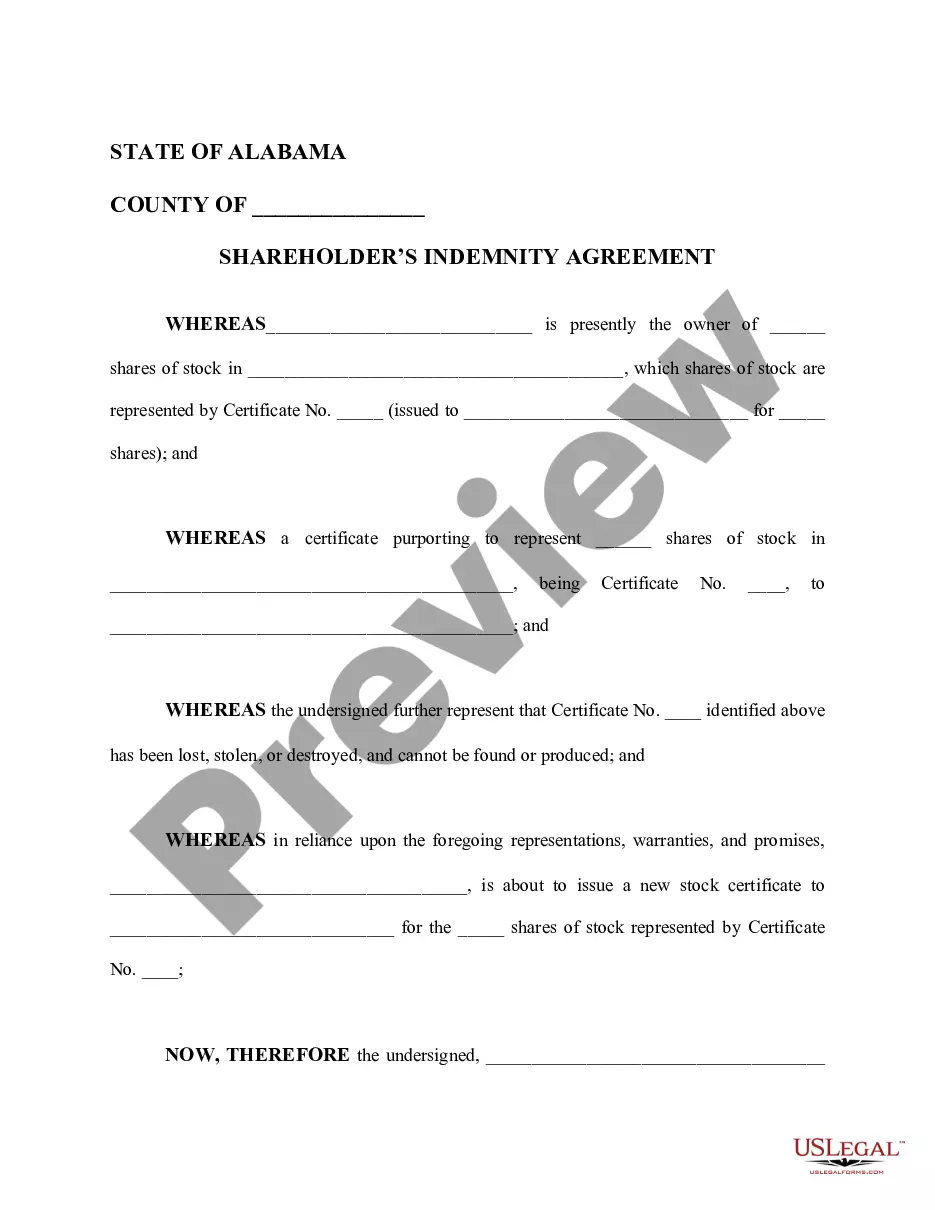
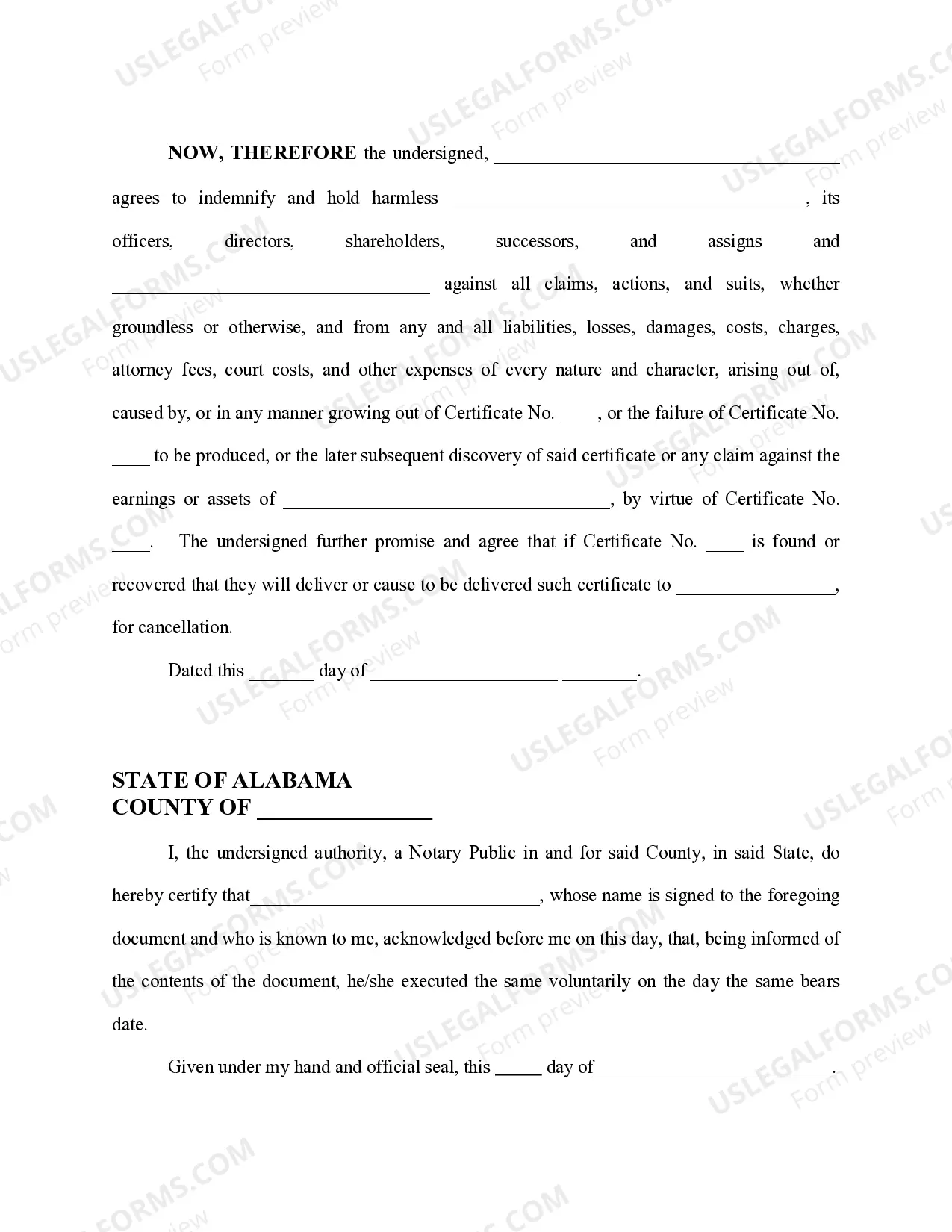
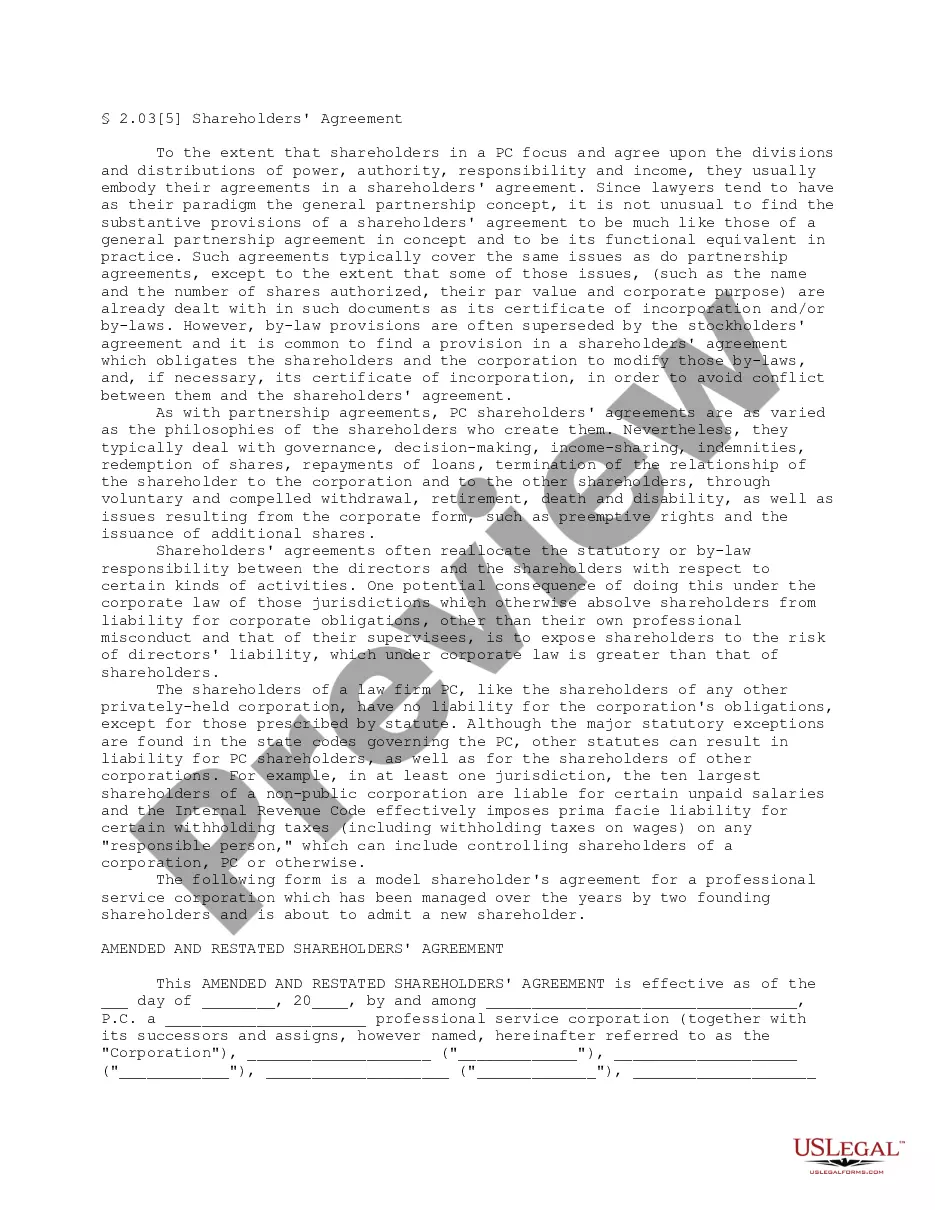
The Shareholder's Indemnity Agreement is a legal document used by shareholders to protect the corporation's officers, directors, and other stakeholders from liabilities associated with a lost stock certificate. This form serves as a commitment from the shareholder to assume responsibility for any potential claims arising due to the loss, ensuring that the corporation and its representatives are held harmless. Its purpose is distinct from forms related to the actual issuance or transfer of stock certificates, focusing solely on indemnification in scenarios where certificates are lost or destroyed.
Key components of this form
- Identification of the shareholder and the corporation.
- Details of the lost stock certificate, including certificate number and number of shares.
- Indemnification clause outlining the shareholder's obligations.
- Signature section for formal acknowledgment by the shareholder.
- Notary acknowledgment if applicable.
When to use this document
This form is necessary when a shareholder has lost a stock certificate and intends to request a replacement from the corporation. It safeguards the corporation's interests by ensuring the shareholder agrees to indemnify the corporation against any claims or liabilities related to the lost certificate, making it a crucial step in the process of issuing new shares.
Who needs this form
- Shareholders who have lost or cannot find their stock certificates.
- Corporations issuing new stock certificates in place of lost ones.
- Corporate officers and directors seeking to protect their interests and those of the entity.
How to prepare this document
- Identify and enter the name of the shareholder and the corporation.
- Provide details about the lost stock certificate, including its number and the number of shares represented.
- Fill in the indemnity clause by confirming the agreement to indemnify the corporation.
- Sign and date the agreement to formalize your commitment.
- Have the document notarized as required for validation.
Notarization guidance
Notarization is required for this form to take effect. Our online notarization service, powered by Notarize, lets you verify and sign documents remotely through an encrypted video session, available 24/7.
Get your form ready online
Our built-in tools help you complete, sign, share, and store your documents in one place.
Make edits, fill in missing information, and update formatting in US Legal Forms—just like you would in MS Word.
Download a copy, print it, send it by email, or mail it via USPS—whatever works best for your next step.
Sign and collect signatures with our SignNow integration. Send to multiple recipients, set reminders, and more. Go Premium to unlock E-Sign.
If this form requires notarization, complete it online through a secure video call—no need to meet a notary in person or wait for an appointment.
We protect your documents and personal data by following strict security and privacy standards.

Make edits, fill in missing information, and update formatting in US Legal Forms—just like you would in MS Word.

Download a copy, print it, send it by email, or mail it via USPS—whatever works best for your next step.

Sign and collect signatures with our SignNow integration. Send to multiple recipients, set reminders, and more. Go Premium to unlock E-Sign.

If this form requires notarization, complete it online through a secure video call—no need to meet a notary in person or wait for an appointment.

We protect your documents and personal data by following strict security and privacy standards.
Typical mistakes to avoid
- Failing to accurately describe the lost certificate details.
- Not signing or dating the form before submission.
- Neglecting to have the document notarized when required.
Why complete this form online
- Convenience of completing the form at your own pace.
- Immediate access to downloadable formats for easy editing and customization.
- Secure storage and retrieval of form documentation.
Looking for another form?
Form popularity
FAQ
It's still your business decision whether you sign them or not, but you should do so only where it is a critical contract that you have no way of modifying or negotiating changes. In contrast, the best kind of Indemnity Agreement is commonly called a Mutual Indemnity Agreement or a Mutual Hold Harmless Provision.
Indemnity is compensation paid by one party to another to cover damages, injury or losses.An example of an indemnity would be an insurance contract, where the insurer agrees to compensate for any damages that the entity protected by the insurer experiences.
Identify Time Periods for Asserting Indemnification Rights. Provide Notice in a Timely Fashion. Notify All Concerned Parties. Understand Limitations on Recovery. Exclusive Remedy. Scope of Damages. Claims Process/Dispute Resolution.
Executing Your Hold Harmless Agreement Once the hold harmless agreement has been completed, simply have all parties sign and date to complete the document. Although not required, it is always a good idea to have the document notarized for extra protection.
Company/Business/Individual Name shall fully indemnify, hold harmless and defend _______ and its directors, officers, employees, agents, stockholders and Affiliates from and against all claims, demands, actions, suits, damages, liabilities, losses, settlements, judgments, costs and expenses (including but not
The date of the agreement. The name of the person held harmless or protected, with their address. The name of the other party to the agreement, with their address. Details about the activity or event the agreement is about, such as horseback riding or country club membership.
A letter of indemnity must mention the details of both the parties involved in the transaction. These details are, generally, full legal name and complete official or residential address with pin code.
Drafting of the indemnity clause An indemnifier must limit the amount of indemnities that is given while entering into a contract. An express obligation must be imposed so as to minimize the loss, and the duration of time in which the claim can be brought must be limited.
A typical example is an insurance company wherein the insurer or indemnitor agrees to compensate the insured or indemnitee for any damages or losses he/she may incur during a period of time.