Alabama Release and Indemnity Agreement for Corporate Debts
What is this form?
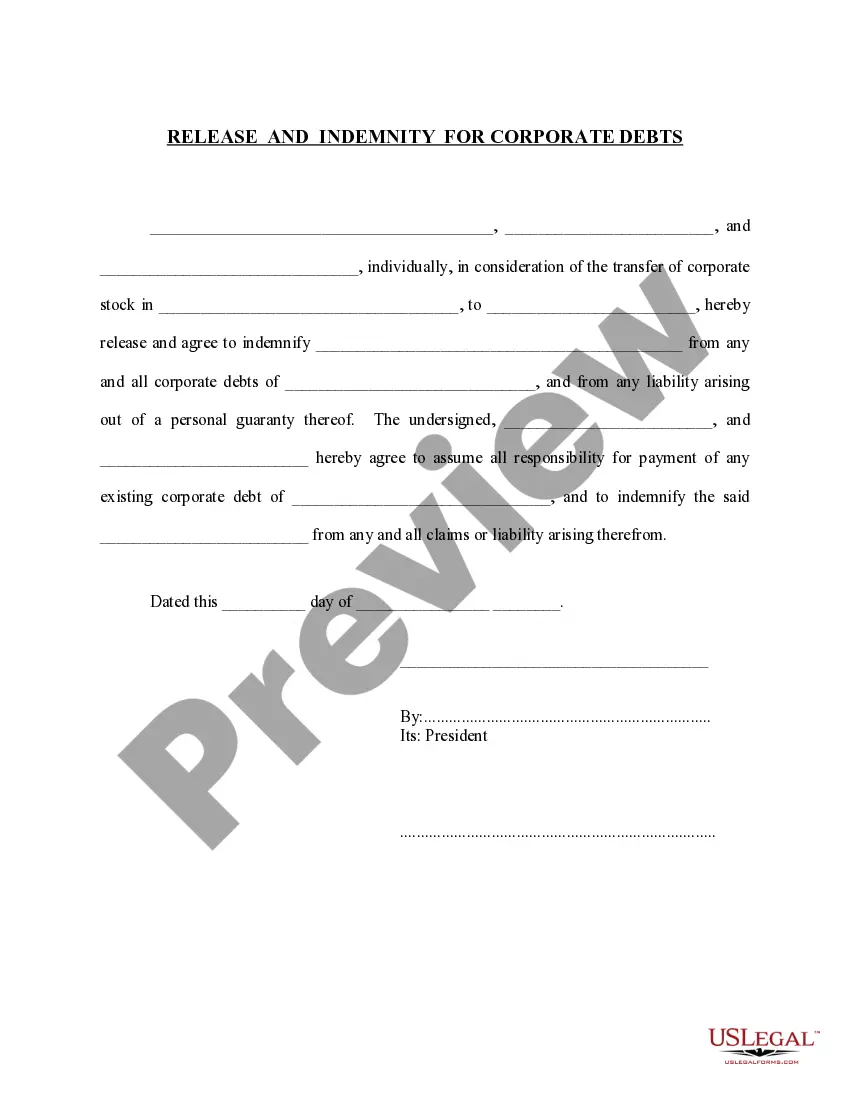
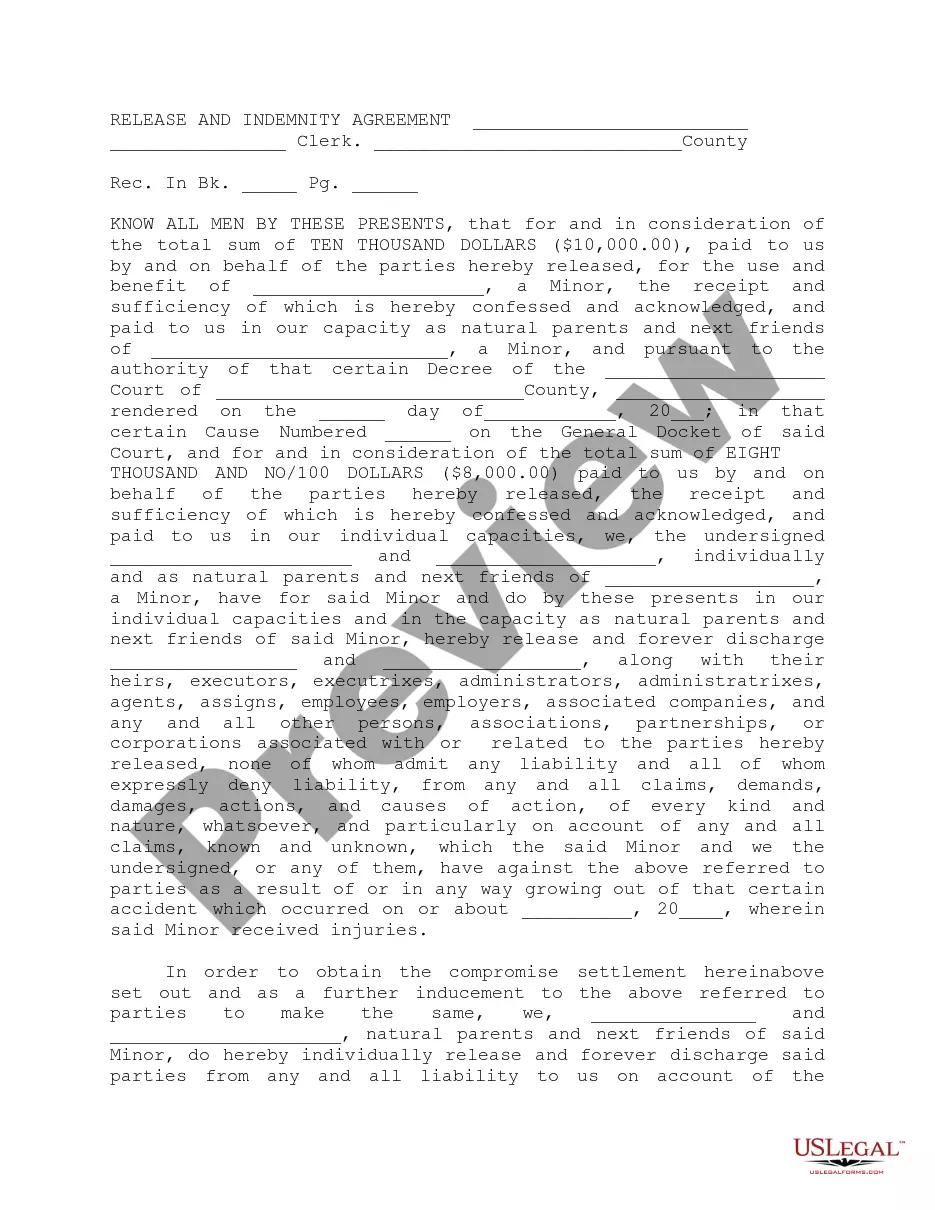
The Release and Indemnity Agreement for Corporate Debts is a legal document designed to release one party from liability for corporate debts in exchange for a transfer of corporate stock. This specific form allows individuals or entities to formally waive any claims related to existing corporate obligations while ensuring that they assume responsibility for these debts. It differs from other indemnity agreements by focusing specifically on corporate liabilities and stock transfers.
Form components explained
- Identification of parties involved in the agreement.
- Details regarding the corporate stock being transferred.
- Release statement indicating the waiver of liability for corporate debts.
- Indemnification clause outlining responsibilities for existing corporate debts.
- Date of the agreement's execution.
- Signature fields for the parties involved, including a corporate representative.
Common use cases
This form should be utilized when a corporation is transferring stock and wants to ensure that the receiving party accepts responsibility for any existing debts associated with the corporation. It is particularly relevant in scenarios involving mergers, acquisitions, or significant ownership changes where past liabilities might come into play.
Who this form is for
- Corporate officers and stakeholders involved in stock transfers.
- Individuals assuming responsibilities for corporate debts.
- Legal representatives negotiating corporate stock transactions.
- Business owners looking to define liability in corporate agreements.
How to prepare this document
- Identify the parties involved in the agreement, including their respective roles.
- Specify the details of the corporate stock being transferred.
- Clearly state the corporate debts being released and indemnified.
- Include the date when the agreement is executed.
- Ensure all parties sign the document, including the corporate president or other authorized representative.
Notarization guidance
This form does not typically require notarization to be legally valid. However, some jurisdictions or document types may still require it. US Legal Forms provides secure online notarization powered by Notarize, available 24/7 for added convenience.
Get your form ready online
Our built-in tools help you complete, sign, share, and store your documents in one place.
Make edits, fill in missing information, and update formatting in US Legal Forms—just like you would in MS Word.
Download a copy, print it, send it by email, or mail it via USPS—whatever works best for your next step.
Sign and collect signatures with our SignNow integration. Send to multiple recipients, set reminders, and more. Go Premium to unlock E-Sign.
If this form requires notarization, complete it online through a secure video call—no need to meet a notary in person or wait for an appointment.
We protect your documents and personal data by following strict security and privacy standards.

Make edits, fill in missing information, and update formatting in US Legal Forms—just like you would in MS Word.

Download a copy, print it, send it by email, or mail it via USPS—whatever works best for your next step.

Sign and collect signatures with our SignNow integration. Send to multiple recipients, set reminders, and more. Go Premium to unlock E-Sign.

If this form requires notarization, complete it online through a secure video call—no need to meet a notary in person or wait for an appointment.

We protect your documents and personal data by following strict security and privacy standards.
Common mistakes to avoid
- Not including all necessary party names and signatures.
- Leaving out critical details about the corporate debts.
- Not dating the agreement, which can impact enforceability.
- Using ambiguous language that may lead to future disputes.
Why use this form online
- Instant access and downloads of the specific form types in various formats.
- Convenient editing options to tailor the agreement to your needs.
- Guided instructions that help users fill out the form correctly.
- Secure storage options for legal documents for easy retrieval.
Looking for another form?
Form popularity
FAQ
It's still your business decision whether you sign them or not, but you should do so only where it is a critical contract that you have no way of modifying or negotiating changes. In contrast, the best kind of Indemnity Agreement is commonly called a Mutual Indemnity Agreement or a Mutual Hold Harmless Provision.
Unlike a release, which suppresses a cause of action, an indemnity creates a potential cause of action between the indemnitee and the indemnitor.A release extinguishes any actual or potential claims the releasor may have against the releasee without regard to third parties.
What is an indemnity?An indemnity form also limits the person's contractual and delictual liability. This means that a person indemnifies another person from liability by giving up his/her right to sue that person when s/he suffers damages, loses something or gets injured.
There are no formal requirements for creating a valid indemnity, so it could be oral, or in writing but not signed. However, an indemnity would still have to meet the requirements for a valid contract as it (in common with a guarantee) is only enforceable as a contractual obligation.
An Indemnity Bond may be drafted as below and executed on a stamp paper of the value which differs for every state. This deed of Indemnity executed on DATE at PLACE by ___________ having its registered office at ___________, through Mr.
First, include the date the document is being executed (signed). Title the letter as a "Letter of Indemnity" to make it clear what the document is about. Include a statement that the agreement will be governed by the laws of the specific state (where the agreement would be taken to court).
The date of the agreement. The name of the person held harmless or protected, with their address. The name of the other party to the agreement, with their address. Details about the activity or event the agreement is about, such as horseback riding or country club membership.
This form of a Release Agreement, Indemnity Agreement and Hold Harmless Agreement releases a party from certain specified liabilities. Releases are used to transfer risk from one party to another and protect against the released party or reimburse the released party for damage, injury, or loss.
Indemnity is compensation paid by one party to another to cover damages, injury or losses.An example of an indemnity would be an insurance contract, where the insurer agrees to compensate for any damages that the entity protected by the insurer experiences.