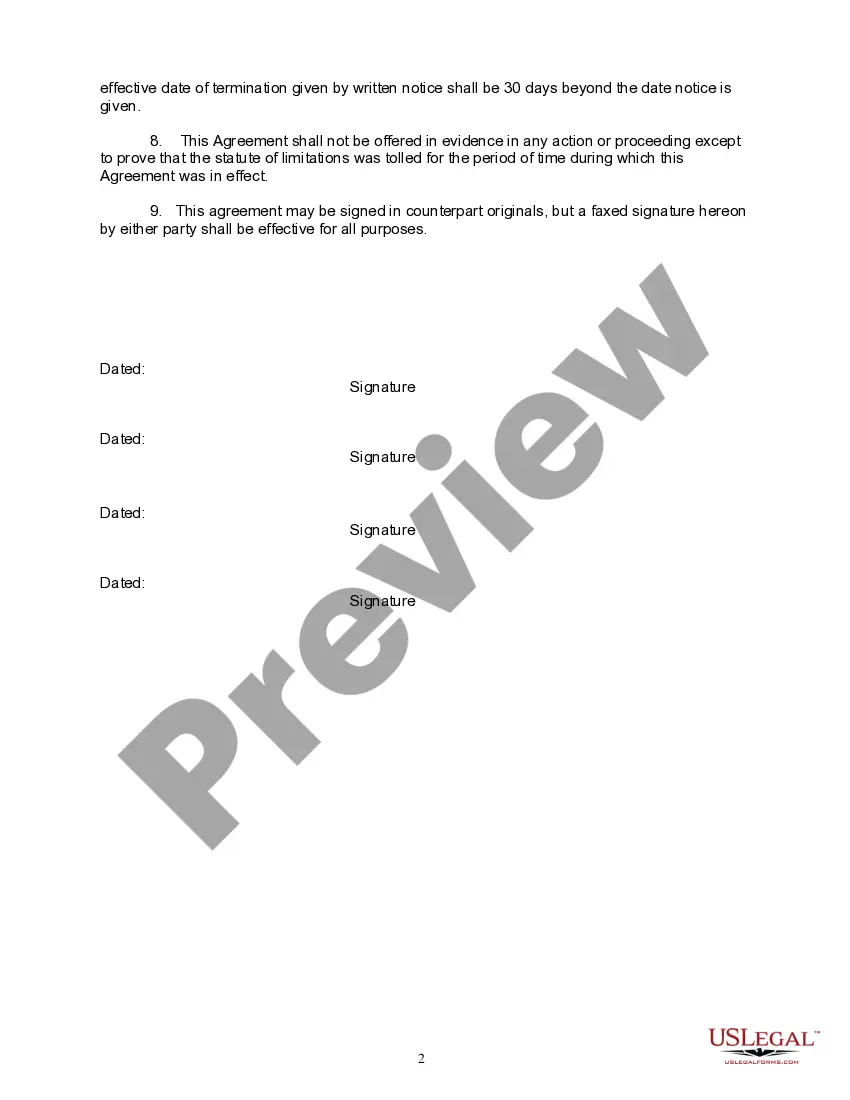
Alaska Agreement to Toll Statute of Limitations
Description


How to fill out Agreement To Toll Statute Of Limitations?
It is feasible to spend numerous hours online attempting to locate the legal document template that satisfies the state and federal requirements you will need.
US Legal Forms offers a vast array of legal templates that have been evaluated by experts.
It is easy to download or print the Alaska Agreement to Toll Statute of Limitations from my service.
If available, utilize the Review option to check the document template too. If you wish to get an additional version of the form, use the Lookup section to find the template that meets your needs and requirements. Once you have located the template you require, click Get now to proceed. Select the pricing plan you need, enter your information, and sign up for an account on US Legal Forms. Complete the transaction. You can use your credit card or PayPal account to pay for the legal document. Choose the format of the document and download it to your device. Make changes to your document if necessary. You can complete, modify, sign, and print the Alaska Agreement to Toll Statute of Limitations. Acquire and print numerous document templates using the US Legal Forms website, which provides the largest selection of legal forms. Utilize professional and state-specific templates to address your business or personal needs.
- If you possess a US Legal Forms account, you can Log In and click the Acquire option.
- After that, you can complete, modify, print, or sign the Alaska Agreement to Toll Statute of Limitations.
- Every legal document template you purchase is yours permanently.
- To obtain an additional copy of any purchased form, visit the My documents tab and click the corresponding option.
- If you are visiting the US Legal Forms website for the first time, follow the simple instructions provided below.
- First, ensure you have selected the correct document template for your area/city of choice.
- Review the form description to confirm you have chosen the right one.
Form popularity
FAQ
The statute of limitations for written contracts in Alaska is three years. This period begins when the breach occurs, giving you a limited window to take legal action. If you find yourself needing more time, an Alaska Agreement to Toll Statute of Limitations can be an effective solution. This agreement allows parties to extend their timeline, providing peace of mind during negotiations or settlement discussions.
Rule 45 in Alaska refers to the rules governing subpoenas in civil procedures. It outlines the process for issuing subpoenas to compel attendance or production of documents in legal proceedings. Familiarity with Rule 45 can be crucial, particularly when you are involved in disputes that may require evidence gathering. If you have concerns about deadlines, an Alaska Agreement to Toll Statute of Limitations may also play a role in your strategy.
Contract law in Alaska is primarily based on the Uniform Commercial Code and common law principles. It governs the creation, interpretation, and enforcement of agreements between parties. Understanding the nuances of Alaska contract law is essential, especially when considering an Alaska Agreement to Toll Statute of Limitations. This agreement can help protect your rights and interests when engaging in contractual obligations.
Yes, a tolling agreement does extend the statute of limitations. When parties sign an Alaska Agreement to Toll Statute of Limitations, they agree to pause the countdown of the statute for a specified period. This can be beneficial in allowing more time for negotiations or dispute resolution without the pressure of an impending lawsuit. It is a practical tool to ensure fairness in legal proceedings.
In Alaska, the statute of limitations on written contracts is generally three years. This means that you have three years from the date of the breach to file a lawsuit. However, if you enter into an Alaska Agreement to Toll Statute of Limitations, you may extend this time frame. This agreement can provide additional time for both parties to resolve disputes without rushing to court.
Criminal mistreatment in the first degree: 6 years after the crime occurred, or 12 years after the offense is first reported to law enforcement, or if the victim was under 18 years of age, anytime before the victim turns 30 years of age.
The statute of limitations of domestic violence in Alaska is five years.
What Is a Statute of Limitations? A statute of limitations is a law that sets the maximum amount of time that parties involved in a dispute have to initiate legal proceedings from the date of an alleged offense, whether civil or criminal.
The state differentiates between misdemeanor assaults and felony assaults - the latter are more serious. Alaska classifies felony assault as either assault in the first degree (the most serious), assault in the second degree, or assault in the third degree. Assault in the fourth degree is considered a misdemeanor.
A statute of limitations is a law that forbids prosecutors from charging someone with a crime that was committed more than a specified number of years ago. The main purpose of these laws is to ensure that convictions are based upon evidence (physical or eyewitness) that has not deteriorated with time.