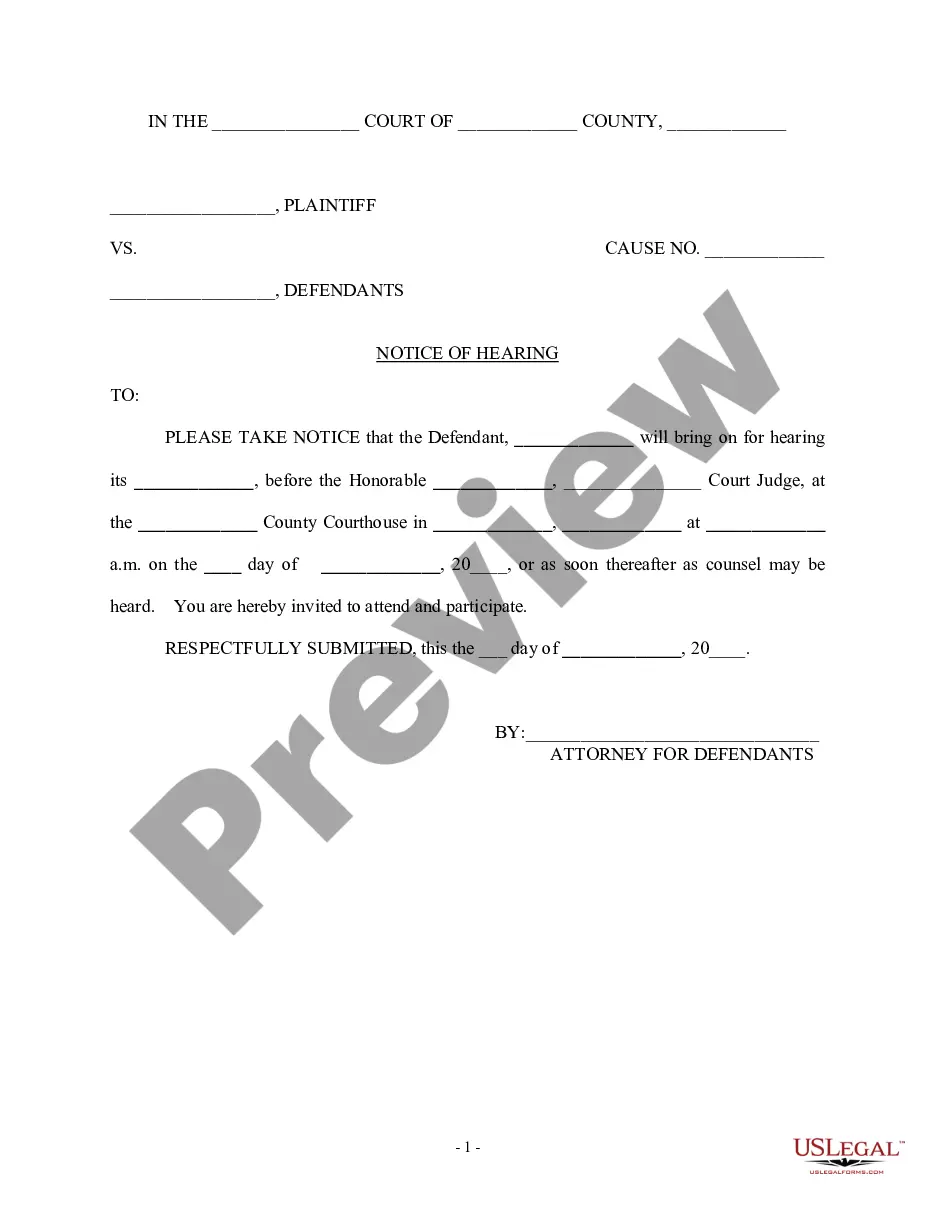
Alaska Notice of Hearing
Description
Get your form ready online
Our built-in tools help you complete, sign, share, and store your documents in one place.
Make edits, fill in missing information, and update formatting in US Legal Forms—just like you would in MS Word.
Download a copy, print it, send it by email, or mail it via USPS—whatever works best for your next step.
Sign and collect signatures with our SignNow integration. Send to multiple recipients, set reminders, and more. Go Premium to unlock E-Sign.
If this form requires notarization, complete it online through a secure video call—no need to meet a notary in person or wait for an appointment.
We protect your documents and personal data by following strict security and privacy standards.

Make edits, fill in missing information, and update formatting in US Legal Forms—just like you would in MS Word.

Download a copy, print it, send it by email, or mail it via USPS—whatever works best for your next step.

Sign and collect signatures with our SignNow integration. Send to multiple recipients, set reminders, and more. Go Premium to unlock E-Sign.

If this form requires notarization, complete it online through a secure video call—no need to meet a notary in person or wait for an appointment.

We protect your documents and personal data by following strict security and privacy standards.
Looking for another form?
How to fill out Notice Of Hearing?
You can utilize time online searching for the legal document format that meets the federal and state requirements you will require. US Legal Forms offers thousands of legal templates that are assessed by experts.
It is easy to obtain or print the Alaska Notice of Hearing from the platform. If you possess a US Legal Forms account, you can Log In and click the Download button. Subsequently, you can complete, modify, print, or sign the Alaska Notice of Hearing.
Every legal document format you purchase is yours permanently. To acquire another copy of any purchased form, visit the My documents section and click the appropriate button.
Select the format of your document and download it to your device. Make modifications to the document as needed. You can complete, edit, sign, and print the Alaska Notice of Hearing. Download and print thousands of document templates using the US Legal Forms website, which offers the largest assortment of legal forms. Utilize professional and state-specific templates to address your business or personal needs.
- If you are using the US Legal Forms website for the first time, follow the straightforward instructions outlined below.
- First, ensure that you have selected the correct document format for your region/area of interest. Review the form description to confirm you have chosen the right document.
- If available, utilize the Review button to examine the document format as well.
- To find another version of your form, use the Search field to locate the format that fulfills your requirements and needs.
- Once you have identified the format you need, click on Purchase now to proceed.
- Choose the pricing plan you desire, enter your details, and register for your account on US Legal Forms.
- Complete the payment. You can use your Visa or Mastercard or PayPal account to pay for the legal document.
Form popularity
FAQ
The Coordinated Resources Project (CRP) - also known as the Juneau Mental Health Court - is a voluntary ?therapeutic? or ?problem solving? court located within the Juneau District Court that hears cases involving individuals diagnosed with mental disabilities who are charged with misdemeanor offenses and focuses on ...
Anyone with a financial or property interest in the estate can file a Demand for Notice with the court any time after the person's death. The right to demand notice ends when you no longer have a legal interest in the estate.
How Long Do You Have to File Probate After Death in Alaska? There is no limit to when you can file a will with probate court after the deceased passes in Alaska.
In felony cases in other locations, after the arraignment, if the case does not settle or get dismissed the judge holds a preliminary hearing. At this hearing, the judge will decide if there is enough evidence that the defendant committed the crime to make the defendant have to appear for a trial.
AK Form P-340, which may also referred to as Information To Heirs And Devisees, is a probate form in Alaska. It is used by executors, personal representatives, trustees, guardians & other related parties during the probate & estate settlement process.
Anyone with a financial or property interest in the estate can file a Demand for Notice with the court any time after the person's death. The right to demand notice ends when you no longer have a legal interest in the estate.
There is usually some finality to a trial. At the end of a trial, there will be a ruling or judgment made by the judge or the jury. A hearing, on the other hand, is often you used as a catch all term to describe any all matter that comes before a judge.
Rule 12. Closing Estates. (a) Duty to Close Estates. When a personal representative has completed administration of the estate, the personal representative either shall petition to close the estate by formal closing under AS 13.16. 620 or AS 13.16. 625 or file a sworn statement under AS 13.16.