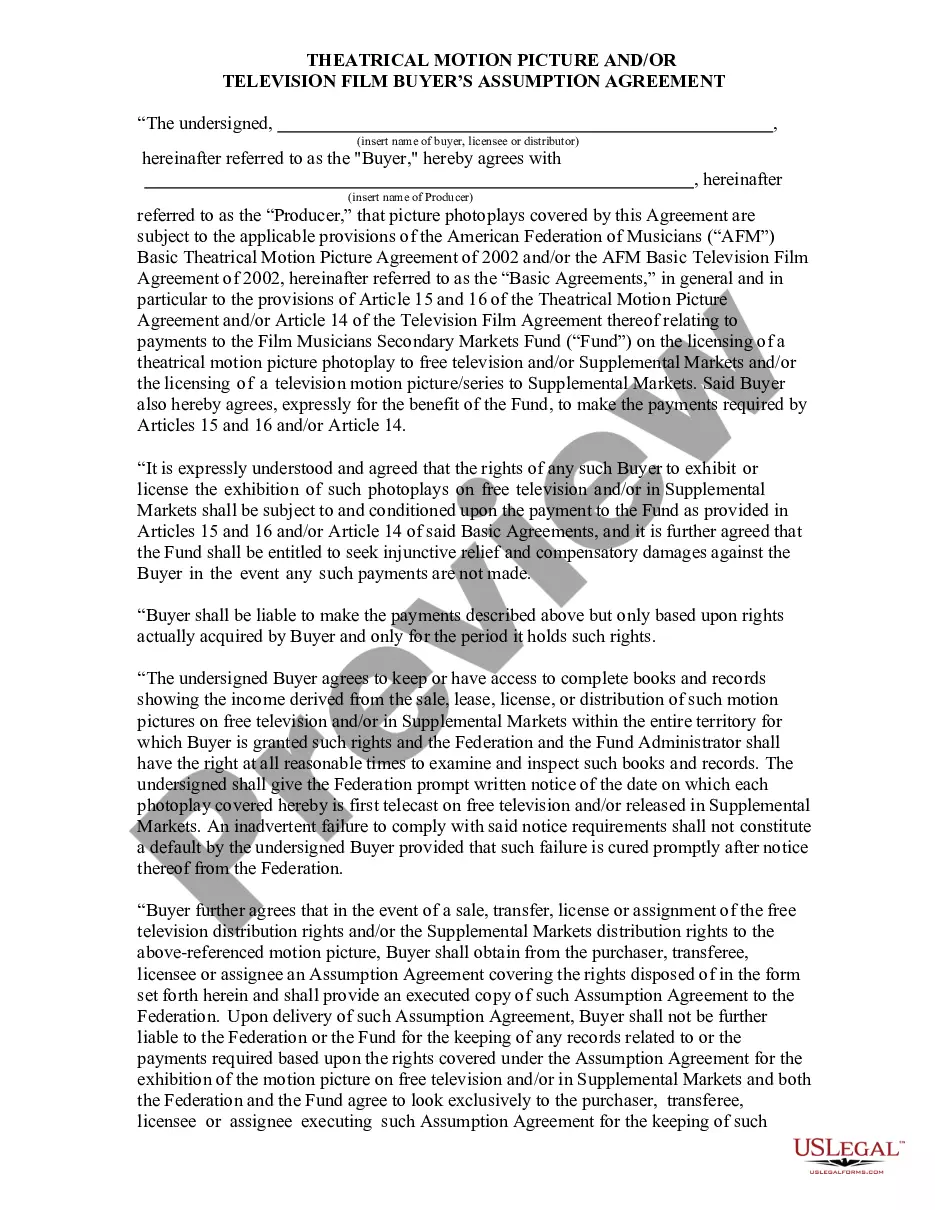
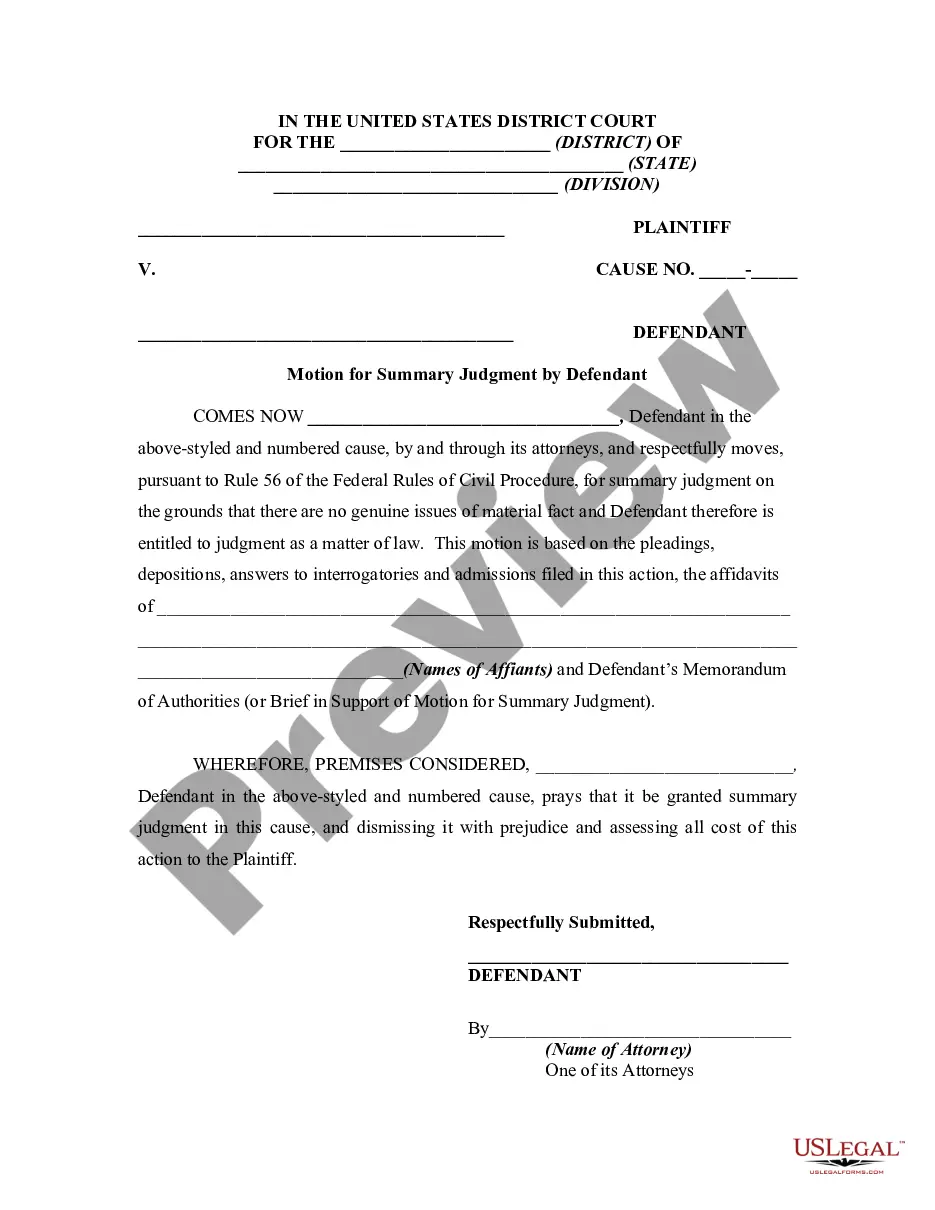
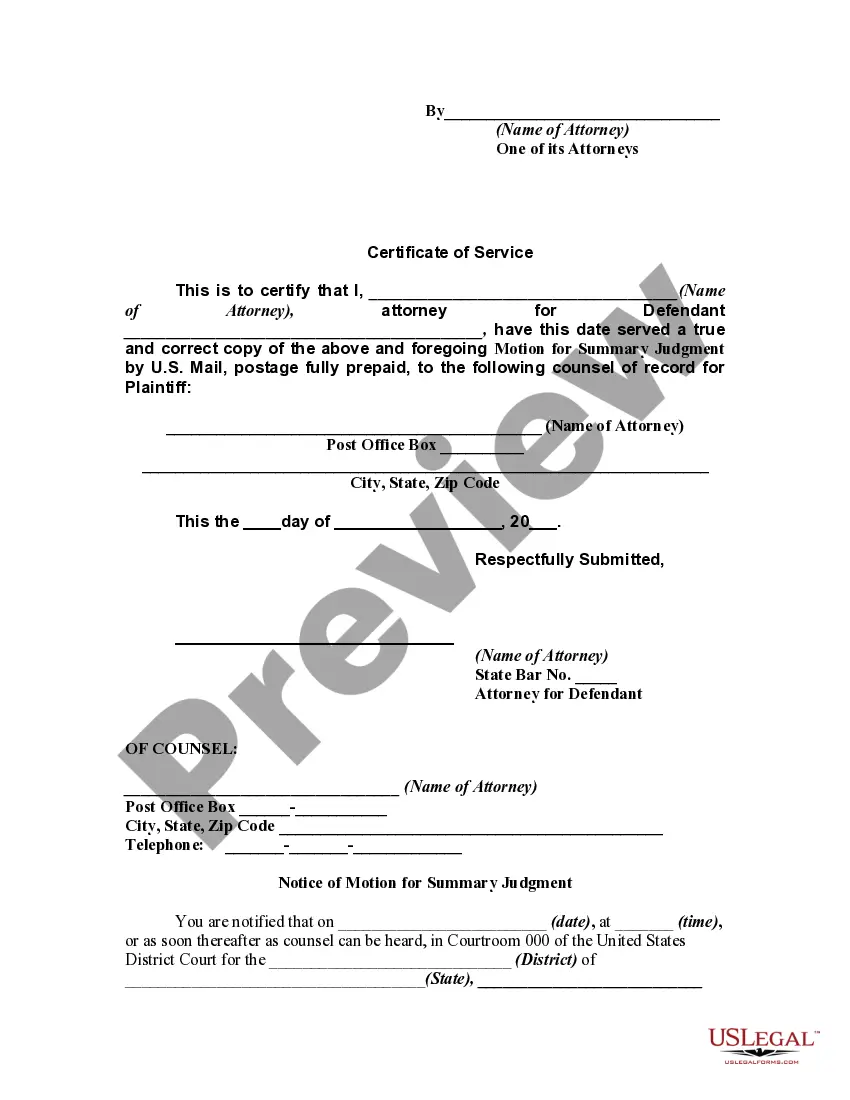
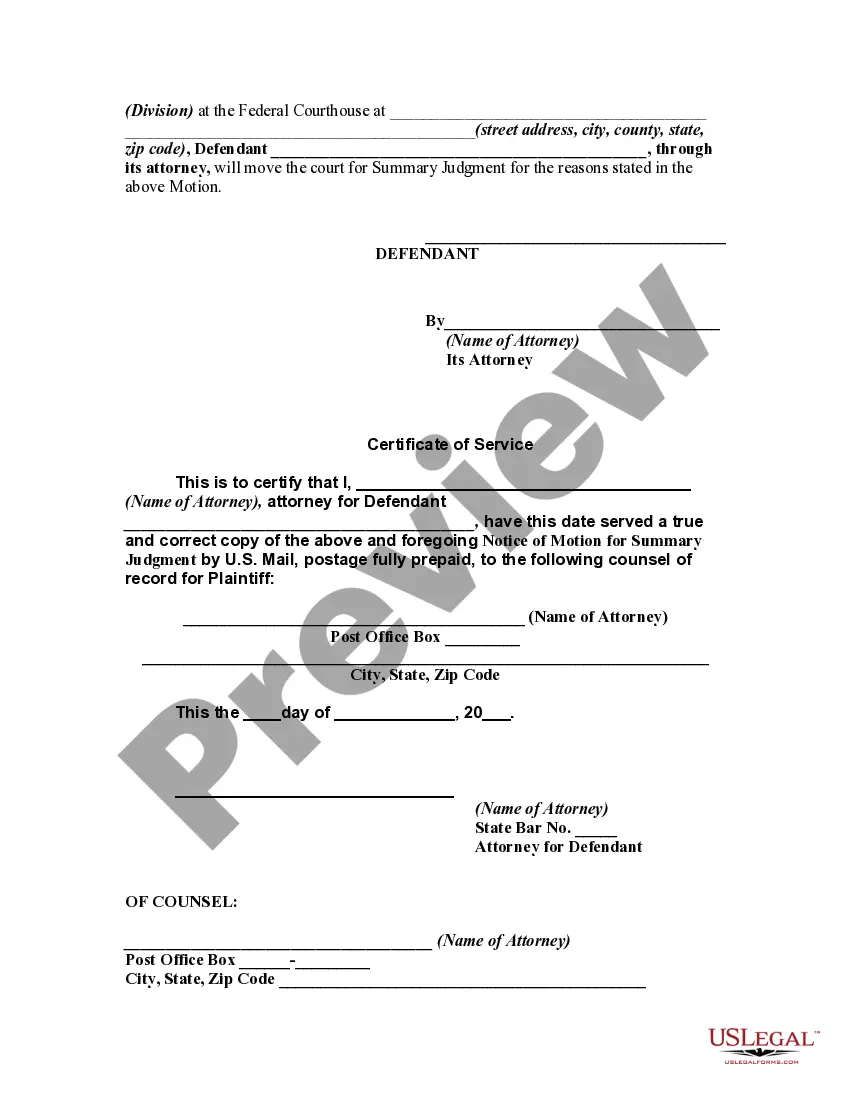
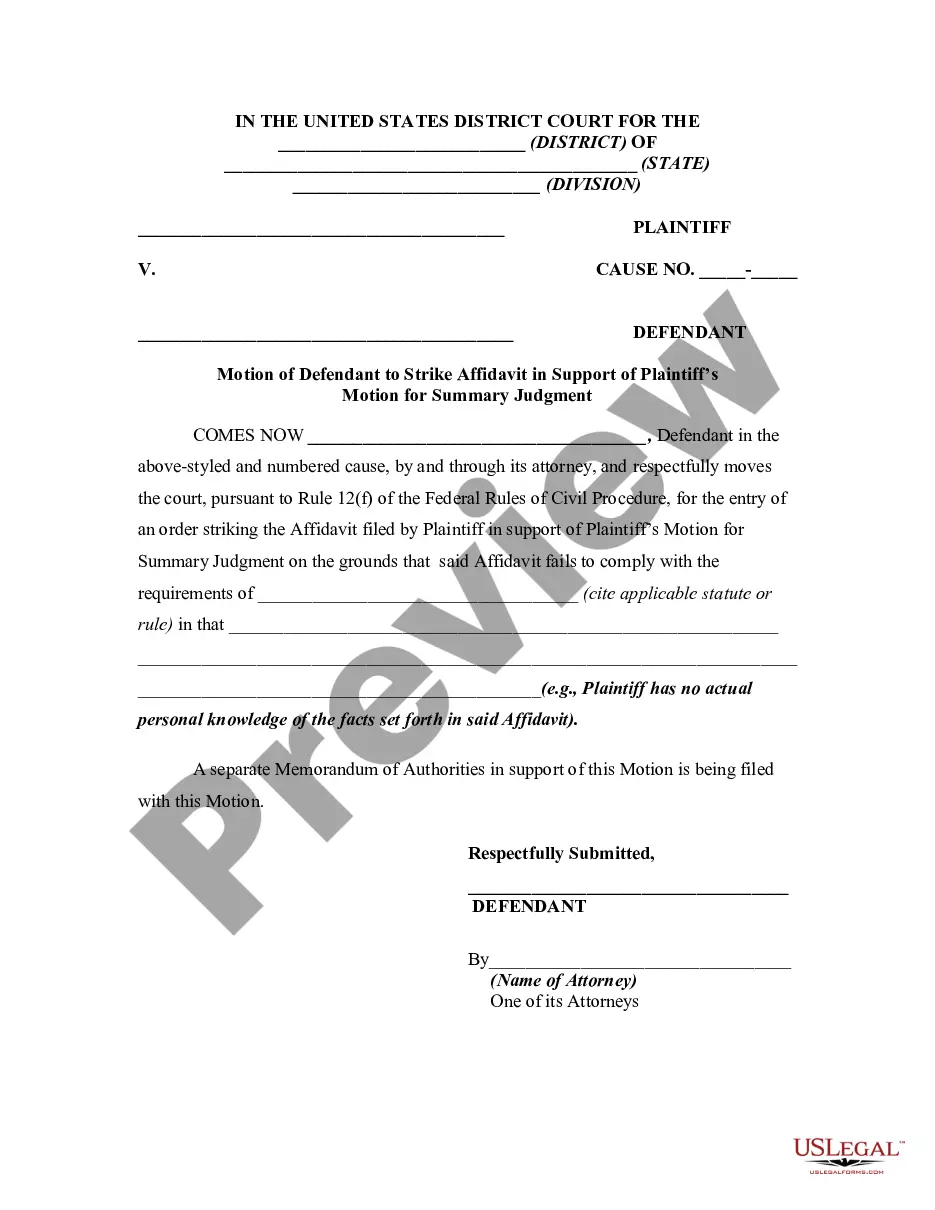
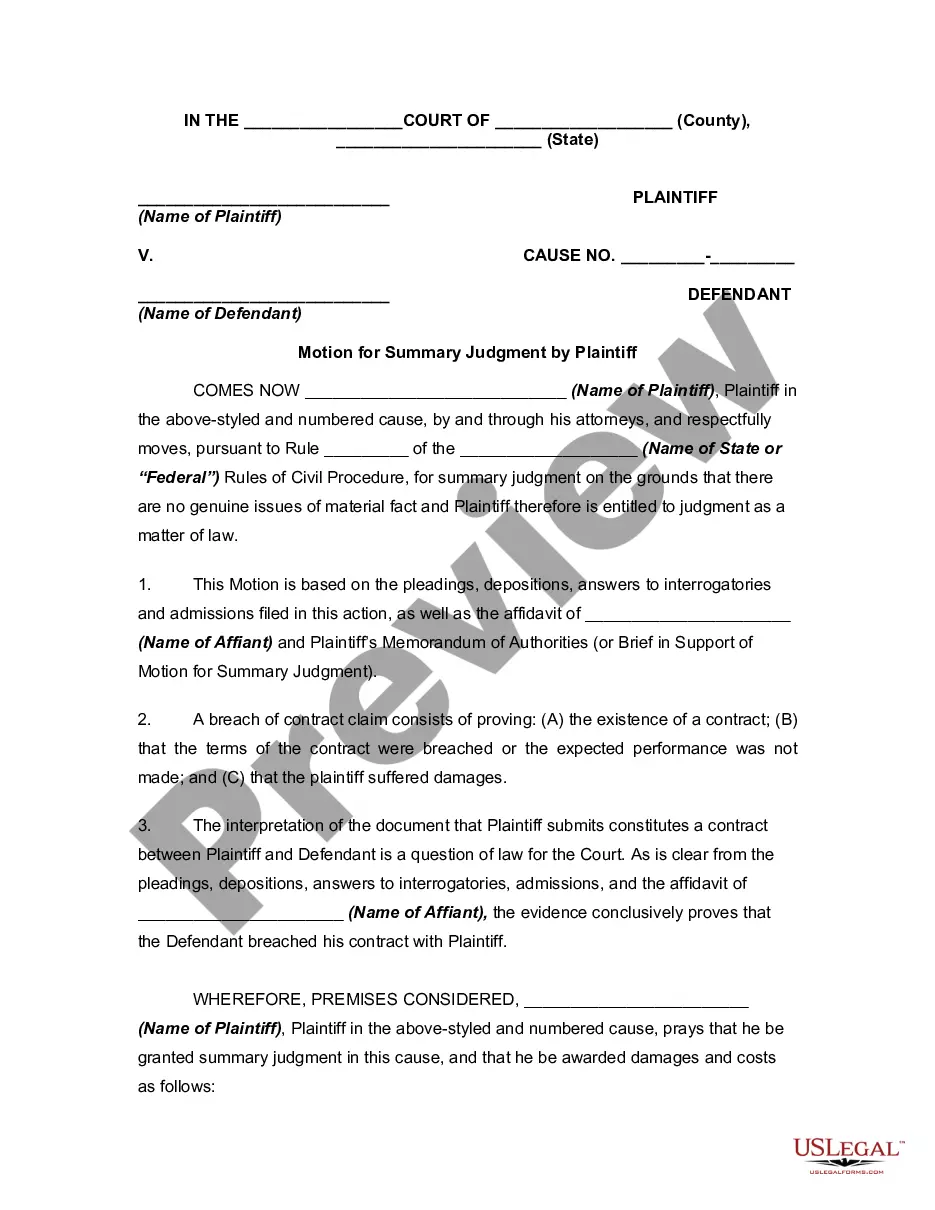
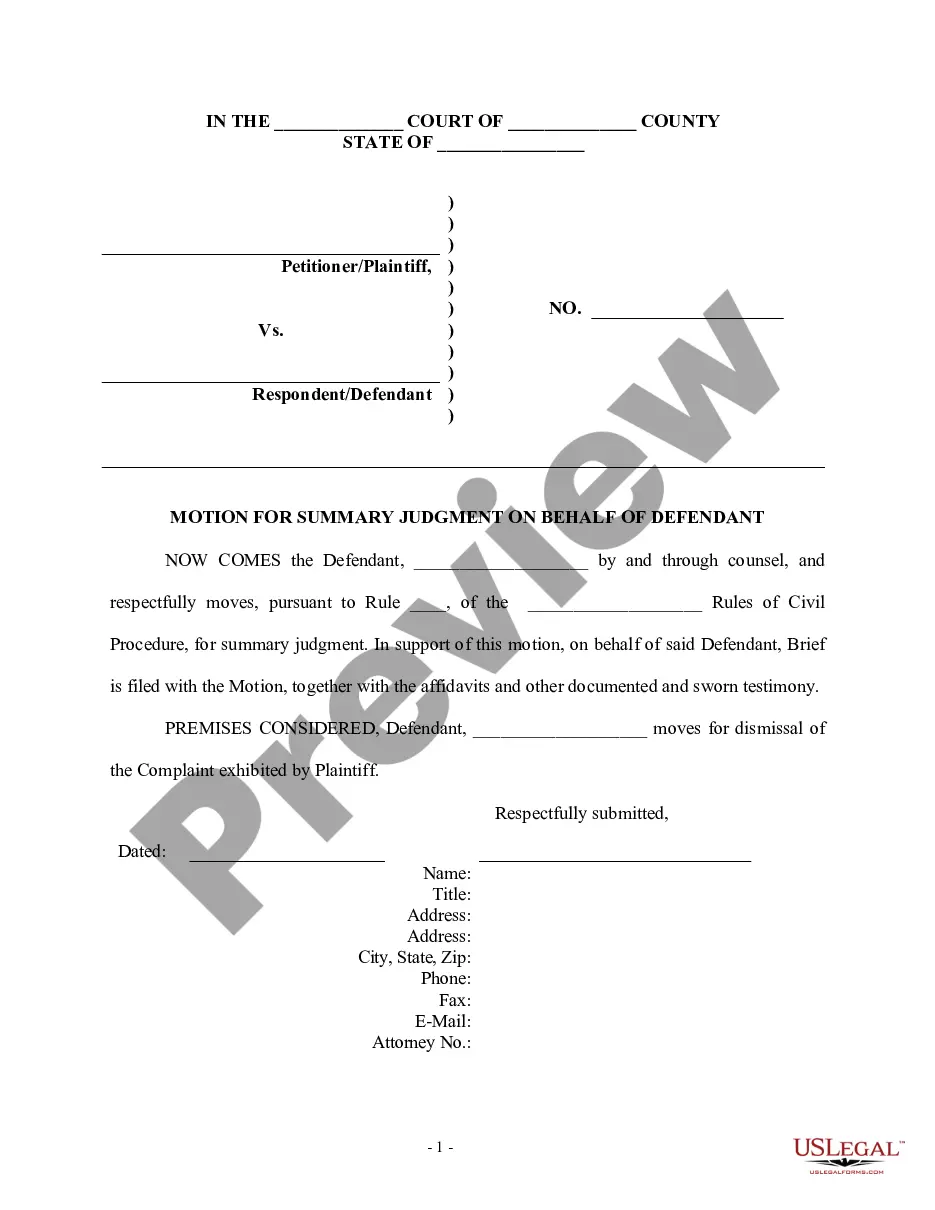
This form is a generic motion for summary judgment. The motion adopts the "notice pleadings" format of the Federal Rules of Civil Procedure, which have been adopted by most states in one form or another.
Alaska Motion for Summary Judgment by Defendant with Notice of Motion
Category:
State:
Multi-State
Control #:
US-00920BG
Format:
Word;
Rich Text
Instant download
Description
Free preview

Get your form ready online
Our built-in tools help you complete, sign, share, and store your documents in one place.
Built-in online Word editor
Make edits, fill in missing information, and update formatting in US Legal Forms—just like you would in MS Word.
Export easily
Download a copy, print it, send it by email, or mail it via USPS—whatever works best for your next step.
E-sign your document
Sign and collect signatures with our SignNow integration. Send to multiple recipients, set reminders, and more. Go Premium to unlock E-Sign.
Notarize online 24/7
If this form requires notarization, complete it online through a secure video call—no need to meet a notary in person or wait for an appointment.
Store your document securely
We protect your documents and personal data by following strict security and privacy standards.

Make edits, fill in missing information, and update formatting in US Legal Forms—just like you would in MS Word.

Download a copy, print it, send it by email, or mail it via USPS—whatever works best for your next step.

Sign and collect signatures with our SignNow integration. Send to multiple recipients, set reminders, and more. Go Premium to unlock E-Sign.

If this form requires notarization, complete it online through a secure video call—no need to meet a notary in person or wait for an appointment.

We protect your documents and personal data by following strict security and privacy standards.
Looking for another form?


How to fill out Motion For Summary Judgment By Defendant With Notice Of Motion?
It is feasible to dedicate time online trying to discover the legal document template that meets the state and federal requirements you need.
US Legal Forms provides a vast array of legal forms that can be reviewed by professionals.
You can conveniently download or print the Alaska Motion for Summary Judgment by Defendant with Notice of Motion from our service.
If available, use the Preview option to view the document format simultaneously. To find another version of your form, use the Search field to locate the template that fits your needs and requirements. Once you have found the template you want, click on Acquire now to proceed. Select the pricing plan you desire, enter your credentials, and sign up for an account on US Legal Forms. Complete the transaction. You can use your credit card or PayPal account to pay for the legal document. Choose the format of your document and download it to your device. Make adjustments to your document if necessary. You can complete, modify, sign, and print the Alaska Motion for Summary Judgment by Defendant with Notice of Motion. Download and print thousands of document templates using the US Legal Forms website, which offers the largest collection of legal forms. Utilize professional and state-specific templates to meet your business or personal needs.
- If you already have a US Legal Forms account, you may Log In and click the Download option.
- After that, you can complete, modify, print, or sign the Alaska Motion for Summary Judgment by Defendant with Notice of Motion.
- Every legal document template you obtain is yours permanently.
- To acquire an additional copy of a purchased form, visit the My documents tab and click the corresponding option.
- If you are using the US Legal Forms site for the first time, follow the simple instructions below.
- First, ensure you have selected the correct document format for your area/region of choice.
- Check the form description to confirm you have selected the right form.
Form popularity
FAQ
An answering party may not give lack of information or knowledge as a reason for failure to admit or deny unless the party states that the party has made reasonable inquiry and that the information known or readily obtainable by the party is insufficient to enable the party to admit or deny.
What Is a Summary Judgment Motion? A motion for summary judgment is when a litigant in a case, either the plaintiff or the defendant, asks the court to end the case without holding a trial.
At the trial or hearing any party may rebut any relevant evidence contained in a deposition whether introduced by that party or by any other party.
A parent or guardian of a minor who has a claim against another person has the power to execute a full release or a covenant not to sue, or to execute a stipulation for entry of judgment on such claim.
Rule 40 - Index to Cases (a) The court system shall maintain an index by last name of every party named in every case filed, regardless of whether a party's true name is protected in the public index under paragraphs (b) or (c) of this rule.
Rule 77 - Motions (a)Service. All motions, orders to show cause, petitions, applications and every other such matter shall be served upon the adverse party, or, after the adverse party has appeared by counsel, upon counsel for the adverse party.
One or more members of a class may sue or be sued as representative parties on behalf of all only if (1) the class is so numerous that joinder of all members is impracticable, (2) there are questions of law or fact common to the class, (3) the claims or defenses of the representative parties are typical of the claims ...
Without leave of court or written stipulation, a party may serve only thirty interrogatories upon another party, including all discrete subparts.