Alaska Request to Modify or Dissolve Protective Order - Multiple Petitioners
Overview of this form
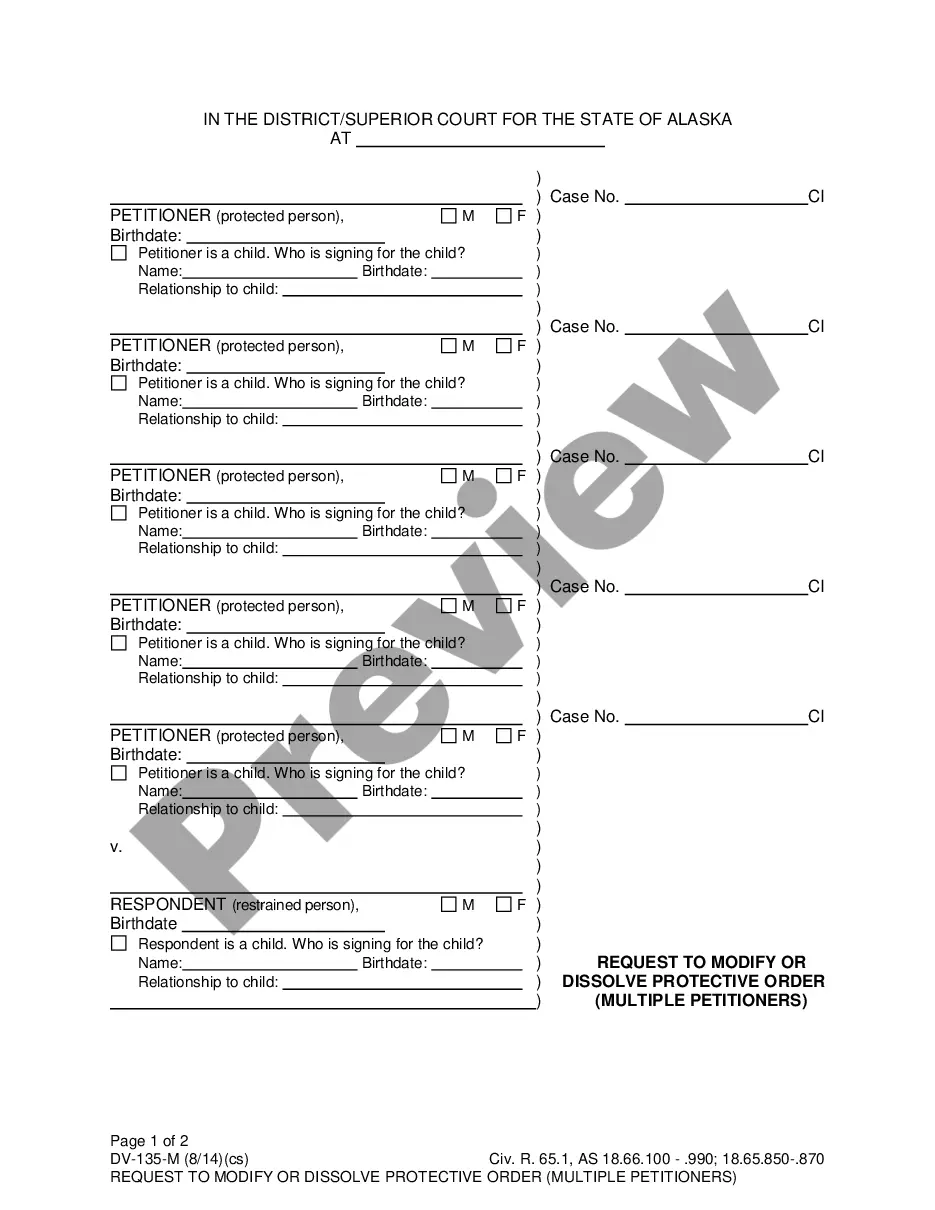
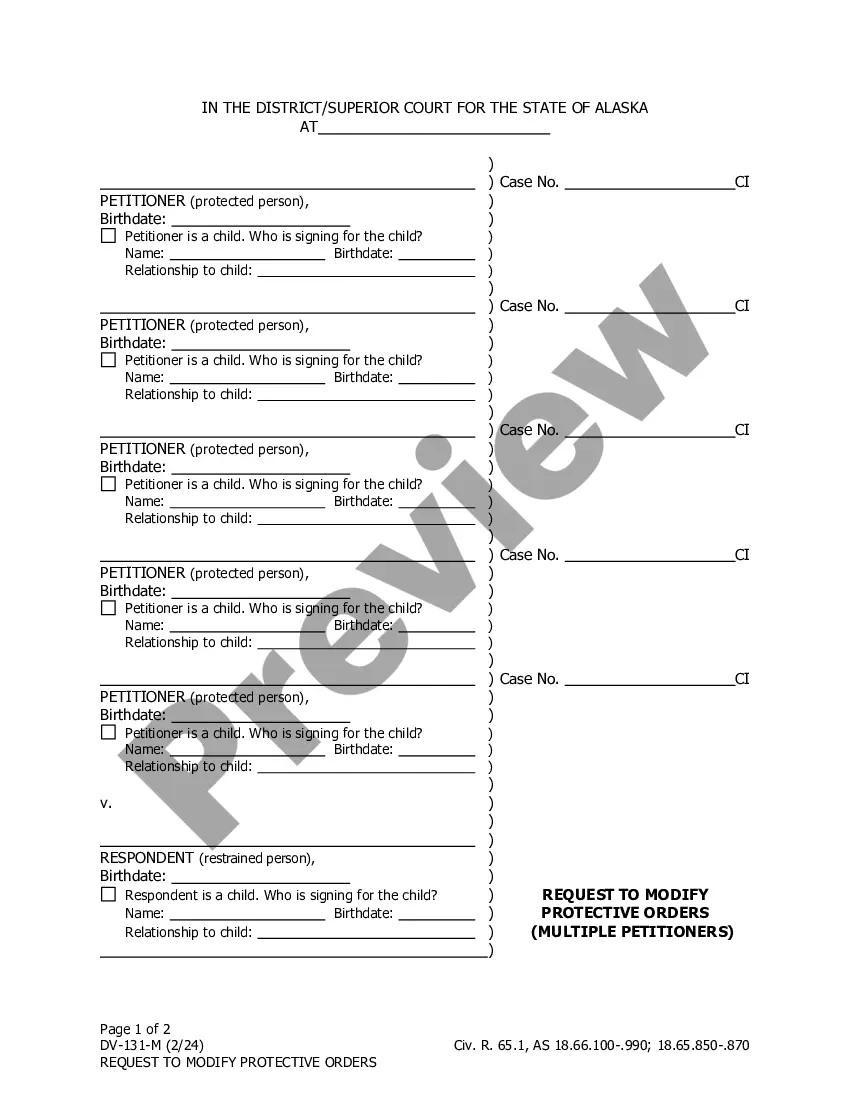
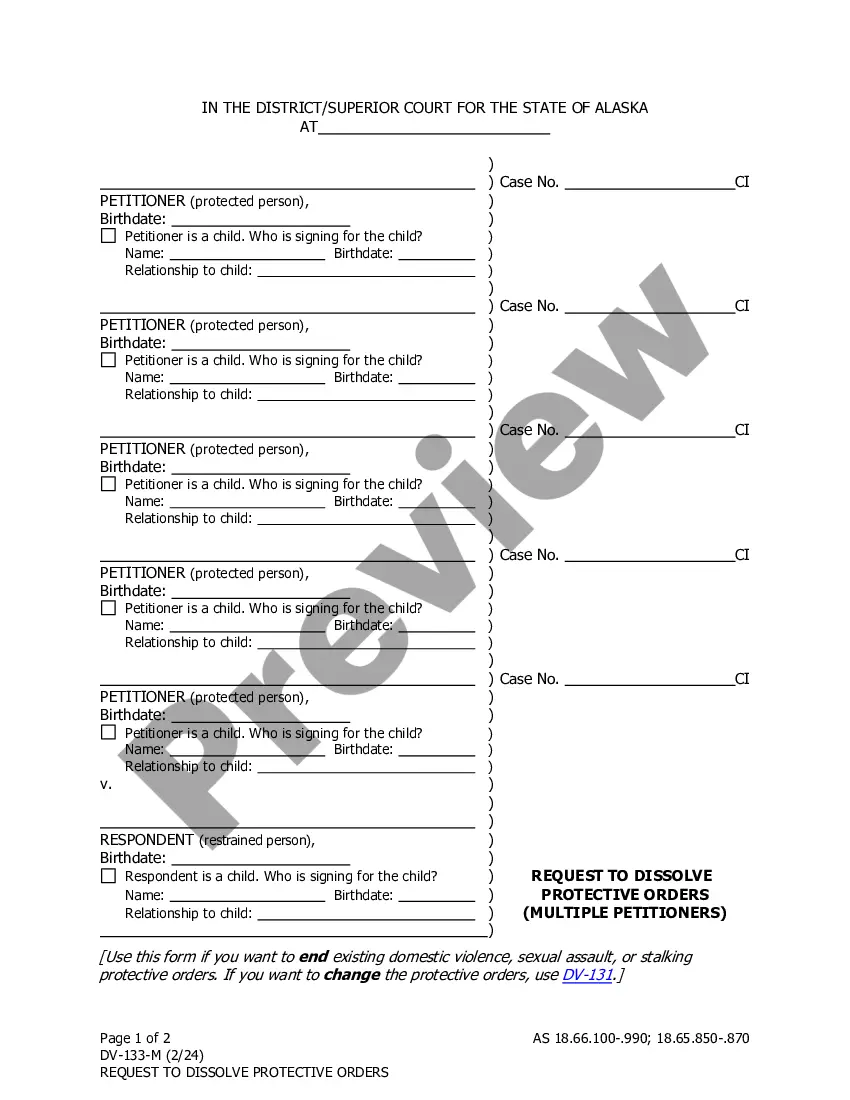
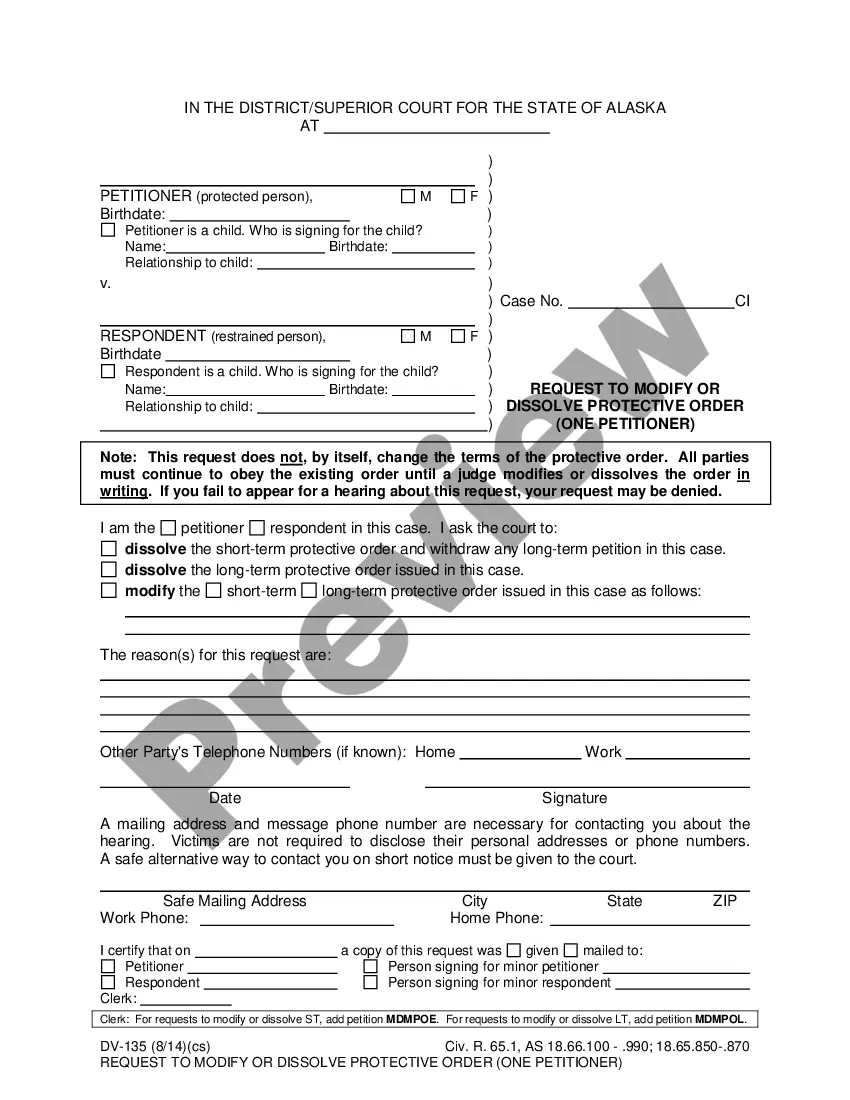
The Request to Modify or Dissolve Protective Order is a legal document specifically designed for petitioners in Alaska. This form allows multiple petitioners to request changes to an existing protective order. Understanding the purpose of this form helps differentiate it from other legal documents related to protective orders, such as initial petitions or responses to protective orders.
Main sections of this form
- Case number: Identifies the specific case in court.
- Petitioner's details: Includes personal information such as name, birthdate, and if the petitioner is a child, the representative's information.
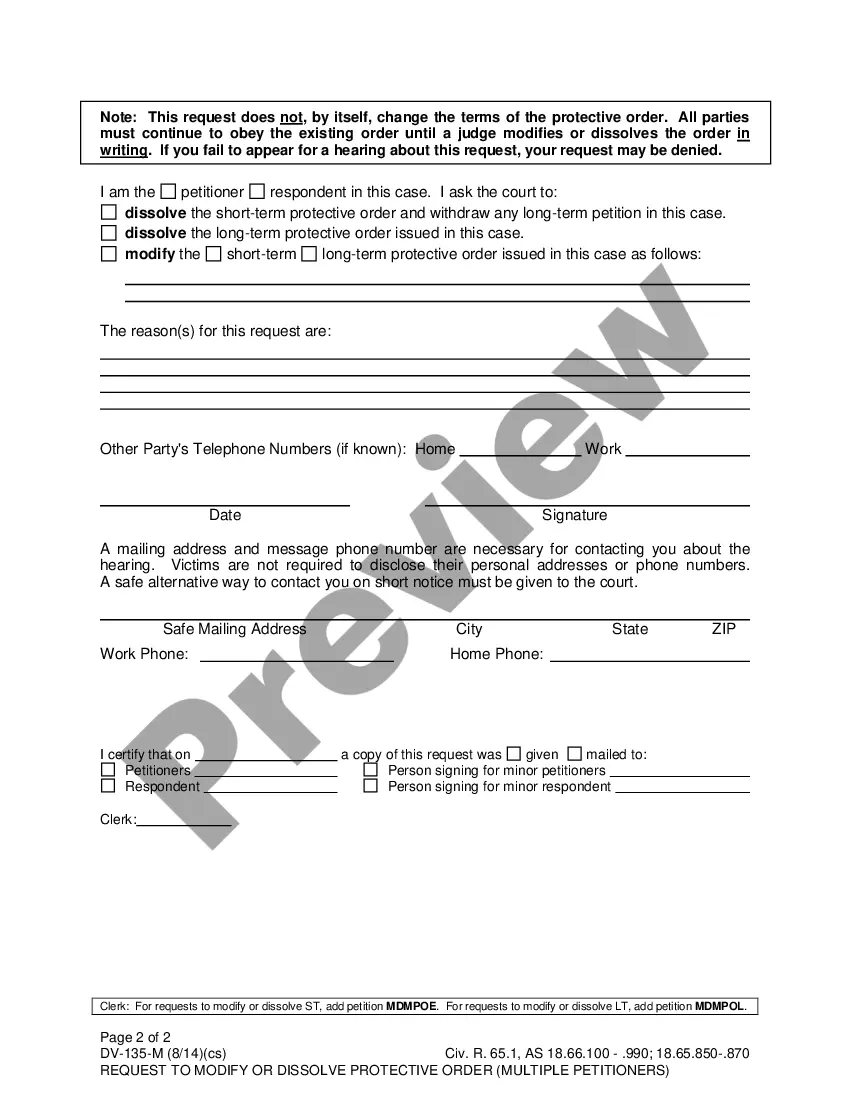
- Request specifics: Clearly states whether the petitioner seeks to dissolve or modify the protective order.
- Reason for request: Requires an explanation as to why the modification or dissolution is being sought.
- Contact information: Mandatory mailing address and phone number for court contact.
- Certification of service: Evidence that copies of the request have been shared with the relevant parties.
When this form is needed
This form should be used when one or more petitioners wish to change the terms of an existing protective order, either by modifying its provisions or dissolving it entirely. It is essential in scenarios where the situation surrounding the protective order has changed, such as reconciliation between parties or evidence that the protective measures are no longer necessary.
Intended users of this form
- Multiple petitioners seeking to modify or dissolve a protective order against a respondent.
- Individuals who were previously granted a short-term or long-term protective order and need legal modification.
- Parents or guardians signing on behalf of minor children who are protected under a current order.
Instructions for completing this form
- Fill in the case number at the top of the form.
- Provide the details of each petitioner (name, date of birth) and the relationship to any minors.
- Clearly indicate whether you wish to modify or dissolve the protective order.
- Explain the reasons for your request in the space provided.
- Ensure that you provide a safe mailing address and contact number.
- Sign and date the form, certifying that copies have been provided to the relevant parties.
Notarization guidance
This form does not typically require notarization unless specified by local law. Always check local requirements to confirm if notarization may be needed in your specific situation.
Get your form ready online
Our built-in tools help you complete, sign, share, and store your documents in one place.
Make edits, fill in missing information, and update formatting in US Legal Forms—just like you would in MS Word.
Download a copy, print it, send it by email, or mail it via USPS—whatever works best for your next step.
Sign and collect signatures with our SignNow integration. Send to multiple recipients, set reminders, and more. Go Premium to unlock E-Sign.
If this form requires notarization, complete it online through a secure video call—no need to meet a notary in person or wait for an appointment.
We protect your documents and personal data by following strict security and privacy standards.

Make edits, fill in missing information, and update formatting in US Legal Forms—just like you would in MS Word.

Download a copy, print it, send it by email, or mail it via USPS—whatever works best for your next step.

Sign and collect signatures with our SignNow integration. Send to multiple recipients, set reminders, and more. Go Premium to unlock E-Sign.

If this form requires notarization, complete it online through a secure video call—no need to meet a notary in person or wait for an appointment.

We protect your documents and personal data by following strict security and privacy standards.
Avoid these common issues
- Not including the case number, which can delay processing.
- Failing to explain the reasons for modification or dissolution adequately.
- Not providing a safe mailing address or contact information.
- Overlooking the requirement to serve copies of the request to involved parties.
Why complete this form online
- Easy access and download of the form, allowing you to complete it at your convenience.
- Editable electronic format ensures that all necessary information can be filled out accurately.
- Form updates are made in compliance with the latest Alaska regulations, ensuring legal validity.
Legal use & context
The Request to Modify or Dissolve Protective Order is enforceable in Alaska once filed. However, it is crucial to comply with existing court orders until formally modified by the court.
Quick recap
- This form is essential for petitioners looking to change the terms of an existing protective order.
- All petitioners must provide valid reasons for their requests.
- It's imperative to follow court instructions carefully to ensure legal compliance.
Looking for another form?
Form popularity
FAQ
You cannot drop the charges, but as long as the judge believes that you are not being forced or coerced into dropping the No Contact order, he/she should drop it. Just go to the court that put the order in effect and ask the Clerk's office to pull the case and tell them what it is that you are seeking.
Modifications: After the court has granted either the ex parte temporary protective order or long term protective order, if you want to change part of the order, you can file your request with the court. Only the judge has the power to modify the order.It is not valid unless it is written in a court order.
If you believe the protection order was granted improperly or that it is no longer needed, you can file a motion asking the court to dissolve (terminate or cancel) the protection order.If the court schedules a hearing and grants the motion, the protection order will become immediately void and unenforceable.
Consult with a family law attorney experienced in defending people against false restraining orders. You must go to court for the final restraining order hearing and present your evidence proving why the accusations against you are false. The evidence can be police reports, witnesses, text messages and or emails.
If you believe the protection order was granted improperly or that it is no longer needed, you can file a motion asking the court to dissolve (terminate or cancel) the protection order. After you file the motion, the court will decide whether or not to schedule a hearing.
Get the documents. In order to be prepared to fight the order you need to know exactly what is being said about you. Know the law in your state. Know the timelines for contesting these orders, and take action immediately when you are informed that there may be an order against you.
There are no costs involved in applying for a protection order, unless an attorney is used.Once a protection order is granted, it is valid until the victim withdraws it. If the perpetrator lodges an appeal, the order will continue to operate until it is cancelled by the appeal court.
When parents choose to end their marriage through divorce, they may need to address a variety of complex child custody issues.However, protective orders can also be based on false accusations, or they may be used in an attempt to gain an unfair advantage during divorce.