South Dakota Renunciation And Disclaimer of Joint Tenant or Tenancy Interest
Overview of this form
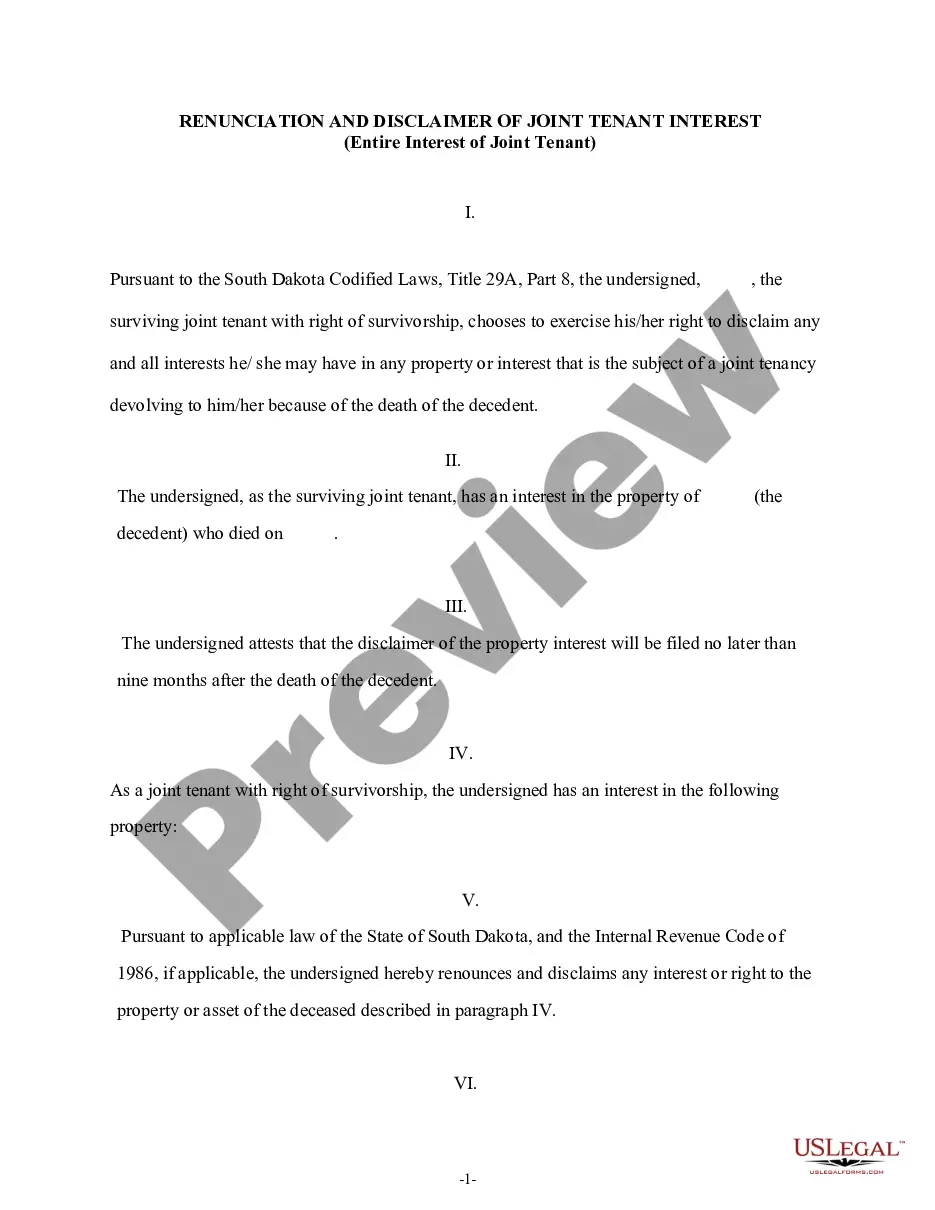
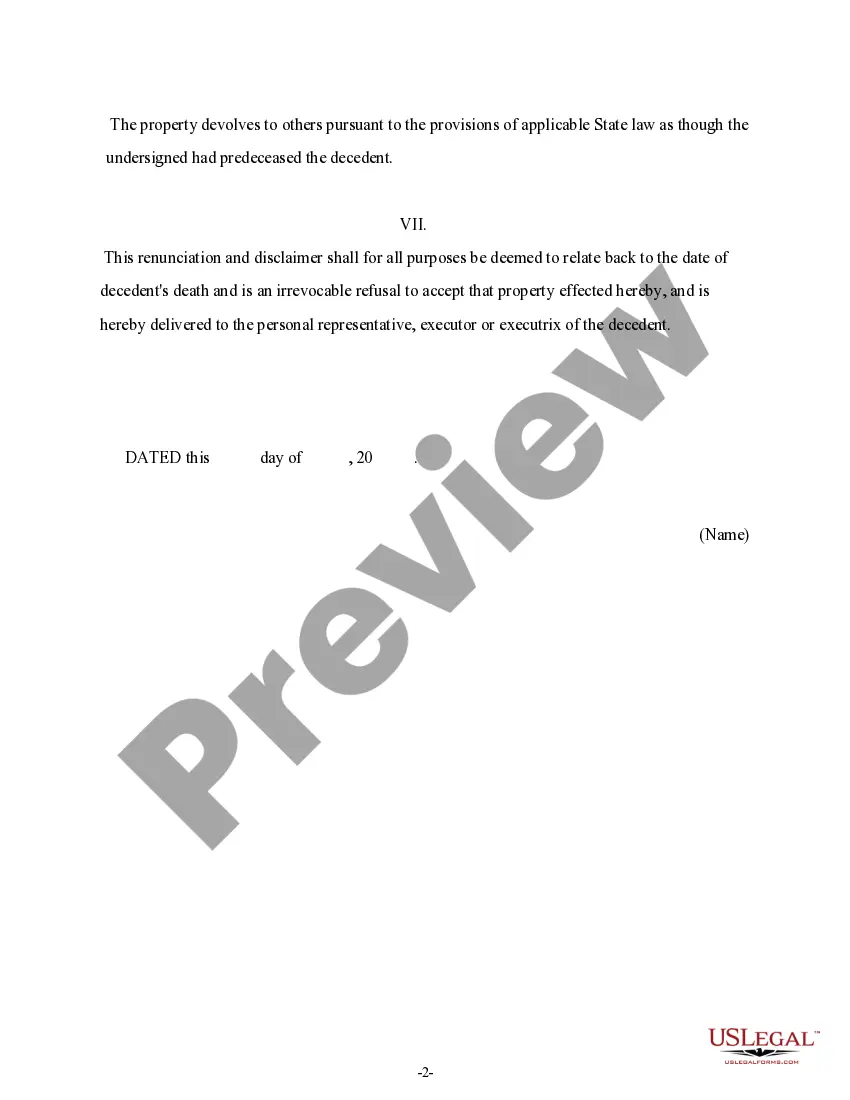
The Renunciation and Disclaimer of Joint Tenant or Tenancy Interest form is a legal document that allows a surviving joint tenant to formally refuse their interest in a shared property. This form is specific to situations where one joint tenant has passed away, and the surviving tenant opts to disclaim their share of the property based on South Dakota Codified Laws. Unlike other estate planning tools, this disclaimer acts as an irrevocable decision that eliminates the survivorâs claim to the property, thus allowing it to pass to other heirs according to state law.
Key parts of this document
- A declaration of the joint tenancy interest being disclaimed.
- A clause specifying the effect of the disclaimer on the propertyâs distribution.
- A section for the surviving tenant's acknowledgment of the decision.
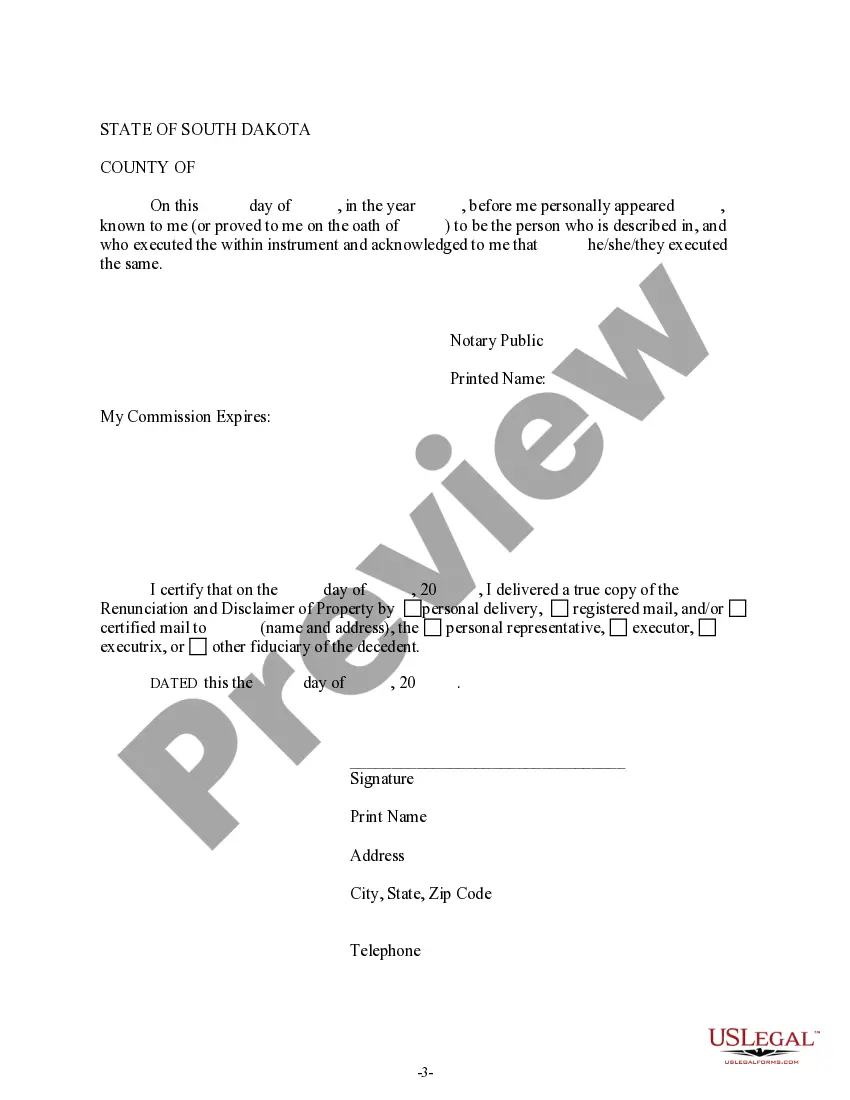
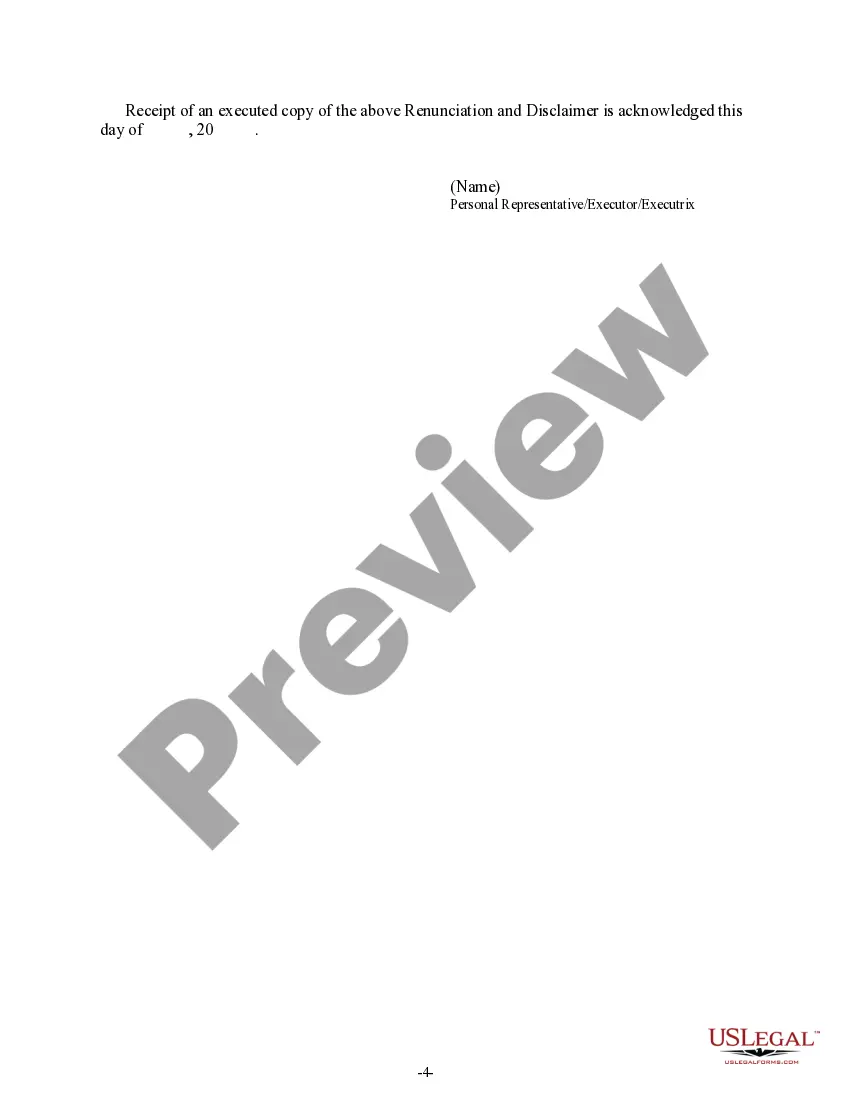
- A certificate for verification of the delivery of the documentation.


When to use this document
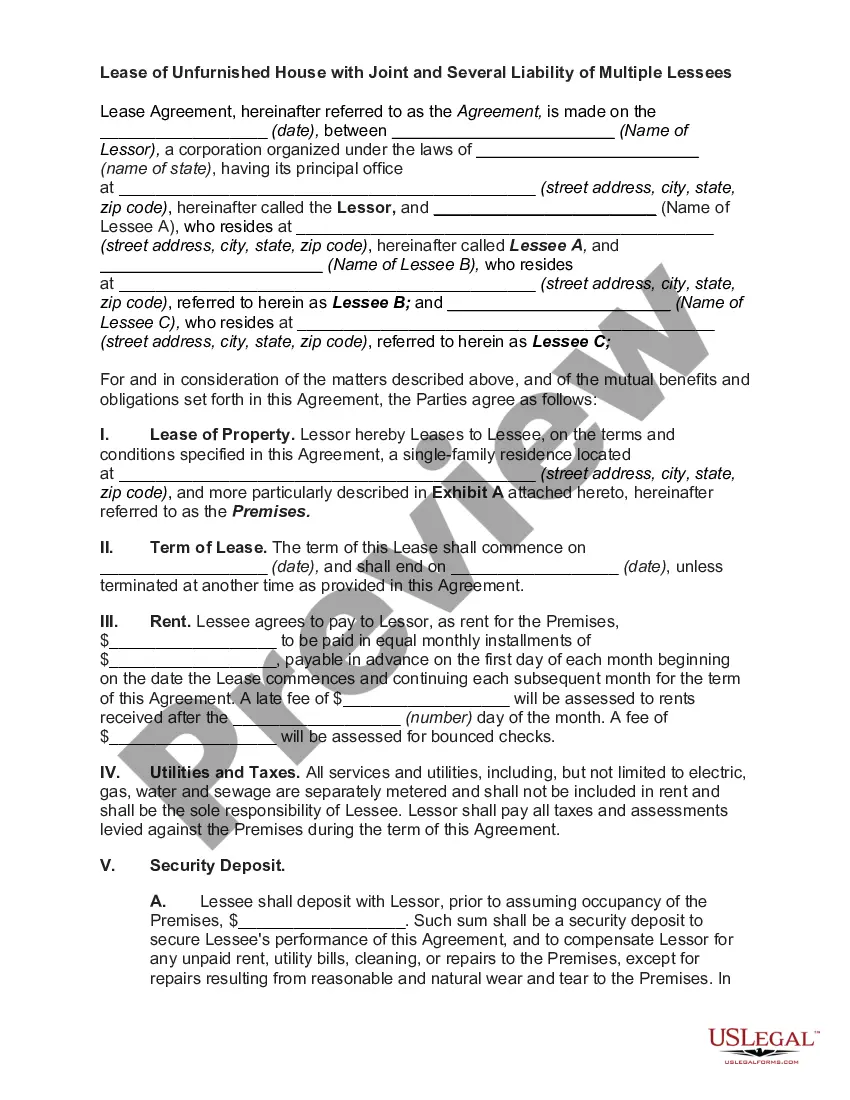
This form is necessary when a surviving joint tenant wishes to renounce their interest in property owned jointly with a deceased individual. This situation often arises in the context of real estate where joint tenancy was used as an estate planning tool. Utilizing this form ensures that the joint tenant's decision is legally recognized, and the property can be distributed according to state law.
Intended users of this form
- Surviving joint tenants who have inherited property from a deceased co-tenant.
- Individuals looking to formally disclaim their interest in the estate to ensure proper distribution according to their wishes.
- Anyone who is advised by an attorney to execute a disclaimer as part of estate planning or asset management.
How to complete this form
- Identify the parties involved in the joint tenancy, including the decedent and the surviving tenant.
- Specify the property subject to the joint tenancy interest.
- Complete the declaration of renunciation and ensure all required signatures are provided.
- Submit the form as required and obtain acknowledgment or certificate of delivery.
Is notarization required?
To make this form legally binding, it must be notarized. Our online notarization service, powered by Notarize, lets you verify and sign documents remotely through an encrypted video session.
Get your form ready online
Our built-in tools help you complete, sign, share, and store your documents in one place.
Make edits, fill in missing information, and update formatting in US Legal Forms—just like you would in MS Word.
Download a copy, print it, send it by email, or mail it via USPS—whatever works best for your next step.
Sign and collect signatures with our SignNow integration. Send to multiple recipients, set reminders, and more. Go Premium to unlock E-Sign.
If this form requires notarization, complete it online through a secure video call—no need to meet a notary in person or wait for an appointment.
We protect your documents and personal data by following strict security and privacy standards.
Make edits, fill in missing information, and update formatting in US Legal Forms—just like you would in MS Word.
Download a copy, print it, send it by email, or mail it via USPS—whatever works best for your next step.
Sign and collect signatures with our SignNow integration. Send to multiple recipients, set reminders, and more. Go Premium to unlock E-Sign.
If this form requires notarization, complete it online through a secure video call—no need to meet a notary in person or wait for an appointment.
We protect your documents and personal data by following strict security and privacy standards.
Common mistakes to avoid
- Failing to sign the disclaimer, making it unenforceable.
- Not specifying the correct property details, leading to legal complications.
- Neglecting to comply with the state's acknowledgment requirements.
Why complete this form online
- Convenience of downloading and completing the form at any time.
- Immediate access to tailored legal templates drafted by licensed attorneys.
- Editability allows for customization before finalization.
Quick recap
- The form allows a surviving joint tenant to renounce their inheritance of an interest in a property.
- It ensures that the property passes to other beneficiaries as dictated by state law.
- Completing the form accurately and in a timely manner is crucial to fulfilling the survivor's intentions.
Looking for another form?
Form popularity
FAQ
The surviving spouse can serve as the sole trustee, but cannot have any power to direct the beneficial enjoyment of the disclaimed property unless the power is limited by an "ascertainable standard." This is necessary both to qualify the disclaimer and to avoid any taxable general power of appointment.
Any disclaimer of an interest in a trust by a trust beneficiary must be made to the trustee of that trust. For a disclaimer to be valid, it must be supported by some evidence that the beneficiary is disclaiming their interest. Silence or otherwise passive behaviour will not suffice.
The beneficiary can avoid receiving the trust assets through a disclaimer. A disclaimer is a legal act where the beneficiary instructs the trustee to disregard the beneficiary as though he was dead, as though he predeceased the trust's intended end.
Yes, a fiduciary can disclaim an interest in property if the will, trust or power of attorney gives the fiduciary that authority or if the appropriate probate court authorizes the disclaimer.The primary reason an executor or trustee might disclaim property passing to an estate or trust is to save death taxes.
Jointly owned property is treated as consisting of a both present and a future interest in the jointly owned property. Thus, a surviving spouse may disclaim the future interest in jointly owned property on the death of their spouse, including assets that were held by the spouses as tenants by the entirety.
It must be in writing. It must be made within 9 months of the date of death of the decedent. The disclaimant cannot receive any benefits from the assets.
Property owned in joint tenancy automatically passes, without probate, to the surviving owner(s) when one owner dies. Setting up a joint tenancy is easy, and it doesn't cost a penny.
A disclaimer trust is a clause typically included in a person's will that establishes a trust upon their death, subject to certain specifications. This allows certain assets to be moved into the trust by the surviving spouse without being subject to taxation.
Danger #1: Only delays probate. Danger #2: Probate when both owners die together. Danger #3: Unintentional disinheriting. Danger #4: Gift taxes. Danger #5: Loss of income tax benefits. Danger #6: Right to sell or encumber. Danger #7: Financial problems.