Pennsylvania Quitclaim Deed from Individual Grantor to Three Individual Grantees with Release of Life Estate
Overview of this form
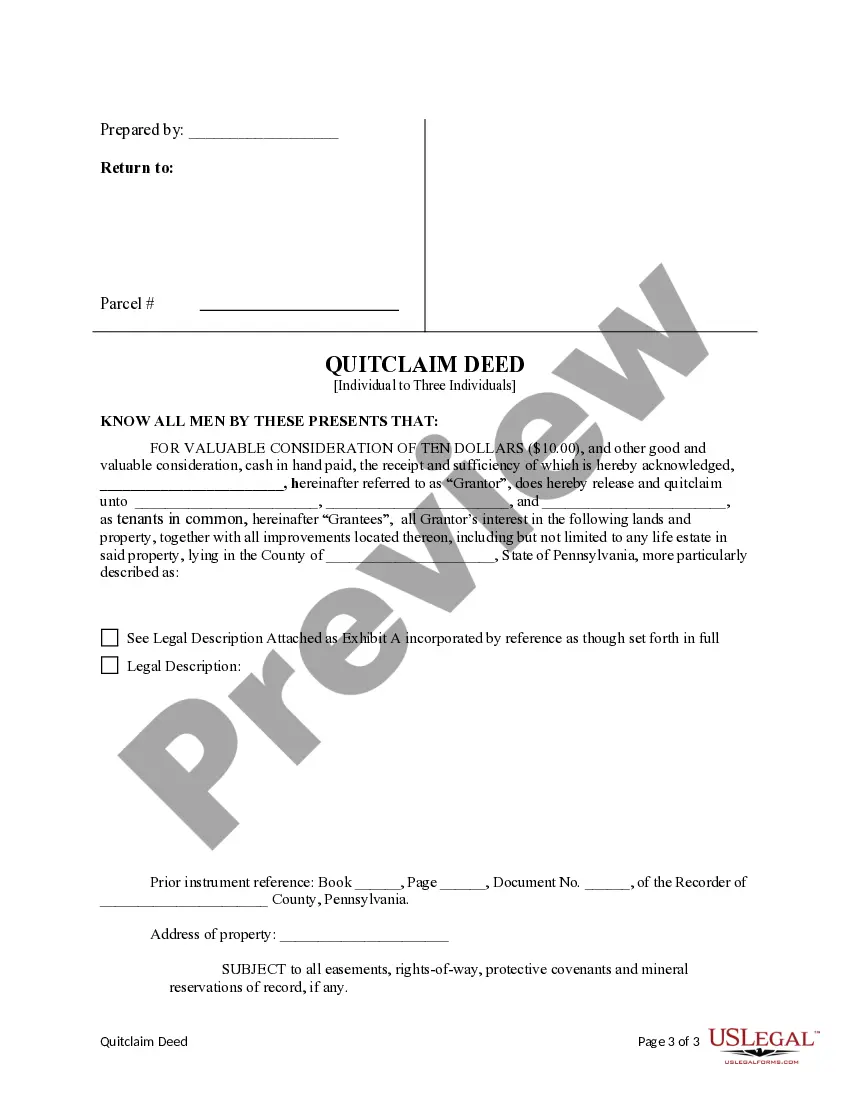
This form is a Quitclaim Deed that enables an individual Grantor to legally convey property rights to three individual Grantees. Unlike a warranty deed, which assures the Grantees that the Grantor has a clear title to the property, a quitclaim deed merely transfers whatever interest the Grantor may have in the property, without any guarantees. This form includes a release of any life estate retained by the Grantor, meaning the Grantor relinquishes their right to use the property for their lifetime.
What’s included in this form
- Grantor's identity and acknowledgment of consideration.
- Details of the Grantees who will receive the property.
- Precise legal description of the property being conveyed.
- Statement addressing the release of a reserved life estate.
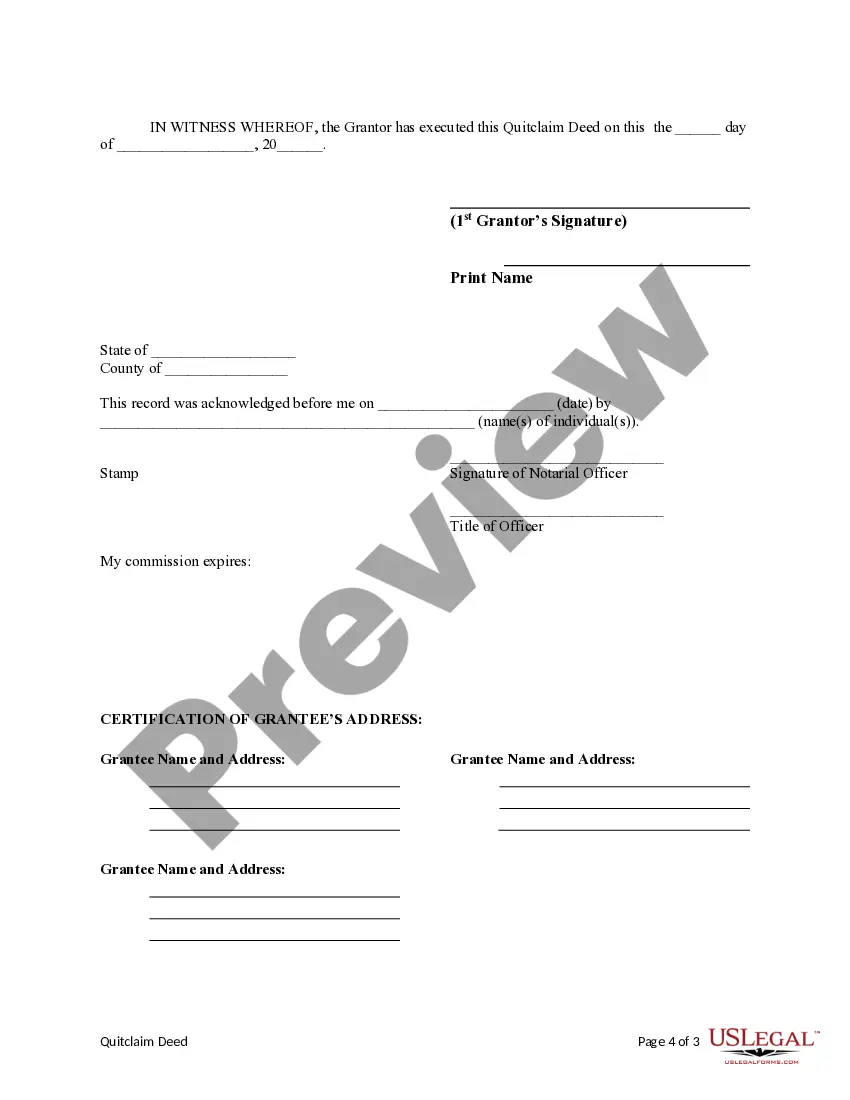
- Signature lines for the Grantor and witnesses.





When to use this form
This Quitclaim Deed is used in scenarios such as when an individual wants to transfer their interest in a property to multiple people, like family members or business partners. It is commonly used during estate planning, when handling property division after a divorce, or when transferring property into or out of a trust. This form is ideal for situations where the Grantor does not wish to make warranties about the property's title.
Intended users of this form
- Individuals wishing to transfer property ownership to three specific recipients.
- People involved in family estate planning or inheritance arrangements.
- Anyone looking to eliminate their interest in a property without guarantees.
Completing this form step by step
- Identify the parties involved: Enter the names of the Grantor and the three Grantees.
- Specify the property: Provide a clear legal description of the property being transferred.
- Enter details of consideration: State the value exchanged, typically noted as ten dollars.
- Sign the form: The Grantor must sign it in front of a witness or notary, if required.
- Attach any legal descriptions: Include any necessary exhibits that detail the property further.
Notarization requirements for this form
This document requires notarization to meet legal standards. US Legal Forms provides secure online notarization powered by Notarize, allowing you to complete the process through a verified video call, available 24/7.
Get your form ready online
Our built-in tools help you complete, sign, share, and store your documents in one place.
Make edits, fill in missing information, and update formatting in US Legal Forms—just like you would in MS Word.
Download a copy, print it, send it by email, or mail it via USPS—whatever works best for your next step.
Sign and collect signatures with our SignNow integration. Send to multiple recipients, set reminders, and more. Go Premium to unlock E-Sign.
If this form requires notarization, complete it online through a secure video call—no need to meet a notary in person or wait for an appointment.
We protect your documents and personal data by following strict security and privacy standards.

Make edits, fill in missing information, and update formatting in US Legal Forms—just like you would in MS Word.

Download a copy, print it, send it by email, or mail it via USPS—whatever works best for your next step.

Sign and collect signatures with our SignNow integration. Send to multiple recipients, set reminders, and more. Go Premium to unlock E-Sign.

If this form requires notarization, complete it online through a secure video call—no need to meet a notary in person or wait for an appointment.

We protect your documents and personal data by following strict security and privacy standards.
Mistakes to watch out for
- Not including a complete legal description of the property.
- Failing to have the form properly witnessed or notarized as required.
- Omitting the names of all Grantees or inaccurately entering their information.
- Leaving out the acknowledgment of consideration.
Why use this form online
- Convenience: Easily fill out the form online and download it for printing.
- Editability: Modify the form as needed before finalizing it.
- Reliability: Ensure that the form meets legal standards with attorney-reviewed templates.
Summary of main points
- The quitclaim deed allows an individual to transfer property rights to multiple grantees without guarantees regarding the title.
- This form includes essential clauses, such as releasing any life estate associated with the property.
- Ensure accurate completion by carefully filling out all required fields and providing a correct property description.
Looking for another form?
Form popularity
FAQ
You'll need to pay a fee, which varies from county to county. For example, in Montgomery County, near Philadelphia, the fee for recording a deed is $86.75 for up to four pages and up to four names, and $1 per additional name and $4 per additional page.
Filing a quitclaim deed is a right of any property owner. You can file a quitclaim deed without refinancing your mortgage, but you are still responsible for the payments. Transferring the mortgage without refinancing is possible through an assumption of the loan, which requires lender approval.
Fill in the deed form. Print it out. Have the grantor(s) and grantee(s) sign and get the signature(s) notarized. Fill out a Statement of Value form, if necessary. Get the Uniform Parcel Number (UPI) on the deed certified, if required by your county.
But you might be wondering if an owner can transfer a deed to another person without a real estate lawyer. The answer is yes. Parties to a transaction are always free to prepare their own deeds.A quitclaim deed, for example, is far simpler than a warranty deed.
Quitclaim Does Not Release Debts Signing a quitclaim deed and giving up all rights to the property doesn't release you from any financial obligations you may have. It only removes you from the title, not from the mortgage, and you are still responsible for making payments.
It's usually a very straightforward transaction, but it's possible for a quitclaim deed to be challenged. If a quitclaim deed is challenged in court, the issue becomes whether the property was legally transferred and if the grantor had the legal right to transfer the property.
Even if you sign a quitclaim deed, the mortgage balance will continue to show up on your credit report. This will hurt what is called your debt utilization ratio. This may mean you have too much debt to be qualified for your next mortgage when you want to buy a new home.
To use a Quitclaim Deed to add someone to a property deed or title, you would need to create a Quitclaim Deed and list all of the current owners in the grantor section. In the grantee section, you would list all of the current owners as well as the person you would like to add.