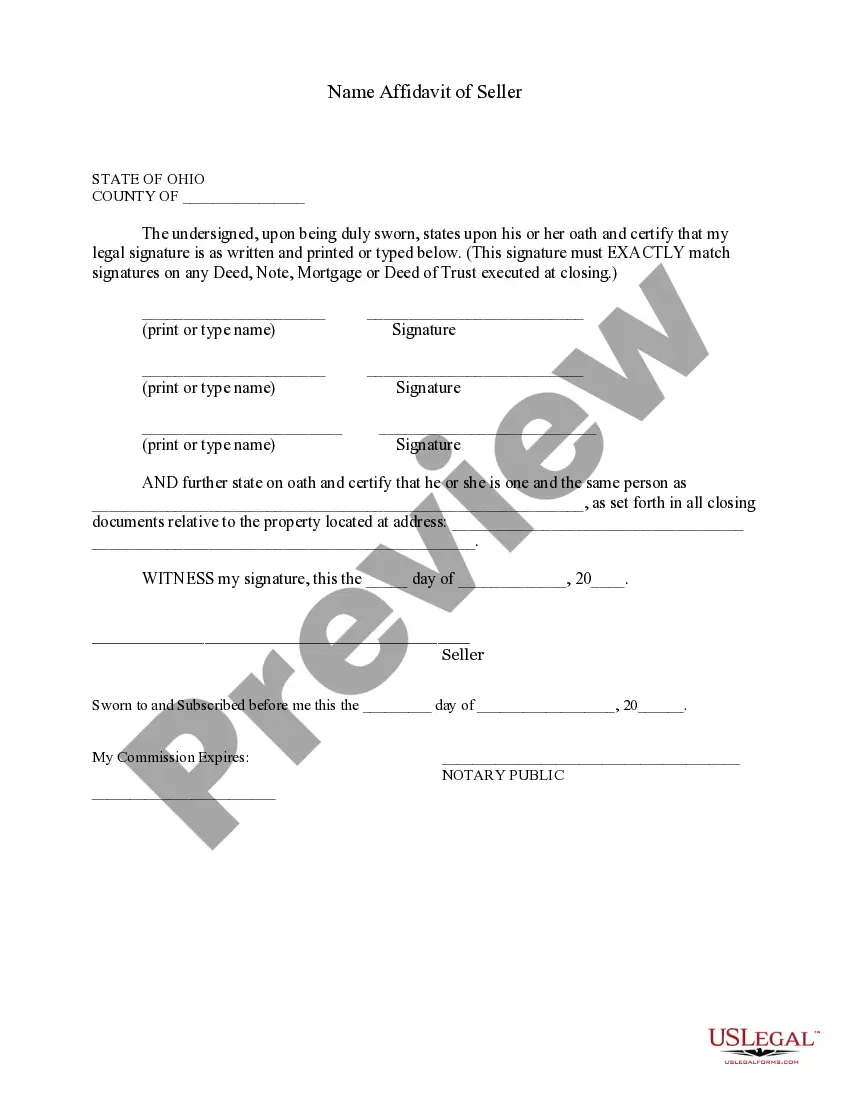
Ohio Name Affidavit of Seller
Overview of this form
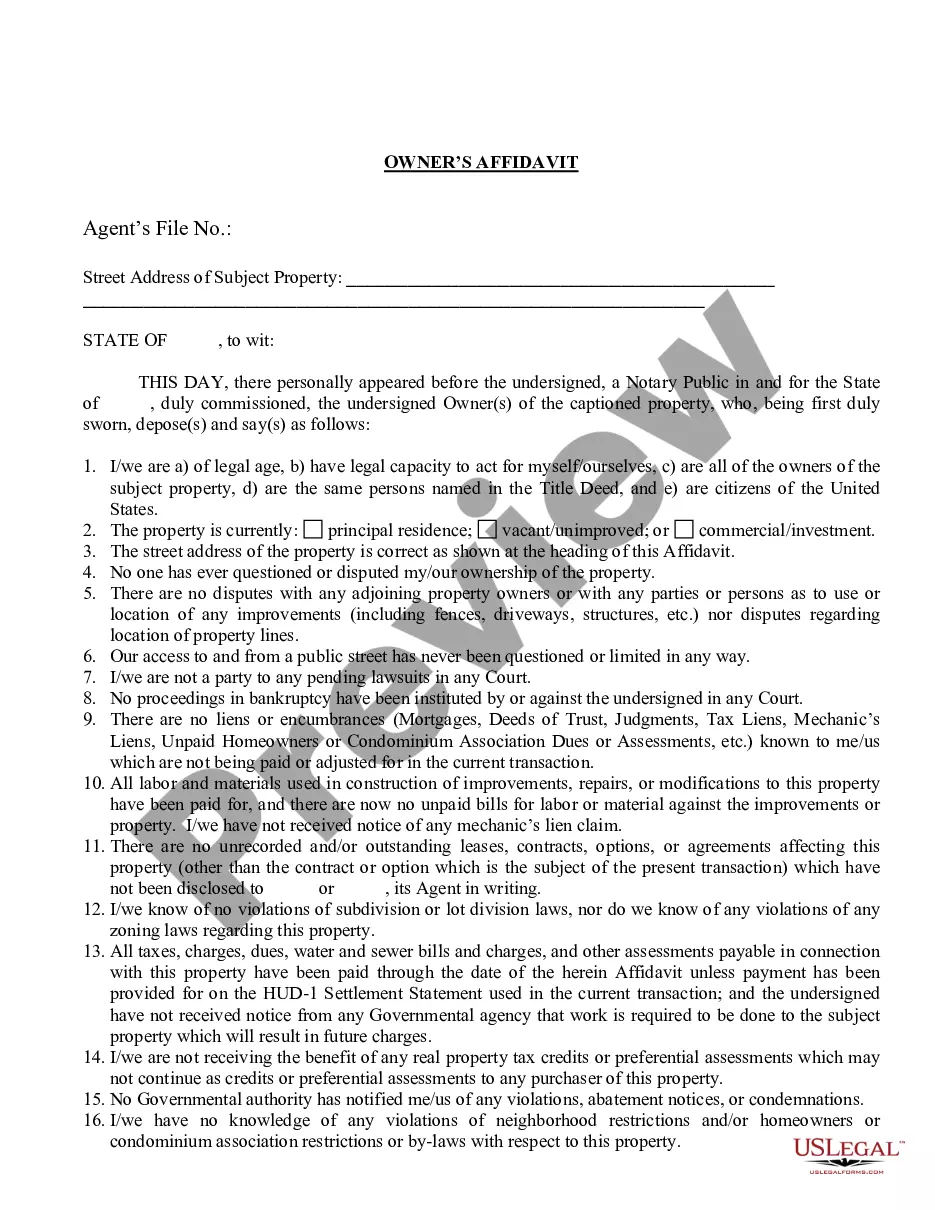
The Name Affidavit of Seller is a legal document used by sellers to affirm their legal name and any known alias names. This affidavit ensures clarity by confirming that different signatures on legal documents, such as deeds or mortgages, belong to the same individual. It serves as an important tool to prevent misunderstandings in transactions involving property sales.
Key parts of this document
- Legal name of the seller: The seller's full legal name must be clearly stated.
- Alias names: Any other names the seller is known by must be included.
- Signatures: The form requires the seller's signature and printed name to match other related documents.
- Property information: The address related to the transaction is to be specified.
- Notary details: Certification by a notary public is required to validate the affidavit.

Situations where this form applies
This form should be used in real estate transactions whenever the seller has used different variations of their name in legal documents. It is crucial when the sellerâs identity must be clarified to ensure that all documents related to the property transfer can be seamlessly processed and recognized as valid.
Who this form is for
- Sellers engaging in property sales who have used multiple names.
- Real estate agents assisting clients in property transactions.
- Notaries public who need to verify the identity of the seller.
- Legal professionals involved in real estate documentation.
Completing this form step by step
- Provide your full legal name in the first section.
- List any alias names you have used.
- Sign the form to match your signature on related documents.
- Fill in the property address where the transaction is taking place.
- Complete the notary section, including the date of notarization.
Is notarization required?
Yes, this form must be notarized to be legally valid. The affidavit requires a notary public to confirm the identity of the seller and the authenticity of the signatures provided. US Legal Forms offers integrated online notarization services, available 24/7, ensuring a secure and efficient process.
Get your form ready online
Our built-in tools help you complete, sign, share, and store your documents in one place.
Make edits, fill in missing information, and update formatting in US Legal Forms—just like you would in MS Word.
Download a copy, print it, send it by email, or mail it via USPS—whatever works best for your next step.
Sign and collect signatures with our SignNow integration. Send to multiple recipients, set reminders, and more. Go Premium to unlock E-Sign.
If this form requires notarization, complete it online through a secure video call—no need to meet a notary in person or wait for an appointment.
We protect your documents and personal data by following strict security and privacy standards.

Make edits, fill in missing information, and update formatting in US Legal Forms—just like you would in MS Word.

Download a copy, print it, send it by email, or mail it via USPS—whatever works best for your next step.

Sign and collect signatures with our SignNow integration. Send to multiple recipients, set reminders, and more. Go Premium to unlock E-Sign.

If this form requires notarization, complete it online through a secure video call—no need to meet a notary in person or wait for an appointment.

We protect your documents and personal data by following strict security and privacy standards.
Common mistakes to avoid
- Failing to ensure the signature matches other legal documents.
- Not listing all known alias names, which may cause confusion.
- Incomplete property information that does not match the transaction.
- Submitting the affidavit without notarization.
Benefits of completing this form online
- Convenience of downloading forms anytime, from anywhere.
- Edit and fill clearly, ensuring accuracy.
- Reliable access to attorney-drafted templates to meet legal standards.
Main things to remember
- The Name Affidavit of Seller is essential for clarifying identity in real estate transactions.
- Accurate signatures and names are crucial to avoid legal complications.
- This form must be completed and notarized to ensure its acceptance by all relevant parties.
Looking for another form?
Form popularity
FAQ
An Ohio bill of sale is a document that acts as proof of ownership when an item is sold. A bill of sale in Ohio does not need to be notarized.
Obtain a copy of your vehicle title from the seller of the vehicle. Visit a notary public in Ohio. Notaries public are common at banks, post offices and government offices. Provide the notary public with your photo identification before you sign your name to the title of the vehicle in the presence of the notary.
All Sellers/signers must personally appear before the notary! NO exceptions! They must sign exactly as their name appears on the front of the title as the vehicle owner. If multiple owners, both must sign, although not necessarily at the same time.
Ohio law does not expressly prohibit a notary public from notarizing for a spouse or family member, however, Ohio Revised Code section 147.141 states a notary public may not perform a notarial act if the notary has a conflict of interest with regard to the transaction.
Dual ownership requires both parties to be present unless a notarized power of attorney is provided. Social Security numbers for all parties are required. Photocopies of title are not accepted. If you choose to have a 45-day temporary tag issued, it must be obtained before you transfer the vehicle title into your name.
You not need both parties to be physically present at the time of notarization, but you can only notarize for the person who is appearing before you. The other person can have their signature notarized at another time.
A notary public who has a direct or indirect financial (or other beneficial) interest in a document may not notarize such a document. The better practice is not to notarize for a spouse or family member in order to preserve the integrity of the notarization and to prevent a challenge to the notarization.