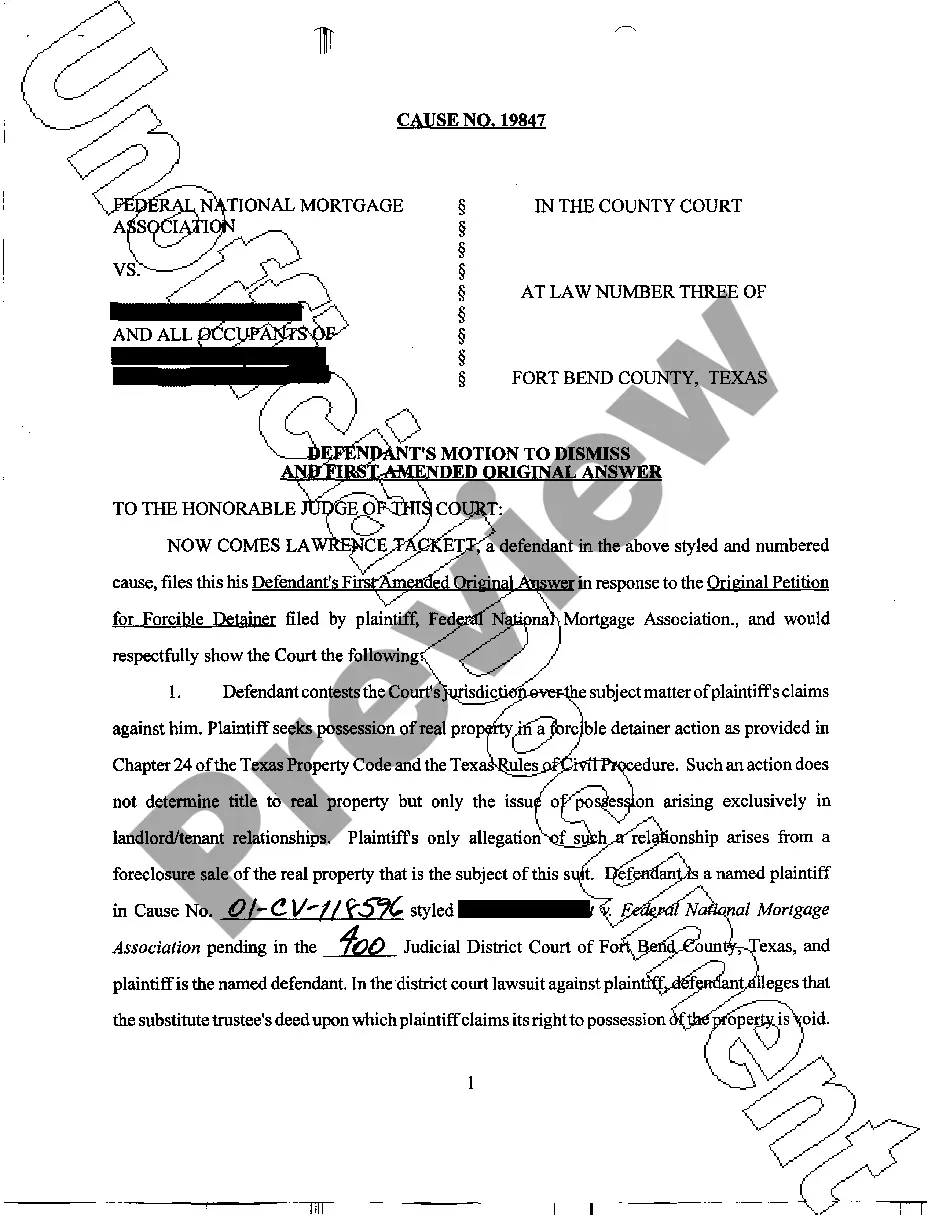
Nevada Notice of Lease for Recording
Overview of this form
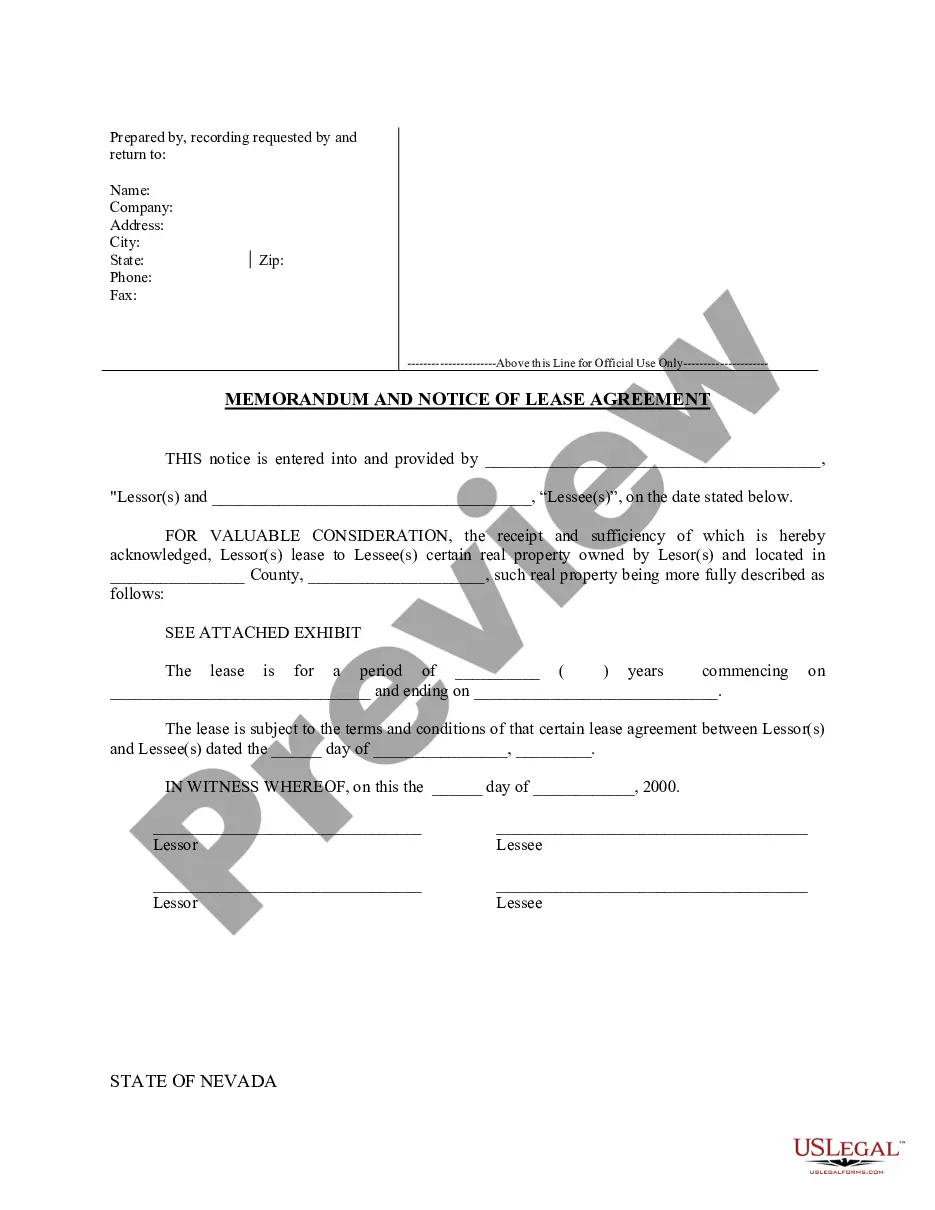
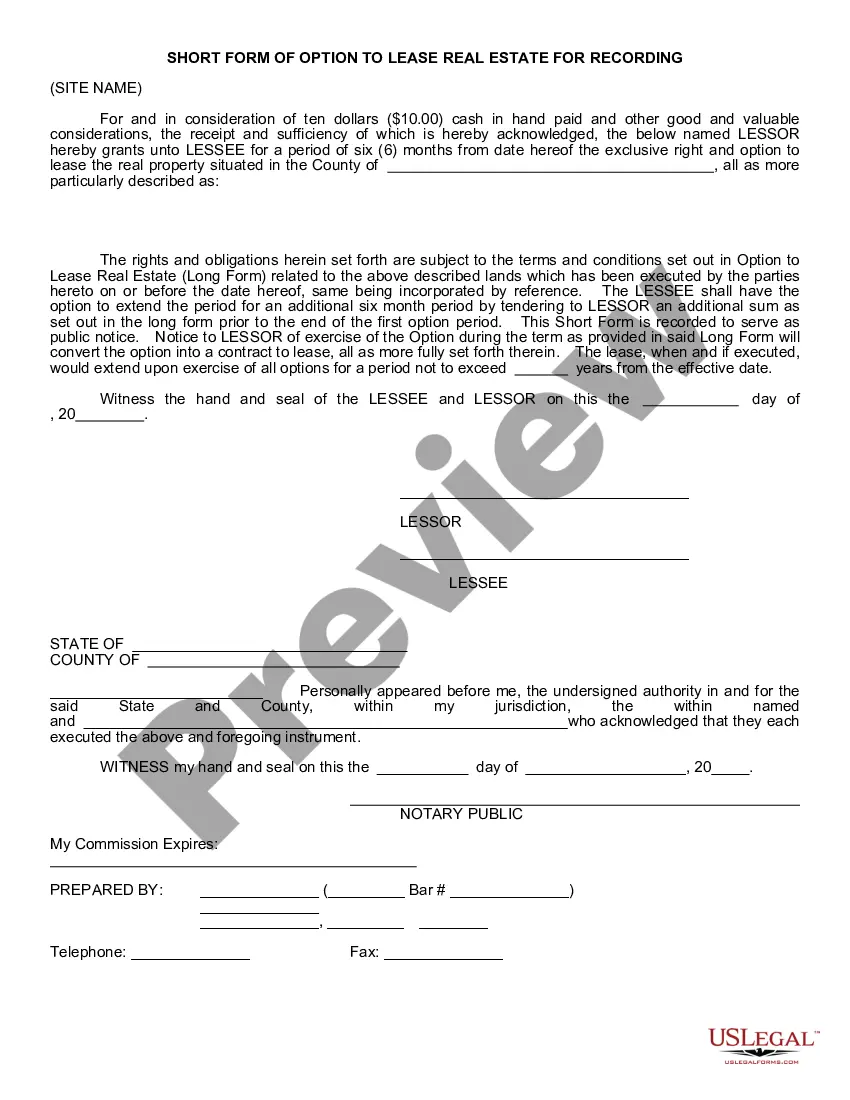
The Notice of Lease for Recording is a legal document used to formally inform relevant parties that a lease exists for a particular parcel of real estate. Unlike the full lease agreement, this memorandum simplifies the recording process by summarizing the essential details of the lease, making it a useful tool for landlords and tenants alike.
Key parts of this document
- Prepared by and recording requested by sections for party identification.
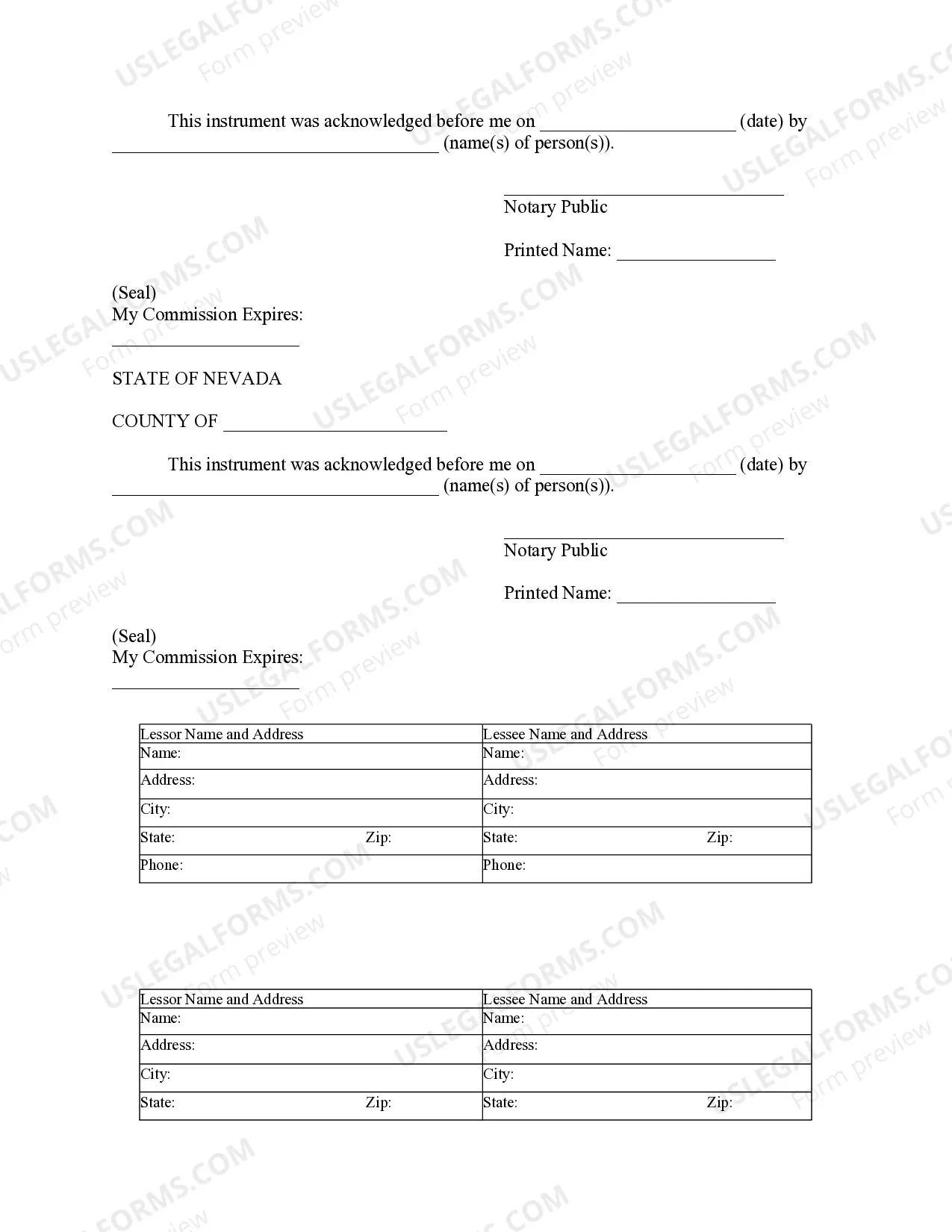
- Identification of lessor(s) and lessee(s), including names, addresses, and contact information.
- Description of the leased real property, including the county and any attached exhibits.
- Lease duration specifying the start and end dates of the lease.
- Terms and conditions reference, noting the original lease agreement date.
- Signature lines for both lessor(s) and lessee(s), along with notarization sections.

Common use cases
This form should be used when a landlord wants to officially record a lease agreement with a tenant. It is particularly important in situations where the property may be subject to other claims, ensuring that the lease is acknowledged in public records. It's also useful when there is a need to establish the lease's existence for future reference or transactions involving the property.
Who needs this form
- Landlords seeking to protect their lease agreements.
- Tenants who want to ensure their lease is officially documented.
- Real estate agents involved in property leases.
- Property managers maintaining official records for rental properties.
How to complete this form
- Identify and enter the names of the lessor(s) and lessee(s).
- Provide the address of the property being leased, ensuring clarity on the location.
- Specify the duration of the lease, including both the starting and ending dates.
- Include the reference to the original lease agreement date.
- Obtain all required signatures from both parties and confirm notarization as necessary.
Notarization guidance
Notarization is required for this form to take effect. Our online notarization service, powered by Notarize, lets you verify and sign documents remotely through an encrypted video session, available 24/7.
Get your form ready online
Our built-in tools help you complete, sign, share, and store your documents in one place.
Make edits, fill in missing information, and update formatting in US Legal Forms—just like you would in MS Word.
Download a copy, print it, send it by email, or mail it via USPS—whatever works best for your next step.
Sign and collect signatures with our SignNow integration. Send to multiple recipients, set reminders, and more. Go Premium to unlock E-Sign.
If this form requires notarization, complete it online through a secure video call—no need to meet a notary in person or wait for an appointment.
We protect your documents and personal data by following strict security and privacy standards.

Make edits, fill in missing information, and update formatting in US Legal Forms—just like you would in MS Word.

Download a copy, print it, send it by email, or mail it via USPS—whatever works best for your next step.

Sign and collect signatures with our SignNow integration. Send to multiple recipients, set reminders, and more. Go Premium to unlock E-Sign.

If this form requires notarization, complete it online through a secure video call—no need to meet a notary in person or wait for an appointment.

We protect your documents and personal data by following strict security and privacy standards.
Avoid these common issues
- Failing to provide the complete address of the leased property.
- Omitting the original lease agreement date.
- Not obtaining the necessary signatures from all parties involved.
- Overlooking the notarization requirement, if applicable.
Advantages of online completion
- Convenience of downloading the form anytime, from anywhere.
- Editability allows for personalized entries before printing.
- Access to templates drafted by licensed attorneys ensures legal compliance.
- Easy storage and retrieval of electronic records.
Legal use & context
- Recorded notices provide public evidence that a lease exists, protecting the rights of both parties.
- Failure to record the lease may affect priority in case of liens or disputes over property ownership.
- This document is enforceable in accordance with real estate laws specific to the jurisdiction where the property is located.
Main things to remember
- The Notice of Lease for Recording is essential for documenting leases publicly.
- It includes crucial lease details to guard property rights.
- Proper completion and notarization are vital for legal enforceability.
Looking for another form?
Form popularity
FAQ
Leases with an initial term not exceeding seven years are not required to be recorded so long as each renewal term under the lease (a) is for seven years or fewer, and (b) may be effected or prevented by a party to the lease or its assigns.
Recording a lease means that it (or a Notice of Lease) is submitted to the public record, usually at the local Registry of Deeds following the signing of it by both parties.Some states require that certain kinds or length of leases be recorded, so parties should review their applicable state laws.
The lease becomes legally binding when all parties have signed: the landlord and all tenants living in the unit who are 18 and older. If you're worried about situations where a lease needs to end early, learn about breaking a lease and grounds for eviction.
Recording a lease means that it (or a Notice of Lease) is submitted to the public record, usually at the local Registry of Deeds following the signing of it by both parties.Some states require that certain kinds or length of leases be recorded, so parties should review their applicable state laws.
The Lease Must be in Writing It does not matter if the lease is handwritten or typed. If the lease is for more than one year, it must be in written form and contain the following terms.
State law regulates several rent-related issues, including late and bounced-check fees, the amount of notice (at least 45 days in Nevada) landlords must give tenants to raise the rent, and how much time (five days in Nevada) a tenant has to pay overdue rent or move before a landlord can file for eviction.
Nevada is one of several states that allow tenants to break a lease for any reason and will not hold renters responsible for the entire amount of the remaining lease. Under Nevada Revised Statute 118.175, the landlord must make their "reasonable best efforts" to re-rent the unit as quickly as possible.
In some circumstances, a tenant can break a fixed-term agreement early without penalty. A tenant can give 14 days' written notice to end an agreement early without penalty if: they have accepted an offer of social housing (e.g. from DCJ Housing)
In the event of an unregistered lease deed / rent agreement that requires mandatory registration, the courts have termed the tenancy to be a month tenancy, terminable on a 15 days notice, by either of the parties. This means that lessee cannot enforce the agreed lease period on the lessor.