Florida Notice to Lessor Exercising Option to Purchase
Understanding this form
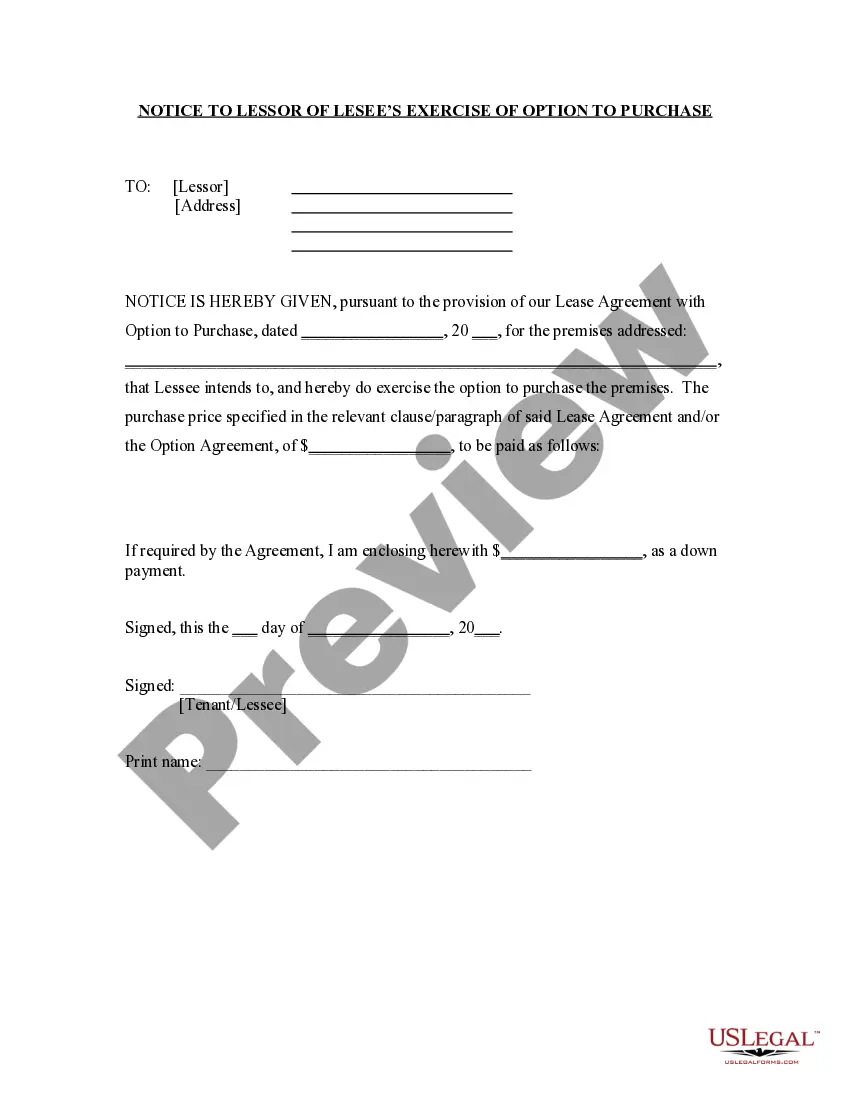
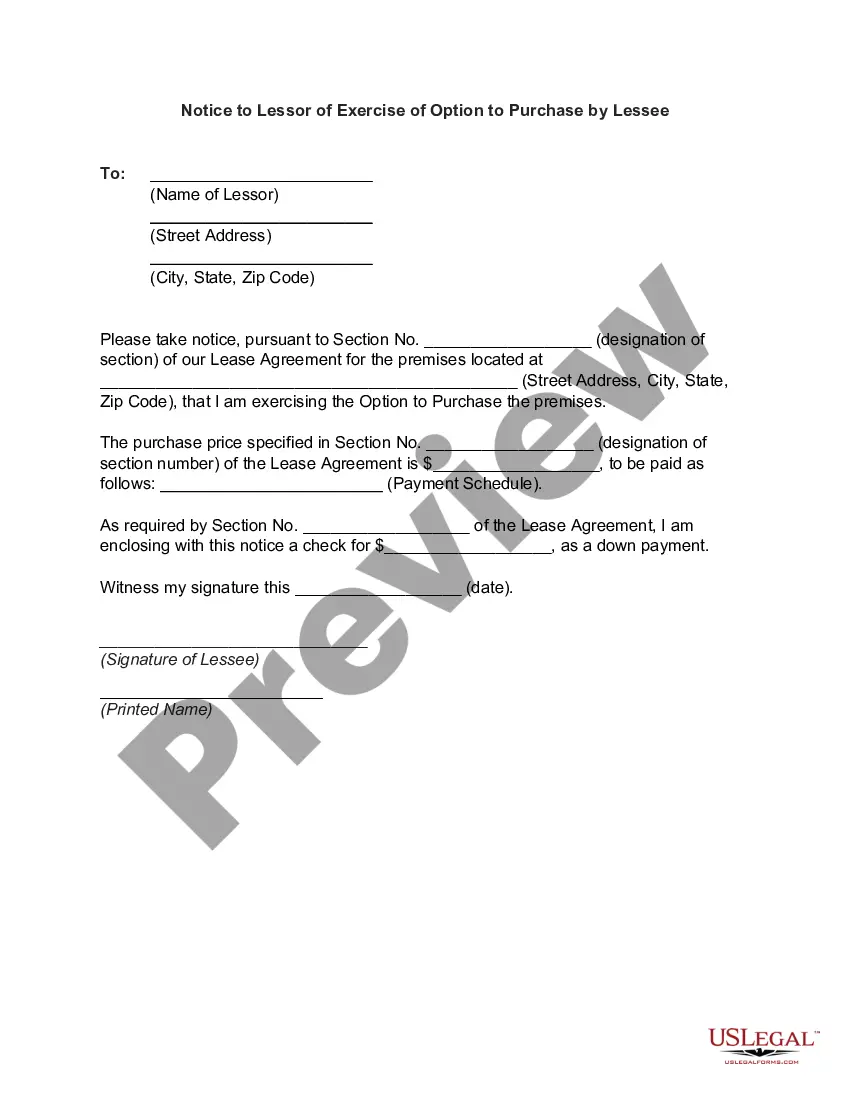
The Notice to Lessor Exercising Option to Purchase is a legal notice from a tenant to their landlord indicating the tenant's intent to exercise their right to purchase the property as specified in their lease or option agreement. This form serves as formal communication confirming the tenant's decision to buy the property at an agreed-upon price within a specified timeframe, differentiating it from general lease agreements by focusing on the purchase option aspect.
Form components explained
- Identification of the parties involved: tenant (lessee) and landlord (lessor).
- Statement of intent: declaration that the tenant is exercising the option to purchase.
- Details of the purchase price: amount specified in the lease agreement.
- Payment terms: outlines how the purchase price will be paid.
- Signature line: for the tenant to sign and date the notice.
When to use this document
This form is utilized when a tenant decides to proceed with purchasing the property they are renting, as per the terms outlined in their lease agreement. It is essential to use this notice when the tenant is within the agreed timeframe to exercise their purchase option, ensuring that the landlord is formally notified in compliance with the contractual terms.
Intended users of this form
- Tenants who have a lease or an option agreement that includes a purchase option.
- Landlords who need a formal notification from a tenant regarding their intent to purchase property.
- Individuals or businesses looking to secure ownership of rented real estate.
Steps to complete this form
- Fill in the names of the tenant and landlord at the beginning of the notice.
- Clearly state that you are exercising the option to purchase the premises.
- Provide the purchase price as specified in the lease or option agreement.
- Detail the payment terms agreed upon for the transaction.
- Sign and date the notice to formally indicate your intent.
Notarization requirements for this form
Notarization is required for this form to take effect. Our online notarization service, powered by Notarize, lets you verify and sign documents remotely through an encrypted video session, available 24/7.
Get your form ready online
Our built-in tools help you complete, sign, share, and store your documents in one place.
Make edits, fill in missing information, and update formatting in US Legal Forms—just like you would in MS Word.
Download a copy, print it, send it by email, or mail it via USPS—whatever works best for your next step.
Sign and collect signatures with our SignNow integration. Send to multiple recipients, set reminders, and more. Go Premium to unlock E-Sign.
If this form requires notarization, complete it online through a secure video call—no need to meet a notary in person or wait for an appointment.
We protect your documents and personal data by following strict security and privacy standards.

Make edits, fill in missing information, and update formatting in US Legal Forms—just like you would in MS Word.

Download a copy, print it, send it by email, or mail it via USPS—whatever works best for your next step.

Sign and collect signatures with our SignNow integration. Send to multiple recipients, set reminders, and more. Go Premium to unlock E-Sign.

If this form requires notarization, complete it online through a secure video call—no need to meet a notary in person or wait for an appointment.

We protect your documents and personal data by following strict security and privacy standards.
Typical mistakes to avoid
- Failing to submit the notice within the required timeframe specified in the agreement.
- Not including all necessary details such as the purchase price or payment terms.
- Neglecting to sign and date the notice before sending it to the landlord.
Why complete this form online
- Convenience: Easily download and fill out the form from the comfort of your home.
- Editability: Adjust the form as needed before finalizing it.
- Reliability: Secure access to legal language reviewed by licensed attorneys.
Main things to remember
- The Notice to Lessor Exercising Option to Purchase is crucial for tenants looking to buy the property they lease.
- Completing the form accurately and within the required timeframe is essential for legal compliance.
- Understanding your rights and obligations under the lease agreement can protect your interests during the purchase process.
Looking for another form?
Form popularity
FAQ
Lease-option contracts give you the right to buy the home when the lease expires, while lease-purchase contracts require you to buy it. You pay rent throughout the lease, and in some cases, a percentage of the payment is applied to the purchase price.
Lease Option to Purchase A contract in which a landlord/seller leases his or her property to a tenant/buyer for a specific monthly rent, and which gives the tenant the right (but not the obligation) to buy the property at or before the end of the lease period for a price established in advance.
Step 1: Negotiate and agree on the resale price. Step 2: You grant the OTP to the buyers. Step 3a: Buyers exercise the OTP if they wish to proceed with the purchase. Step 3b: Let the OTP expire if the buyers do not wish to proceed with the purchase. Step 4: Decide when to submit the resale application.
Lease-option contracts give you the right to buy the home when the lease expires, while lease-purchase contracts require you to buy it. You pay rent throughout the lease, and in some cases, a percentage of the payment is applied to the purchase price.
Officially record the lease agreement and purchase option. The easiest way to do this is have the paperwork notarized and then recorded in your local public real estate records. Escrow the deed. Record a mortgage.
You do not need a license to do lease options.It is illegal to "broker" without a license. That is not what you are doing. You are gaining equitable interest in a property and once you do you are locating a tenant/buyer.
A lease-option-to-buy arrangement can be a solution for some potential homebuyers, but it's not right for everyone. If you're not certain that you're going to be able to purchase the rental home at the end of the lease period, you might be better served with a standard rental agreement.
Document everything in writing. Keep a written record of everything that is agreed on, and be careful to use the right terms in the agreement. Consult an attorney. Use separate agreements. Keep the term short. Take a security deposit. Pay like an owner. Factor in repair costs. Don't give large rent credits.