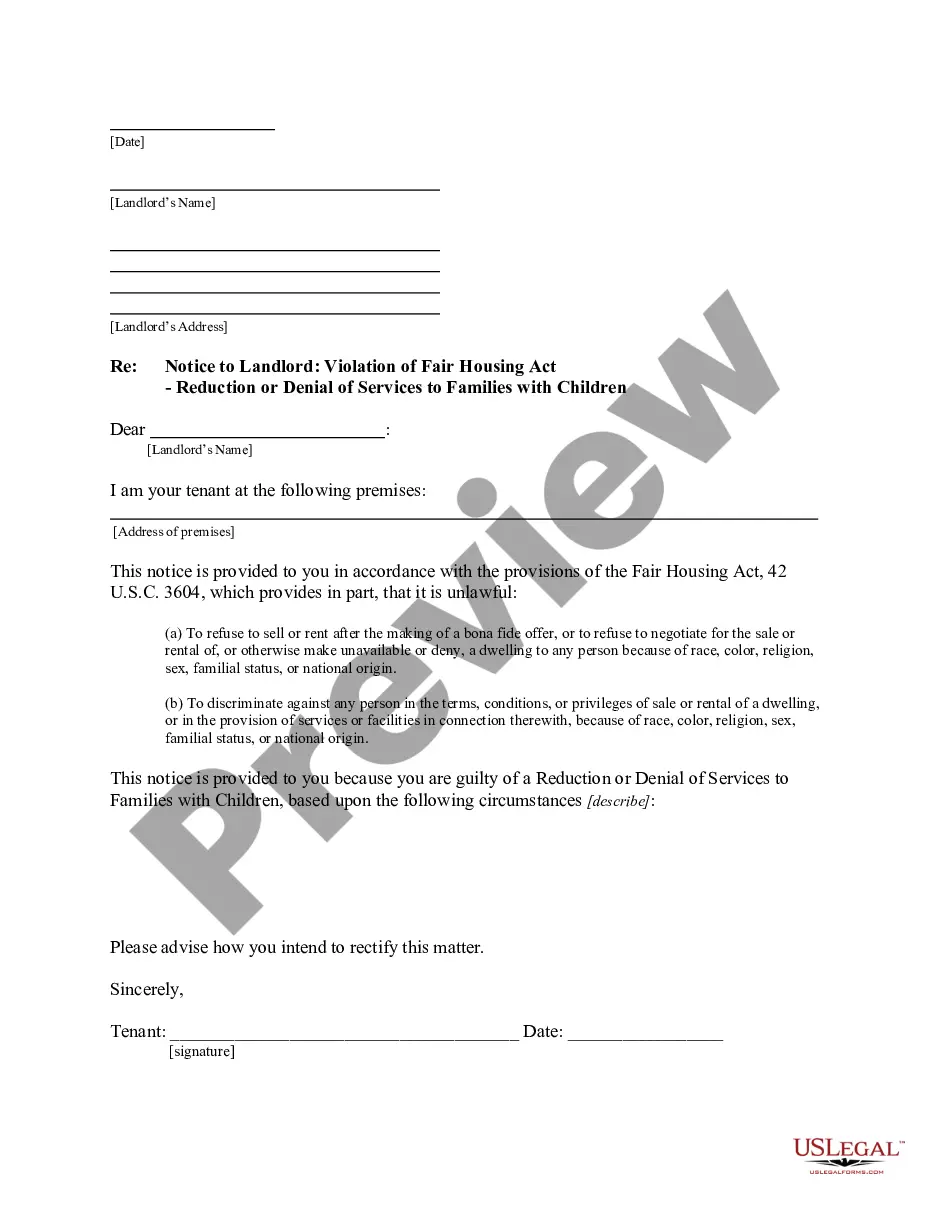
Connecticut Letter from Tenant to Landlord about Fair Housing Reduction or Denial of services to Family with Children
What is this form?
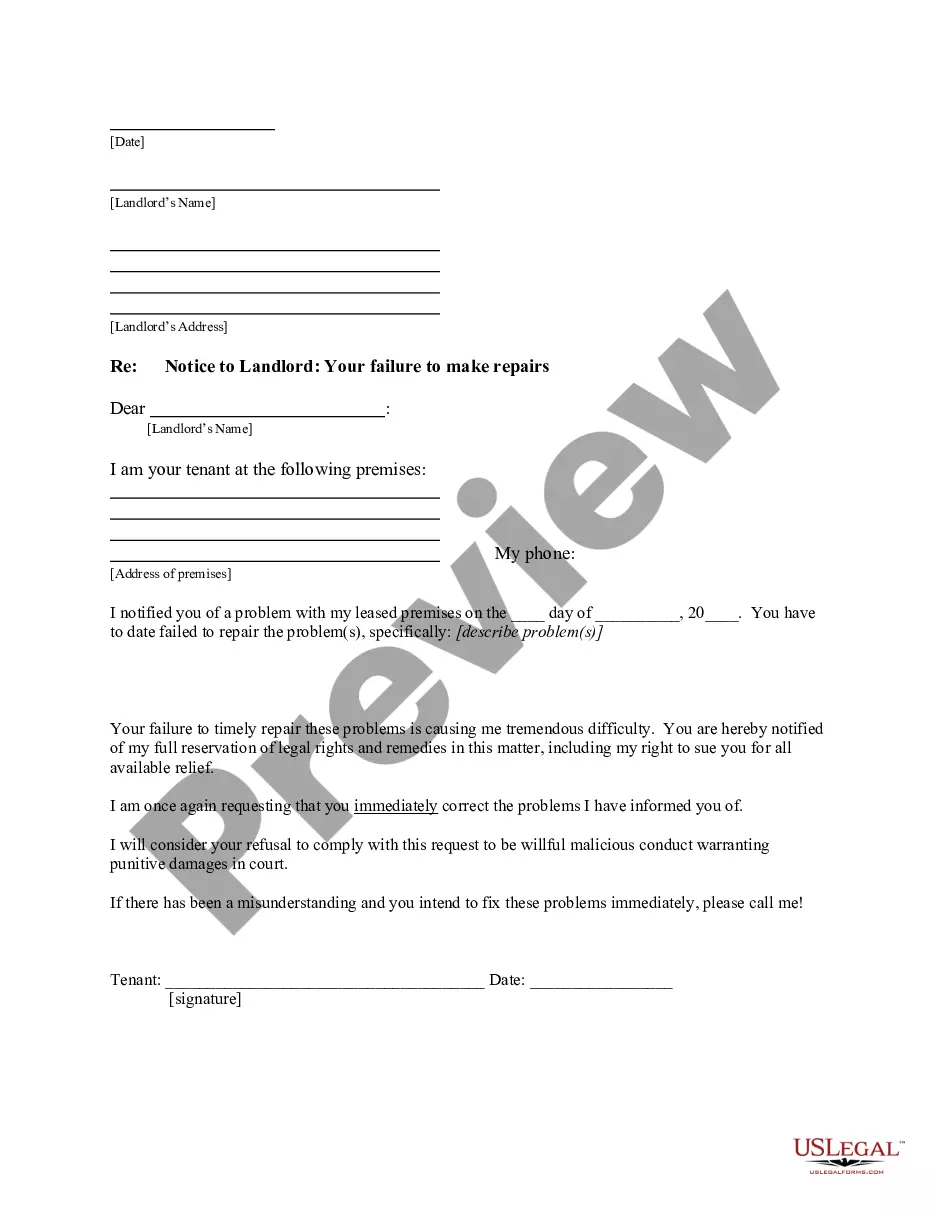
This form is a written notice from a tenant to a landlord, addressing potential violations of the Fair Housing Act due to the unfair reduction or denial of services to families with children. It serves as an important tool that informs landlords of their obligations concerning housing discrimination. By using this letter, tenants can formally document their grievances and seek resolution in a lawful manner.
Form components explained
- Identification of the landlord and tenant.
- Specific reference to the Fair Housing Act and the relevant provisions violated.
- Statement of denial or reduction of services experienced.
- Details outlining the circumstances of the alleged discriminatory act.
- A request for corrective action from the landlord.

When to use this form
This form should be used when a tenant believes that their landlord is engaging in discriminatory practices, specifically regarding services provided to families with children. Common scenarios include situations where families are denied access to amenities, or when adjustments in leasing terms negatively impact families due to their familial status.
Who this form is for
- Tenants who are experiencing discrimination based on familial status.
- Families with children seeking to address unfair treatment concerning housing services.
- Individuals intending to document grievances for potential legal action.
Instructions for completing this form
- Identify and enter the names and contact information of both the tenant and landlord.
- Clearly state the nature of the discrimination experienced and reference the applicable Fair Housing Act provisions.
- Describe the specific actions taken by the landlord that constitute a reduction or denial of services.
- Include a request for the landlord to remedy the situation, specifying what corrective actions are sought.
- Sign and date the letter before sending it to the landlord to ensure the notice is valid.
Notarization guidance
This form does not typically require notarization unless specified by local law.
Get your form ready online
Our built-in tools help you complete, sign, share, and store your documents in one place.
Make edits, fill in missing information, and update formatting in US Legal Forms—just like you would in MS Word.
Download a copy, print it, send it by email, or mail it via USPS—whatever works best for your next step.
Sign and collect signatures with our SignNow integration. Send to multiple recipients, set reminders, and more. Go Premium to unlock E-Sign.
If this form requires notarization, complete it online through a secure video call—no need to meet a notary in person or wait for an appointment.
We protect your documents and personal data by following strict security and privacy standards.

Make edits, fill in missing information, and update formatting in US Legal Forms—just like you would in MS Word.

Download a copy, print it, send it by email, or mail it via USPS—whatever works best for your next step.

Sign and collect signatures with our SignNow integration. Send to multiple recipients, set reminders, and more. Go Premium to unlock E-Sign.

If this form requires notarization, complete it online through a secure video call—no need to meet a notary in person or wait for an appointment.

We protect your documents and personal data by following strict security and privacy standards.
Common mistakes to avoid
- Failing to clearly specify the discriminatory actions taken by the landlord.
- Not referencing specific provisions of the Fair Housing Act that apply to the situation.
- Neglecting to sign and date the letter.
Benefits of using this form online
- Easy access to downloadable templates crafted by licensed attorneys.
- Editable forms that allow customization to your specific circumstances.
- Instantly printable for immediate use, ensuring timely communication with your landlord.
- The Fair Housing Act prohibits discrimination in housing based on familial status.
- This form can serve as crucial documentation if disputes escalate to legal claims.
- It is advisable to keep a copy for personal records in case further action is necessary.
Looking for another form?
Form popularity
FAQ
Under the Fair Housing Act, various discriminatory actions are considered illegal, such as refusing to rent to families with children. Additionally, discriminatory advertising, setting different rental terms, or evicting tenants based on family status are also prohibited. Understanding these illegal actions can help protect your rights as a tenant. A Connecticut Letter from Tenant to Landlord about Fair Housing Reduction or Denial of services to Family with Children can assist in addressing such issues appropriately.
To file a fair housing complaint in Connecticut, you can start by contacting the Connecticut Commission on Human Rights and Opportunities (CHRO). Fill out a complaint form that outlines your experiences and provides evidence of discrimination. It can be helpful to support your complaint with a Connecticut Letter from Tenant to Landlord about Fair Housing Reduction or Denial of services to Family with Children to clearly articulate your situation.
The most common fair housing complaints often relate to discrimination against families with children. Many landlords mistakenly believe they can restrict housing access based on family size or the presence of children. This understanding is key for tenants to assert their rights. A Connecticut Letter from Tenant to Landlord about Fair Housing Reduction or Denial of services to Family with Children can address these common issues directly.
In Connecticut, fair housing rules prohibit discrimination based on protected classes, including family status. Landlords must provide equal access to housing, and they cannot deny services to families with children. Understanding these laws can empower tenants to stand up against discrimination. Utilizing a Connecticut Letter from Tenant to Landlord about Fair Housing Reduction or Denial of services to Family with Children can be crucial in addressing violations.
Proving housing discrimination can involve several steps. First, gather all relevant documentation, such as emails or letters that show the discrimination. Next, find witnesses who can support your claim, and keep a record of any incidents where you believe you were treated unfairly. Using a Connecticut Letter from Tenant to Landlord about Fair Housing Reduction or Denial of services to Family with Children can help articulate your concerns effectively.
In Connecticut, housing discrimination laws protect individuals from being discriminated against based on familial status, among other factors. Landlords cannot refuse services or make housing decisions that unfairly disadvantage families with children. Understanding these laws is essential, and utilizing a Connecticut Letter from Tenant to Landlord about Fair Housing Reduction or Denial of services to Family with Children can effectively address any violations.
A professional letter should maintain a respectful tone while clearly stating your requests or concerns. Start with your contact information, the date, and your landlord’s contact details. Make sure to include any pertinent information, especially if it relates to the Connecticut Letter from Tenant to Landlord about Fair Housing Reduction or Denial of services to Family with Children, as this shows you are informed about your rights.
To create a powerful complaint letter, start by outlining the complaint clearly, including all relevant details. Use a calm and respectful tone while emphasizing the impact of the situation on your family. Citing the Connecticut Letter from Tenant to Landlord about Fair Housing Reduction or Denial of services to Family with Children helps frame your complaint within a legal context, enhancing its seriousness.
When writing a letter about problems you're facing, be direct and specific about each issue. List the problems in a logical order and describe how they affect your living situation and family, if applicable. This aligns with the Connecticut Letter from Tenant to Landlord about Fair Housing Reduction or Denial of services to Family with Children. Providing clear details will help your landlord respond promptly.
Begin your dispute letter by addressing the specific issue you want to contest and providing evidence or dates related to your disagreement. Your tone should remain professional while clearly stating your expectations. You may also want to mention the guidelines under the Connecticut Letter from Tenant to Landlord about Fair Housing Reduction or Denial of services to Family with Children, as this may strengthen your position.