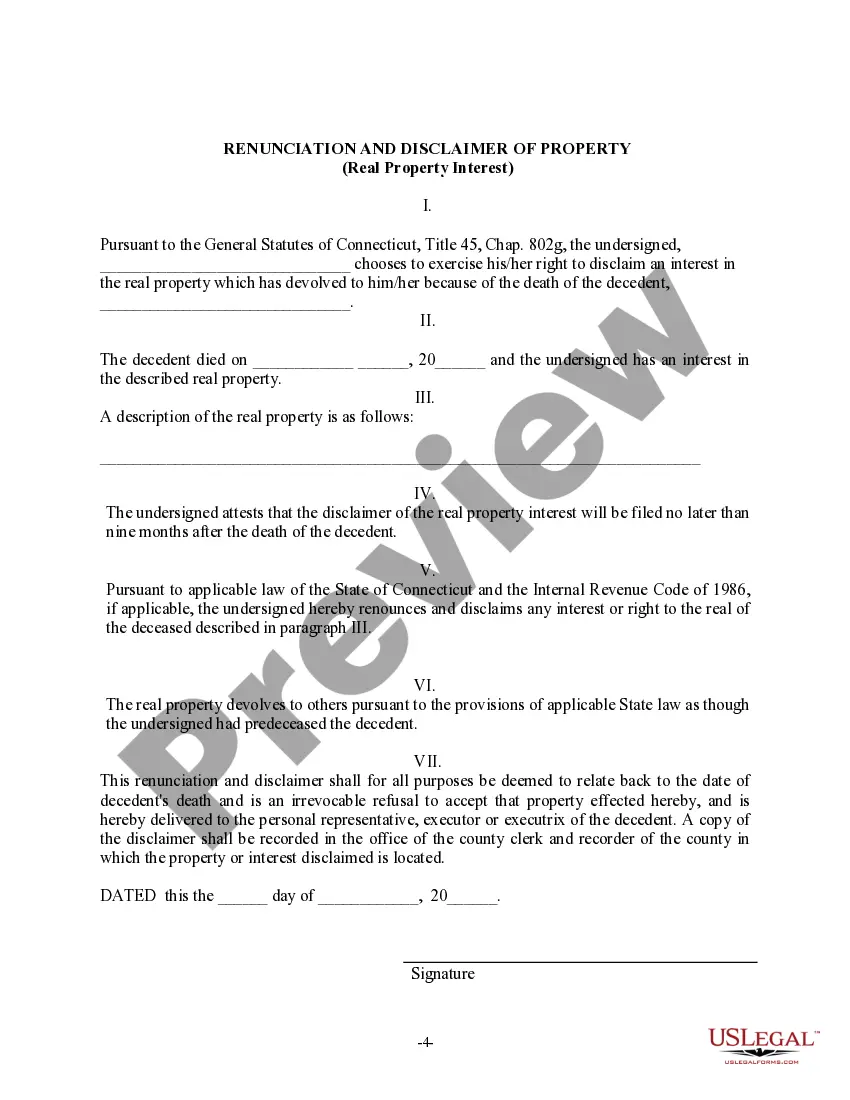
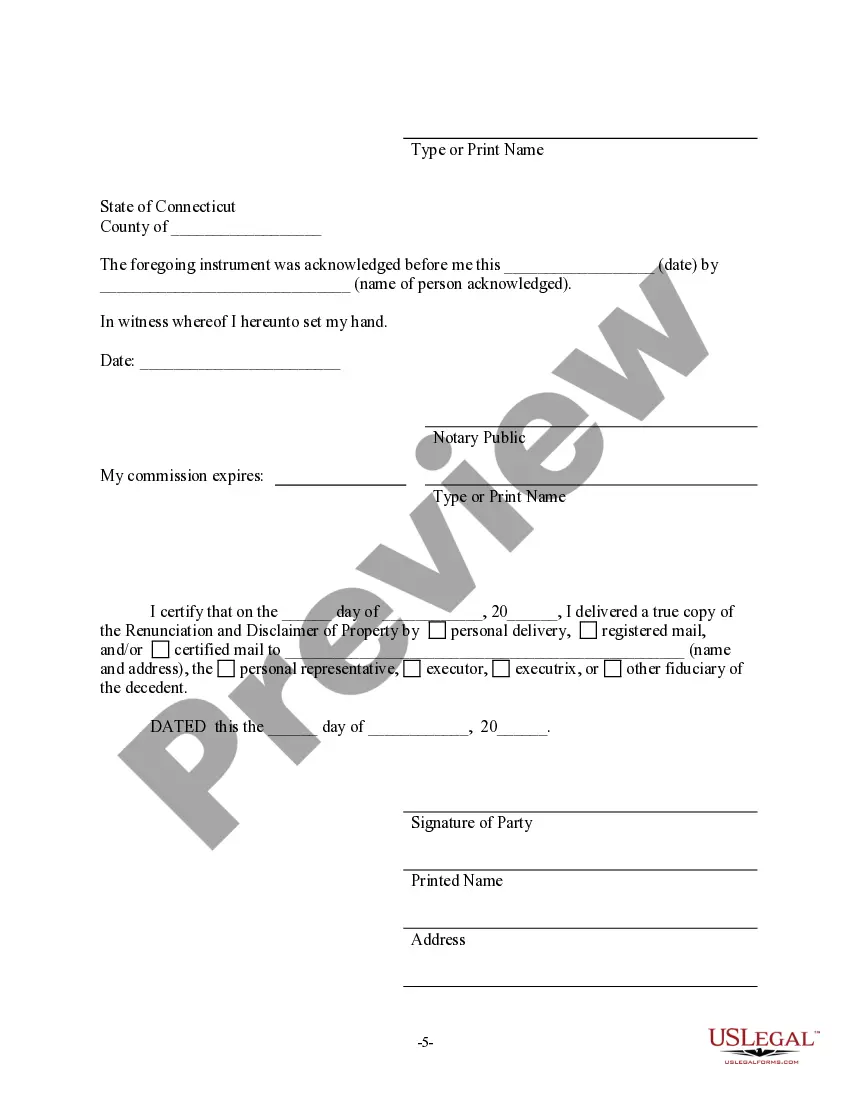
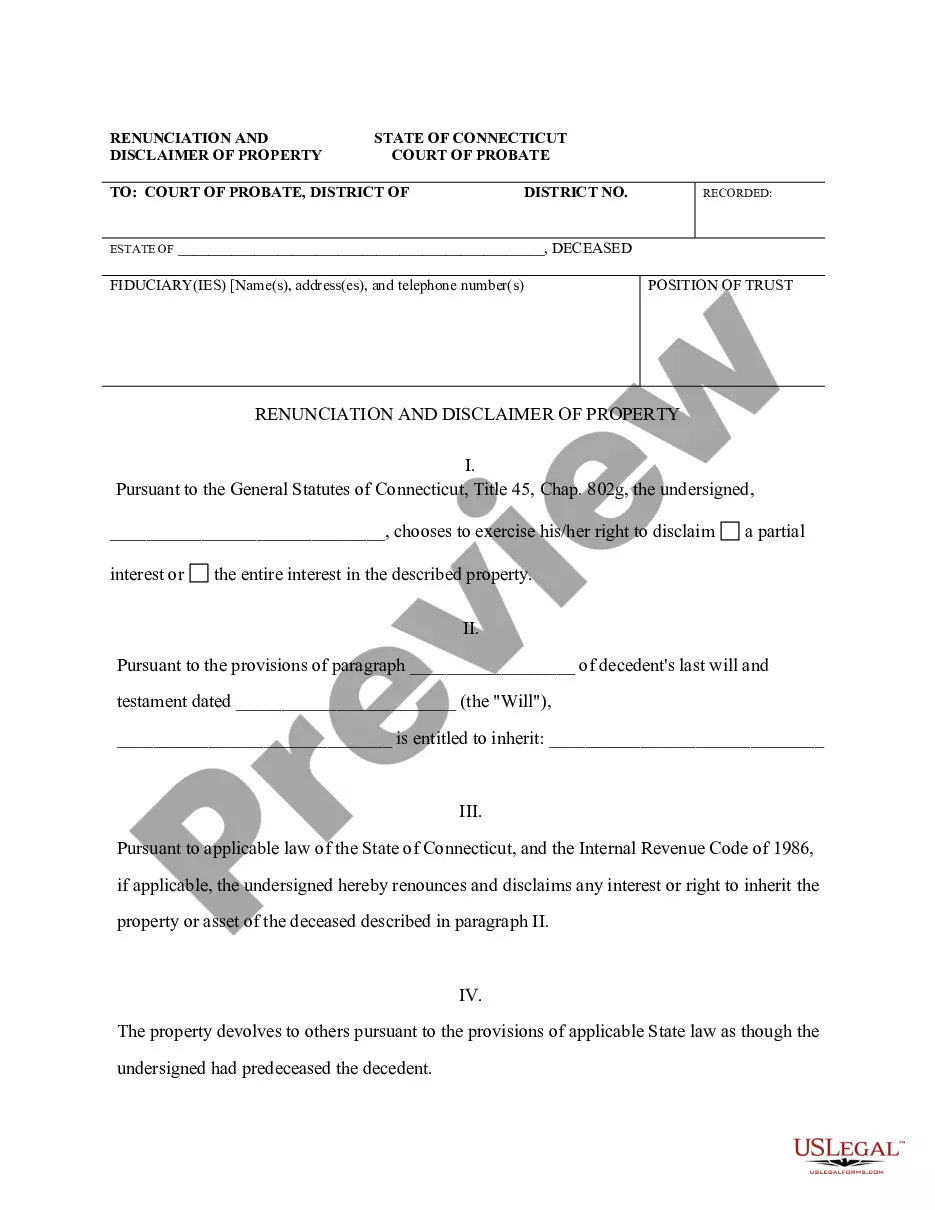
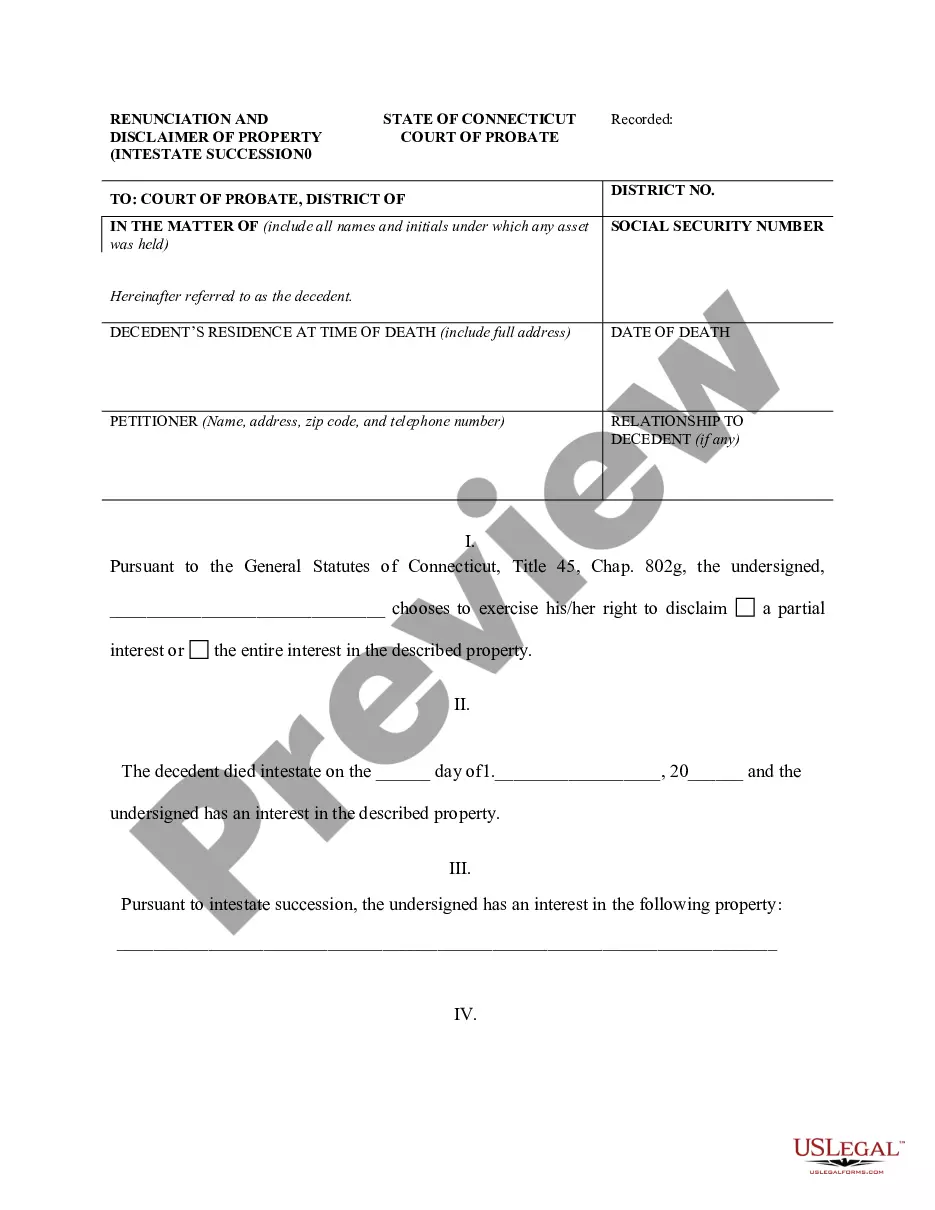
Connecticut Renunciation And Disclaimer of Real Property Interest
GENERAL STATUTES OF CONNECTICUT
TITLE 45a PROBATE COURTS AND PROCEDURE
CHAPTER 802g* DISCLAIMER OF PROPERTY
Construction of chapter. Definitions.
(a) The provisions of sections 45a-578 to 45a-585, inclusive,
shall be liberally construed to promote their underlying purpose and policy
of readily permitting the disclaimer of interests.
(b) As used in said sections, (1) the term "nontestamentary instrument"
includes, but is not limited to, a trust other than a trust created under
a will, an annuity, a policy of life, health or accident insurance, a bank
account or any contract or other document naming another party as beneficiary
thereof whether such beneficiary takes by survivorship, payment on death
or outright grant, but does not include a will; (2) the term "interest"
means any interest in property, real or personal, including any power whether
granted by instrument or by law, even if held in a fiduciary capacity;
(3) the term "will" includes all codicils thereto; and (4) the terms "joint
tenancy", "joint tenant" and "joint tenants" have the same meaning and
effect as provided in sections 47-14a to 47-14k, inclusive.
(c) A disclaimer which complies with the requirements of said sections
is irrevocable.
Title 45a, Chap. 802g*, Sec. 45a-578. (Formerly Sec. 45-299).
(1972, P.A. 62, S. 13; P.A. 81-396, S. 7; P.A. 97-189, S. 1; 97-246,
S. 98, 99.)
History: P.A. 81-396 added provision requiring liberal construction,
amended definition of "nontestamentary instrument" as trust "other than
a trust created under a will" or outright grant, added definition of "interest"
and provided that disclaimer in compliance with requirements of chapter
is irrevocable; Sec. 45-299 transferred to Sec. 45a-578 in 1991; P.A. 97-189
amended Subsec. (b) by redefining "interest" and defining "will", "joint
tenancy", "joint tenant" and "joint tenants"; P.A. 97-246 made P.A. 97-189
effective October 1, 1997 and applicable to disclaimers delivered on or
after said date and transfers affected by such disclaimers, effective June
27, 1997. Annotation to former section 45-299: Subsec. (a): Cited. 211
C. 323, 329, 330.
Disclaimer of property in decedent's estate. Time limitation.
Effect of disclaimer.
(a) An heir, next of kin, devisee, legatee, person succeeding
to a disclaimed interest, beneficiary under a will, trustee, donee of a
power of appointment granted by a will, appointee under a power of appointment
exercised by a will, or any other recipient of an interest, may disclaim
in whole or in part any interest under a will or any interest passing by
intestacy by delivering a written disclaimer in the manner hereinafter
provided.
(b)
(1) A guardian or conservator of the estate of a minor
or incapable person, an executor, administrator or other personal representative
of the estate of a decedent, if such fiduciary is not authorized by will
to disclaim, or a trustee under a will or nontestamentary trust instrument
which does not authorize such trustee to disclaim, may with approval of
any probate court having jurisdiction under subdivision (3) of this subsection,
disclaim on behalf of such minor, incapable person, decedent, decedent's
estate, or trust, within the same time and in the same manner as could
a capable person.
(2) If the will under which an executor, administrator or other
personal representative of the estate of a decedent or the will or trust
instrument under which a trustee of a testamentary or nontestamentary trust
is acting authorizes such fiduciary to disclaim and does not expressly
require Probate Court approval of a disclaimer, such fiduciary may disclaim
on behalf of such decedent, estate or trust within the same time and in
the same manner as could a capable person and need not seek approval of
the Probate Court for such disclaimer, provided such fiduciary may petition
any probate court having jurisdiction under subdivision (3) of this subsection
for authority to disclaim.
(3) A guardian or conservator of the estate of a minor or incapable
person, an executor, administrator or other personal representative of
the estate of a decedent, or a trustee under a will or a nontestamentary
trust instrument may file a petition requesting authority to disclaim an
interest under a will or passing by intestacy in the probate court having
jurisdiction over such disclaiming fiduciary, and if there is no such court
in this state, in the probate court for any district (A) having jurisdiction
over the estate or trust from which the interest to be disclaimed is derived,
(B) where such disclaiming fiduciary, if not a natural person, has a place
of business, (C) where the testator or intestate person from whom the interest
to be disclaimed derives resided at the time of death, (D) where the settlor
of the disclaiming trust resided at the time of its creation, resided at
the time of such settlor's death or resides at the time of such petition
or, (E) where the disclaiming fiduciary or any beneficiary of the disclaiming
estate or trust resides. The Probate Court shall have jurisdiction over
proceedings for authority to disclaim as provided for in this subdivision.
A petition requesting authority to disclaim by a fiduciary of an estate
or trust not otherwise subject to the jurisdiction of the Probate Court
shall not subject such estate or trust or its fiduciary to the continuing
jurisdiction of the Probate Court.
(c) The disclaimer shall (1) describe the interest disclaimed, (2)
be executed by the disclaimant in the manner provided for the execution
of deeds of real property either by the laws of this state or by the laws
of the place of execution, and (3) declare the disclaimer and the extent
thereof.
(d) A disclaimer under this section shall be effective if made in
the following manner:
(1) A disclaimer of a present interest shall be delivered
not later than the date which is nine months after the later of: (A) The
death of the decedent or the donee of the power or, (B) if the disclaimer
is made by or on behalf of a natural person, the day on which such person
attains the age of eighteen years, or, if such person does not survive
to the age of eighteen years, the day on which such person dies;
(2) a disclaimer of a future interest shall be delivered not later
than the date which is nine months after the later of:
(A) The event that determines that the taker of the
interest is finally ascertained and such interest is indefeasibly vested
or,
(B) if the disclaimer is made by or on behalf of a natural person,
the day on which such person attains the age of eighteen years, or, if
such person does not survive to the age of eighteen years, the day on which
such person dies;
(3) the disclaimer shall be delivered to the legal representative of
the estate of the decedent or deceased donee of the power or the holder
of the legal title to the property to which the interest relates; and
(4) if an interest in real property is disclaimed, a copy of such
disclaimer shall also be recorded in the office of the town clerk of the
town in which the real property is situated within such nine-month period,
and, if a copy of such disclaimer is not so recorded, it shall be ineffective
against any person other than the disclaimant, or the person on whose behalf
such disclaimer is made, but only as to such real property interest. Although
not a condition to disclaimer, if within such nine-month period, a copy
of such disclaimer and a receipt therefor, executed by such legal representative
or such holder of legal title in the same manner as provided for the disclaimer,
are filed in the probate court having jurisdiction over the estate of the
decedent or deceased donee, such action shall constitute conclusive evidence
of timely disclaimer.
(e) If a disclaimer is made pursuant to this section, the interest
disclaimed shall devolve as follows:
(1) If the deceased owner or donee of a power of appointment
has provided for another disposition in the event of a disclaimer, the
interest disclaimed shall devolve as provided in the will in the event
of a disclaimer.
(2) If the deceased owner or donee of a power of appointment has
not provided for another disposition in the event of a disclaimer,
the interest disclaimed shall devolve as follows:
(A) If the disclaimant is a natural person acting for himself
or herself, the interest disclaimed shall devolve as if the disclaimant
had predeceased the deceased owner or the donee of the power of appointment,
as the case may be.
(B) If the disclaimant is acting on behalf of a natural person,
as attorney-in-fact, guardian, conservator or other personal representative,
the interest disclaimed shall devolve as if the person on whose behalf
the disclaimer is made had predeceased the deceased owner or the donee
of the power of appointment, as the case may be.
(C) If the disclaimant is an executor, administrator or other personal
representative acting on behalf of a deceased person, the interest disclaimed
shall devolve as if the deceased person on whose behalf the disclaimer
is made had predeceased the deceased owner or the donee of the power of
appointment, as the case may be.
(D) If the disclaimant is an executor, administrator or other personal
representative acting on behalf of an estate, the disclaimed interest,
other than an interest that is a fiduciary power, shall devolve as if the
disposition to the estate were ineffective.
(E) If the disclaimant is the trustee of a trust or is a corporation,
partnership, limited liability company, foundation, or other entity, the
disclaimed interest, other than an interest that is a fiduciary power,
shall devolve as if the disposition to the trust or entity were ineffective.
(F) If the disclaimant is an executor, administrator, trustee, or
other personal representative and the interest disclaimed is a fiduciary
power, the effect of such disclaimer shall be as follows: (i) If the disclaimer
is made by all of the acting fiduciaries for themselves and on behalf of
all successor fiduciaries, then the disclaimed fiduciary power shall be
treated, for all current acting fiduciaries and for all successor fiduciaries,
as if such fiduciary power never existed; (ii) if the disclaimer is made
by a fiduciary for such fiduciary alone but not on behalf of other or successor
fiduciaries, then the disclaimed fiduciary power shall be treated, as to
such disclaiming fiduciary, as if such fiduciary power never existed; however,
such fiduciary power shall continue to be exercisable by any fiduciary
who has not disclaimed such power and by all successor fiduciaries.
(3) If a disclaimer is addressed to an interest disposed of by a particular
provision of a will, then the interest disclaimed shall devolve pursuant
to subdivisions (1) and (2) of subsection (e) of this section, but only
for purposes of such provision, and such interest may devolve to or for
the benefit of the disclaimant, or the person, estate, trust, corporation,
partnership, limited liability company, foundation, or other entity on
whose
behalf the disclaimer is made, under other provisions of such will, by
intestacy or otherwise.
(4) Any future interest that takes effect in possession or enjoyment
at or after the termination, whether by death or otherwise, of the interest
disclaimed shall, unless otherwise provided in the will, take effect, (A)
in the case of a disclaimer by or on behalf of a natural person,
as if the disclaimant or the person on whose behalf the disclaimer is made
had predeceased the deceased owner or the donee of the power, as the case
may be, or, (B) in the case of a disclaimer on behalf of a trust, estate,
corporation, partnership, limited liability company, foundation, or other
entity, as if the disposition to such entity were ineffective.
(5) A disclaimer shall relate back for all purposes to the date
of death of the deceased owner or of the donee of the power of appointment.
(f) In a case in which the estate of a decedent receives a settlement
in a wrongful death action and a beneficiary of the estate dies intestate
within seven months of the prior decedent, and such beneficiary's estate
receives some part of such settlement, subsection (d) shall be waived,
and the interest of the beneficiary may be disclaimed without being subject
to a nine-month disclaimer period, provided such disclaimer is made on
or before December 1, 1997.
Title 45a, Chap. 802g*, Sec. 45a-579. (Formerly Sec. 45-300).
(1972, P.A. 62, S. 1; P.A. 80-476, S. 340; P.A. 81-396, S. 8; P.A.
82-472, S. 126, 183; P.A. 97-189, S. 2; 97-243, S. 65, 67; 97-246, S. 98,
99.)
History: P.A. 80-476 rearranged provisions and divided section
into Subsecs.; P.A.
81-396 rephrased Subsecs. (a) to (c) and added Subsecs. (d) and
(e) containing requirements for effective disclaimer and provisions governing
disposition of disclaimer upon decease of owner or donee of power of appointment;
P.A. 82-472 made technical change in Subsec. (d); Sec. 45-300 transferred
to Sec. 45a-579 in 1991; P.A. 97-189 rephrased section; P.A. 97-243 added
new Subsec. (f) re waiver when beneficiary dies intestate within seven
months of prior decedent, effective June 24, 1997; P.A. 97-246 made P.A.
97-189 effective October 1, 1997, and applicable to disclaimers delivered
on or after said date and transfers affected by such disclaimers, effective
June 27, 1997. Annotations to former section 45-300:
Subsec. (b): Cited. 211 C. 323?325. Subsec. (e): Cited. 211
C. 323, 325.
Right to disclaim barred, when. Binding effect of disclaimer
or waiver.
(a) The right to disclaim an interest is barred by any:
(1) Assignment, conveyance, encumbrance, pledge or transfer of the interest
or any part thereof, (2) written waiver of the right to disclaim such interest,
(3) acceptance of such interest or any of its benefits, provided for such
purpose a fiduciary power shall not be deemed accepted unless it has been
exercised, (4) sale of such interest under judicial sale, made before the
disclaimer is effected, or (5) failure by the owner of the equity of redemption
in such interest in real property to redeem pursuant to a judgment of strict
foreclosure.
(b) The right to disclaim shall exist notwithstanding any limitation
on the interest of the disclaimant in the nature of a spendthrift provision
or similar restriction.
(c) A disclaimer or a written waiver of the right to disclaim, shall
be binding upon the disclaimant or person waiving and all parties claiming
by, through or under such disclaimant or person.
Title 45a, Chap. 802g*, Sec. 45a-580. (Formerly Sec. 45-303).
(1972, P.A. 62, S. 4; P.A. 80-476, S. 342; P.A. 81-396, S. 10;
P.A. 97-189, S. 3; 97-246, S. 98, 99.)
History: P.A. 80-476 divided section into Subsecs., revising Subdiv.
indicators accordingly and substituted "chapter" for "section" in Subsec.
(c); P.A. 81-396 restated previous provisions in simpler language; Sec.
45-303 transferred to Sec. 45a-580 in 1991. P.A. 97-189 amended Subsec.
(a) by adding provision to Subdiv. (3) re fiduciary power not deemed accepted
unless exercised and added new Subdiv. (5) re failure of owner to redeem
pursuant to judgment of strict foreclosure; P.A. 97-246 made P.A. 97-189
effective October 1, 1997, and applicable to disclaimers delivered on or
after said date and transfers affected by such disclaimers, effective June
27, 1997. Annotations to former section 45-303: Cited. 179 C. 463,
466?468. Is not exclusive list of bars to disclaimers. 211 C. 323, 329,
330.
Right to disclaim under other law.
The a-585, inclusive, shall not abridge the
right of any person to assign, convey, release, renounce or disclaim under
any other statute or under common law. The enactment of said sections shall
not be construed as an impairment of the validity of a partial or complete
disclaimer, (1) whether or not such disclaimer was made prior to October
1, 1981, or (2) with respect to a disclaimer of an interest in joint tenancy
real property, whether such disclaimer was or is made under any other statute
or common law before, on or after October 1, 1997.
Title 45a, Chap. 802g*, Sec. 45a-581. (Formerly Sec. 45-304).
(1972, P.A. 62, S. 5; P.A. 81-396, S. 12; P.A. 97-189, S. 4; 97-246,
S. 98, 99.)
History: P.A. 81-396 deleted provisions re right of person to renounce
property and disclaimers under a testamentary instrument and substituted
"October 1, 1981" for "April 20, 1972"; Sec. 45-304 transferred to Sec.
45a-581 in 1991; P.A. 97-189 deleted "any interest arising" and substituted
"or disclaim", designated existing provision re disclaimer made prior to
October 1, 1981, as Subdiv. (1) and added Subdiv. (2) re disclaimer of
interest in joint tenancy made before, on or after October 1, 1997; P.A.
97-246 made P.A. 97-189 effective October 1, 1997 and applicable to disclaimers
delivered on or after said date and transfers affected by such disclaimers,
effective June 27, 1997.
Prior interests.
An interest that exists on October 1, 1981,
as to which, if a present interest, the time for delivering a disclaimer
under section 45a-562, subsections (3) and (35) of section 45a-234, subsections
(4) and (19) of section 45a-235, and sections 45a-578 to 45a-584, inclusive,
has not expired or, if a future interest, the interest has not become indefeasibly
vested or the taker finally ascertained, may be disclaimed within nine
months after October 1, 1981.
Title 45a, Chap. 802g*, Sec. 45a-582. (Formerly Sec. 45-305).
(1972, P.A. 62, S. 6; P.A. 80-476, S. 343; P.A. 81-396, S. 11;
P.A. 95-117, S. 26.) History: P.A. 80-476 made minor changes in wording
but made no substantive changes; P.A. 81-396 replaced previous provisions;
Sec. 45-305 transferred to Sec. 45a-582 in 1991; P.A. 95-117 deleted reference
to Subsec. (d) of Sec. 45a-549.
Disclaimer of property passing under nontestamentary instrument.
Time limitation. Effect of disclaimer.
(a) A grantee, donee, joint-tenant of personal property
or real property, person succeeding to a disclaimed interest, beneficiary
under a nontestamentary instrument, trustee, donee of a power of appointment
granted by a nontestamentary instrument, or an appointee under a power
of appointment exercised by a nontestamentary instrument or any other recipient
of an interest may disclaim in whole or, except as provided in subsection
(f) of this section, in part any interest under a nontestamentary instrument
by delivering a written disclaimer in the manner hereinafter provided.
(b)
(1) A guardian or conservator of the estate of a minor
or incapable person, an executor, administrator or other personal representative
of the estate of a decedent, if such fiduciary is not authorized by will
to disclaim, or a trustee under a will or nontestamentary trust instrument
which does not authorize such trustee to disclaim, may, with approval of
any probate court having jurisdiction under subdivision (3) of this subsection,
disclaim on behalf of such minor, incapable person, decedent, decedent's
estate, or trust, within the same time and in the same manner as could
a capable person.
(2) If the will under which an executor, administrator or other
personal representative of the estate of a decedent or the will or trust
instrument under which a trustee of a testamentary or nontestamentary trust
is acting authorizes such fiduciary to disclaim and does not expressly
require Probate Court approval of a disclaimer, such fiduciary may disclaim
on behalf of such decedent, estate or trust within the same time and in
the same manner as could a capable person and need not seek approval of
the Probate Court for such disclaimer, provided such fiduciary may petition
any probate court having jurisdiction under subdivision (3) of this subsection
for authority to disclaim.
(3) A guardian or conservator of the estate of a minor or incapable
person, an executor,administrator or other personal representative of the
estate of a decedent, or a trustee under a will or a nontestamentary trust
instrument may file a petition requesting authority to disclaim an interest
under a nontestamentary instrument in the probate court having jurisdiction
over such disclaiming fiduciary, and if there is no such court in this
state, in the Probate Court for any district, (A) where such disclaiming
fiduciary, if not a natural person, has a place of business, (B) where
the creator of the interest resided at the time of its creation, resided
at the time of such creator's death or resides at the time of such petition,
(C) where the settlor of the disclaiming trust resided at the time of its creation, resided at the time of such settlor's death
or resides at the time of such petition, or (D) where the disclaiming fiduciary
or any beneficiary of the disclaiming estate or trust resides. The Probate
Court shall have jurisdiction over proceedings for authority to disclaim
as provided for in this subdivision. A petition requesting authority to
disclaim by a fiduciary of an estate or trust not otherwise subject to
the jurisdiction of the Probate Court shall not subject such estate or
trust or its fiduciary to the continuing jurisdiction of the Probate Court.
(c) The disclaimer shall (1) describe the interest therein disclaimed,
(2) be executed by the disclaimant in the manner provided for the execution
of deeds of real property either by the laws of this state or by the laws
of the place of execution, and (3) declare the disclaimer and the extent
thereof.
(d) A disclaimer under this section shall be effective if made in
the following manner:
(1) A disclaimer of a present interest shall be delivered
not later than the date which is nine months after the later of (A) the
effective date of the nontestamentary instrument or, (B) if the disclaimer
is made by or on behalf of a natural person, the day on which such person
attains the age of eighteen years or, if such person does not survive to
the age of eighteen years, the day on which such person dies.
(2) A disclaimer of a future interest shall be delivered not later
than the date which is nine months after the later of (A) the event determining
that the taker of the interest is finally ascertained and such interest
is indefeasibly vested or (B) if the disclaimer is made by or on behalf
of a natural person, the day on which such person attains the age of eighteen
years or, if such person does not survive to the age of eighteen years, the
day on which such person dies.
(3) If the disclaimant, or the person on whose behalf the disclaimer
is made, does not have actual knowledge of the existence of the interest,
the disclaimer shall be delivered not later than the date which is nine
months after the later of (A) the date on which the disclaimant, or the
person on whose behalf the disclaimer is made, first has actual knowledge
of the existence of the interest or (B) if the disclaimer is made by or
on behalf of a natural person, the day on which such person attains the
age of eighteen years or, if such person does not survive to the age of
eighteen years, the day on which such person dies.
(4) The disclaimer shall be delivered to the transferor of the interest,
his legal representative or the holder of the legal title to the property
to which such interest relates.
(5) If an interest in real property is disclaimed, a copy of such
disclaimer shall also be recorded in the office of the town clerk in which
the real property is situated within such nine-month period, and if a copy
of such disclaimer is not so recorded, it shall be ineffective against
any person other than the disclaimant, or the person on whose behalf
such disclaimer is made, but only as to such real property interest. For
the purposes of this section, the effective date of a nontestamentary instrument
is the date on which the maker no longer has power to revoke it or to transfer
to the maker or another the entire legal and equitable ownership of the
interest.
(e) Except as otherwise provided in subsection (f) of this section,
if a disclaimer is made pursuant to this section, the interest disclaimed
shall devolve as follows:
(1) If the nontestamentary instrument provides for another
disposition in the event of a disclaimer, the interest disclaimed shall
devolve as provided in the nontestamentary instrument in the event of a
disclaimer.
(2) If the nontestamentary instrument does not provide for another
disposition in the event of a disclaimer, the interest disclaimed shall
devolve as follows:
(A) If the disclaimant is a natural person acting for himself
or herself, the interest disclaimed shall devolve as if the disclaimant
had died immediately before the effective date of such nontestamentary
instrument.
(B) If the disclaimant is acting on behalf of a natural person,
as attorney-in-fact, guardian, conservator or other personal representative,
the interest disclaimed shall devolve as if the person on whose behalf
the disclaimer is made had died immediately before the effective date of
such nontestamentary instrument.
(C) If the disclaimant is an executor, administrator or other personal
representative acting on behalf of a deceased person, the interest disclaimed
shall devolve as if the deceased person on whose behalf the disclaimer
is made had died immediately before the effective date of such nontestamentary
instrument.
(D) If the disclaimant is an executor, administrator or other personal
representative acting on behalf of an estate, the interest disclaimed shall
devolve as if the disposition to the estate were ineffective.
(E) If the disclaimant is the trustee of a trust or is a corporation,
partnership, limited liability company, foundation, or other entity, the
disclaimed interest, other than an interest that is a fiduciary power,
shall devolve as if the disposition to the trust or entity
were ineffective.
(F) If the disclaimant is a trustee and the interest disclaimed
is a fiduciary power, the effect of such disclaimer shall be as follows:
(i) If the disclaimer is made by all of the acting trustees for themselves
and on behalf of all successor trustees, then the disclaimed fiduciary
power shall be treated, for all current acting trustees and for all successor
trustees, as if such fiduciary power never existed; (ii) if the disclaimer
is made by a trustee for such trustee alone but not on behalf of other
or successor trustees, then the disclaimed fiduciary power shall be treated,
as to such disclaiming trustee, as if such fiduciary power never existed;
however, such fiduciary power shall continue to be exercisable by any trustee
who has not disclaimed such power and by all successor trustees.
(3) If a disclaimer is addressed to an interest disposed of by a particular
provision of a nontestamentary instrument, then the interest disclaimed
shall devolve pursuant to subdivisions (1) and (2) of this subsection,
but only for purposes of such provision, and such interest may devolve
to or for the benefit of the disclaimant, or the person, estate, trust,
corporation, partnership, limited liability company, foundation, or other
entity on whose behalf the disclaimer is made, under other provisions of
such nontestamentary instrument, by intestacy or otherwise.
(4) Any future interest that takes effect in possession or enjoyment
at or after the termination, whether by death or otherwise, of the interest
disclaimed shall, unless otherwise provided in the nontestamentary instrument,
take effect, (A) in the case of a disclaimer by or on behalf of a natural
person, as if the disclaimant or the person on whose behalf the disclaimer
is made had died immediately before the effective date of such nontestamentary
instrument or, (B) in the case of a disclaimer on behalf of a trust, estate,
corporation, partnership, limited liability company, foundation, or other
entity, as if the disposition to such entity were ineffective.
(5) A disclaimer shall relate back for all purposes to the effective
date of the nontestamentary instrument.
(f) The disclaimer of an interest in real property by a joint tenant
following the death of another joint tenant shall have the same effect
as if (1) before dying, the deceased joint tenant had severed his interest
by conveyance to, and receipt of, reconveyance from, a stranger, (2) such
severed interest of the deceased joint tenant, upon his death, had passed
in equal shares to any nondisclaiming joint tenant or joint tenants, and
(3) if there were no nondisclaiming joint tenants, as if such interest
had passed as part of the estate of the deceased joint tenant. If the disclaimed
interest is deemed to have passed to more than one surviving joint tenant,
such surviving joint tenants shall hold such disclaimed interest as tenants
in common. If two or more joint tenants survive the deceased joint tenant,
the joint tenancy interests they held prior to the death of the deceased
joint tenant shall remain joint tenancy interests as to each other. A partial
disclaimer of an interest in real property by a joint tenant shall be void.
Title 45a, Chap. 802g*, Sec. 45a-583. (Formerly Sec. 45-306).
(1972, P.A. 62, S. 7; P.A. 80-476, S. 344; P.A. 81-396, S. 9; P.A.
82-472, S. 127, 183; P.A. 97-189, S. 5, 6; 97-246, S. 98, 99.)
History: P.A. 80-476 rearranged provisions and divided section
into Subsecs.; P.A.81-396 rephrased previous provisions of Subsecs. (a)
to (c) and added Subsecs. (d) and (e) re requirements for effective disclaimer
and disposition in cases where interest devolves to disclaimant under nontestamentary
instrument; P.A. 82-472 made technical changes in Subsec. (d); Sec. 45-306
transferred to Sec. 45a-583 in 1991; P.A. 97-189 rephrased section and
added new Subsec. (f) re disclaimer of interest by joint tenant following
death of another joint tenant; P.A. 97-246 made P.A. 97-189 effective October
1, 1997, and applicable to disclaimers delivered on or after said date
and transfers affected by such disclaimers, effective June 27, 1997.
Taxation. Refund for overpayment.
Any interest, rights or powers in property,
real or personal, which have been duly disclaimed pursuant to the provisions
of sections 45a-578 to 45a-585, inclusive, shall be subject to the tax
imposed under chapter 216, and acts amendatory thereof, as if such interests
had originally passed to those receiving such interests as a result of
disclaimer. If an interest which may be disclaimed has not been disclaimed
prior to the computation or the decree provided for in subsection (b) of
section 12-367, such tax may be computed as if no possibility of disclaimer
existed. A refund for overpayment of such tax as a result of disclaimer
may be obtained if a claim for such refund is filed within the time limit
and in the manner specified in subsection (d) of section 12-367.
Title 45a, Chap. 802g*, Sec. 45a-584. (Formerly Sec. 45-312).
(1972, P.A. 62, S. 14; P.A. 81-396, S. 13.) History: P.A. 81-396
replaced provisions re computation of tax and added provision refund for
overpayment of tax; Sec. 45-312 transferred to Sec. 45a-584 in 1991. Annotations
to former section 45-312: Cited. 179 C. 463, 467. Cited. 211 C. 323, 329,
330.
Disclaimers made on or after October 1, 1981.
Validity of disclaimers made prior to October
1, 1981. The provisions of sections 45a-578 to 45a-584, inclusive, shall
apply to disclaimers made on or after October 1, 1981, provided disclaimers
respecting transfers of property made before and applicable to estates
of persons dying before October 1, 1981, shall be valid if made in accordance
with the provisions of said sections in effect on September 30, 1981, or
in accordance with other statutory or common law.
Title 45a, Chap. 802g*, Sec. 45a-585. (Formerly Sec. 45-311a).
(P.A. 83-520, S. 9.)