Arizona Quitclaim Deed from Corporation to Two Individuals
Overview of this form
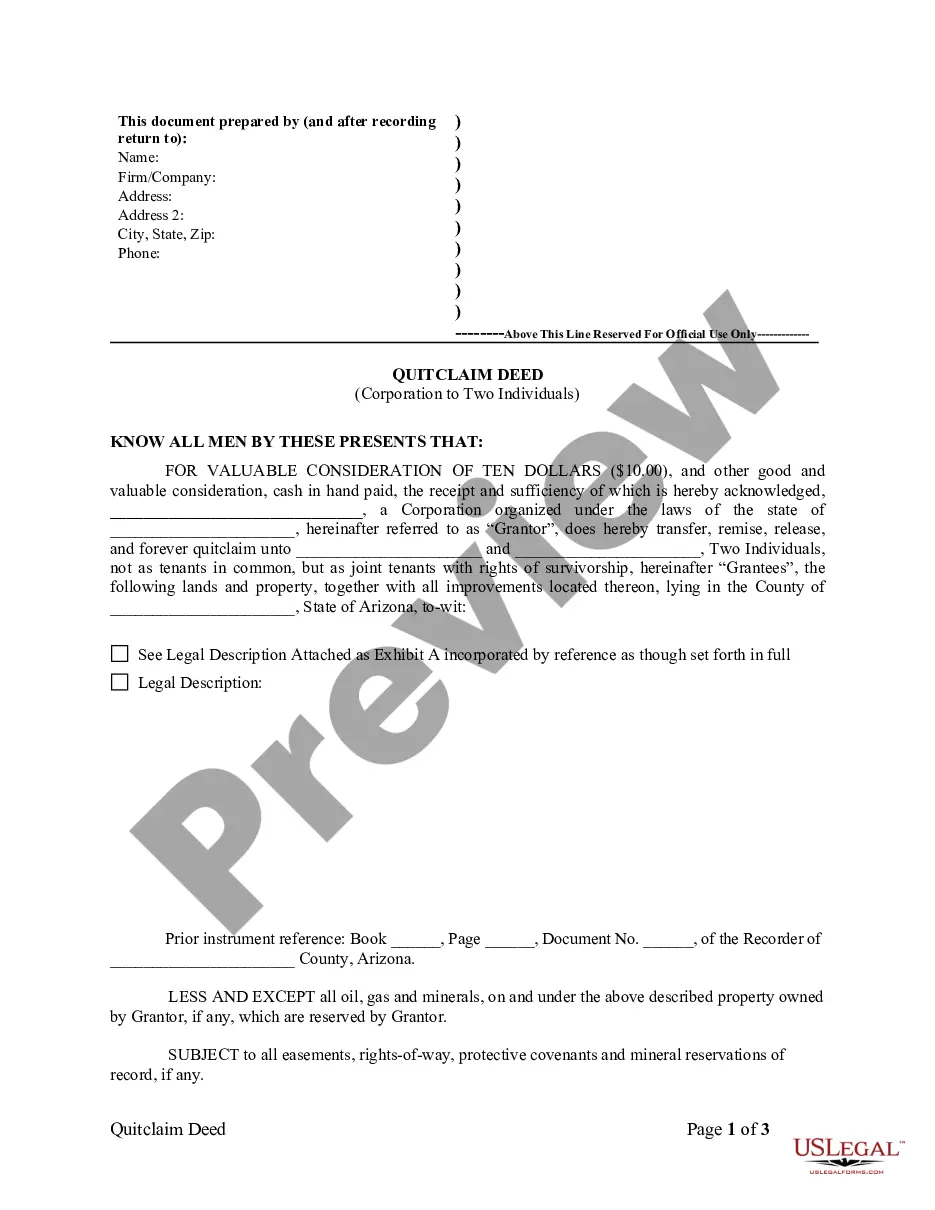
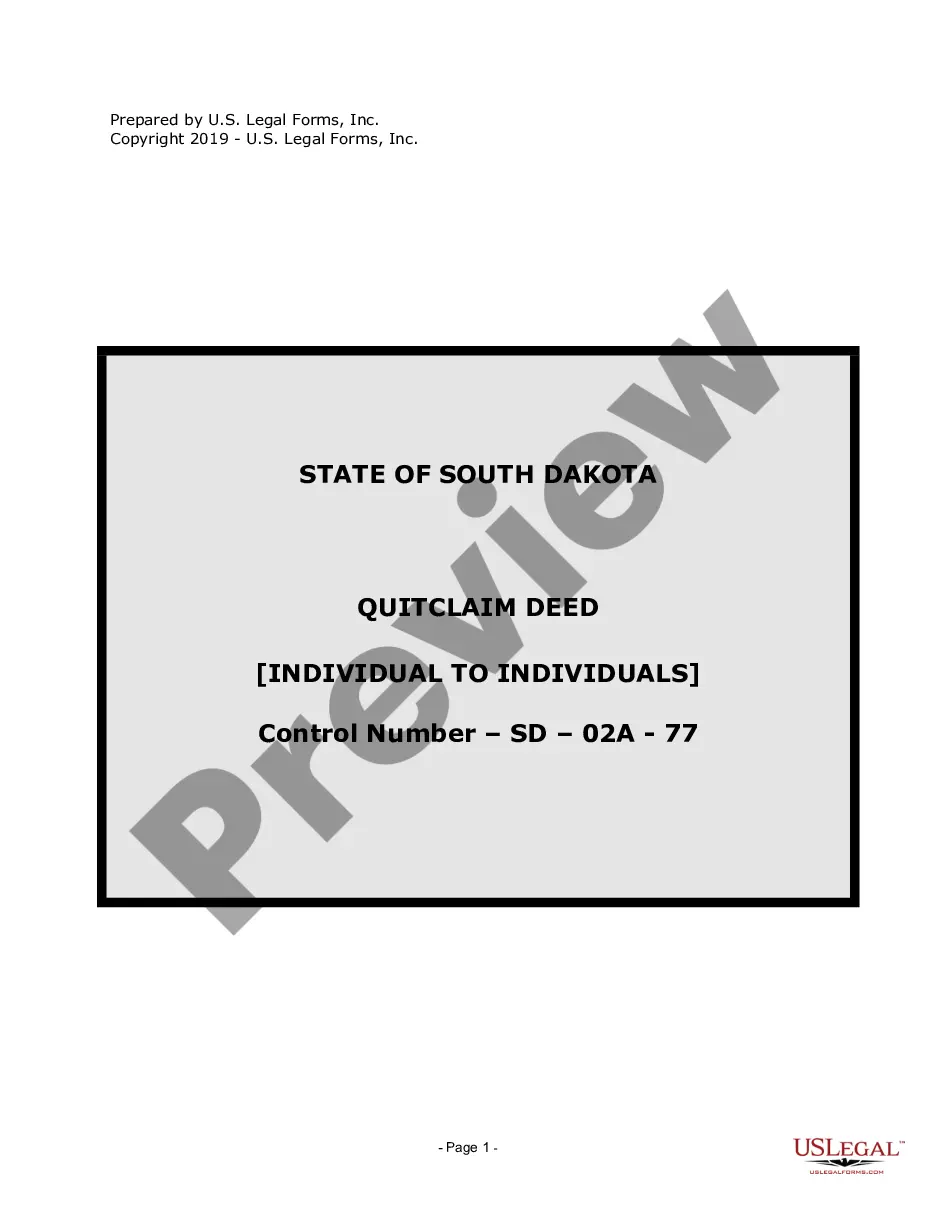
The Quitclaim Deed from Corporation to Two Individuals is a legal document that allows a corporation (the Grantor) to transfer property ownership to two individuals (the Grantees). This form differs from other deeds as it conveys the property without guaranteeing clear title, meaning the Grantor does not warrant against any claims to the property. It is essential for situations where a corporation is divesting property rights to individuals while explicitly reserving certain rights, such as mineral rights.
What’s included in this form
- Identification of Grantor and Grantees
- Description of the property being transferred
- Reservation of oil, gas, and mineral rights
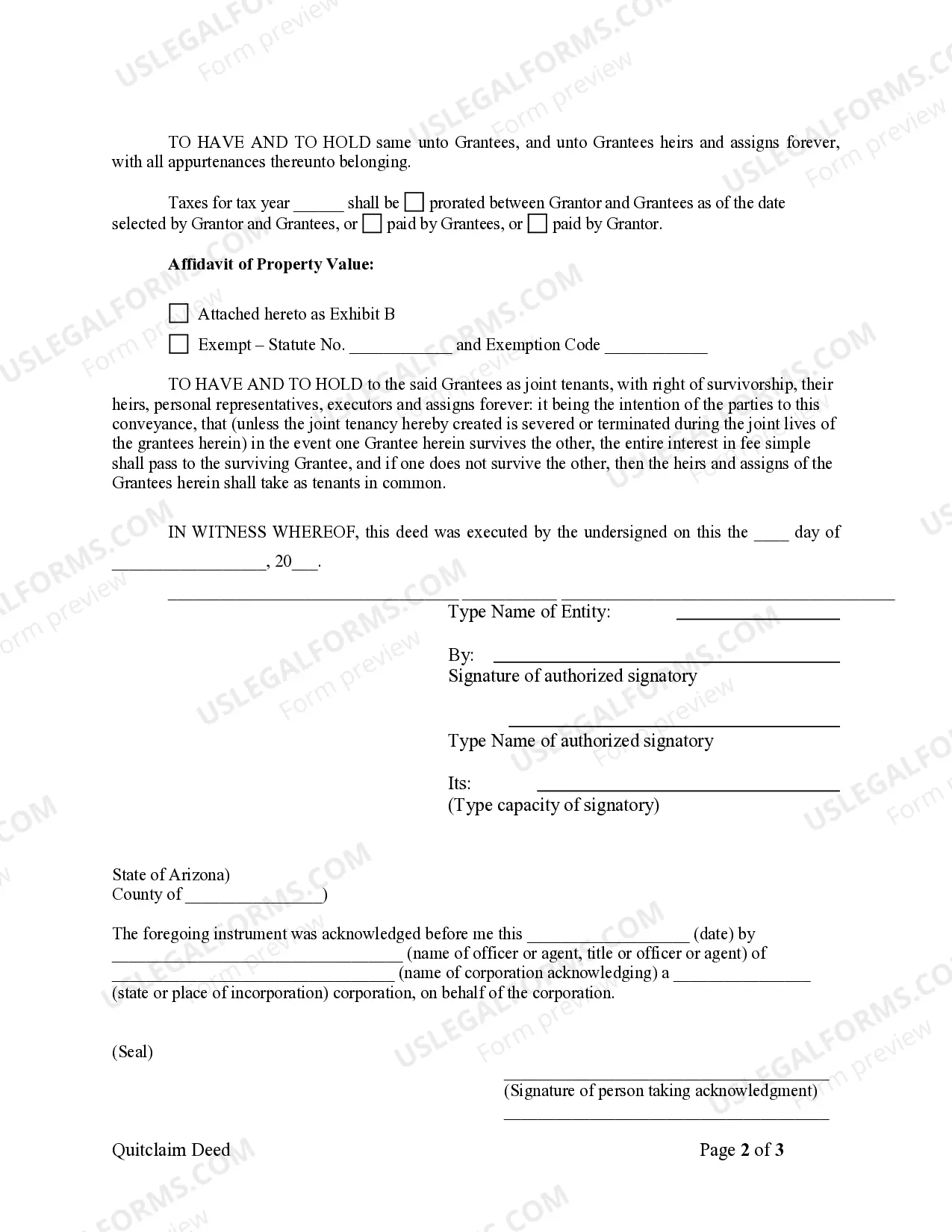
- Joint tenancy provisions for Grantees
- Proration of taxes between Grantor and Grantees
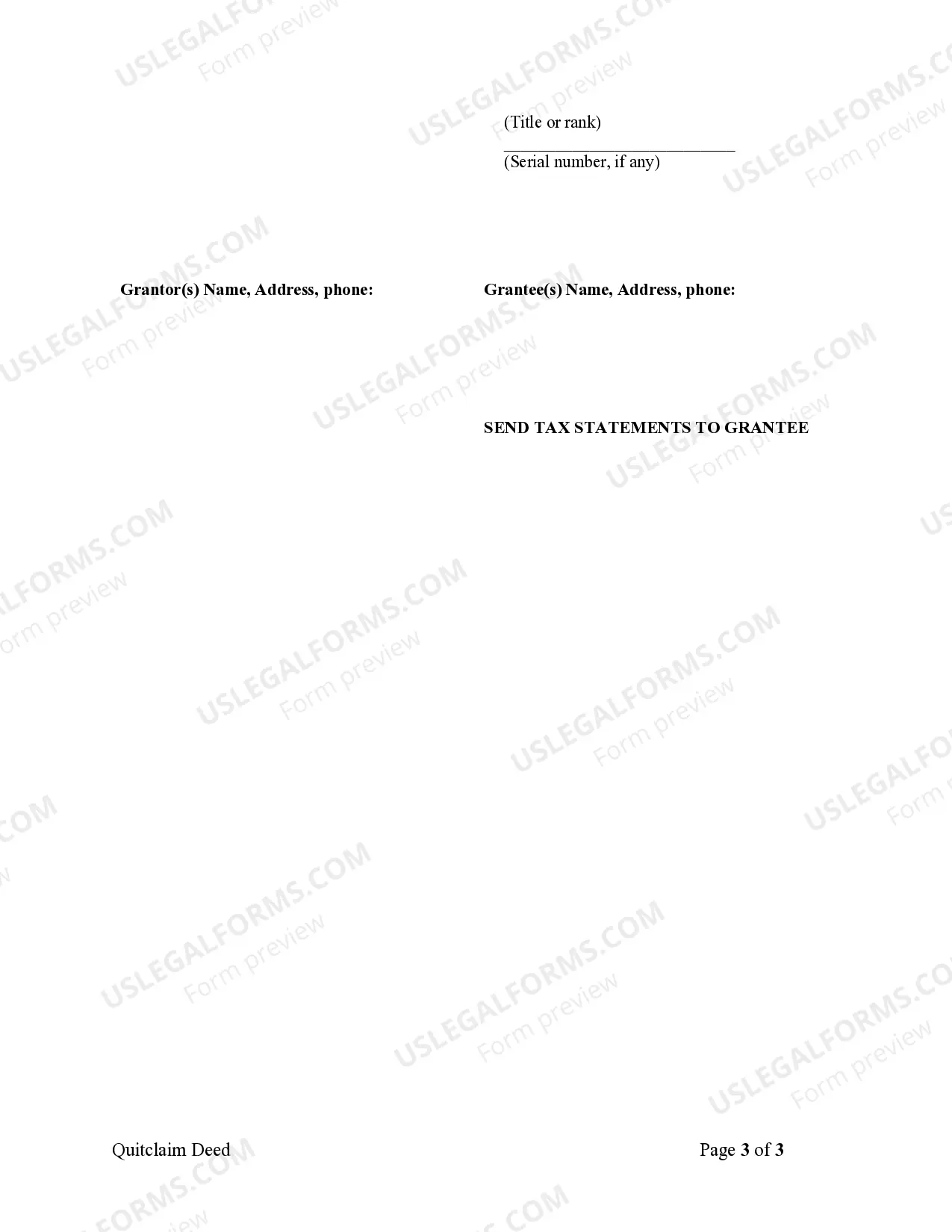
- Signature and notarization sections




Common use cases
This form should be used when a corporation is transferring its property rights to two individuals, particularly in cases where the corporation wishes to avoid the complexities of a warranty deed. Common scenarios include corporate asset liquidation, property conveyance between partners, or estate planning where individuals inherit property owned by a corporation.
Who can use this document
- Corporations looking to transfer property to individuals
- Individuals who are receiving property from a corporation
- Real estate professionals facilitating corporate property transfers
How to prepare this document
- Identify the Grantor, the corporation, along with the full names of the Grantees.
- Clearly describe the property being conveyed, ensuring to include legal descriptions.
- Specify any reservations, such as oil, gas, and mineral rights.
- Decide on tax payment responsibilities, whether to prorate or assign payments.
- Complete the signature section, ensuring it is signed by an authorized representative of the corporation.
- Have the document notarized if required, ensuring it meets local legal standards.
Is notarization required?
This form must be notarized to be legally valid. Notarization ensures the authenticity of the Grantor's signature and confirms the identity of the signer. US Legal Forms provides integrated online notarization services, allowing you to notarize documents via secure video calls from the comfort of your home.
Get your form ready online
Our built-in tools help you complete, sign, share, and store your documents in one place.
Make edits, fill in missing information, and update formatting in US Legal Forms—just like you would in MS Word.
Download a copy, print it, send it by email, or mail it via USPS—whatever works best for your next step.
Sign and collect signatures with our SignNow integration. Send to multiple recipients, set reminders, and more. Go Premium to unlock E-Sign.
If this form requires notarization, complete it online through a secure video call—no need to meet a notary in person or wait for an appointment.
We protect your documents and personal data by following strict security and privacy standards.
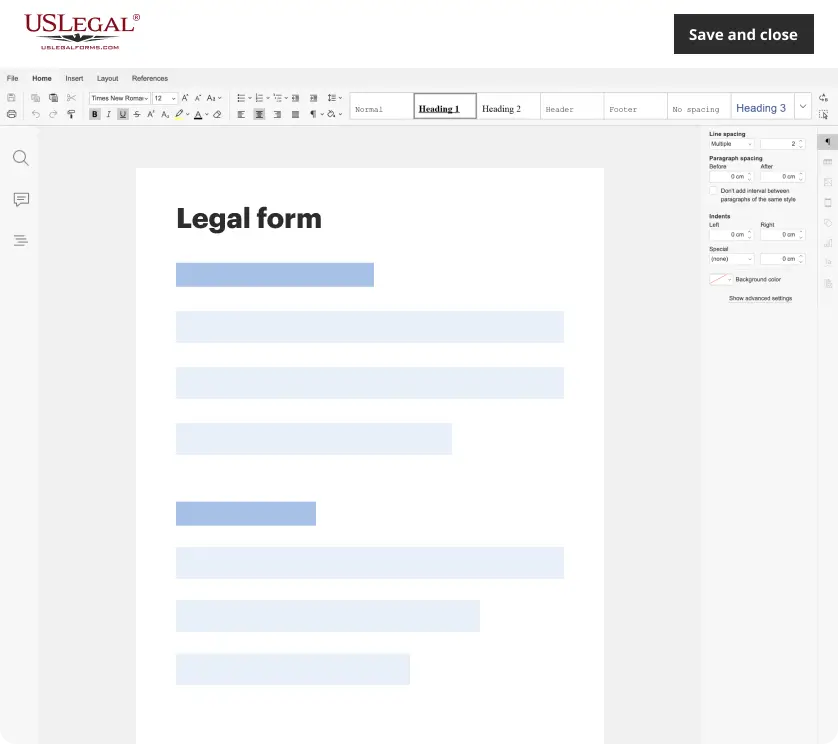
Make edits, fill in missing information, and update formatting in US Legal Forms—just like you would in MS Word.
Download a copy, print it, send it by email, or mail it via USPS—whatever works best for your next step.
Sign and collect signatures with our SignNow integration. Send to multiple recipients, set reminders, and more. Go Premium to unlock E-Sign.
If this form requires notarization, complete it online through a secure video call—no need to meet a notary in person or wait for an appointment.
We protect your documents and personal data by following strict security and privacy standards.
Common mistakes
- Failing to include a complete and accurate legal description of the property.
- Not specifying the rights being reserved, such as mineral rights.
- Forgetting to have the document signed by an authorized corporate officer.
- Overlooking the need for notarization, if mandated by local law.
- Not prorating taxes properly if applicable.
Why complete this form online
- Convenience of downloading and printing the form instantly.
- Editability to customize the document to fit specific needs.
- Reliability, as the forms are drafted by licensed attorneys ensuring legal compliance.
Legal use & context
- This deed serves to transfer ownership but does not ensure that the property is free of liens or claims.
- It is an effective tool for informal property transfers, particularly between known parties.
- The form is recognized as valid in most jurisdictions as long as state-specific rules are followed.
What to keep in mind
- The Quitclaim Deed from Corporation to Two Individuals allows for property transfer without guarantees on the title.
- It is best used in situations where the parties are familiar with the property's risks.
- Proper execution, including notarization, is crucial for the deed's validity.
Looking for another form?
Form popularity
FAQ
When you add someone to a deed in Arizona, there may be tax implications to consider. While the transfer might not trigger a property tax increase immediately, it can affect the tax basis for the new owner. It is advisable to consult a tax professional to understand fully the implications of your decision.
Adding someone to a deed in Arizona involves executing an Arizona Quitclaim Deed from Corporation to Two Individuals. This form transfers interest from the current owner to the new person. Make sure to have the deed notarized and recorded with your local county recorder for it to be legally binding.
To add someone to the deed of your house in Arizona, you will need to use an Arizona Quitclaim Deed from Corporation to Two Individuals. You must complete the deed form and have it signed in front of a notary. After this, file the deed with your county recorder's office to make the change official.
Adding someone to a deed can complicate property ownership. It may create issues during the sale of the property or in cases of divorce or death. Additionally, all parties on the deed share liability for property taxes and mortgages. Therefore, consider the long-term implications before making such a decision.
Yes, you can add someone to the deed of your house using an Arizona Quitclaim Deed from Corporation to Two Individuals. This process allows you to transfer ownership rights easily. However, it's important to ensure that both parties understand their rights and responsibilities after the addition. Consulting with a legal expert is recommended to navigate the complexities.
Both parties do not need to be present to execute a quitclaim deed. In the case of an Arizona Quitclaim Deed from Corporation to Two Individuals, one party can sign on behalf of the other if they have proper authorization. However, having both parties present can make the process smoother and help clarify any questions. Always verify specific requirements in your local area for best practices.
To add a co-owner to a deed, you must prepare a new deed that includes both parties' names. If you are using an Arizona Quitclaim Deed from Corporation to Two Individuals, it simplifies the process, as one party can transfer their interest without formal titles. After drafting the new deed, have it signed and notarized. Finally, file the updated deed with your local county recorder’s office.
You can include multiple individuals on a quitclaim deed. When transferring property using an Arizona Quitclaim Deed from Corporation to Two Individuals, it is common to have two or more owners listed. This flexibility allows you to establish co-ownership easily. However, always check local regulations to ensure compliance.
If a quitclaim deed is not recorded in California, the transfer of ownership may not be enforceable against third parties. In the case of an Arizona Quitclaim Deed from Corporation to Two Individuals, failing to record it could lead to disputes regarding property rights and claims by other individuals. Recording protects the grantee's interests and establishes public notice of ownership. Therefore, it's crucial to ensure that any quitclaim deed, including those executed in Arizona, is recorded to avoid potential legal complications.
Yes, many individuals have utilized the Arizona Quitclaim Deed from Corporation to Two Individuals to facilitate property transfers. Experiences shared on platforms like Quora indicate that people frequently use this method during various life events, such as family changes or financial planning. Users often report that quitclaim deeds are an efficient way to handle property without the complexities of other deed types. Each case serves as an example of how accessible and practical this option can be.